


The Trust Handoff
Shoppers get an answer from AI, then go looking for proof. Nobody owns the proof.
Amazon made buying easy and Google made finding easy. AI has now made it easy to ask what you should get. And the moment it answers, the shopper leaves.
They type the product name plus "Reddit." They open YouTube. They dig through three-year-old forum threads written by people who actually owned the thing. They already have a recommendation; what they're hunting for now is verification.
That last step is unowned. The business is a Chrome extension and companion research site that identifies the exact product a shopper is looking at, pulls the best owner and expert evidence about that specific model, and puts it next to the buy button. What lands there isn't a truth score or another AI summary hovering over Amazon's reviews. It's an inspectable evidence card: who recommends it, what breaks, which generation they were talking about, and a link to every source.
Call it the trust handoff layer.
The lazy version of this business (scrape Reddit, attach a score to Amazon listings, collect affiliate commissions) keeps getting rebuilt. Two attempts are already dead and a third launched in May 2026. The demand is obviously real. So is the wall, and it's the same wall every time.
Here's the version that survives it:
The money: 50 publishers at $249 a month is $12,450 MRR, before a single consumer subscription at $59 a year.
Inside:
• The Reddit API math that decides the model
• Publisher-first GTM with the outreach email
• Category sequencing, coffee gear first
• The 100-product gold set and its five tests
The behavior is already measured
U.S. retail e-commerce hit $340.2 billion in the second quarter of 2026, up 12.2% year over year and 17.1% of all retail sales. The addressable piece is much smaller: purchases where getting it wrong costs $300 and two years of irritation. Grinders, vacuums, power tools, outdoor gear, appliances.
Inside that slice, the research step has been quantified. A survey of 1,463 U.S. online shoppers fielded in April 2026 found 43% had used an AI assistant to research a purchase in the previous 90 days. Of those, 86% verified the recommendation somewhere else before buying: 45% always, 41% sometimes. Only 14% took the answer at face value. And 42% said they wouldn't trust an AI recommendation on anything over $25 without a second source.
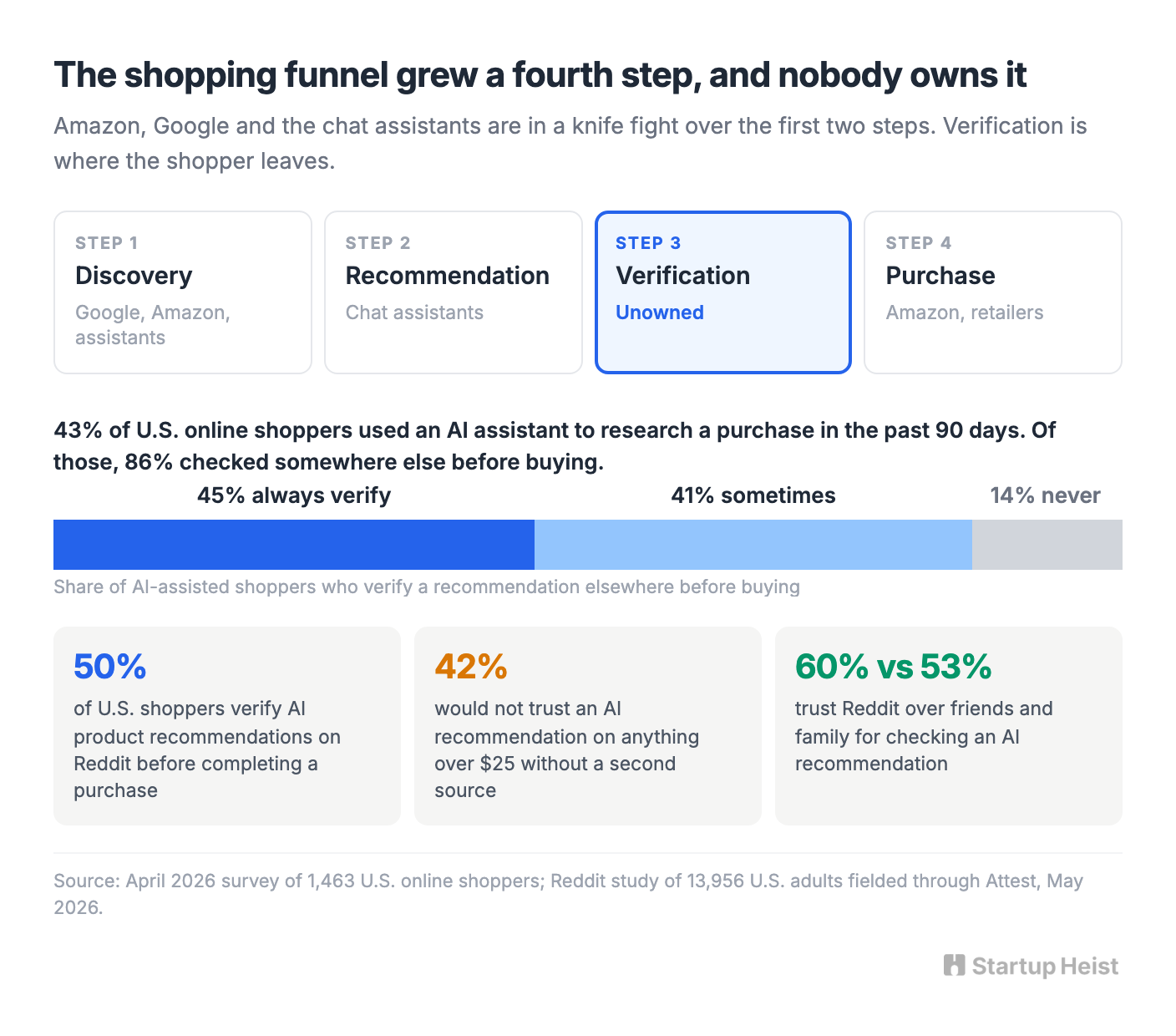
Reddit ran its own study, polling 13,956 U.S. adults through Attest in May 2026. Half of U.S. shoppers verify AI product recommendations on Reddit before completing a purchase. More than one in five now type "Reddit" directly into search queries. Americans said they trust Reddit for checking an AI recommendation more than they trust friends and family, 60% to 53%.
The shopping funnel now has four steps: discovery, recommendation, verification, purchase. Amazon, Google, and the chat assistants are in a knife fight over the first two. Better AI doesn't shrink step three. A confident answer about a $600 espresso machine makes you want the three-year ownership report more, not less.
The lazy version keeps hitting the same wall
Mozilla bought Fakespot in 2023 to grade the authenticity of retailer reviews, then shut the Firefox Review Checker on June 10, 2025 and killed Fakespot itself on July 1, 2025, saying the idea resonated but didn't fit a model it could sustain. GigaBrain is the more instructive death. It indexed Reddit and YouTube, shipped a Chrome extension whose GigaPulse feature surfaced Reddit commentary directly on Amazon product pages, and charged $10 a month or $80 a year for Pro, the closest thing to a proven price point here. On February 8, 2026 it shut the search product down, refunded every prepaid Pro and Ultra account, and pivoted to AI video, citing platform policy changes restricting data access.
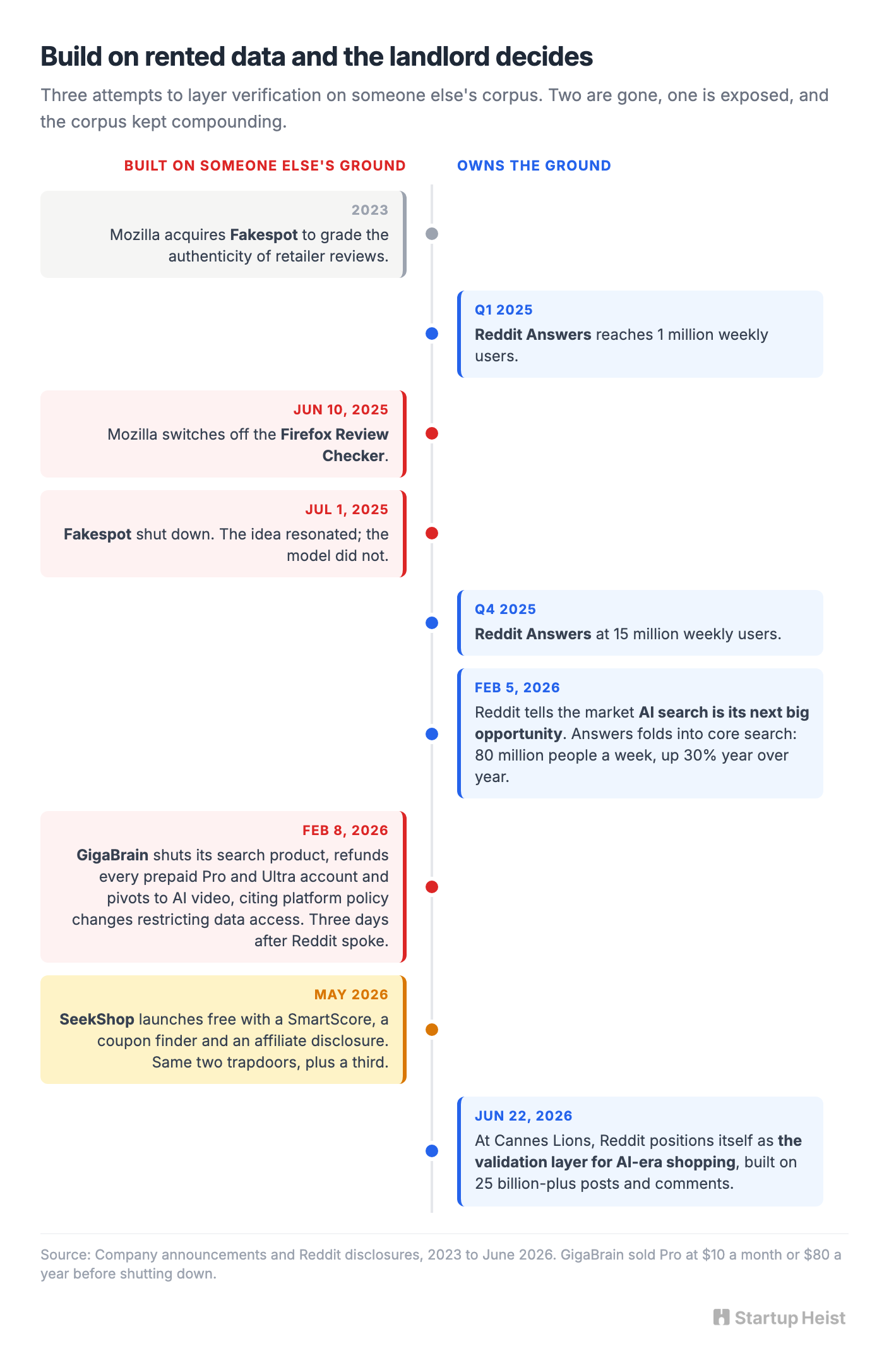
The playbook is already running again. SeekShop, a free Chrome extension launched around May 2026, blends Reddit, YouTube, retailer, and expert-review sentiment into a "SmartScore" on product pages at Amazon, Walmart, Target, and Best Buy, with a coupon finder and an affiliate disclosure attached. It's early and small, 200-plus beta testers and 4.7 stars on the Chrome Web Store, and it stands on the same two trapdoors that opened under GigaBrain: Reddit access it does not control and Amazon extension policy it does not write. The coupon-and-commission model adds a third, which is that it gets paid when you buy.
Three days before GigaBrain's announcement, on February 5, 2026, Reddit told the market that AI search was its next big opportunity. Reddit Answers had gone from one million weekly users in the first quarter of 2025 to fifteen million by the fourth, and Reddit folded Answers into core search, which now serves eighty million people a week, up 30% from sixty million a year earlier. That surface is compounding. The same month it began testing AI product deep dives, and at Cannes Lions on June 22, 2026 it positioned itself as the validation layer for AI-era shopping, built on the 25 billion-plus posts and comments it calls Reddit Community Intelligence. The incumbent is moving to occupy this exact frame.
The GigaBrain team wrote their own postmortem in one line: build on ground you control.
The question worth owning
Fakespot answered "can I trust these reviews?" GigaBrain answered "what does Reddit think?" SeekShop answers "what's the score?" All three are thin questions, and all three are answerable by a larger party who owns the underlying surface. The question worth owning is different: should I buy this specific product, in this specific generation, for my specific situation?
A perfectly authentic Amazon review can be useless. "Five stars, arrived quickly" tells you nothing about a $450 grinder. You want to know whether it retains coffee between doses and whether the enthusiasm you're reading refers to the model actually in your cart.
That's evidence synthesis, and it doesn't compress into a number. Take one grinder across four buyers: enthusiasts love the grind consistency, beginners find the workflow miserable, apartment dwellers mention the noise before anything else, and budget buyers conclude a machine at half the price gets 95% of the way there. There is no single sentiment to report. A universal truth score demos beautifully and is intellectually dishonest.
The right interface looks like an investment research card. Best for: espresso enthusiasts prioritizing consistency. Durability: mixed. Repairability: strong. Beginner friendliness: weak. Recurring owner complaint: retention when switching beans. Model warning: most long-term ownership discussion refers to the 2024 revision, limited evidence for the 2026 motor. Evidence base: 23 relevant discussions, four communities, 2023 to 2026, high-confidence product match. Underneath, the reasons owners recommend it and the reasons they don't, each linked to its source.
And the card has to be willing to print INSUFFICIENT EVIDENCE. Every AI product is built to produce an answer. A trust product occasionally has to refuse, and that refusal is the feature competitors won't copy.
The technical moat is boring on purpose
Unlock the Vault.
Join founders who spot opportunities ahead of the crowd. Actionable insights. Zero fluff.
“Intelligent, bold, minus the pretense.”
“Like discovering the cheat codes of the startup world.”
“SH is off-Broadway for founders — weird, sharp, and ahead of the curve.”


