


The Carbon RFP Rescue
Don't build carbon accounting software. Build the thing a 14-person agency opens when procurement says: send us your Scope 1-3 emissions by Friday.
A software consultancy with fourteen employees has a Fortune 500 client worth $300,000 a year. The renewal is moving through procurement when a spreadsheet lands in the founder's inbox.
Do you measure greenhouse-gas emissions? Provide your most recent Scope 1, Scope 2, and Scope 3 inventory. What methodology was used? What percentage of the calculation comes from primary data? Have you established emissions-reduction targets?
There is no sustainability team. The finance lead knows what the company spent on AWS, flights, coworking, contractors, and electricity. Nobody knows what Scope 3 Category 6 means.
The founder has three options. Hire a consultant. Buy carbon-accounting software priced for companies a hundred times his size. Or type increasingly desperate questions into Google and hope whatever spreadsheet he produces looks credible enough to keep the renewal moving.
The third option is the business.
The money: 5,000 suppliers on a $249 annual plan is $1.25M a year, roughly $104K a month before rescue packs and expert reviews.
Inside:
• Full MVP scope: intake, engine, response pack
• Three-tier pricing from $99 to $749
• Concierge launch: 30 responses done by hand
• Three compounding moats worth building
The product is not an official carbon receipt. No number you generate from an invoice turns a small vendor into a compliant supplier, and anyone selling that is selling a liability. What sells is narrower and worth far more: a supplier-response tool that converts basic operational data into a transparent annual emissions estimate, a methodology statement, a calculation workbook, a reusable answer library, and a packet a procurement team will accept.
Answer enterprise carbon questionnaires without pretending to be a sustainability department. The pitch is that simple, and the timing on it is unusually good.
Where the regulation actually lands
There is a tempting version of this story where new climate laws force every freelancer to calculate the carbon footprint of every invoice, and you build the generator and print money. The story is wrong, and believing it points you at the wrong customer.
California's SB 253 applies to U.S. business entities with more than $1 billion in annual revenue that do business in California. In August 2026, CARB's 15-day modifications pushed the first Scope 1 and Scope 2 filing to November 10, 2026, and deferred Scope 3 and limited assurance to 2027. Europe moved the same direction. The Omnibus I Directive entered into force on March 18, 2026, narrowing CSRD to companies above 1,000 employees and €450 million in turnover, and adding a value-chain cap that limits what large reporters may demand from smaller suppliers below that threshold.
The regulated party is the enterprise buyer. Your customer sits one link down the chain, and the money sits in that gap, because large companies now need supplier data they cannot generate themselves. Suppliers sit inside the buyer's Scope 3 inventory. The GHG Protocol draws a hard line between supplier-specific primary data and industry-average secondary estimates, and tells reporting companies to go collect the primary kind for material categories. Every enterprise that follows that instruction pushes a wave of supplier carbon questionnaires down the chain through EcoVadis, CDP, procurement portals, and homegrown spreadsheets, into firms with no one to answer them.
The product is transaction enablement. The supplier wants to keep the account, the buyer wants usable numbers, and procurement wants the form completed. Nobody in that chain wants another carbon dashboard.
The window opens wider in 2027
Three developments turned a vague trend into a schedule you can plan against.
On July 21, 2026, CARB previewed how Scope 3 reporting will phase in. Rather than all fifteen categories, the proposal starts with five: purchased goods and services, fuel- and energy-related activities, waste generated in operations, business travel, and employee commuting. CARB chose them because they are already commonly reported and have mature calculation methods. The list is nearly a description of a professional-services firm. You do not need lifecycle analysis of aluminum, textiles, or freight networks to produce a defensible first-pass profile of a design studio.
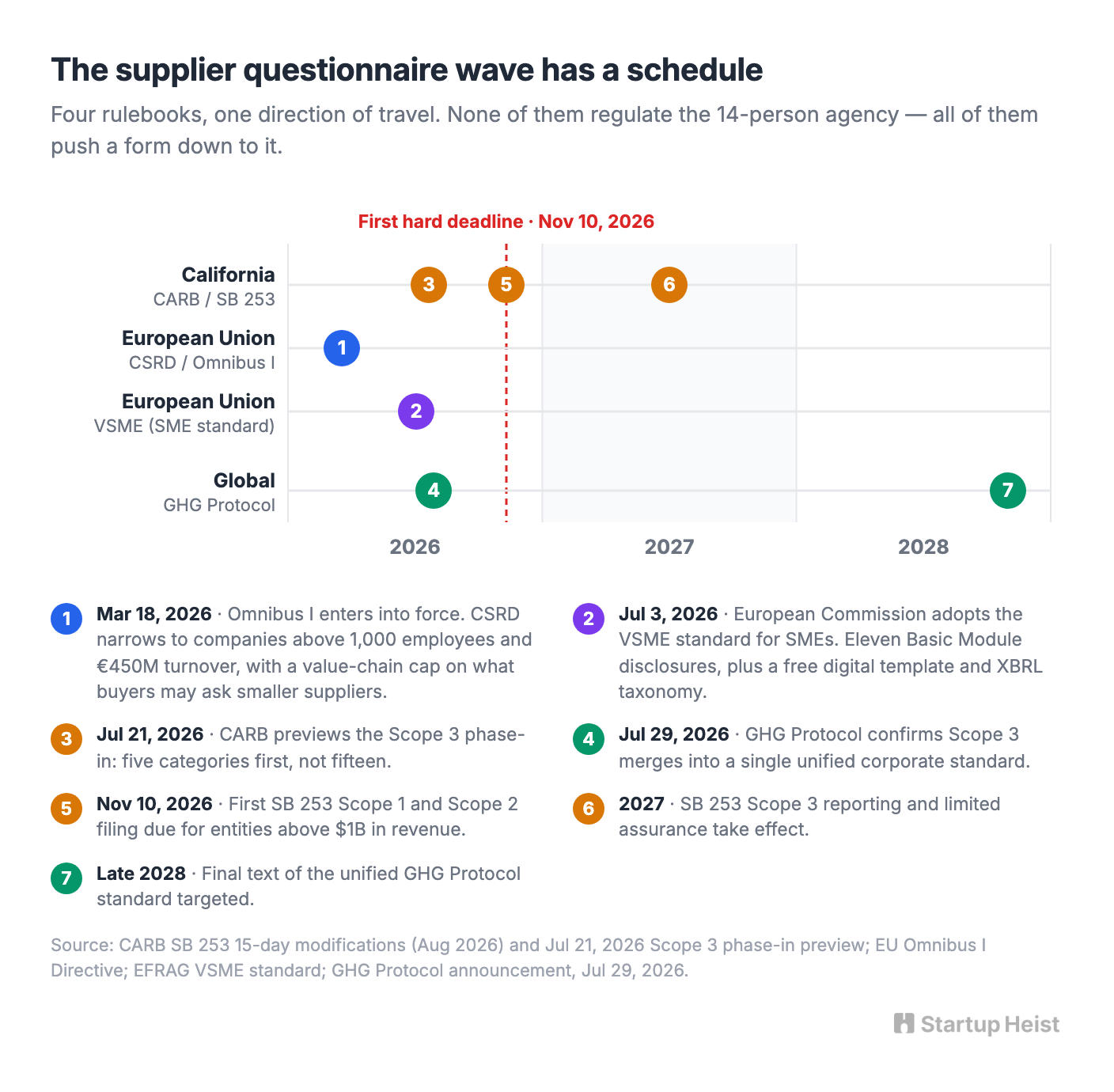
The second development handed you a schema. On July 3, 2026, the European Commission adopted the Voluntary Sustainability Reporting Standard for SMEs, built explicitly so smaller businesses can satisfy data requests from large customers, banks, and investors. Its Basic Module contains eleven disclosure requirements, including B3 on energy consumption and greenhouse-gas emissions. It is also the reference point for the value-chain cap, which means it defines the ceiling of what a big buyer is entitled to ask. EFRAG went further and published a free digital template, an XBRL taxonomy, and an open-source converter under an MIT license.
The third confirms the direction of travel well past 2027. On July 29, 2026, the GHG Protocol confirmed that its Scope 3 Standard will merge into a single unified corporate standard, with proposals to make Scope 3 reporting mandatory for a conforming inventory and to require 95% category coverage. Final text is targeted for late 2028. Buyer questionnaires get stricter from here, which makes supplier-side carbon documentation a multi-year structural trend rather than a one-time compliance event.
Regulators standardized the messiest layer of the problem and gave the data model away. Software gets built on schemas.
The calculator is already free
Most attempts at this die on the same trap: building "enter your expenses, calculate your corporate carbon footprint" and charging for it.
The feature is already commoditized. The SME Climate Hub gives away a Small Business Carbon Calculator built for companies with 1 to 50 employees, covering Scopes 1, 2, and 3 on Climatiq's verified factors, alongside an advanced multi-site version and a dedicated Scope 3 tool. Greenly runs a free five-minute calculator. Normative launched a free SME calculator with Google.org backing while selling supplier-engagement software upstream, and VSME-specific tools are arriving on the same free-tier logic. Every one of those companies will happily hand a fourteen-person agency a number, because the number is the lead magnet, not the product.
The paid job has nothing to do with arithmetic. It sounds like this: a customer just sent me this thing, and I do not know what to give them back. The user wants the procurement problem gone before Friday, and a carbon inventory is only the toll he has to pay to get there.
Start with the request the buyer sent
Every carbon product on the market opens the same way: tell us about your organization. The sequence loses this customer, because it asks a panicked person to become a sustainability analyst before it gives him anything.
Invert it. Your first screen says: upload what your customer sent you. A PDF. An Excel questionnaire. A Word doc. A screenshot. A pasted block of supplier-portal questions. An email forward.
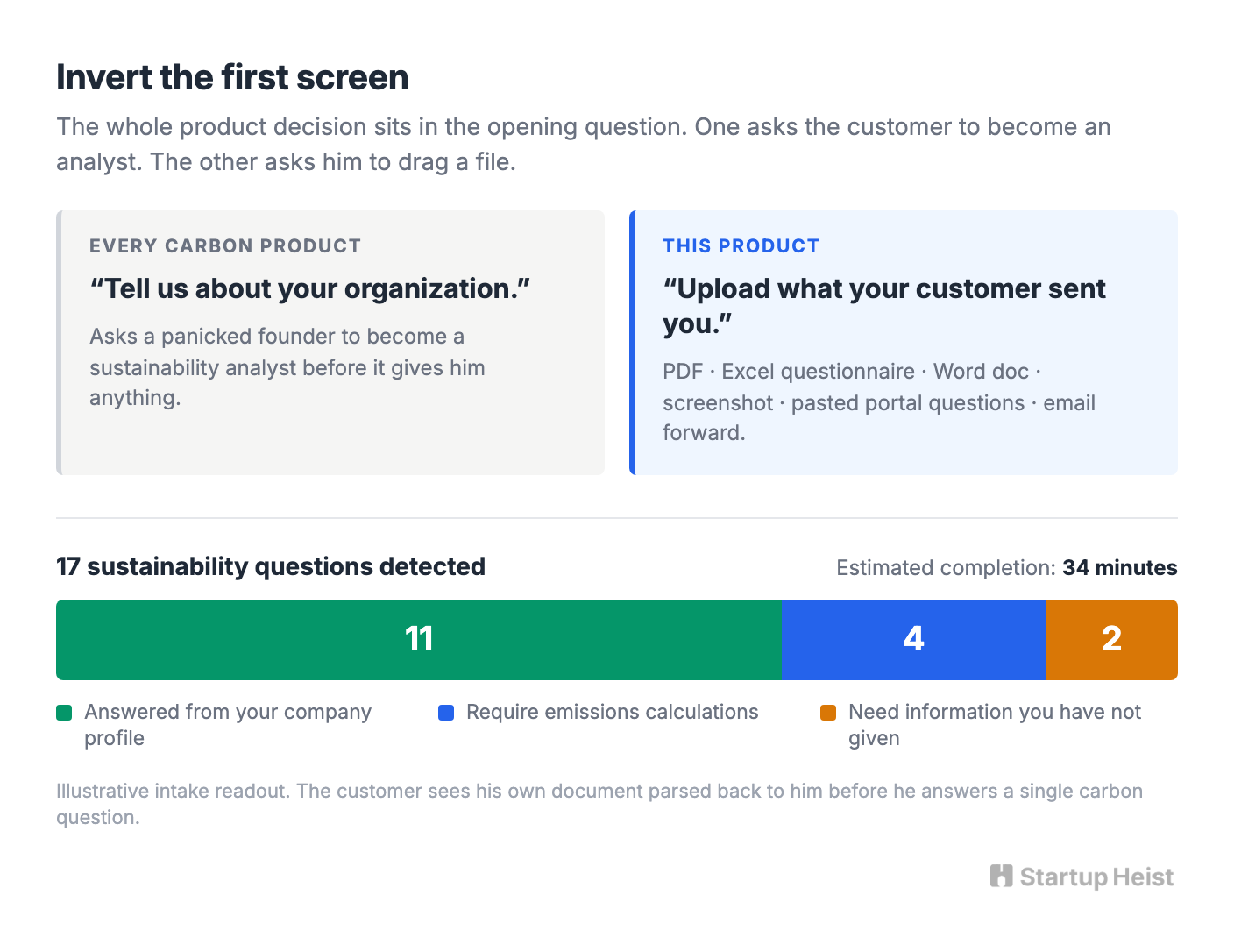
The system reads it and answers in the user's own terms:
We found 17 sustainability questions.
11 can be answered from your company profile.
4 require emissions calculations.
2 need information you haven't given us yet.
Estimated completion time: 34 minutes.
The carbon footprint becomes plumbing underneath the workflow rather than the line item on the price tag, which changes what you compete on. Nobody else in the category has organized around the moment the customer actually feels the pain.
The MVP: four pieces you cannot fake
Unlock the Vault.
Join founders who spot opportunities ahead of the crowd. Actionable insights. Zero fluff.
“Intelligent, bold, minus the pretense.”
“Like discovering the cheat codes of the startup world.”
“SH is off-Broadway for founders — weird, sharp, and ahead of the curve.”


