


The AI Crop Boom Has a Dirty-Data Tollbooth
Build the remediation layer that turns a decade of field trials, phenotype records, genotype manifests, drone images, and GIS files into something a model can actually be trained on.
Everyone wants to build the agricultural AI model.
USDA wants tools that fuse germplasm records, field observations, lab results, and images to speed up crop discovery. Seed companies want better predictions. University labs want publishable results. Breeders want to pick winning traits three seasons sooner.
Before any of that happens, someone has to determine whether "Plot 17-B" in a 2021 spreadsheet is the same ground as "17B" in an image folder, "B17" in a drone export, and "Block 1, Row 7" in the field map.
Nobody wants that job, which is why it pays.
Here's the opportunity:
The money: Five recurring QA clients at $2,000 a month is $10K MRR. A realistic first year lands near $204K, and a mature boutique runs $750K to $2M.
Inside:
• Five-tier offer ladder from $750 to $40K
• The 10-step remediation workflow, tool by tool
• Trigger-event lead lists plus a cold email
• A 30-day launch plan, week by week
The business is a productized data-cleaning and audit desk for agricultural research and breeding teams. Customers ship you their historical files. You return a standardized, documented, model-ready dataset with QC reports, lineage records, a data dictionary, and exports that drop cleanly into the standards the field already runs on.
The moonshot needs plumbing before it can leave the ground, and the plumbers get paid first.
The real signal is a deadline
On July 22, 2026, USDA announced it expects to launch an Agricultural National Science & Technology Challenge before the end of the year, run through the Genesis Mission and AgARDA. The agency is asking universities and outside partners to build practical AI tools that combine images, field data, lab results, and germplasm information so scientists can identify valuable plant and seed traits faster.
A wave of crop-prediction startups is coming. What arrives first is a wave of teams discovering their data can't be joined.
There's a second signal, quieter and much sharper, that almost nobody in startup-land has noticed.
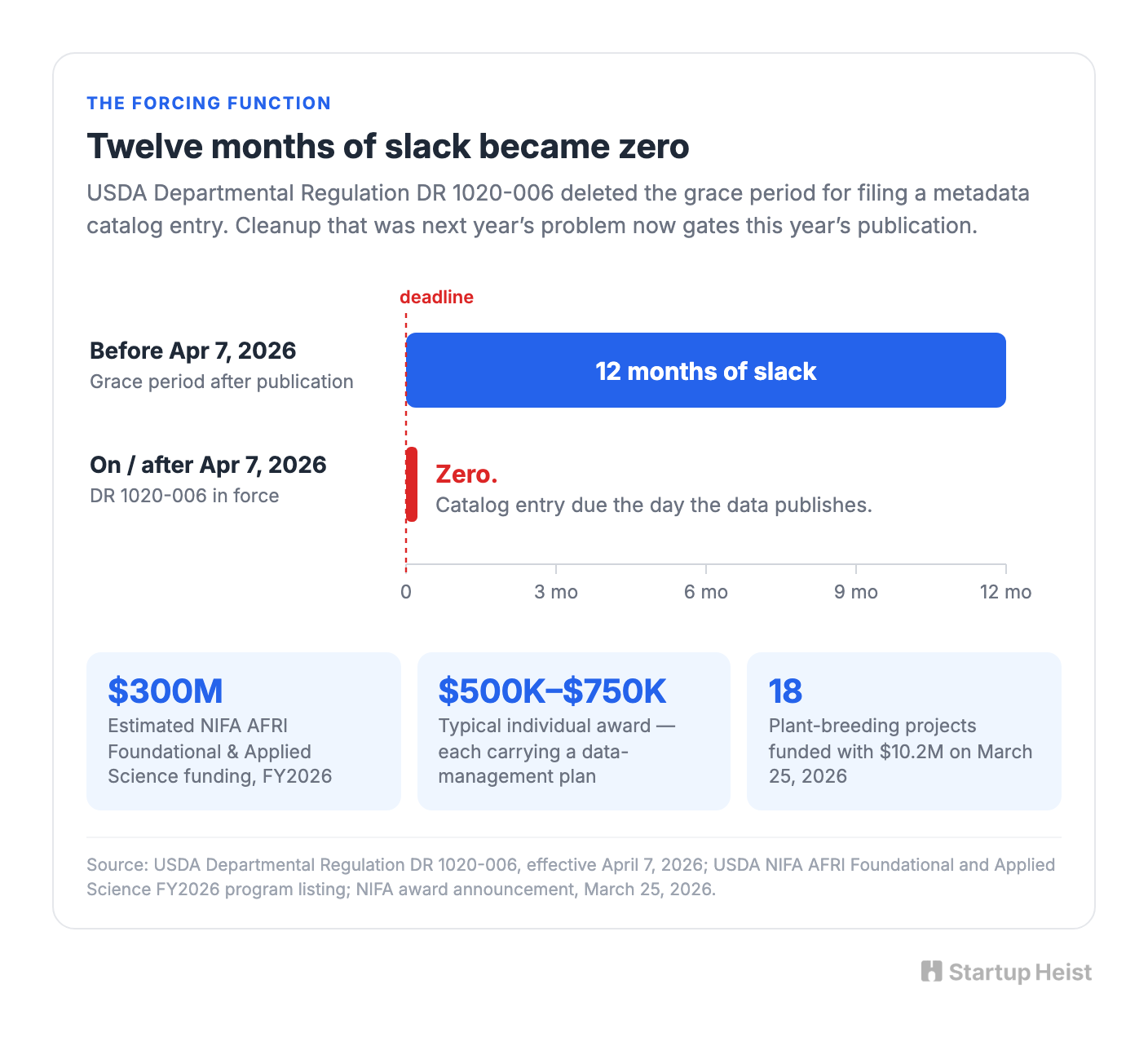
USDA-funded researchers have long been required to register their published data in Ag Data Commons, the department's central catalog. Until April 2026, they had a twelve-month grace period after publication to file that metadata entry. Departmental Regulation DR 1020-006 removed it. Effective April 7, 2026, a standardized metadata catalog entry is due no later than the date the data asset is published.
Twelve months of slack became zero. For a principal investigator sitting on five years of trials across four graduate students and three naming conventions, the cleanup that used to be next year's problem is now a gate on this year's publication.
Layer the funding on top. NIFA's AFRI Foundational and Applied Science program lists an estimated $300 million for fiscal 2026, with most individual awards landing between $500,000 and $750,000. On March 25, 2026, NIFA put $10.2 million into 18 plant-breeding projects. Every one of those awards carries a data-management plan, and now a hard-dated catalog obligation attached to it.
Agricultural data is abundant. The bottleneck sits in the distance between data that exists and data anyone can safely use.
What actually breaks
A single plant-breeding program tends to accumulate field-layout spreadsheets maintained by rotating technicians, phenotype observations recorded under drifting trait names, genotype files from several labs on several platforms, images whose filenames carry partial plot IDs, weather pulled from whichever station was closest that year, GIS boundaries drawn in mismatched coordinate systems, and treatment logs full of abbreviations only one departed postdoc understood.
Then there's the quiet killer: the season somebody changed the plot-numbering convention and didn't write it down.
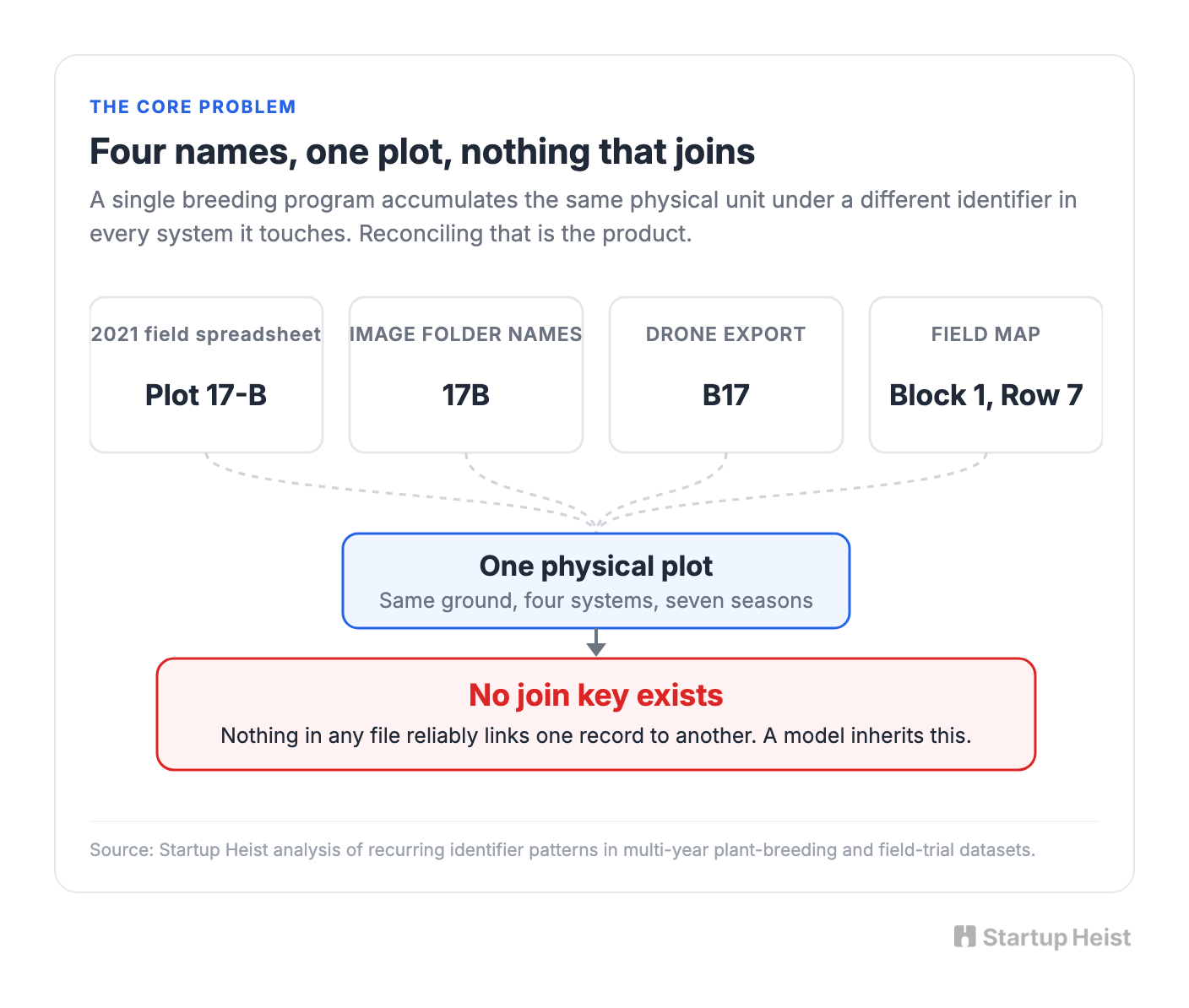
A model doesn't repair that history. It inherits it.
The research community has already mapped this terrain. A 2025 GigaScience review from the AgBioData consortium's data reuse working group catalogued the recurring obstacles across agricultural genomics: inconsistent standards, thin metadata, incompatible formats, ownership restrictions, and teams without the skills or budget to prepare data for reuse. The review is pointed about ontologies, noting that the vocabularies available for describing agricultural species are frequently borrowed from model-organism and medical research, where they fit badly. File formats for genomic data are largely settled; everything around them, from protocols and sample handling to computational transformations and phenotype metadata, is documented unevenly at best. The Government Accountability Office reached the same conclusion from the operational side in its January 2024 precision agriculture report, finding that missing standards block systems from interoperating, make data quality hard to assess, and erode confidence in sharing.
The cost shows up in the modeling itself. Work on mislabeling in cassava breeding found that when phenotype and genotype records get crossed in a training population, the damage doesn't stay put. The bad linkage degrades prediction accuracy and keeps degrading selection decisions until somebody rebuilds the model from scratch. Genomic selection involves more handoffs than conventional phenotypic selection, which means more places for a swap to enter and more generations for it to propagate.
A dirty spreadsheet costs an afternoon. A dirty training set compounds for years.
The existing tools make this problem worse before they make it better
Agricultural research isn't short on software. It has databases, standards, APIs, field apps, and experiment-management platforms. All of that tooling is precisely why the business exists.
DeltaBreed is the clearest illustration. It's an open-source breeding data management system built by Breeding Insight at Cornell for USDA-ARS specialty crop and livestock programs, covering germplasm, ontologies, experiments, observations, and pedigrees. Its own documented workflow contains the trap: you must upload validated germplasm records and ontology terms before you load an experiment. Attempt the experiment upload first and the system throws an error, because it validates observations against the germplasm IDs and ontology terms already in place. The design is sound. It's also precisely where a decade of inherited spreadsheets hits a wall. A breeder may want DeltaBreed, may have funding and leadership backing for DeltaBreed, and still can't get in the front door until someone reconciles the existing germplasm names, trait definitions, trial structures, observation units, and historical IDs.
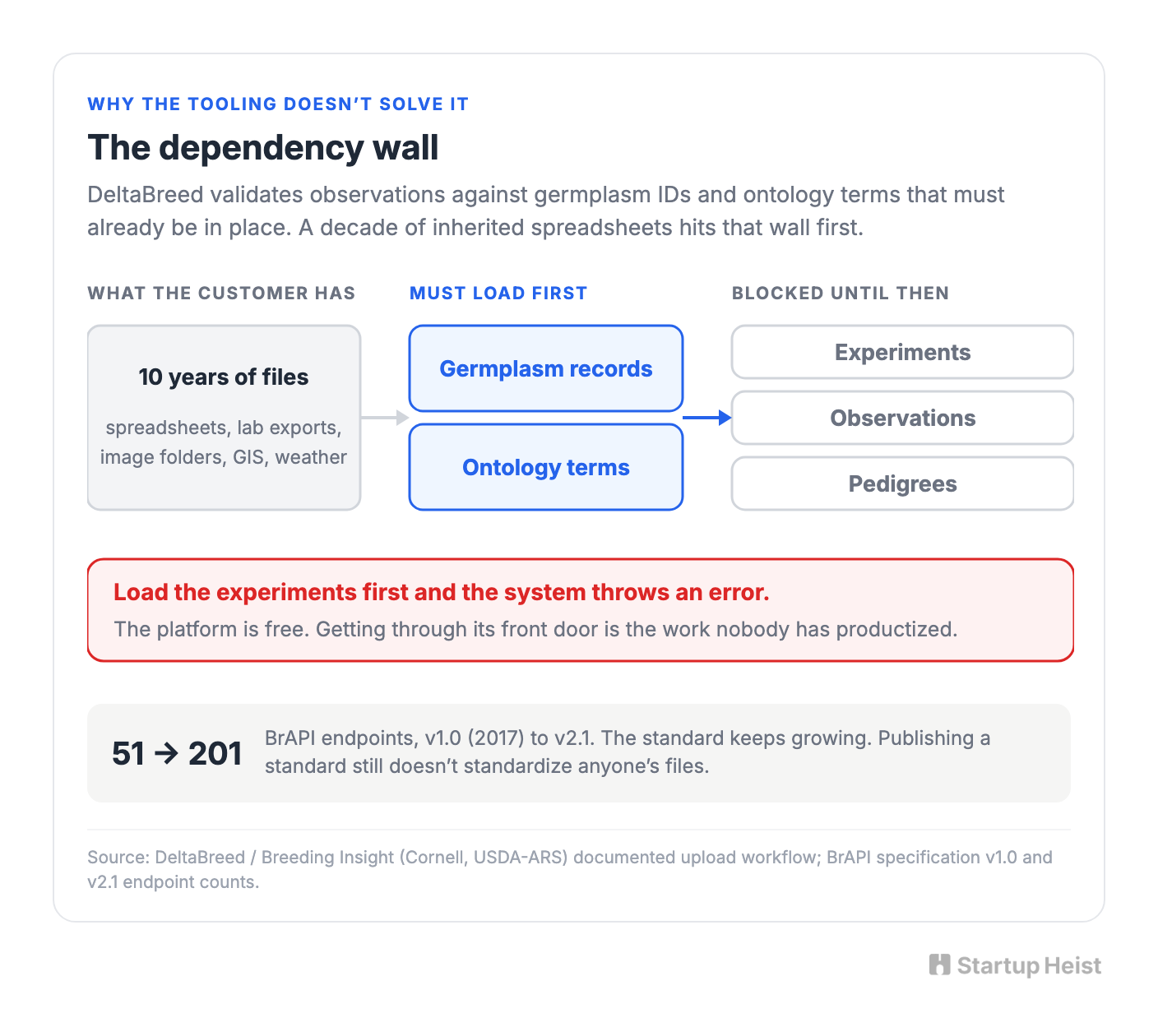
BrAPI, the standardized API specification for exchanging plant-breeding data, has the same shape of gap. Publishing a standard doesn't standardize anyone's files. BrAPI's own implementation guidance is candid that mapping an organization's database model onto the BrAPI model is complex and iterative, requiring developers and scientists to work it out together. The specification has nearly quadrupled since 2017, growing from 51 endpoints in v1.0 to 201 in v2.1, organized into four modules so implementers can take only the parts they need. MIAPPE supplies the checklist for describing a phenotyping experiment. Crop Ontology supplies standardized trait names, methods, and scales.
Every one of these gives a research team a destination. Getting the team's data there is the work nobody has productized.
Who signs the check first
Don't sell this to "agriculture." That word will drag you toward farm-management software, yield dashboards, remote sensing, and machinery integrations, all of which are different businesses with different buyers.
Unlock the Vault.
Join founders who spot opportunities ahead of the crowd. Actionable insights. Zero fluff.
“Intelligent, bold, minus the pretense.”
“Like discovering the cheat codes of the startup world.”
“SH is off-Broadway for founders — weird, sharp, and ahead of the curve.”


