


The Data Center Next Door
Any American homebuyer can pull a flood map in ten seconds. Nothing gives them the same answer about the 300-megawatt data center being negotiated three miles away. That gap has become a business.
A buyer under contract in Loudoun County can check school ratings, tax history, crime statistics, airport noise, wetlands, easements, permit history, and every recorded sale on the block. Most of it is free and arrives in minutes.
Then the buyer asks the question that actually matters in 2026: is anyone trying to build a data center near this house? At that point the workflow collapses.
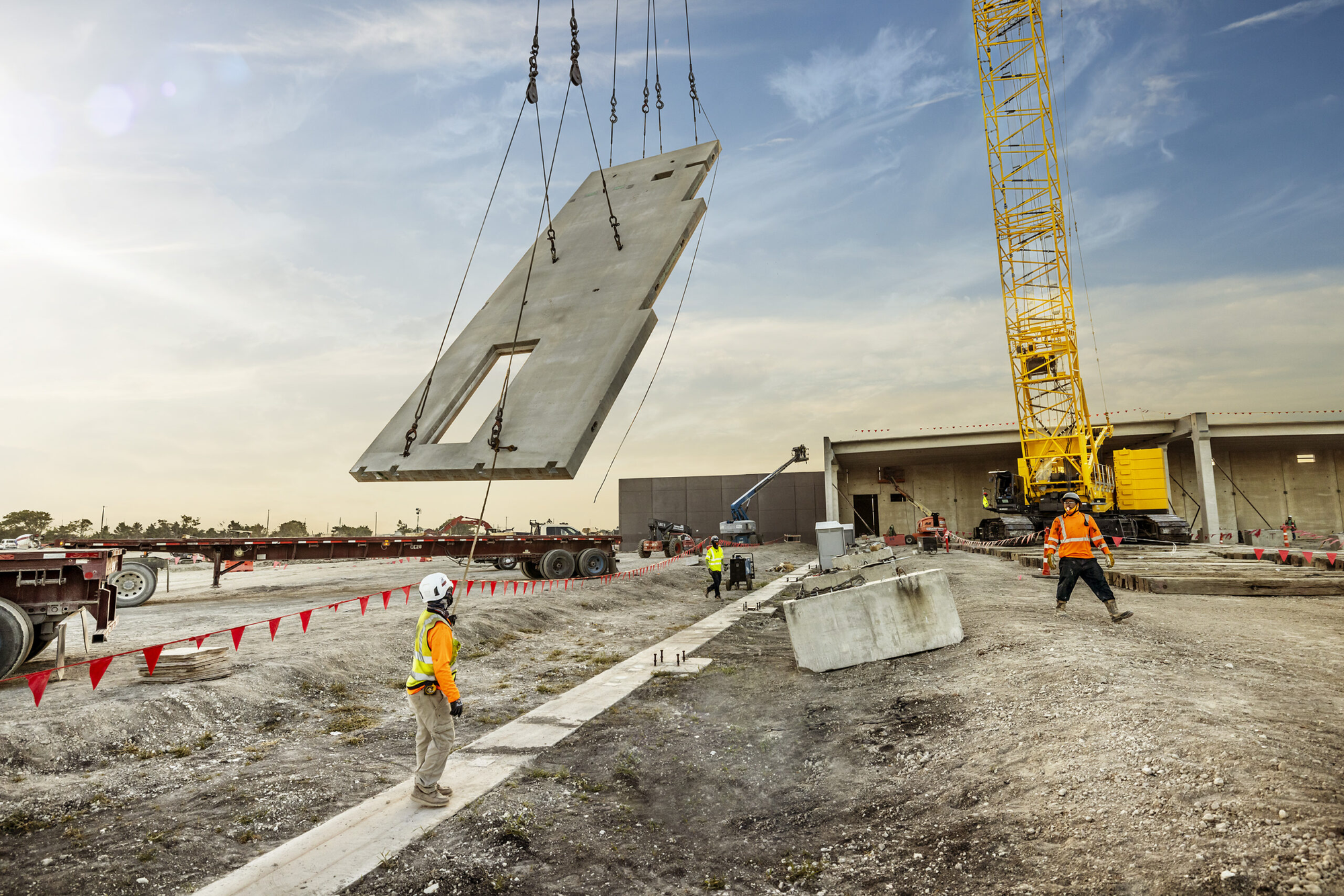
The answer exists. It sits in a planning commission agenda, a rezoning application, a county GIS layer, a utility docket, a water permit, or a hearing notice buried on page 190 of a meeting packet. Sometimes the project carries a code name. Sometimes a developer has quietly assembled 600 acres and filed nothing. In other cases the only visible signal is a transmission corridor drawn across somebody's back pasture.
The information is public and, in any practical sense, invisible. Somebody should be selling the answer.
The money: 100 Northern Virginia agents at $99 a month is $9,900 MRR; 1,000 is $99,000. One local association holds 13,000 of them.
Inside:
• The three-county launch map and its APIs
• Six-rung evidence ladder for what's real
• $149 report first, $99 a month after
• 90-day plan and first-100 outreach script
The gap got expensive in about eighteen months
Public opinion moved faster than almost any land-use issue in recent memory. Gallup put opposition to a local AI data center at somewhere between 42% and 47% in late 2025. By its March 2026 survey, 71% of Americans opposed one being built in their area, and 48% opposed it strongly. Ipsos found in May 2026 that only 27% of Americans believe a data center would meaningfully add to local jobs and economic growth.
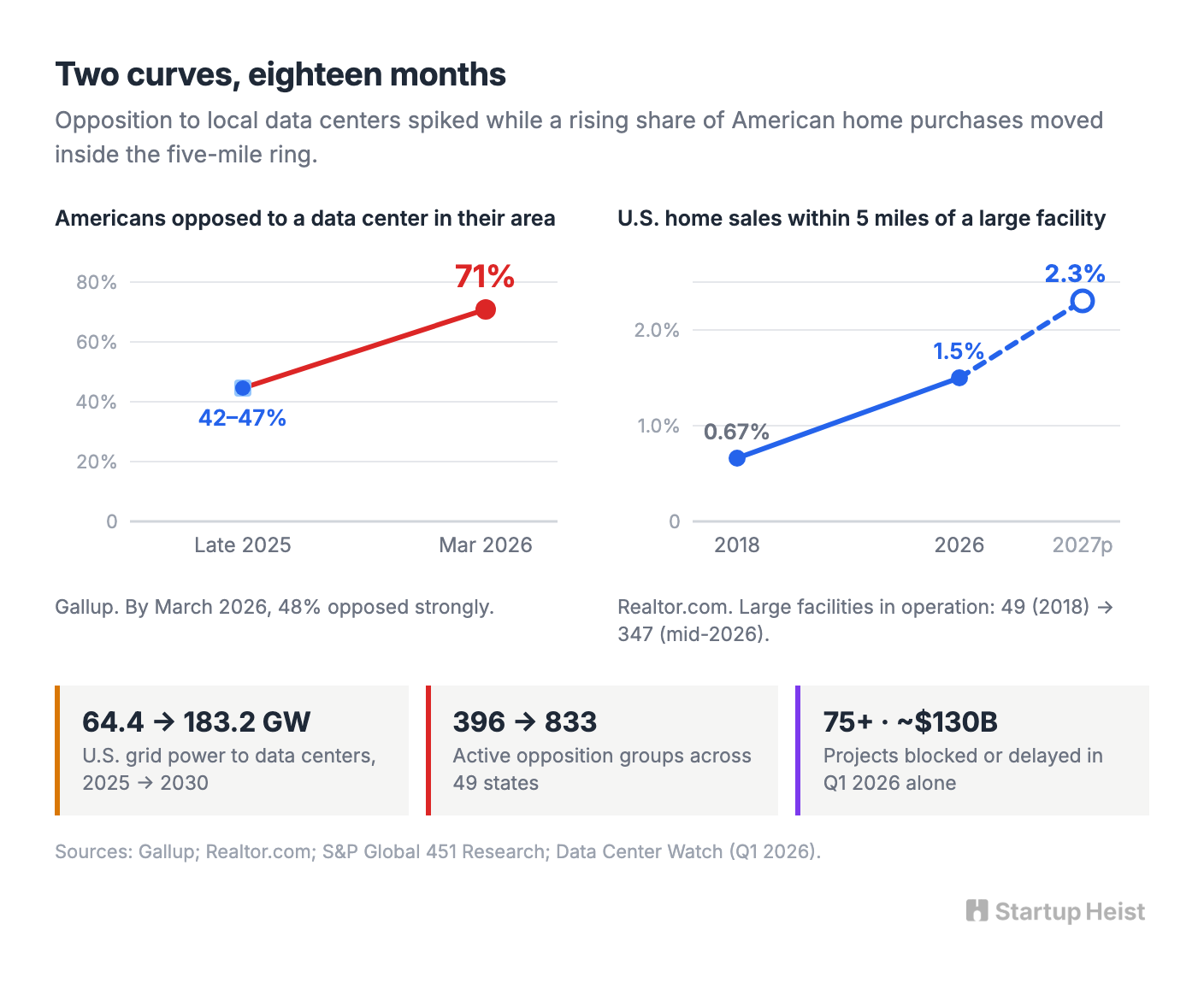
That sentiment now has teeth. Data Center Watch counted at least 75 U.S. projects worth roughly $130 billion blocked or delayed in the first quarter of 2026 alone, which roughly matched its tally for all of 2025. Active opposition groups jumped from 396 at the end of 2025 to 833 by March 2026, spread across 49 states. Moratorium bills surfaced in 14 state legislatures.
The buildout kept accelerating anyway. S&P Global's 451 Research measured U.S. grid power delivered to data centers rising 25% in 2025 to about 64.4 gigawatts, and projects roughly 183.2 GW by 2030. Goldman Sachs, using a different method, expects U.S. data center power demand to climb from 31 GW in 2025 to 41 GW in 2026 and 66 GW in 2027. Realtor.com counted 49 large facilities in operation in 2018 and 347 by mid-2026. The share of U.S. home sales within five miles of one went from 0.67% to about 1.5%, and it projects 2.3% by the end of 2027.
The two curves are crossing. More than one in fifty American home purchases is about to happen inside the five-mile ring of an industry that seven in ten Americans don't want near them.
The heist
Build a paid, county-by-county data center proximity and alert report that tells agents, appraisers, attorneys, and relocation professionals which proposed or early-stage developments and related infrastructure sit near a specific address, and shows the primary government record behind every single claim.
The closest analogue is a title search for what might get built next door.
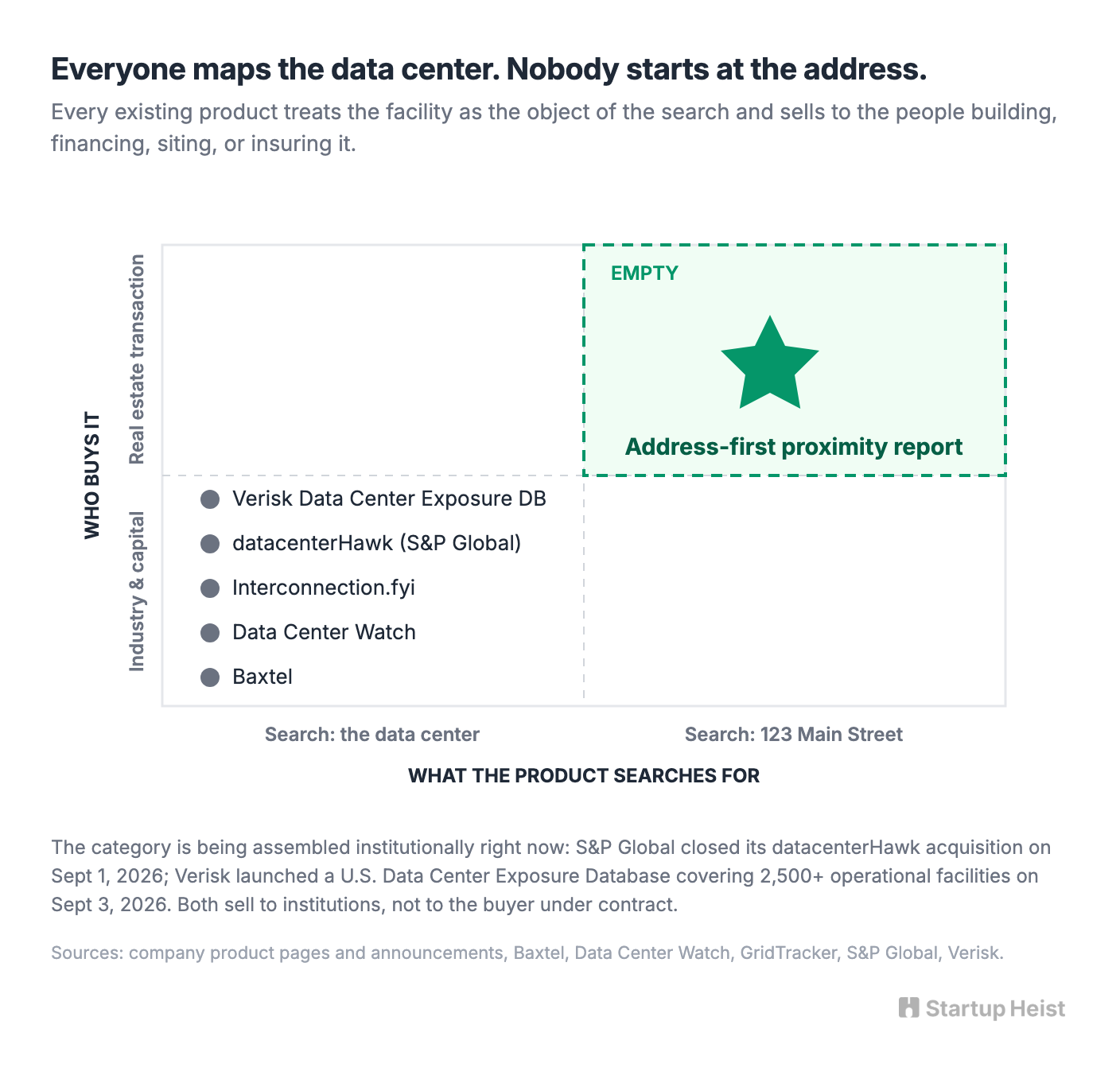
Plenty of people have already mapped data centers. Baxtel tracks operational, under-construction, planned, and prospective facilities with development stages and market data. Data Center Watch tracks projects and the political opposition around them. GridTracker's Interconnection.fyi cleans and standardizes interconnection queue data from more than 50 ISOs and utilities and updates it daily. S&P Global closed its acquisition of datacenterHawk on September 1, 2026, folding asset-level supply, pricing, pipeline, and fiber intelligence into its energy division. On September 3, 2026, Verisk launched a U.S. Data Center Exposure Database covering more than 2,500 operational facilities, built for insurers modeling catastrophe and portfolio risk. That is a different buyer and a different subject, and it is also a warning: the data center exposure category is being assembled institutionally right now, by firms with the capital to move one layer over. Every one of these products treats the data center as the object of the search, and sells to the people building, financing, siting, or insuring them.
The homebuyer starts somewhere else entirely, at 123 Main Street.
Invert the search and the whole product changes. A buyer's agent doesn't want a national infrastructure database; she wants to paste in the address of a $900,000 house and know, before her client waives contingencies, what's documented nearby. An appraiser needs a chronology he can put in a file rather than an activist Facebook post. A land-use attorney needs the case number. All of them are after a decision document, and nobody sells one.
The trap that kills this business
There's a tempting version of this company: the one that promises to tell you how much a nearby data center will cost you. It's a great headline and it will destroy you.
Unlock the Vault.
Join founders who spot opportunities ahead of the crowd. Actionable insights. Zero fluff.
“Intelligent, bold, minus the pretense.”
“Like discovering the cheat codes of the startup world.”
“SH is off-Broadway for founders — weird, sharp, and ahead of the curve.”


