


The AI Boom Needs Electricians. Nobody Is Helping Them Get in the Door.
Engineering News-Record's Top 400 contractors booked $671.4 billion in revenue in 2025, up 11.8% over the prior year. Data centers and the power infrastructure feeding them drove most of that jump. Turner Construction, first on the list for the sixth straight year, grew 40% to $29.2 billion and carries a $44.3 billion backlog.
JLL expects roughly 100 gigawatts of new data center capacity to come online globally by 2030, doubling the world's installed base and pulling as much as $3 trillion through real estate, construction, GPUs, and networking gear. The shell alone now costs an average of $11.3 million per megawatt, up 6% in 2026. That money lands on electrical contractors, mechanical contractors, fiber crews, welders, and commissioning specialists. It doesn't reach them evenly.
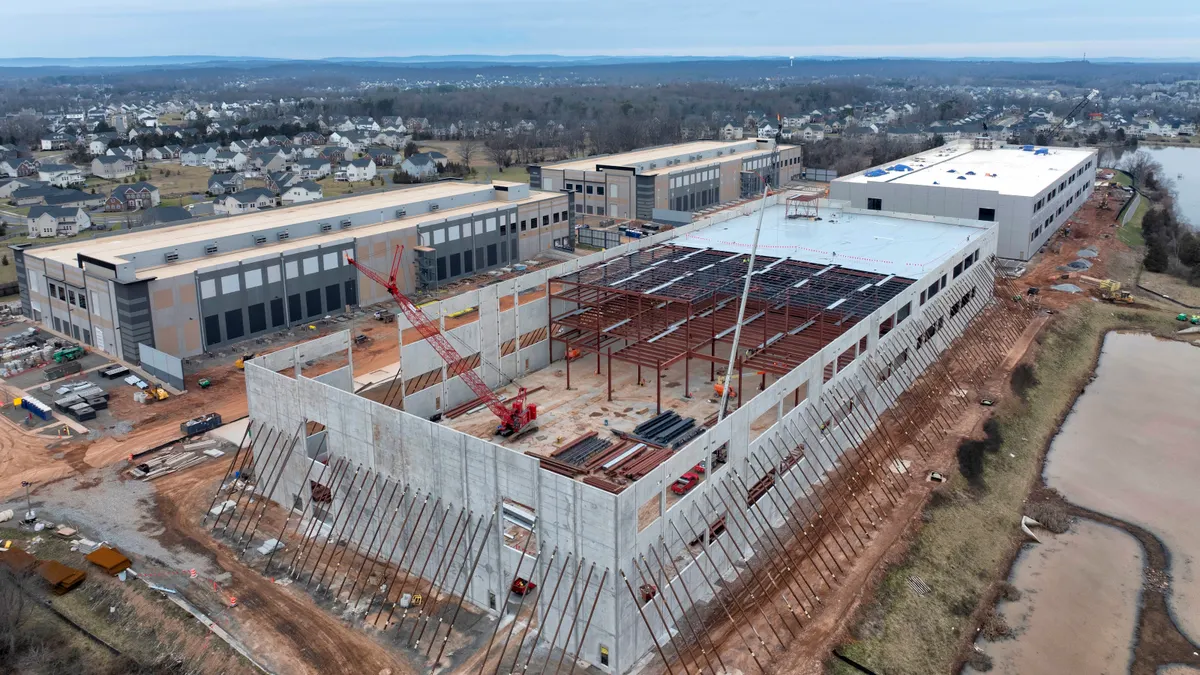
A 20-person electrical contractor can sit 45 minutes from a billion-dollar campus and never touch it. The owner hears about the project after the major packages are assigned. He doesn't know which general contractor holds the electrical scope. His certificate of insurance is stale, his safety history isn't formatted the way the GC's portal wants it, and his bonding letter is two years old. He didn't get beaten on price. He was out before anyone asked him for one.
The distance between those two paragraphs is a business.
The money: Forty managed accounts at $1,500 a month is $60,000 MRR, inside one corridor carrying tens of billions in announced construction.
Inside:
• Eight-week MVP that runs on almost no code
• Setup fee plus retainer pricing that holds
• The Columbus-to-Lebanon wedge market
• Four data moats a scraper can't copy
The Heist
Build a trade-specific bid radar for mission-critical construction, welded to a managed prequalification desk for small and midsized specialty contractors. It turns scattered public signals into opportunities a specific contractor can win, and it keeps that contractor's paperwork loaded and ready to fire.
The AI labor crunch gets read as a recruitment problem, and the money is moving accordingly. Meta launched America's Workforce Academy in June 2026 with $115 million in first-year funding: five weeks of training, tuition covered, housing covered, a daily stipend, an NCCER credential, and a guaranteed full-time job at the end. Two tracks, fiber technician and construction-ready, starting in Indiana, Louisiana, Ohio, and Texas. Meta calls it the largest private-sector skilled-trades commitment with a job guarantee in American history.
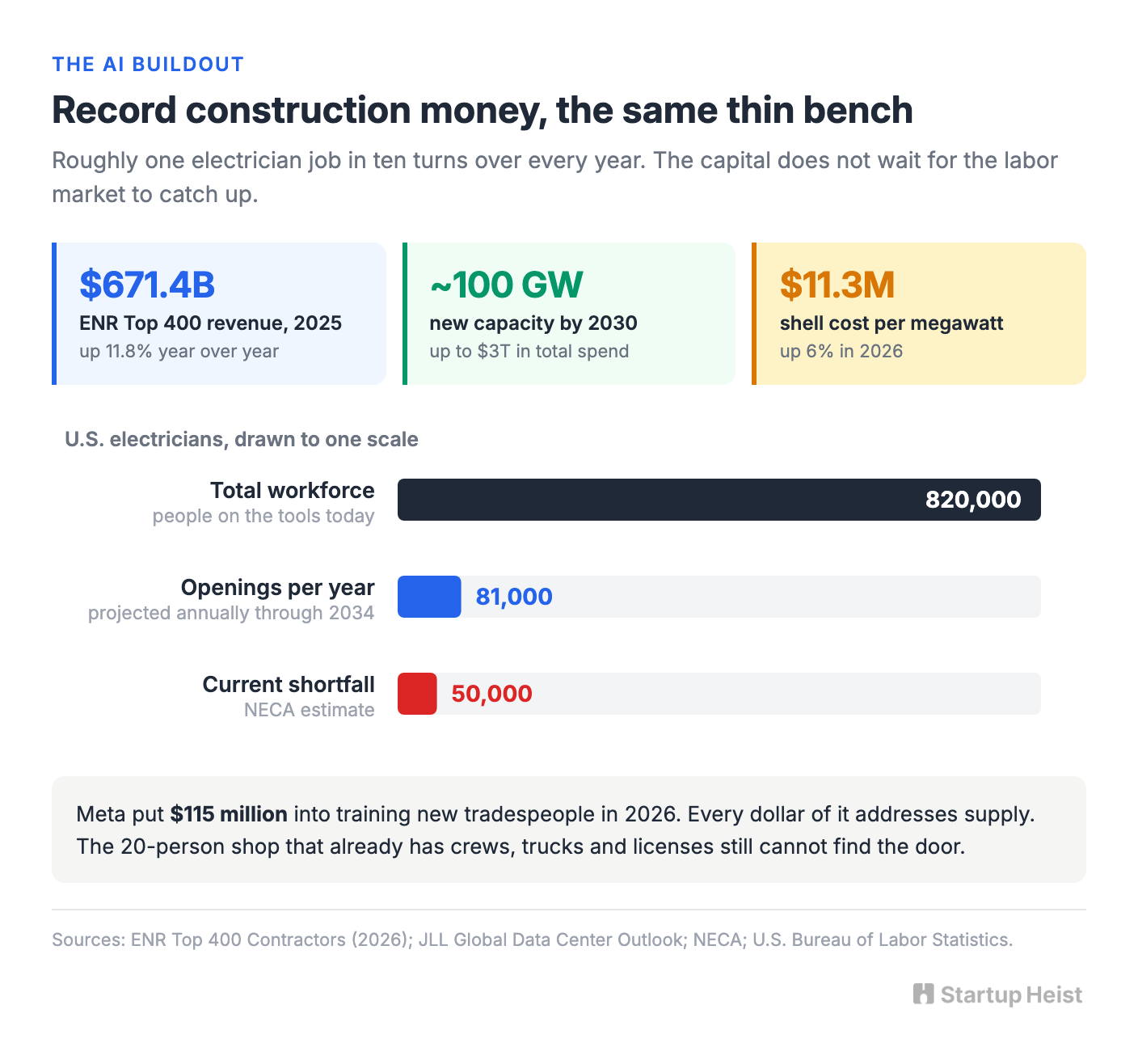
The National Electrical Contractors Association puts the current shortfall at roughly 50,000 electricians. The Bureau of Labor Statistics projects about 81,000 openings a year through 2034 against a workforce of around 820,000. Training more people is the correct response to those numbers, and it solves exactly one side of the market.
On the other side sits a contractor who already has the people. He has the crew, the trucks, the licenses, and fifteen years of hospital and distribution-center work behind him. What he doesn't have is a business development analyst tracking utility dockets, rezoning agendas, tax abatements, GC appointments, vendor portals, and prequalification deadlines. He has a project manager who also estimates and an office manager who also runs payroll.
Lead platforms tell him a project exists. They don't tell him which phase is approaching, which trade packages open next, which GC controls them, whether his bonding capacity fits the scope, what documents the portal will demand, which of those he's missing, or who to call before the invitation to bid goes out.
Two Gates, Both Public
Timing is the first gate. Paperwork is the second. He usually loses at both.
Data center construction has left the traditional hubs. Power availability, land, and the geography of AI inference workloads are pushing campuses into places that have never seen a project this size. JLL reports the average wait for a grid connection in primary data center markets now exceeds four years, while a modern shell goes up in 18 to 24 months. Developers close that gap with on-site generation, battery storage, and behind-the-meter arrangements. Texas and Ireland have gone as far as bring-your-own-power mandates.
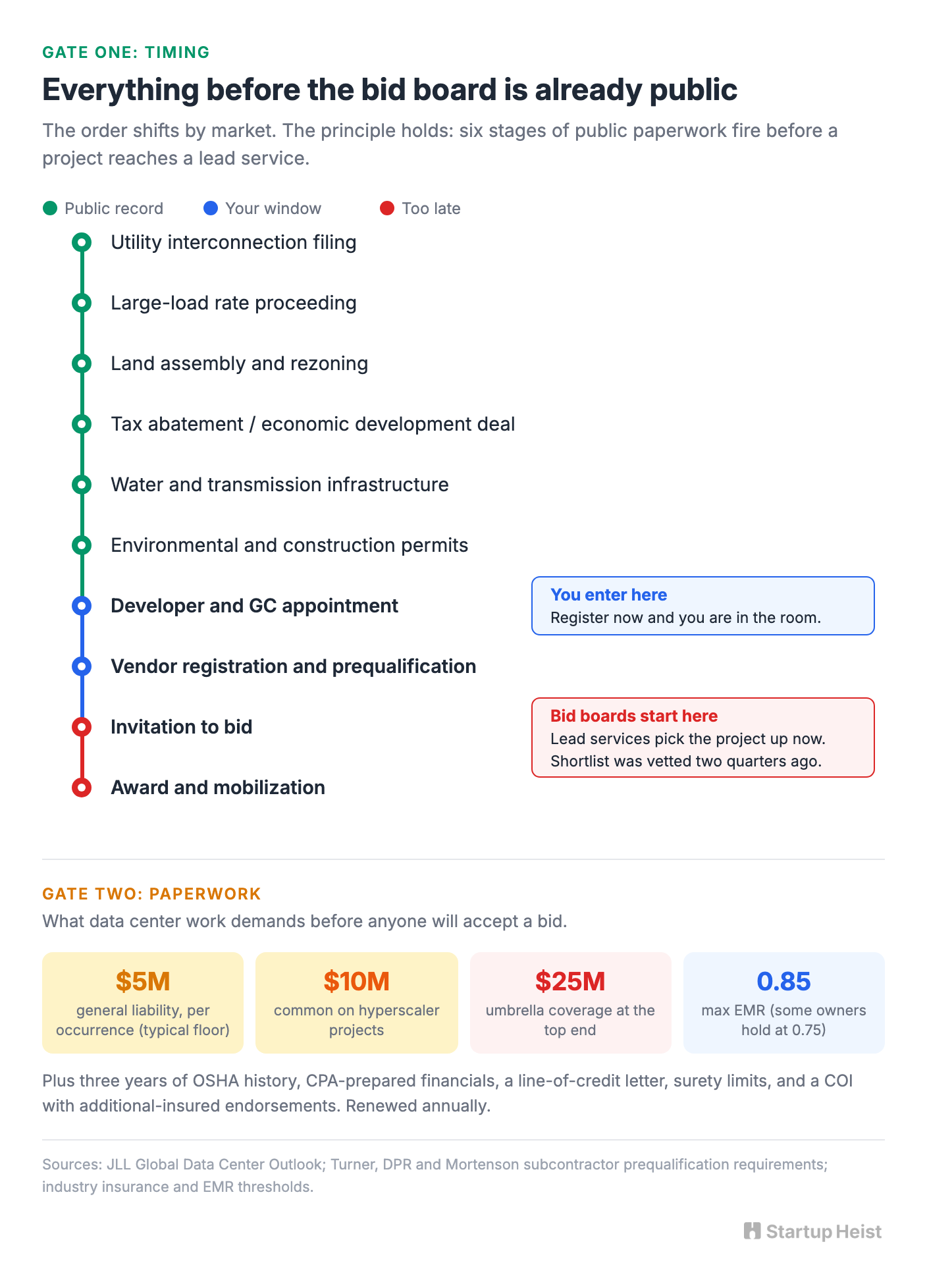
The power story is where the earliest useful signals live. A conventional lead service starts tracking a project when plans hit a bid board, and by then the electrical package already has a shortlist. The real sequence runs earlier: utility interconnection filings, large-load rate proceedings, land assembly and rezoning, tax abatements and economic development agreements, water and transmission infrastructure, environmental and construction permits, developer and GC appointments, vendor registration and prequalification, invitations to bid, then award and mobilization. The order shifts by market. The principle holds. Everything through the permit stage is public, and it surfaces months before anything reaches a bid board. Register with the right GC at the appointment stage and you're in the room. Show up at the invitation stage and the shortlist was vetted two quarters ago.
Then comes the paperwork. Large general contractors evaluate subcontractors as financial, safety, and execution risks before they'll accept a bid at all. Turner's process asks for a W-9, safety-rating verification, three years of safety history, documented safety programs, a current CPA-prepared financial statement, a line-of-credit letter from the bank, surety information with project and aggregate limits, a sample certificate of insurance with additional-insured endorsements, and underrepresented-business certification data. Financials, EMR, and certifications renew annually. DPR wants three years of OSHA records, EMR verification, current insurance, bonding capacity documentation, and both externally prepared and internal financial statements. Mortenson runs its trade partners through Autodesk's TradeTapp.
Data center work tightens the screws. General liability minimums commonly start at $5 million per occurrence, and hyperscaler projects frequently require $10 million or umbrella coverage up to $25 million. Experience modification rate thresholds of 0.85 are standard, and some owners hold the line at 0.75.
Read that list from the contractor's chair. Every item is a document sitting somewhere already: an accountant's inbox, an insurance broker's file, a safety consultant's binder, a drawer. Assembling it takes days. Assembling it correctly, for a specific GC's specific portal, against a deadline that arrived without warning, takes longer than most 30-person shops can spare in a busy quarter. Most contractors who fail prequalification are perfectly qualified. The packet was late, incomplete, or built from documents that had expired.
Nobody Sells to the Subcontractor
ConstructConnect sells project matching, daily lead emails, bidder lists, plans, specs, addenda, and contacts. Starter runs $129 a month per market, Professional $199 a month per market on an annual agreement. Contractors already pay for project discovery, which is the validation you want and the warning you should heed. Rebuilding ConstructConnect with fewer projects and a data-center filter is a losing plan.
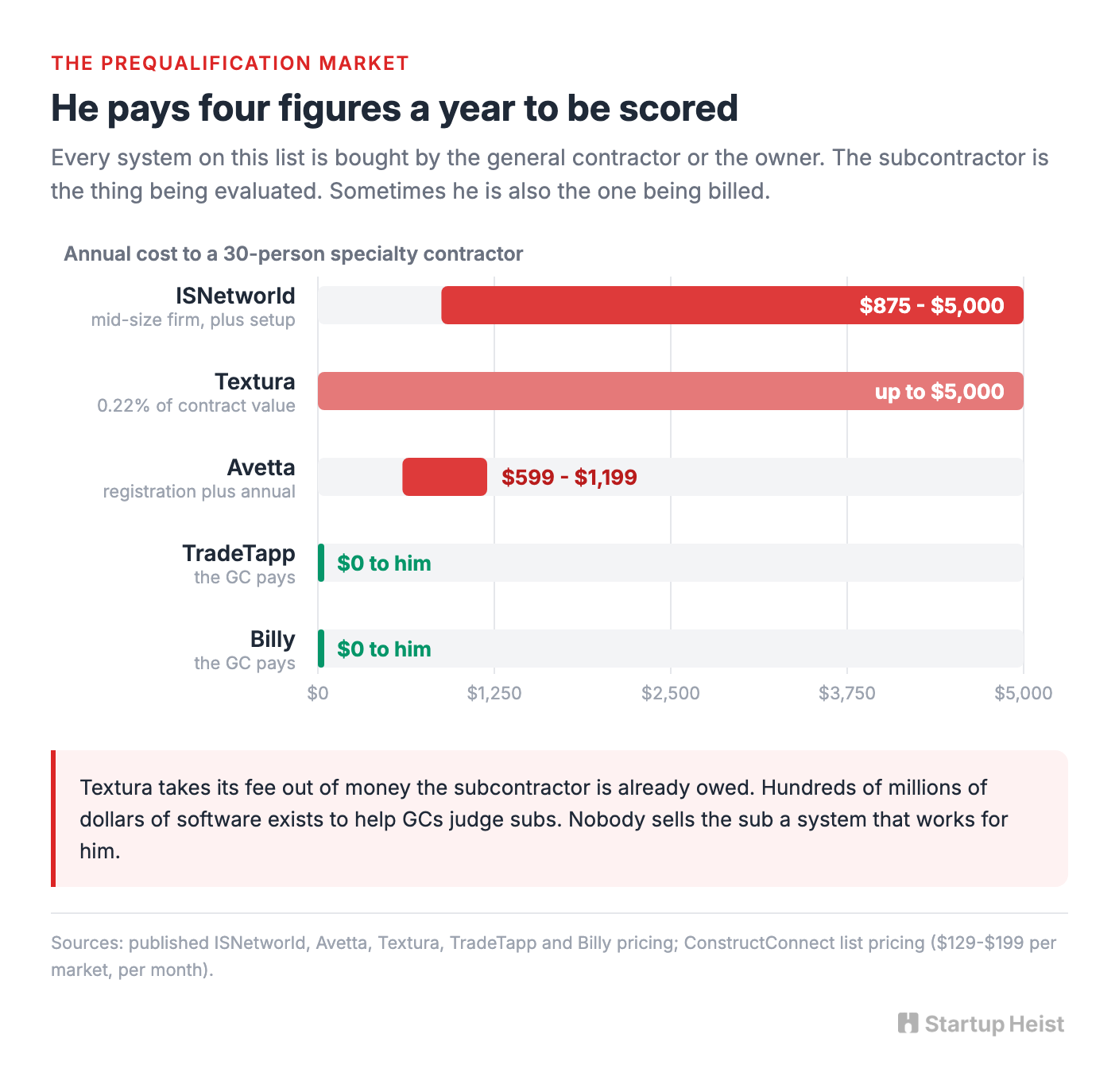
Look at the prequalification side and the pattern gets stranger. TradeTapp, Highwire, COMPASS, ISNetworld, Avetta, Veriforce, Billy, Textura. Every one of them is bought by the general contractor or the owner, and the pitch is risk management: assess your subs, score them, approve them. The subcontractor is the thing being scored.
He sometimes pays for the privilege. TradeTapp and Billy cost him nothing. ISNetworld runs roughly $875 a year at the baseline and $1,700 to $5,000 for a mid-sized firm, plus a setup fee. Avetta takes a $299 registration fee and $300 to $900 a year after that. Textura deducts a usage fee of 0.22% of contract value, capped at $5,000, from money the subcontractor is owed. A 30-person electrical shop can spend four figures a year sitting inside systems built to judge him.
Hundreds of millions of dollars of software exists to help general contractors evaluate subcontractors. Nobody is selling the subcontractor a system that works for him. That is the gap.
| Category | What it already does well | What it leaves open |
|---|---|---|
| ConstructConnect, Dodge, PlanHub | Broad project discovery, bid documents, contacts | Trade-specific interpretation, early mission-critical signals |
| BuildingConnected, TradeTapp | Bid invitations, GC-controlled prequalification | Finding the right GC and preparing the sub before an invitation |
| Highwire, COMPASS, ISNetworld | Contractor risk scoring, reusable qualification data | Opportunity intelligence and hands-on submission support |
| Permit trackers | Early filing and permit detection | Translating raw filings into package-level commercial action |
| Procore, Textura | Managing work after award | Helping a smaller contractor enter the pipeline at all |
Your product sits across all of it. The customer keeps his ConstructConnect subscription, keeps receiving BuildingConnected invitations, keeps filling in TradeTapp questionnaires. You tell him which of those deserve attention this week, what to do about them, and whether his file is ready when it counts. The scarce resource is twenty hours a week of somebody's attention, and nobody at a 30-person shop has it to give. This is a service before it's software, and the service is the part worth building first.
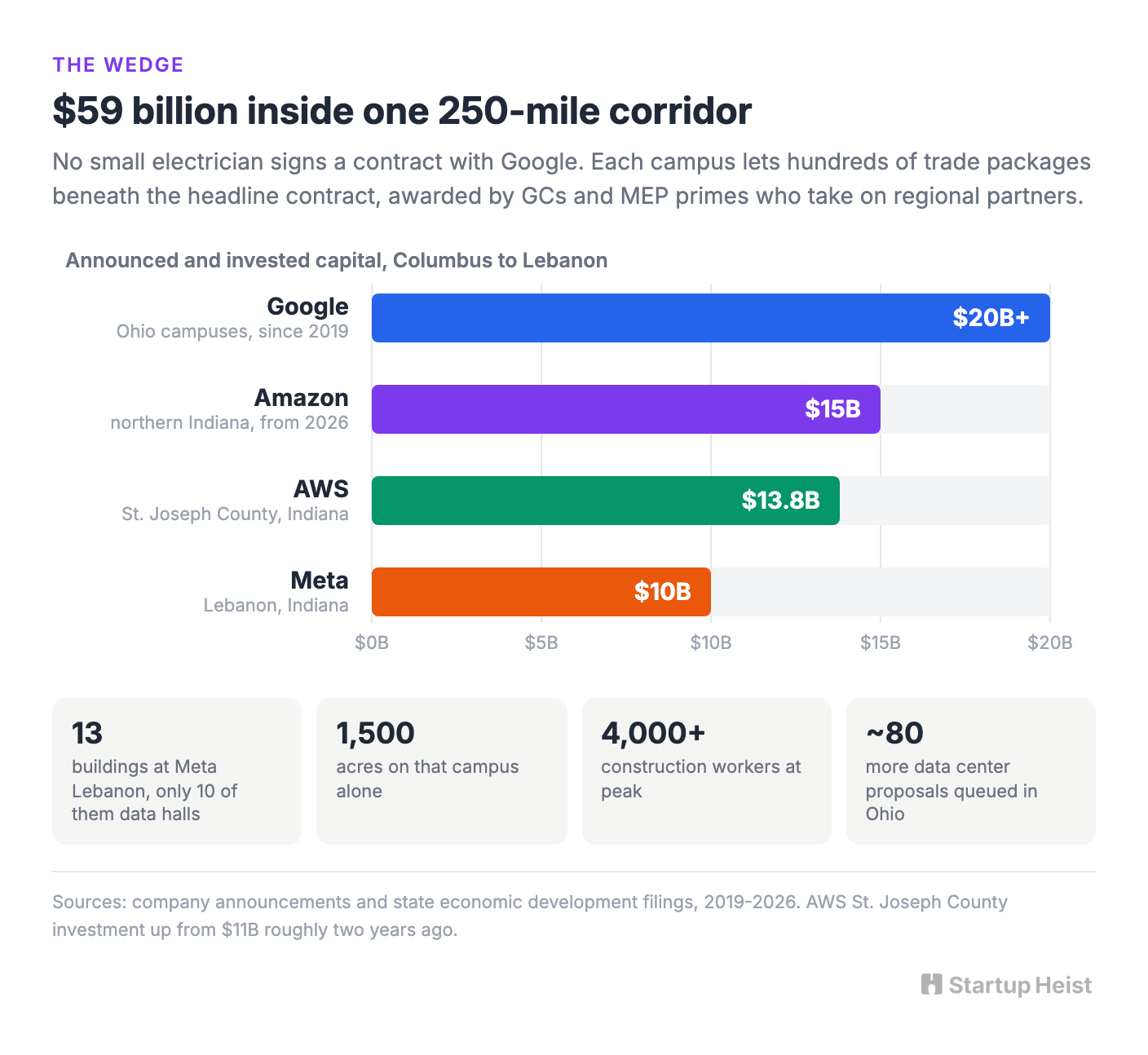
The Wedge: Columbus to Lebanon
One trade, one customer profile, one corridor: commercial and industrial electrical contractors between central Ohio and central Indiana.
Unlock the Vault.
Join founders who spot opportunities ahead of the crowd. Actionable insights. Zero fluff.
“Intelligent, bold, minus the pretense.”
“Like discovering the cheat codes of the startup world.”
“SH is off-Broadway for founders — weird, sharp, and ahead of the curve.”


