


The Anti-SaaS Heist: Build a Local Trade Intelligence Business
ASHRAE writes the standards that American HVAC engineers design to. It also sells advertising, and its 2026 rate card is public.
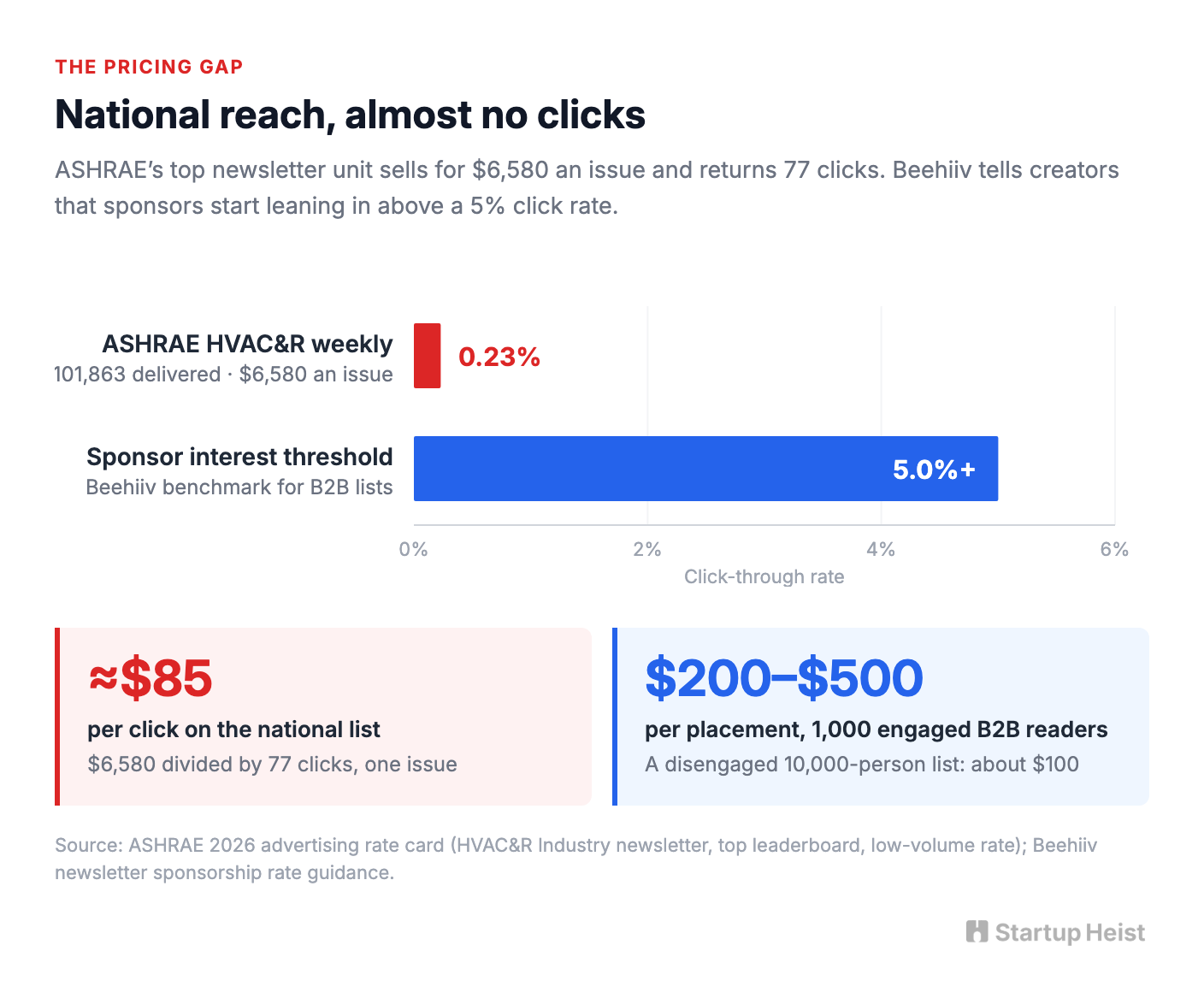
A top leaderboard placement in the weekly HVAC&R Industry newsletter costs $6,580 for a single issue at low volume. The same document discloses exactly what that money buys: an average of 77 clicks, a 0.23% click-through rate against 101,863 delivered emails.
That works out to about $85 per click. Advertisers keep paying it.
Beehiiv, which hosts tens of thousands of publications and sees more small-publisher data on newsletter sponsorship rates than almost anyone, tells its creators that a genuinely engaged 1,000-person list in a valuable B2B niche can command $200 to $500 for a single placement. A disengaged list of 10,000 might be worth $100.
HVAC vendors spend real money to reach a national audience that barely clicks, because the alternative is nothing. Nobody has built the thing they'd rather buy: a small, verified, local audience of people who actually sign purchase orders.
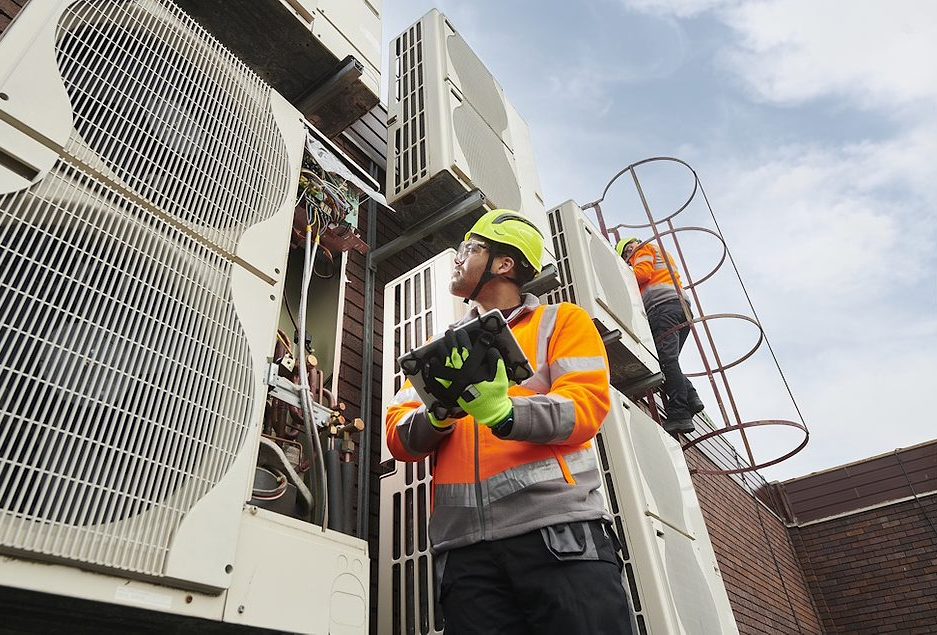
So build it. Pick a fragmented B2B trade, pick one metro, and assemble the operational information those operators hunt for every week better than anyone else: new bids and procurement intelligence, permits that signal upcoming work, distributor and pricing movements, hiring and wage data, code and rebate changes translated into what to do on Monday.
Give all of it away to the operators. Sell access to the companies desperate to reach them.
Call it the Texas Commercial HVAC Project & Procurement Brief. The name has to promise a specific work product, because "HVAC News" promises another AI digest of articles everyone already saw.
What you're actually building is a verified niche audience sitting on top of a proprietary local information asset. The email is how you assemble it. You can test the whole thesis with a few hundred dollars, a spreadsheet, and a willingness to do work other founders consider beneath them.
Here's the opportunity:
The money: At 1,500 to 2,500 verified subscribers, sponsorships, listings, and qualified leads stack to $5,200 a month. Bisnow ran the same model to $40 million.
Inside:
• The MVP database schema, field by field
• Four questions that qualify every subscriber
• A six-level ladder from sponsors to events
• The 90-day playbook and the $5K stack
Why a Small Trade Audience Outprices a Big One
Three thousand random subscribers is three thousand subscribers. One thousand commercial HVAC owners, estimators, and facilities managers in Texas is a defined pool of people who control six-figure purchasing decisions, and every vendor selling into that trade already knows who they are. The math sits downstream. A distributor whose average contractor account is worth $80,000 a year can rationally spend thousands to open one relationship. A recruiter placing a commercial technician bills a fee in the thousands. What those sponsors want is a conversation with a qualified buyer, and CPM has nothing to do with it.
Beehiiv's benchmark is that sponsors start leaning in at click-through rates above 5%. ASHRAE's best-performing unit clicks at 0.23%. A tight local list running a 40% open rate and a 5% click rate belongs to a different asset class than the national incumbent, priced by a different logic.
Someone has already run the full sequence in an adjacent trade. Bisnow started as local commercial real estate newsletters, city by city, sent to the brokers, developers, and property managers in each market. No venture capital. In May 2016 the Wicks Group bought it for a reported $50 million on roughly $15 million of revenue and about $6.8 million of EBITDA. By 2023 it was doing around $40 million across more than 70 newsletters, roughly 50 local markets, and 1.7 million subscribers. In March 2026, Axel Springer, the parent company of Business Insider and Morning Brew, acquired it.
Events made up about 75% of that $40 million. The newsletters assembled a room worth convening, and the room is what vendors paid for. Most founders park events at the bottom of the roadmap as a someday item. Bisnow's financials say events are the business and the newsletter is the acquisition channel that makes them possible. Plan accordingly, even if you don't book a venue for eighteen months.
Information, Not Content
Vertical newsletters usually die at the same spot. They start with a topic. "I'll launch a newsletter about HVAC." That isn't a thesis. Google, LinkedIn, trade magazines, manufacturer blogs, YouTube, Facebook groups, and every chatbot on earth can already tell a contractor what happened in HVAC this week.
The wedge sounds closer to this: every Monday, commercial HVAC contractors in North Texas see the projects, bids, permit activity, workforce movements, and regulatory changes that will affect their revenue over the next ninety days. That's a product, because it's an information advantage. A vertical B2B newsletter earns its price when it collects material that technically exists in public but is genuinely inconvenient to assemble.
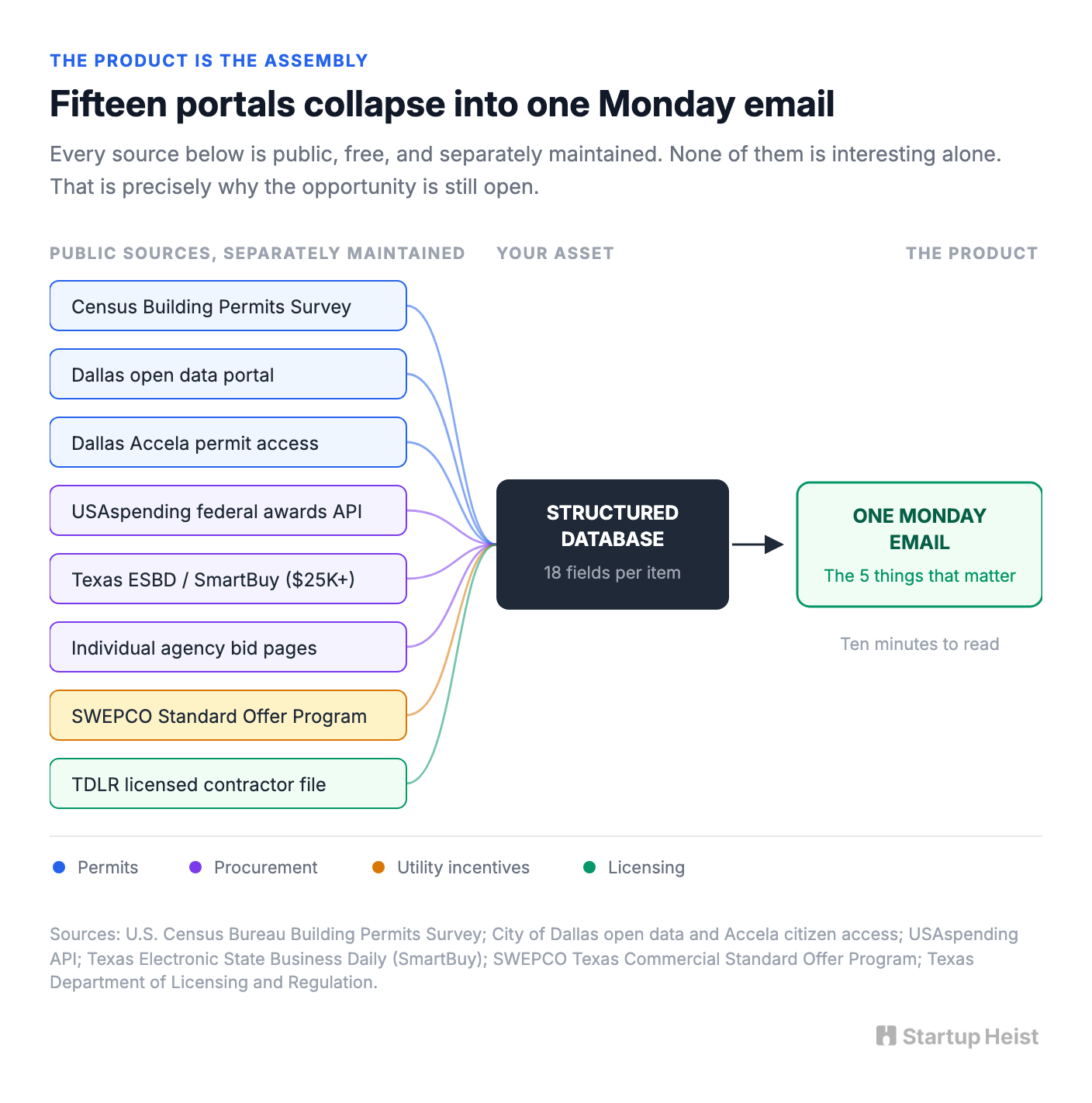
There is far more of it than people assume. The Census Bureau's Building Permits Survey publishes construction authorization data monthly, down to counties and individual permit-issuing jurisdictions. Dallas runs public permit data through its open data portal and its Accela citizen access system. USAspending offers a public API over federal contract awards. Texas posts public bid opportunities of $25,000 and above through the Electronic State Business Daily on the SmartBuy platform, while individual agencies also list HVAC solicitations on their own procurement pages, fragmenting the picture further. SWEPCO's Texas Commercial Standard Offer Program pays incentives on high-efficiency equipment, with the schedule set for Program Years 2026 and 2027.
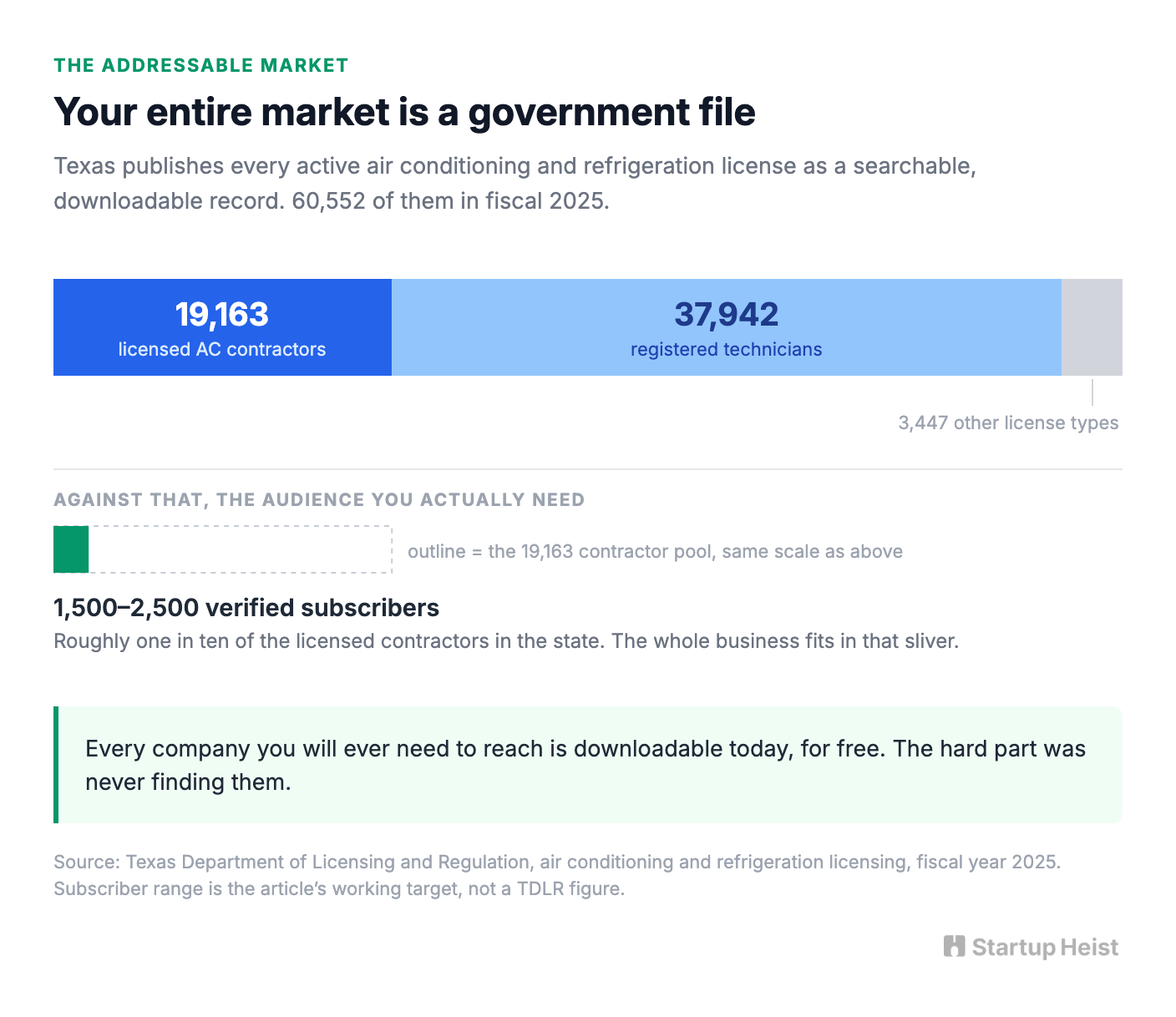
The Texas Department of Licensing and Regulation maintains a searchable, downloadable file of every active air conditioning and refrigeration license in the state. As of fiscal year 2025 that's 60,552 licenses, including 19,163 licensed air conditioning contractors and 37,942 registered technicians. Your total addressable market is a government file with names on it. Every company you'll ever need to reach is downloadable today, for free.
No single one of these sources is interesting on its own, which is exactly why the opportunity exists. Local market intelligence lives in aggregation, filtering, interpretation, historical tracking, and delivery. Your reader doesn't need another portal. They need someone to tell them the five things across fifteen portals that will affect their business this week.
Why HVAC Makes a Clean Example
The model works in dozens of trades. HVAC just shows the criteria clearly.
Mordor Intelligence puts the U.S. HVAC services market at $18.98 billion in 2026, growing at a 5.9% CAGR to $25.35 billion by 2031. The South held a 38% share in 2025 and is advancing at a 7.2% CAGR, well above the national rate. The Bureau of Labor Statistics projects employment for HVAC mechanics and installers to grow 8% from 2024 to 2034, much faster than average, with roughly 40,100 openings a year.
The regulatory clock matters more than either figure. On January 1, 2026, the EPA's HFC Leak Repair and Management Rule took effect, imposing leak detection and repair obligations on owners of appliances holding 15 pounds of refrigerant or more. On May 26, 2026, the EPA finalized a reconsideration of the AIM Act's Technology Transitions provisions, moving the rules again. The phasedown's largest single step, cutting the HFC cap from 60% to 30% of baseline, lands in 2029.
Recurring change is the ingredient you're shopping for, more than growth. A static industry is a bad host for this model. You want a trade where operators repeatedly need to know what changed, what it means, and where the money moved.
HVAC also carries a dense vendor ecosystem, which is what sets your revenue ceiling. A commercial contractor transacts with equipment manufacturers, distributors, parts suppliers, fleet providers, lenders, insurance brokers, payroll services, recruiters, training programs, field-service software, marketing agencies, lead platforms, private equity buyers, and business brokers. Sponsor economics set the ceiling on niche newsletter monetization. Audience size barely moves it.
The Niche Selection Formula
Don't start with what sounds interesting. Score candidates against seven criteria.
Unlock the Vault.
Join founders who spot opportunities ahead of the crowd. Actionable insights. Zero fluff.
“Intelligent, bold, minus the pretense.”
“Like discovering the cheat codes of the startup world.”
“SH is off-Broadway for founders — weird, sharp, and ahead of the curve.”


