


Your Signup Flow Needs Crash-Test Dummies
A new signup flow usually gets tested three ways: the founder clicks through it, a few friends try it, and then it ships and paying customers find whatever is left.
There is a fourth option now, and almost nobody is selling it properly: send a small army of browser agents through the flow before a single human sees it.
Be careful which version of this you build. The flashy pitch is "AI users" that predict what customers will want, and the research has started to dismantle it. A July 2026 cross-domain benchmark ran four language models, from 8B open weights up to frontier scale, against two large sets of real human survey data. The models systematically over-determined demographics, treating identity as far more predictive of attitudes than it is. On a segment-targeting task they inflated the gaps between segments two to fourfold, manufactured splits that do not exist in real people, and would have pointed a team at the wrong segment in half of the U.S. cases and most of the cross-cultural ones.
So skip the fake customers and build crash-test dummies instead.
The business underneath is narrow, and every part of it is already off the shelf.
The money: 300 audits a month at $79 is $23,700 in monthly revenue with no sales team. Agencies buy it as insurance on client deliverables.
Inside:
• The fifteen-scenario library, spelled out
• Four-bucket findings model that earns trust
• $79, $199, $399 pricing ladder
• Agency wedge plus the outreach email
Give the product one URL and one goal.
Create an account and start a free trial.
Then let browser agents attack that flow under deliberately hostile conditions. One hesitates at pricing; another refuses every optional permission. A third arrives on a 390-pixel phone, and a fourth enters data that is technically valid but unusual enough to break something. Others misread ambiguous copy, wander down a navigation path nobody designed for, or hit a validation error and try to dig their way out.
The product records what actually happened. Instead of a sentence like "31% of your customers will abandon signup," you get this:
Seven of twenty defined scenarios failed to complete signup. Four stopped at OAuth. Three hit the same validation message. Here are the replays, screenshots, console errors, and exact reproduction steps.
Recording what happened rather than forecasting what will happen is the whole difference between a dubious synthetic-user product and a credible new category: preflight QA for revenue-critical flows. A founder pastes a staging URL, names the outcome they want, and gets back a same-day Flow Failure Pack containing reproducible defects, behavioral edge cases, and usability hypotheses worth investigating before spending money on traffic or human research.
Nothing here scales into a ten-billion-dollar software company, and that is fine. The shape suits a solo operator: a narrow product that opens as a $79 automated audit, reaches real revenue with no sales team, and, if the data accumulates correctly, hardens into a verification layer nobody else has.
The Gap Between "It Works" and "A Person Can Use It"
Automated testing answers mechanical questions: did the button open the modal, did the API return 200, did the regression suite pass. Human research asks why the participant hesitated, whether they understood the pricing, and what finally made them abandon.
Between those two disciplines sits an awkward, expensive territory. Take a SaaS company that just redesigned its signup flow. Engineering has green tests, the founder created an account without trouble, and the designer reviewed every screen. Nobody has yet tried signing up on a phone, entering a company name long enough to break the layout, navigating backward after OAuth, selecting Pro and then changing their mind, refreshing at the worst possible second, or attempting the whole thing with an already-registered email. None of that belongs in a unit test, and none of it justifies five human sessions every time the flow changes.
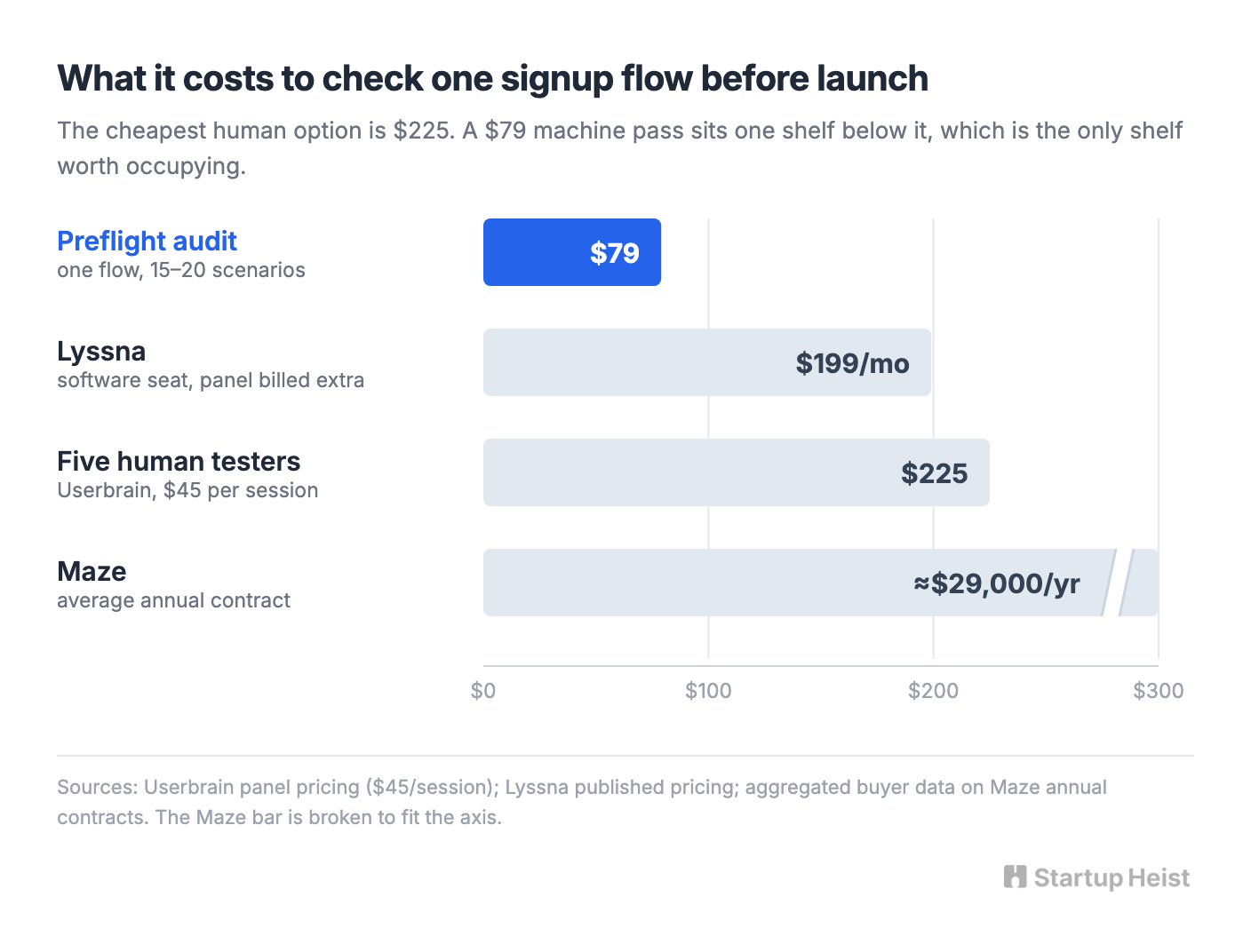
Human sessions are priced accordingly. Userbrain, one of the cheaper real-human platforms, charges $45 per panel tester session, so five testers is $225 before anyone inside the company watches a minute of footage. Lyssna splits the bill at $199 per month for software, $165 on annual billing, with panel participants charged separately at roughly a dollar per minute of test duration. Maze does not publish pricing at all; buyer data across three dozen purchases puts the average annual contract near $29,000, with its AI features locked behind the enterprise tier.
That pricing is fair. Humans deliver evidence about humans, which is the entire point of hiring them. The opening is to sit one step earlier in the sequence, run the cheap machines first, and reserve expensive human attention for the questions that survive. The demand underneath is well documented. Baymard Institute's meta-analysis of fifty studies puts average cart abandonment at 70.22%, and 24% of abandoners walk specifically because the site forced them to create an account. Baymard also estimates the average large ecommerce site could lift conversion 35% through checkout design alone. Signup is where that money leaks, and every leak sits inside a flow somebody shipped believing it worked.
The Infrastructure Just Became Free
In 2023 this product required building a browser cloud. Today the whole stack is off the shelf.
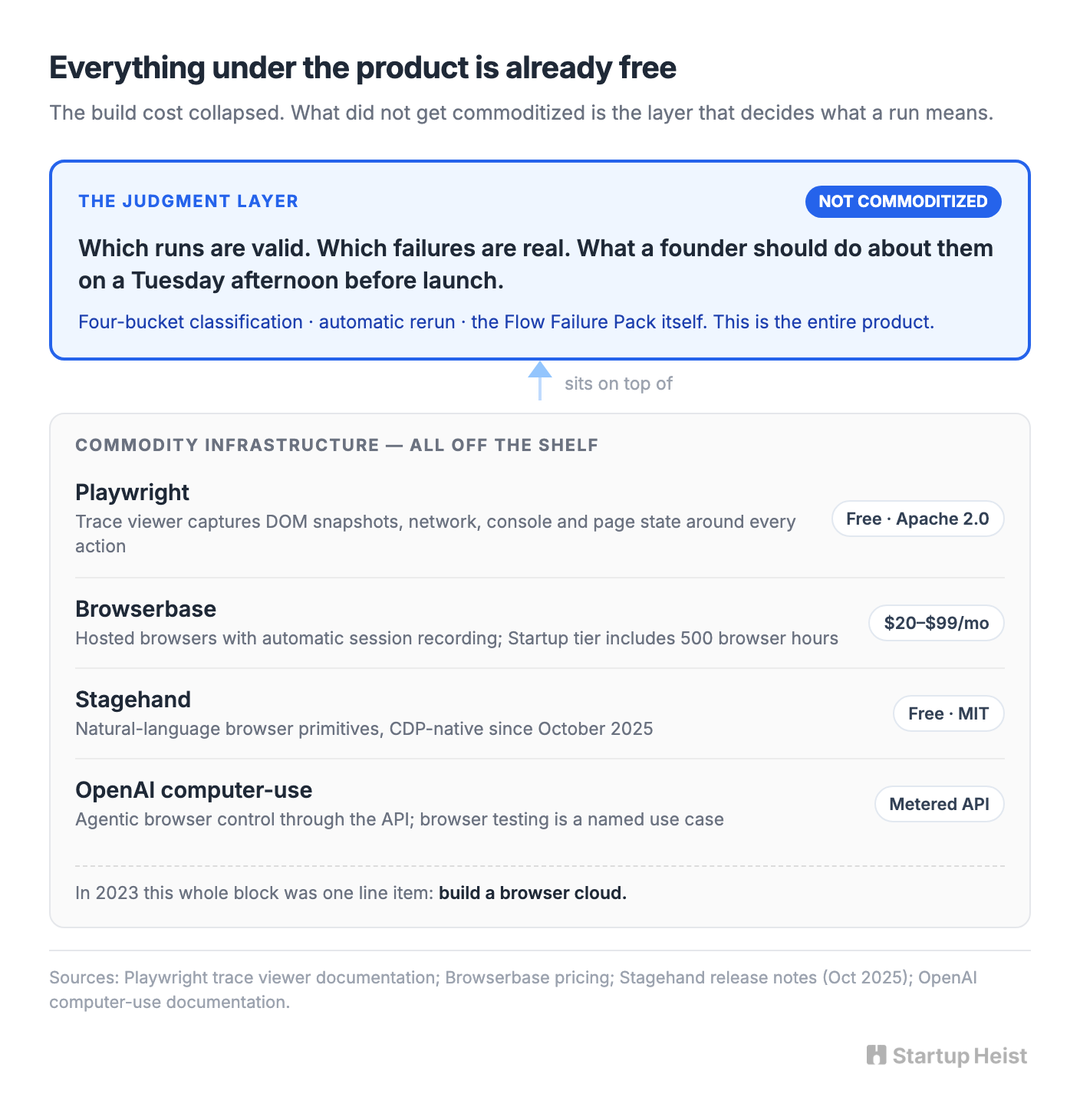
Playwright handles deterministic browser control and ships an observability layer most startups could not afford to build alone. Its trace viewer captures DOM snapshots, network activity, console output, and page state around every single action. That is your evidence engine, already written. Browserbase supplies hosted browsers with automatic session recording, starting at $20 per month for developers and $99 for the Startup tier, which includes 500 browser hours with overages at ten cents an hour. Stagehand, Browserbase's open-source agent SDK, went CDP-native in October 2025 and gives you natural-language browser primitives under an MIT license. OpenAI's computer-use model is available through the API with browser testing as an explicit developer use case.
All of that is commodity infrastructure. What nobody has commoditized is the judgment layer on top: deciding which runs are valid, which failures are real, and what a founder should do about them on a Tuesday afternoon before launch.
The Crowd You Must Not Join
Two groups are already fighting in adjacent territory, and both of them leave your position open.
The first is engineering QA. Momentic lets teams describe end-to-end tests in plain English, auto-heals brittle locators, and plugs into CI. It raised a $15 million Series A in November 2025 led by Standard Capital, bringing its total to $19.2 million, and reports executing over 200 million test steps in a single month. QA.tech runs a similar agentic play. These companies sell into the engineering test stack, where the buyer maintains a suite and the value compounds over quarters.
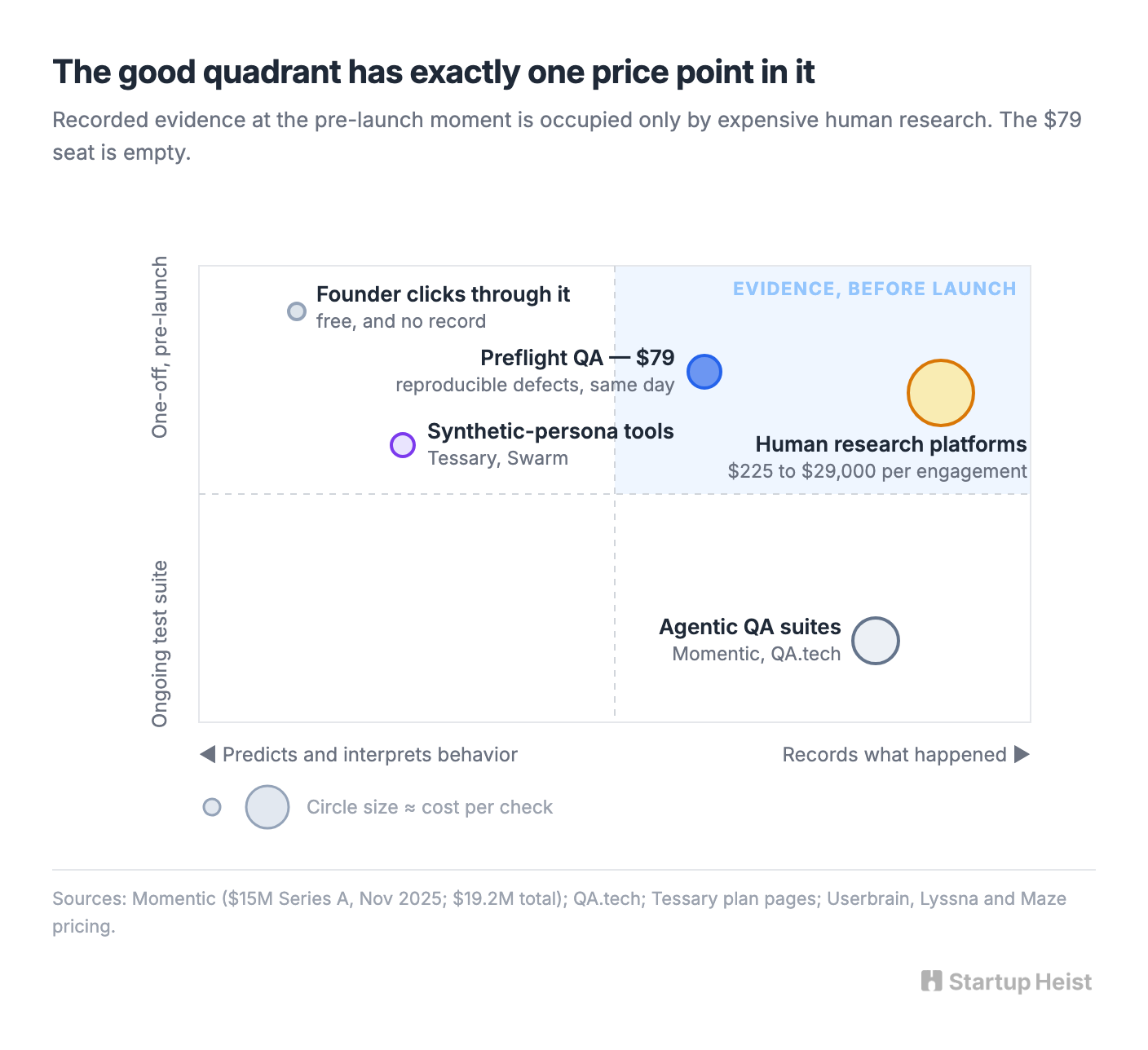
The second is the synthetic-persona crowd. Tessary, Swarm, and a handful of others run AI agents through live URLs and report back what the "user" thought. Most are early; Tessary offers three free sessions a month and keeps its team plan in early access with pricing on request. The category has momentum and a serious credibility problem, which the survey research above only sharpens.
Neither group owns the moment you want. Momentic asks an engineering organization to maintain a test suite. The persona tools ask a founder to take an agent's word for it. You are going to ask a founder one question instead:
What should a customer be able to accomplish here?
Then hand back a decision artifact. Ship, fix first, run five humans, or go look at checkout. That is a productized audit rather than a QA suite, and it is the reason a solo builder can take it. The whole thing takes eight weeks to build, and it starts with fifteen scenarios.
What You Actually Build
Start with SaaS signup and nothing else.
Unlock the Vault.
Join founders who spot opportunities ahead of the crowd. Actionable insights. Zero fluff.
“Intelligent, bold, minus the pretense.”
“Like discovering the cheat codes of the startup world.”
“SH is off-Broadway for founders — weird, sharp, and ahead of the curve.”


