


The AI Margin Firewall
The dangerous customer in an AI startup isn't the one who never comes back. It's the one who loves the product too much.
A founder ships an AI research tool at $15 a month. The typical subscriber runs a few reports a week. Then one customer works out that the thing will happily run hundreds, points an automation at it, and burns more inference in 48 hours than that subscription will generate in a year.
The founder acquired a power user. What landed on the balance sheet was a liability.

This is the structural crack under a large share of AI SaaS pricing. The customer pays a fixed subscription. The company pays a variable bill with no ceiling. Every prompt, image, search call, transcription, reasoning trace, and agent loop adds inference cost, and nothing on the pricing page stops any of it.
The opportunity is an AI cost control layer that sits in front of the model. Proxy every request, identify which end customer it belongs to, check that customer's allowance, reserve the expected cost, and refuse the call when they've consumed what they paid for.
Call it a margin firewall. Its nearest relative is the authorization check a card network runs before a charge clears, not the analytics tab on a gateway.
The shape of the business:
The money: Five hundred customers at a blended $110 a month is $55,000 MRR. Two thousand at $150 builds a $3.6 million ARR company.
Inside:
• Four-to-eight-week MVP scope for the proxy
• Pricing ladder from free sandbox to $399
• Margin-audit cold email that books meetings
• Ninety-day plan and the kill criteria
The theft
Traditional SaaS economics work because the marginal cost of a heavier customer rounds to nothing. Ten people hammering a project-management tool doesn't double the vendor's hosting bill.
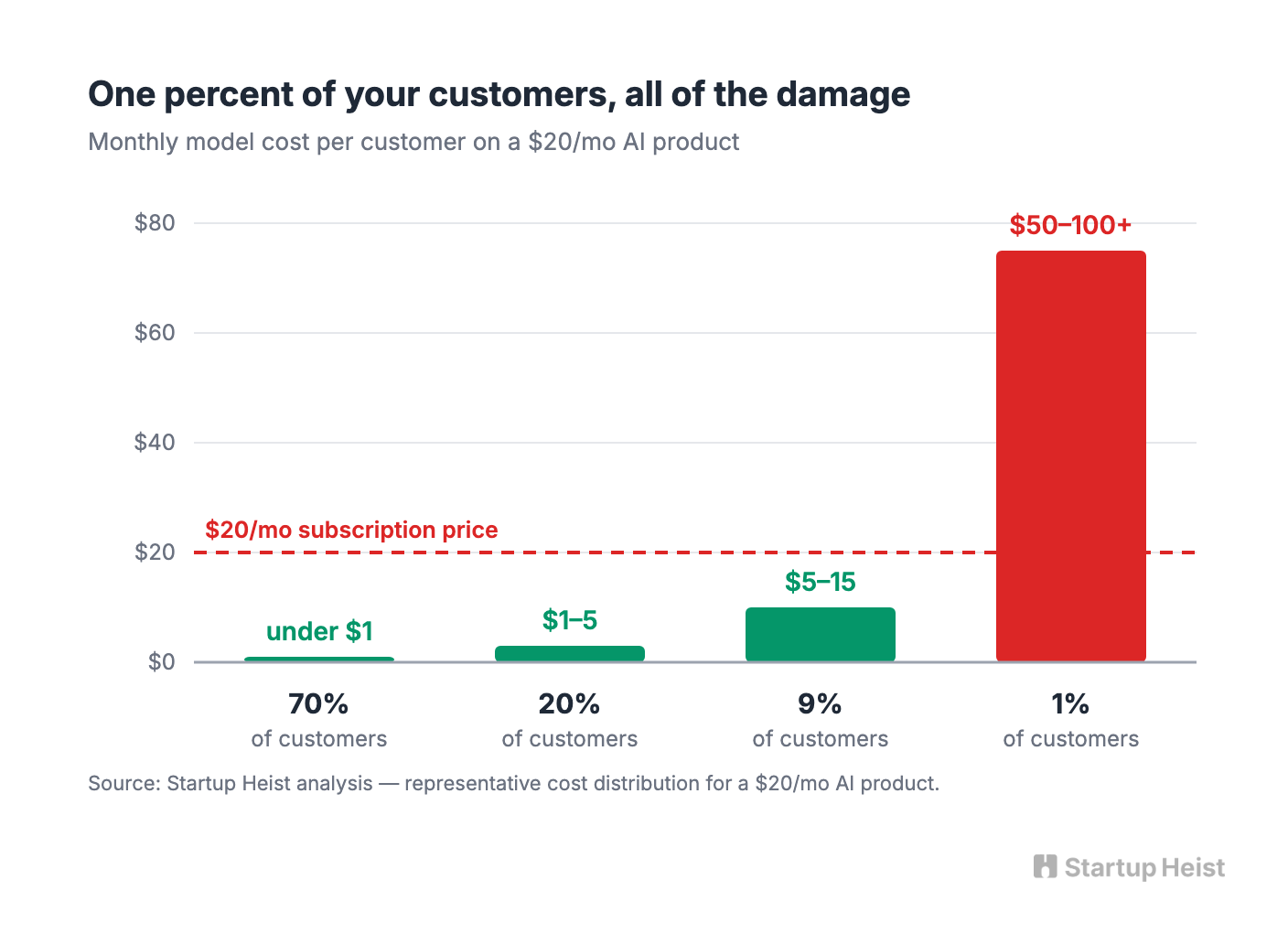
AI software breaks that assumption at the foundation. Say you sell an AI writing product at $20 a month and the average customer costs $2 in model usage. It reads like a beautiful business until you look at the shape of the distribution instead of its center. Seventy percent of your customers cost under a dollar. Twenty percent land between one and five. Nine percent run five to fifteen. The top one percent costs $50, $100, or whatever their automation decides. The blended gross margin still looks healthy while the marginal economics are already broken, and the customers doing the damage are exactly the ones your growth loop selects for.
The exposure widened on July 30, 2026, when OpenAI cut GPT-5.6 Luna's price by 80%, from $1 and $6 per million input and output tokens down to $0.20 and $1.20, and trimmed Terra by 20% to $2 and $12. Sol held at its launch rate of $5 and $30.
The discount matters less than the spread it opened. Sol now costs 25 times Luna on both input and output. One engineer changing a default in a routing config can multiply your cost of goods sold by 25 without touching a single line of the pricing page. Built-in tools stack on top: web search runs $10 per 1,000 calls plus a block of search-content tokens billed at model rates, file search $2.50 per 1,000 queries, code interpreter three cents a session at the base tier.
There are three distinct ways to lose money here, and the first is the only one that usually gets modeled. Usage risk is a customer making far more requests than you planned for. Mix risk is a workflow drifting from a cheap model to an expensive one. Amplification risk is one button press fanning out into a chain of model calls and tool invocations, which is what every agentic feature shipped since 2025 actually does.
None of it shows up in time to matter if you learn about it when the invoice arrives. The intervention has to happen while the requests are still in flight.
The providers won't do it for you
The model provider should handle this, and all three majors ship some form of API spend limit. None of them solves the problem, and one of them got weaker.
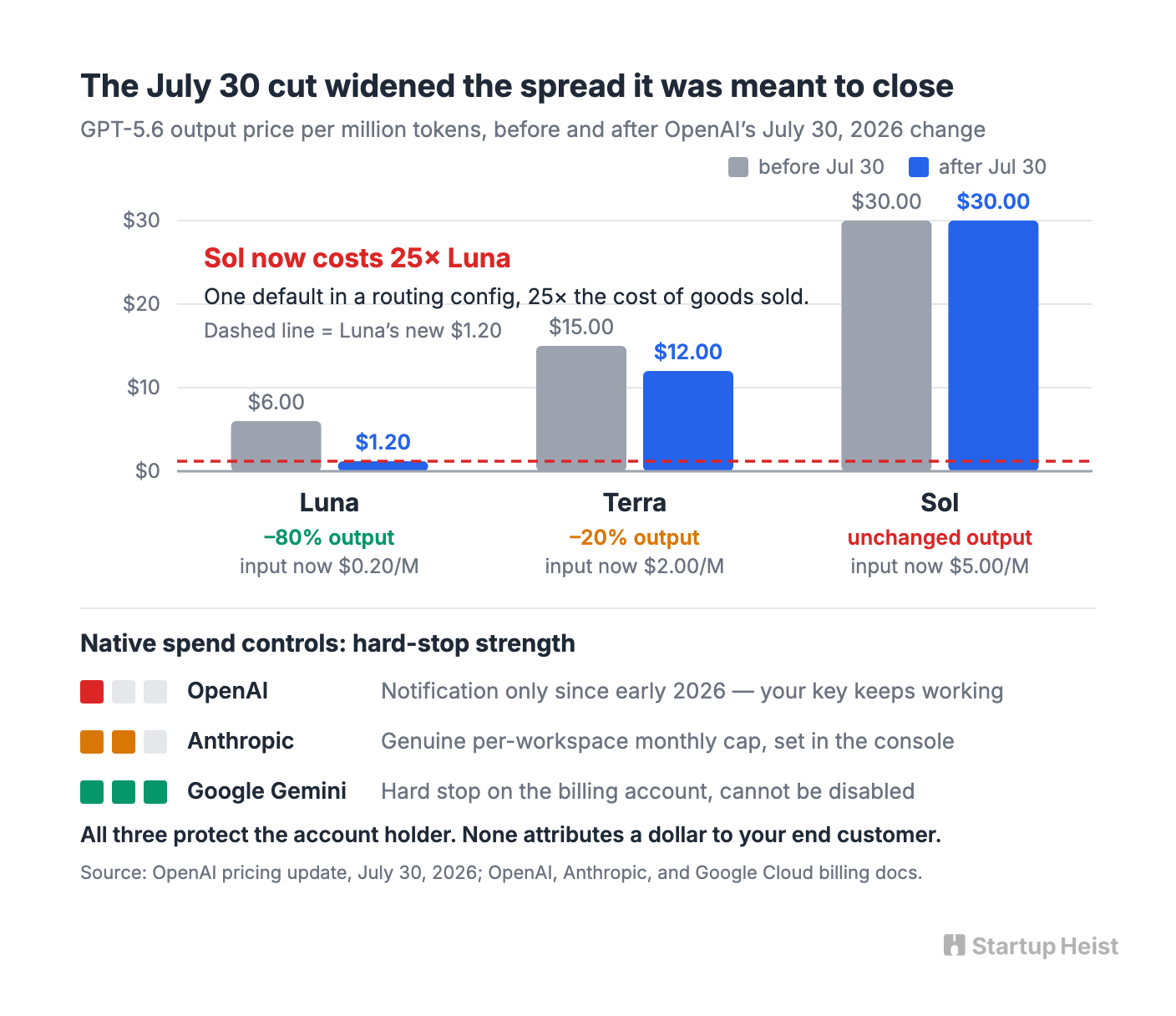
OpenAI quietly converted its monthly budget threshold from a hard cutoff into a notification in early 2026. Cross the line and you get an email and a dashboard banner. Your key keeps working. The charges keep accruing. The only native hard stop left is prepaid credits with auto-recharge turned off, which is org-wide and all-or-nothing: when it fires, every customer you have goes dark at once. Anthropic is stricter, with a genuine per-workspace monthly cap set in the console. Google is the most severe of the three, and its Gemini spend caps can't be disabled at all. Hit the ceiling and every request on that billing account pauses until the next cycle.
Every one of those controls protects the same thing, which is the provider's relationship with the account holder. None of them knows you have customers. The cap fires when your whole company has spent too much, by which point the money is gone and you still can't say which customer took it.
What's already built, and what it refuses to do
The instinct at this point is to go build an AI gateway, which would be a mistake.
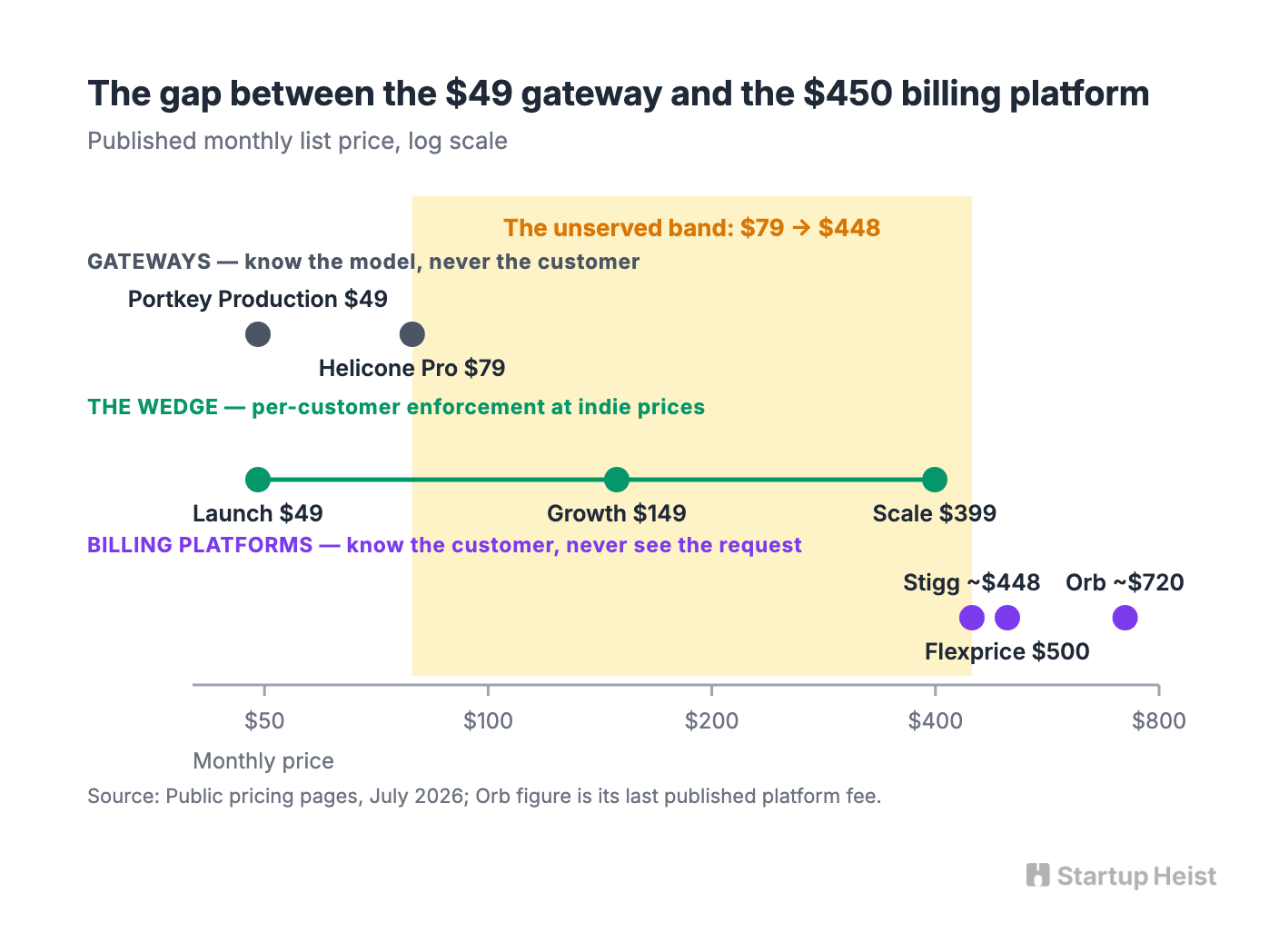
That category is crowded, well capitalized, and consolidating fast. Portkey raised a $15 million Series A on February 19, 2026, led by Elevation Capital with Lightspeed participating, and sells a free developer tier at 10,000 recorded logs a month plus a $49 Production plan at 100,000 logs. Helicone offers 10,000 free requests and a $79 Pro plan, and was acquired by Mintlify on March 3, 2026, after which the product moved into maintenance mode. LiteLLM's open-source proxy already issues virtual keys, tracks spend, applies per-key and per-user budgets across multiple reset windows, and rejects calls that exceed them. Those acquisitions weren't isolated. ClickHouse acquired Langfuse in January 2026, Mintlify took Helicone in March, and Cisco folded Galileo into Splunk Observability in May. Standalone LLM observability is being absorbed as a feature of somebody's larger platform.
Pitching "we proxy your OpenAI calls and show you a cost dashboard" into that is a knife fight against companies with more capital, more features, and open-source distribution.
Look closer at those products, though, and a gap opens up. Portkey gates granular budget and rate limits to its Enterprise tier, so the $49 plan an indie founder would actually buy leaves them out. LiteLLM's budget enforcement carries open, documented correctness bugs: one issue reports keys getting a BudgetExceededError from stale spend data while the management API shows them well under the limit, and another reports user-level budgets going entirely unenforced when a virtual key belongs to a team. Those are the two failure modes that matter most in financial infrastructure, blocking a customer who paid and admitting one who didn't.
A billing-side cluster attacks the same problem from the other direction. Credyt launched on June 10, 2026 selling exactly this primitive, checking a wallet balance before usage is authorized and debiting it atomically, at $1 per monthly active wallet with the first ten free. Flexprice starts at $500 a month. Stigg's Growth plan works out to roughly $448 monthly on an annual contract. Orb stopped publishing prices, and the last public figure put its platform fee near $720.
The map that matters looks like this: gateways know the model but have no per-customer cost attribution, billing platforms know your customer but never see the request, and the products reaching across both start at a price that assumes you already solved the margin problem.
The wedge: a wallet, a policy, and a receipt
The customer isn't shopping for an AI gateway. They want one guarantee: every customer consumes only the AI value they bought. That's a billing problem that happens to require infrastructure to enforce, and it resolves into three primitives.
Unlock the Vault.
Join founders who spot opportunities ahead of the crowd. Actionable insights. Zero fluff.
“Intelligent, bold, minus the pretense.”
“Like discovering the cheat codes of the startup world.”
“SH is off-Broadway for founders — weird, sharp, and ahead of the curve.”


