


The Wall That Notices: Sell the Bird Frame That Hackers Already Proved
A chickadee calls from the maple outside your kitchen. A small computer by the window hears it, names it and never sends a second of audio anywhere. Half a minute later, the framed print in the hallway redraws itself, and a chickadee now sits beside the cedar waxwing that showed up at breakfast, rendered as a hand-colored plate from a nineteenth-century natural history book. By evening the frame has become a portrait of everything that visited your yard that day. You never opened an app, and nothing buzzed.
On September 16, 2026, a Norwegian developer named Arne Giacomo Munthe-Kaas posted exactly this object to Hacker News. His project, Fugleramme (Norwegian for "bird frame"), wires a USB microphone into a Raspberry Pi 5 running BirdNET-Go, an open-source bird classifier, and drives a 13.3-inch color e-paper panel. Every detection is matched to a hand-cut illustration from public-domain plates. The Show HN post reached 2,391 points and 267 comments, a score few Show HN posts ever reach. The most common complaint in the thread was price: roughly €500 in parts.
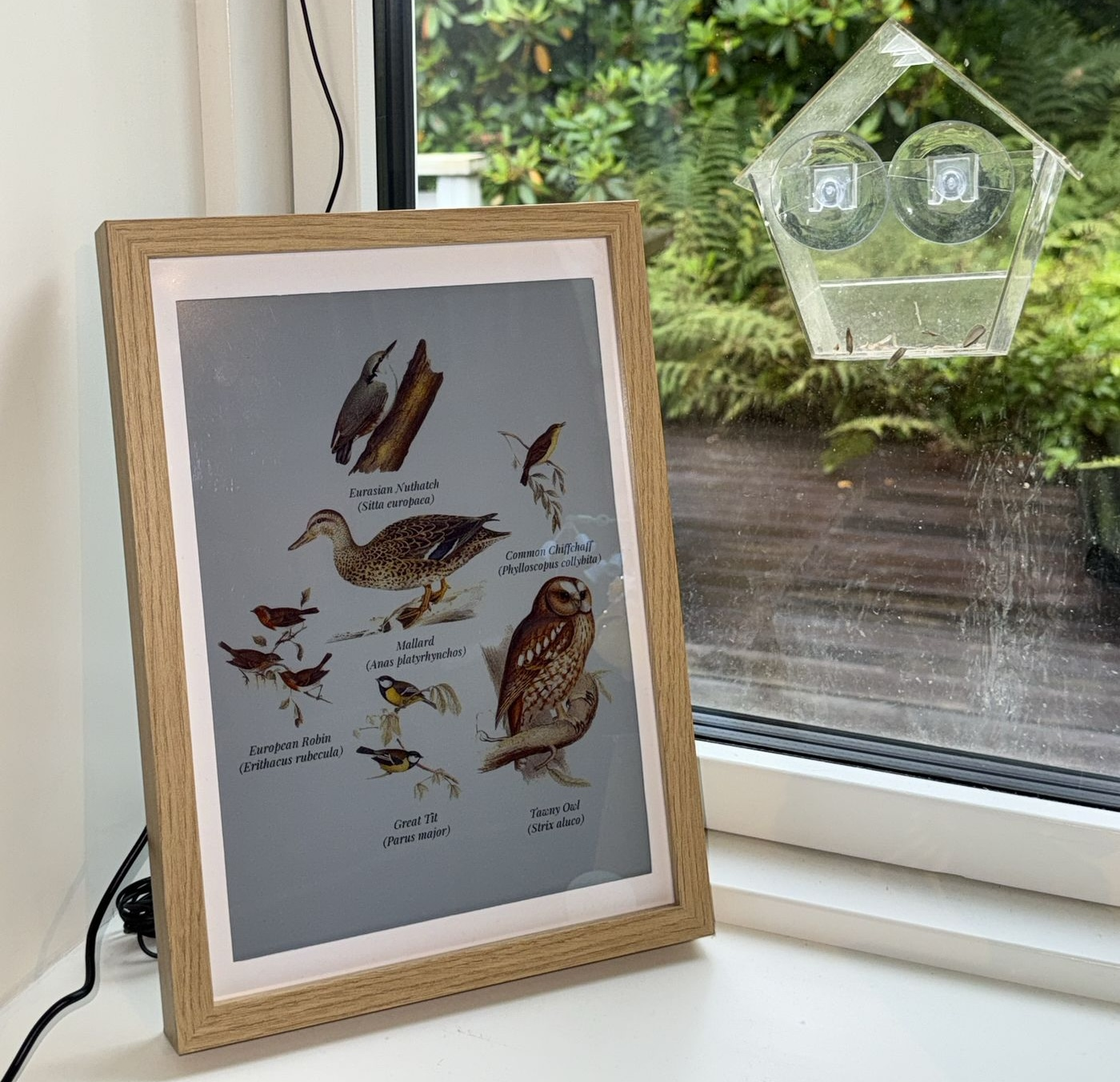
Read that complaint as unmet demand. Thousands of people saw the frame and wanted one, and almost none of them want to flash an SD card, configure Docker or source a fragile glass panel. Whoever sells a finished, licensed, gift-ready version, priced like décor, collects that demand. This is a specialty hardware company, the kind that can reach a few million dollars a year in revenue on healthy margins and a collector brand. The event-to-art engine underneath stays quietly reusable for other niches later.
Here's the opportunity:
The money: Sell 100 frames a month at $449 and you clear about $17K–$19K a month in contribution margin. The hacker version drew 2,391 points on Hacker News.
Inside:
• The $449 bill of materials and unit economics
• How to clear the BirdNET license with Cornell
• A three-screen MVP and a rights-cleared art pipeline
• A 12-week plan to your first 50 paid units
The classifier is the cheap part
Bird identification by sound is now close to free. BirdNET, built by the Cornell Lab of Ornithology's K. Lisa Yang Center for Conservation Bioacoustics with Chemnitz University of Technology, powers most of the hobby ecosystem. Its newest consumer app, BirdNET Live, runs a 9,789-species model entirely on-device with no internet connection. Smart bird feeders from Birdfy and Bird Buddy identify thousands of species from camera photos, and Haikubox sells a box that listens to the yard around the clock.
Every one of those products pushes information at you through a phone. The frame runs the other way: something happens in your physical world, and your home changes to remember it. Walk past the wall in the morning and a pileated woodpecker dominates a composition that held three sparrows last night. You learn it the way you notice the weather.
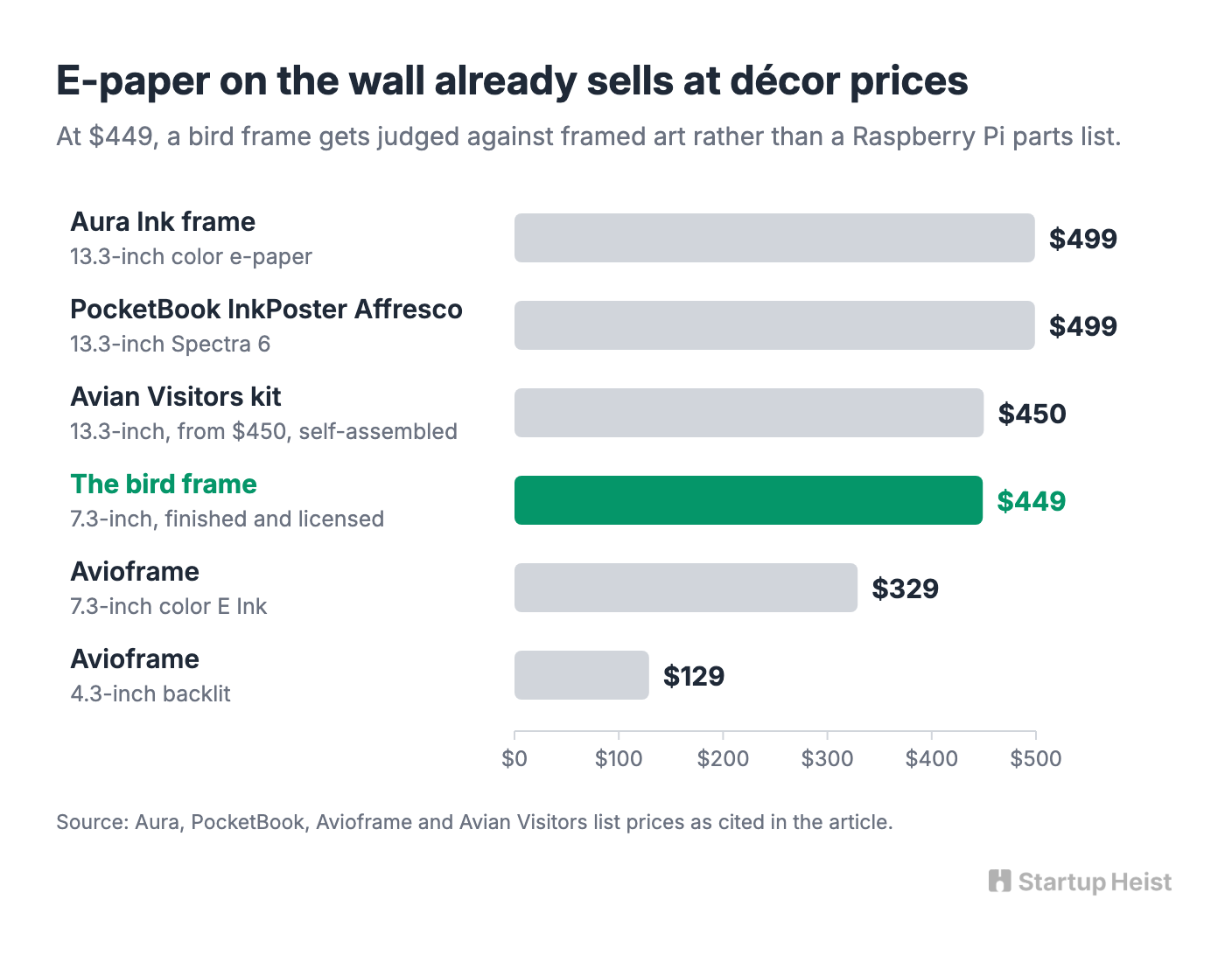
E-paper is what lets the object belong in a living room. It reflects ambient light the way paper does, so it reads as a print, and color e-ink art frames have already crossed into home décor. Aura launched its 13.3-inch color e-paper Ink frame at $499 on October 21, 2025, and PocketBook's InkPoster Affresco sells a 13.3-inch Spectra 6 frame for the same $499. Customers are already paying premium prices for e-paper art on the wall, so a $449 bird frame gets judged against framed art, a far friendlier comparison than a Raspberry Pi parts list.
Planes are taken, and birds are wide open
Aircraft look like the cleaner wedge. Planes broadcast their identity over ADS-B, so there's no microphone and no guessing, and someone has already shipped it. Avioframe sells a 4.3-inch backlit version for $129 and a 7.3-inch color E Ink version for $329, with more than ten views including a poster layout and radar, fed from the open ADS-B network and shipped within two business days. A founder launching an e-ink plane tracker today would be entering second.
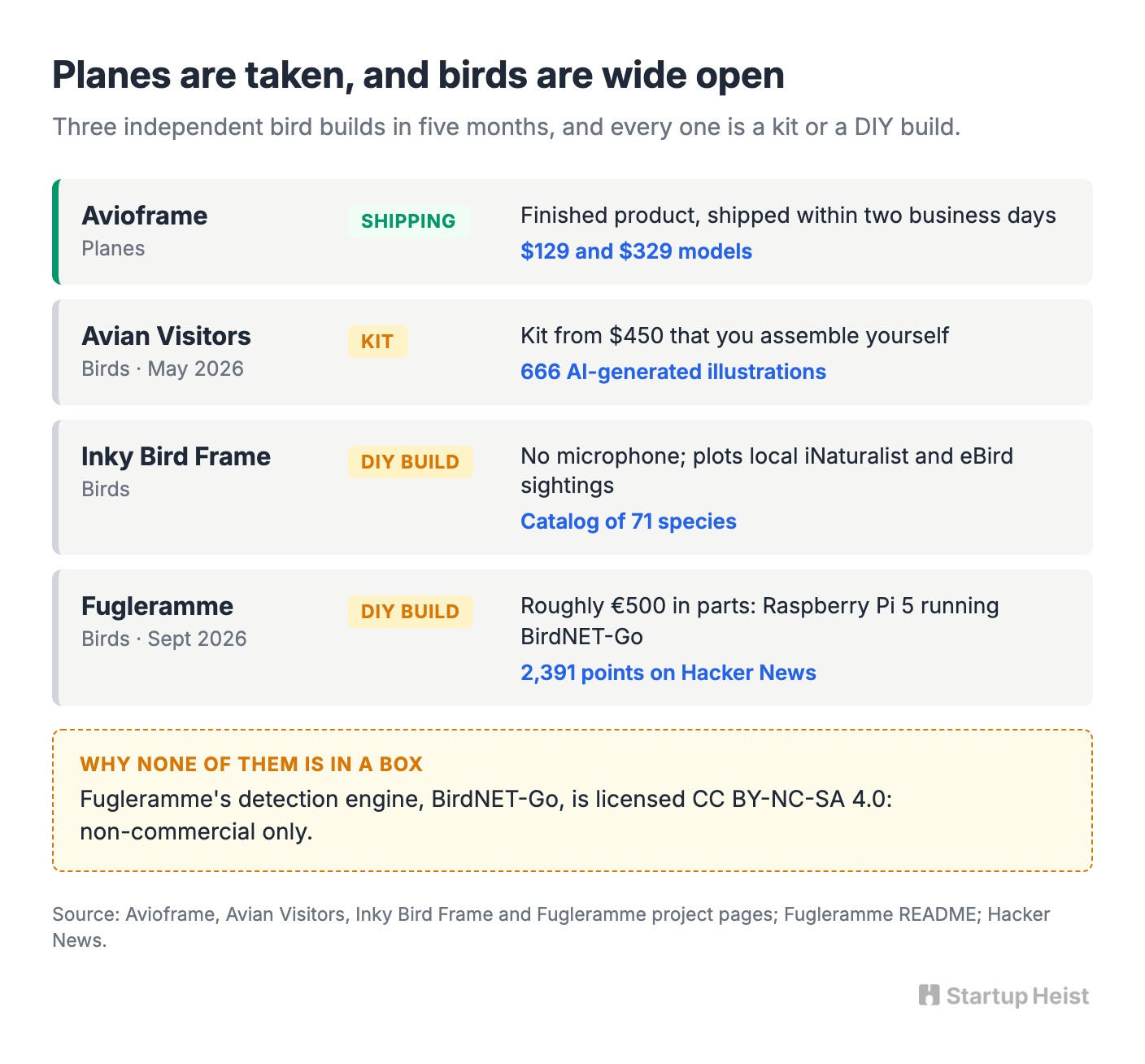
Birds show the opposite pattern: proven demand, three independent builds in five months and no finished product. Teddy Warner's Avian Visitors appeared in May 2026 with a 13.3-inch framed e-ink display, 666 AI-generated illustrations in an Edo-period woodblock style and kits sold from $450, which you assemble yourself. A third project, Inky Bird Frame, skips the microphone and plots local sightings from iNaturalist and eBird against a shared catalog of 71 species. Fugleramme followed in September and went viral. Each one is a kit or a weekend build that expects the buyer to handle a Raspberry Pi, an SD card and configuration, and the listening builds add microphones and sound cards on top.
There's a deeper reason none of them has become a retail product, and it sits in a license file. Fugleramme's own README states that its detection engine, BirdNET-Go, is licensed CC BY-NC-SA 4.0: non-commercial only. The popular BirdNET-Pi project is blunter: "You may not use BirdNET-Pi to develop a commercial product." The hackers proved the magic with software that can't legally be sold in a box, and whoever clears that problem first gets to sell the version everyone in the thread was asking for.
The buyers already spend money on this
The top of the funnel is enormous. The U.S. Fish and Wildlife Service's 2022 national survey counted 96 million Americans who closely observed or tried to identify birds, and 91 million of them did it from home. Birders spent an estimated $107.6 billion on trips, equipment and land that year.
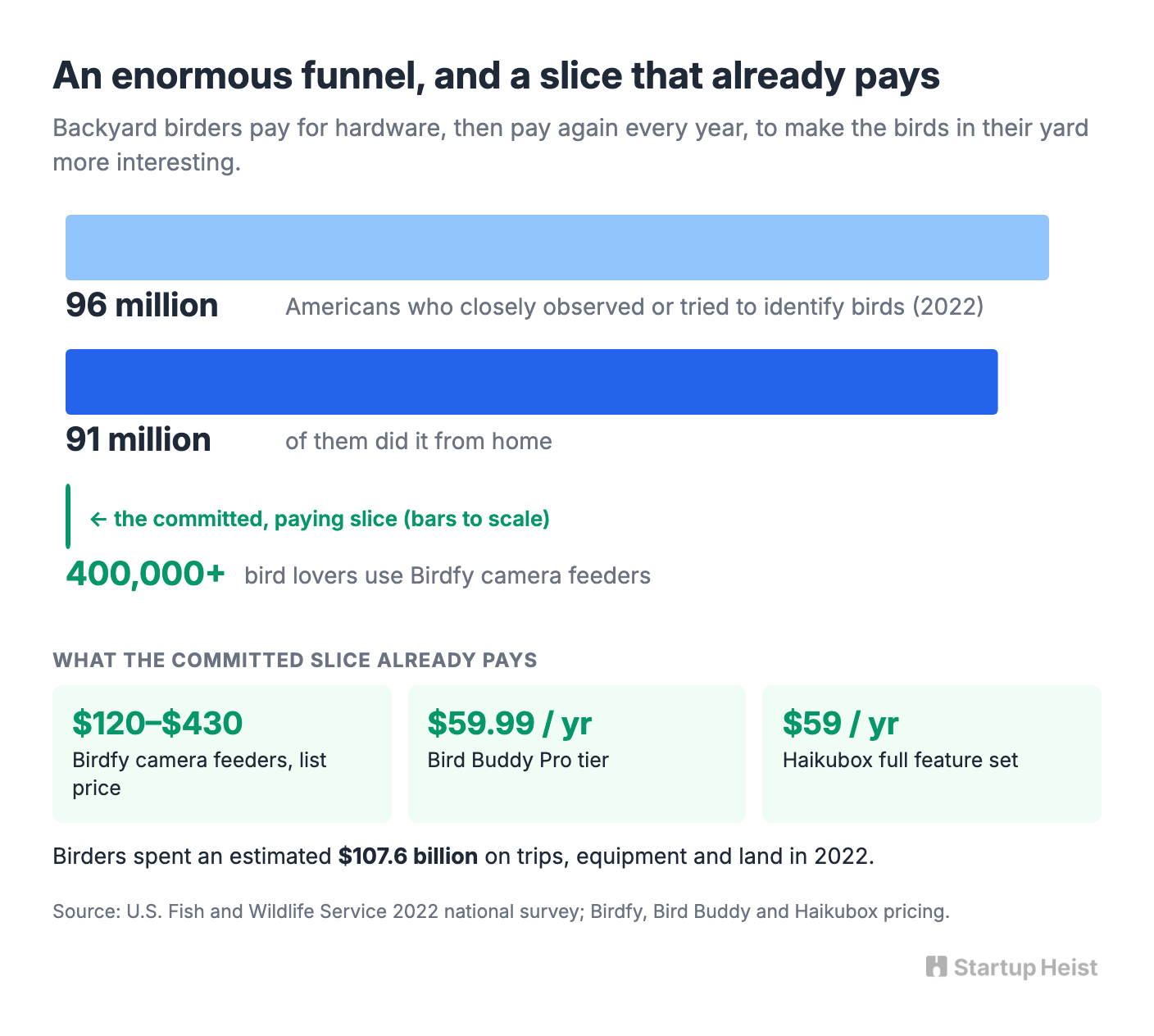
Most of those people will never buy a $449 gadget. The useful signal is what the committed slice of backyard birders already pays for. Birdfy says more than 400,000 bird lovers use its camera feeders, which list from about $120 to $430. Bird Buddy's Pro tier costs $59.99 a year, and Haikubox charges $59 a year for its full feature set. People already pay for hardware, and then pay again every year, to make the birds in their yard more interesting.
Your customer sits in the overlap of serious backyard birders, design-conscious homeowners and, most important, the people shopping for them. The gift buyer is likely the larger market, and the person who buys a bird frame for her father usually never asks how the classifier works.
The $449 version
Unlock the Vault.
Join founders who spot opportunities ahead of the crowd. Actionable insights. Zero fluff.
“Intelligent, bold, minus the pretense.”
“Like discovering the cheat codes of the startup world.”
“SH is off-Broadway for founders — weird, sharp, and ahead of the curve.”


