


eBay's FCC-ID Rule Created a Cleanup Job Nobody Is Doing Well
On October 13, 2026, eBay started asking sellers of wireless electronics for a number most of them had never typed into a listing: the FCC ID.
eBay's notice on the new FCC ID requirement was short. Listings for devices that require Federal Communications Commission certification need a valid FCC ID in a new item-specific field. Depending on the product, a seller without one may be unable to create, revise, relist, or publish the listing, and the listing may be hidden from U.S. buyers.
A seller with twenty items can flip routers over and read labels in an afternoon. For a merchant with 4,000 active listings, the job has no obvious first step. They have to work out which listings need an ID, which already have the right one, which went live before the rule took effect, and how to add a single field to hundreds of listings without breaking anything else.
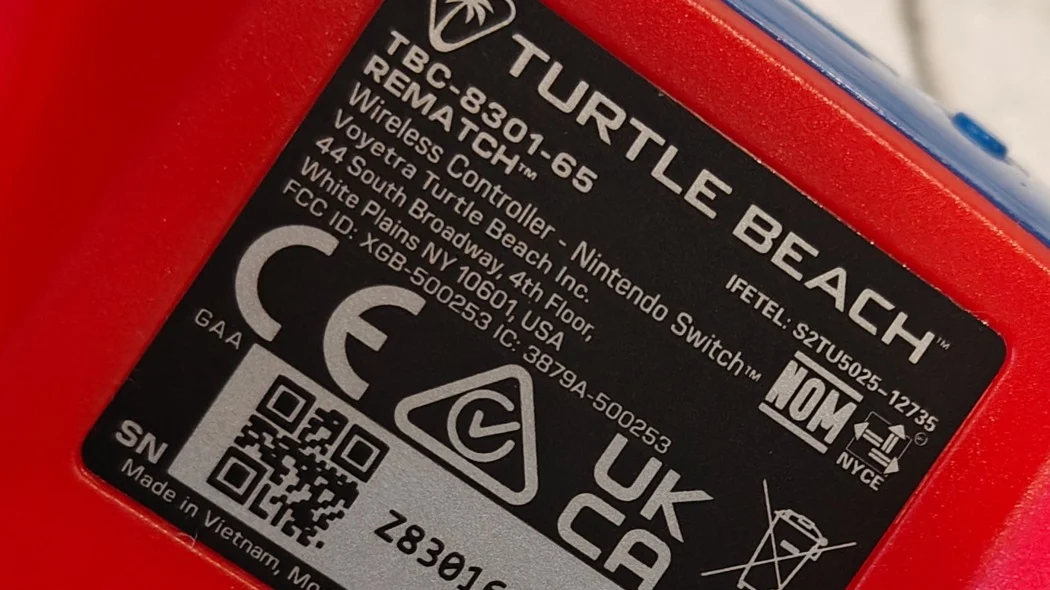
As of mid-October 2026, eBay hasn't given sellers a report or filter that answers any of that. The obvious product is a bulk tool that finds FCC IDs and stamps them into listings, and it would solve half the problem while creating a new one. The federal rule behind eBay's prompt exempts several large classes of listings, editing an older listing can forfeit its exemption, and a perfectly valid FCC ID can belong to the wrong product. The better business is an audit service that tells high-volume sellers which listings need action, finds defensible IDs for those, and leaves the rest alone.
The money: Twenty $99 diagnostics plus ten remediation projects is about $5,000 a month; 250 monitoring subscribers at $49 adds $12,250 MRR.
Inside:
• Five-bucket listing classification system
• Per-variant pricing from a $99 diagnostic
• API write-back that won't wipe item specifics
• 30-day plan to audit five real catalogs
The Rule Behind the Prompt
An FCC ID links a radio-transmitting device to its equipment authorization record. Wi-Fi routers, phones, Bluetooth headphones, drones, smartwatches, and wireless cameras typically carry one. It's a separate identifier from a model number, UPC, serial number, or IMEI, and eBay's guidance says none of those can substitute for it.
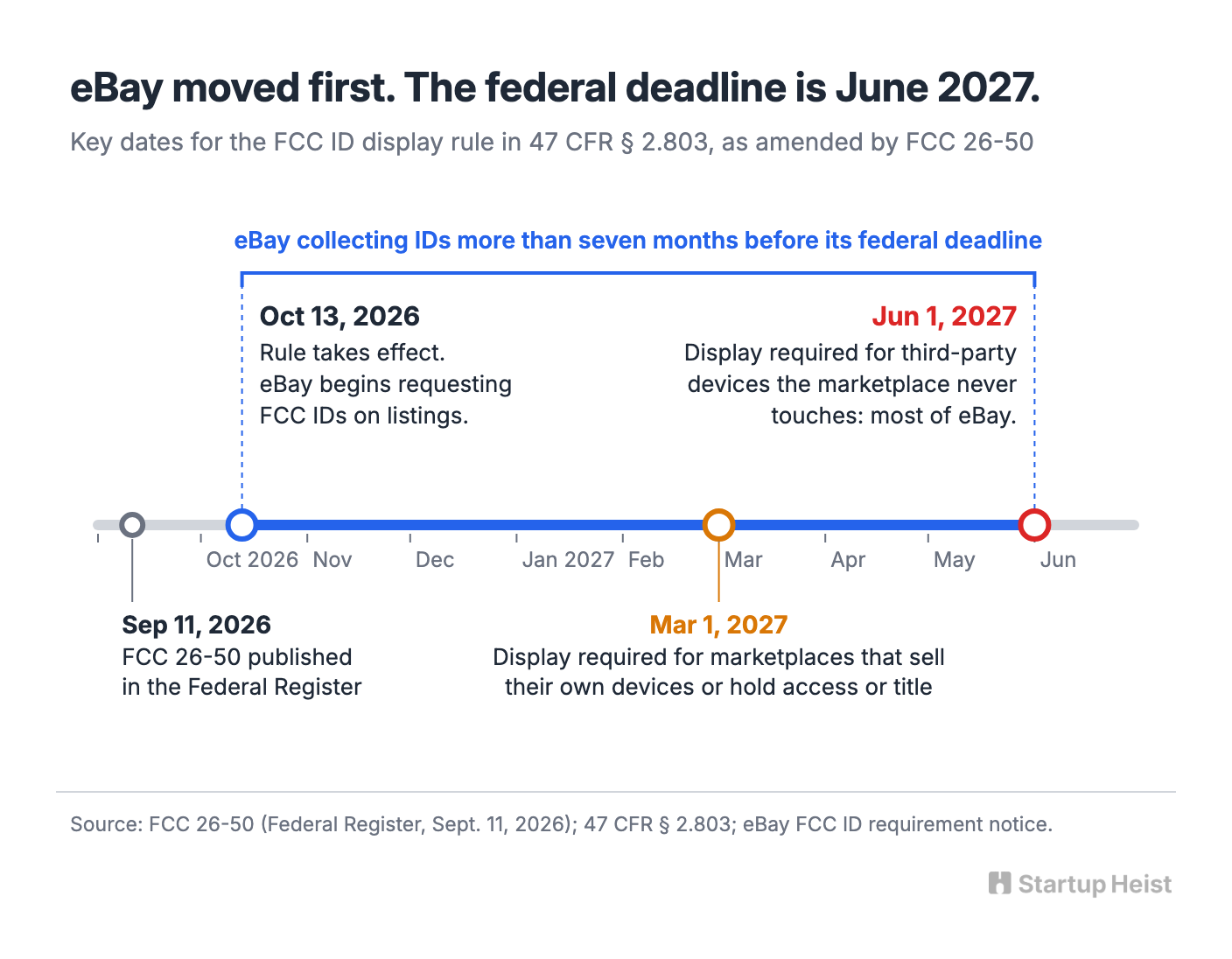
On September 11, 2026, the FCC published order FCC 26-50 in the Federal Register. The order is mostly about national-security risks in the communications supply chain. Tucked inside is an amendment to 47 CFR § 2.803 that makes online marketplaces display FCC IDs at the point of sale. The rule took effect October 13, but the display duty itself carries later compliance dates:
| Date | What happens |
|---|---|
| October 13, 2026 | Rule takes effect. eBay begins requesting FCC IDs on applicable listings. |
| March 1, 2027 | Display required for marketplaces that sell their own devices or have physical access to or title over a third-party seller's device. |
| June 1, 2027 | Display required for marketplaces listing third-party devices they never touch, which describes most of eBay. |
eBay chose to start collecting IDs more than seven months before its federal deadline, and that choice set off the October scramble.
The June 2027 provision also explains why the problem will land on sellers and stay there. A marketplace isn't liable for an inaccurate FCC ID supplied by a third-party seller, provided it checks that the ID exists in the FCC's authorization database and requires the seller to certify accuracy. Expect eBay to confirm that a number is real. Whether it belongs to the item in the box remains the seller's problem.
The Exemptions Are the Business
Section 2.803(c)(3) excludes three kinds of listings from the display requirement:
- Listings published before October 13, 2026, until they are "amended, updated, or republished." The rule defines an amendment as a change to the product description, product images, product specifications, or seller information. Changes to price, search ranking, page layout, translation, and currency display don't count.
- Listings from sellers who are not "high-volume" under the INFORM Consumers Act, which generally means 200 or more sales of new or unused products and $5,000 or more in revenue in any continuous 12-month period within the prior 24 months.
- Listings for used devices, defined as any device previously sold to a retail customer and marketed as used or otherwise not new.
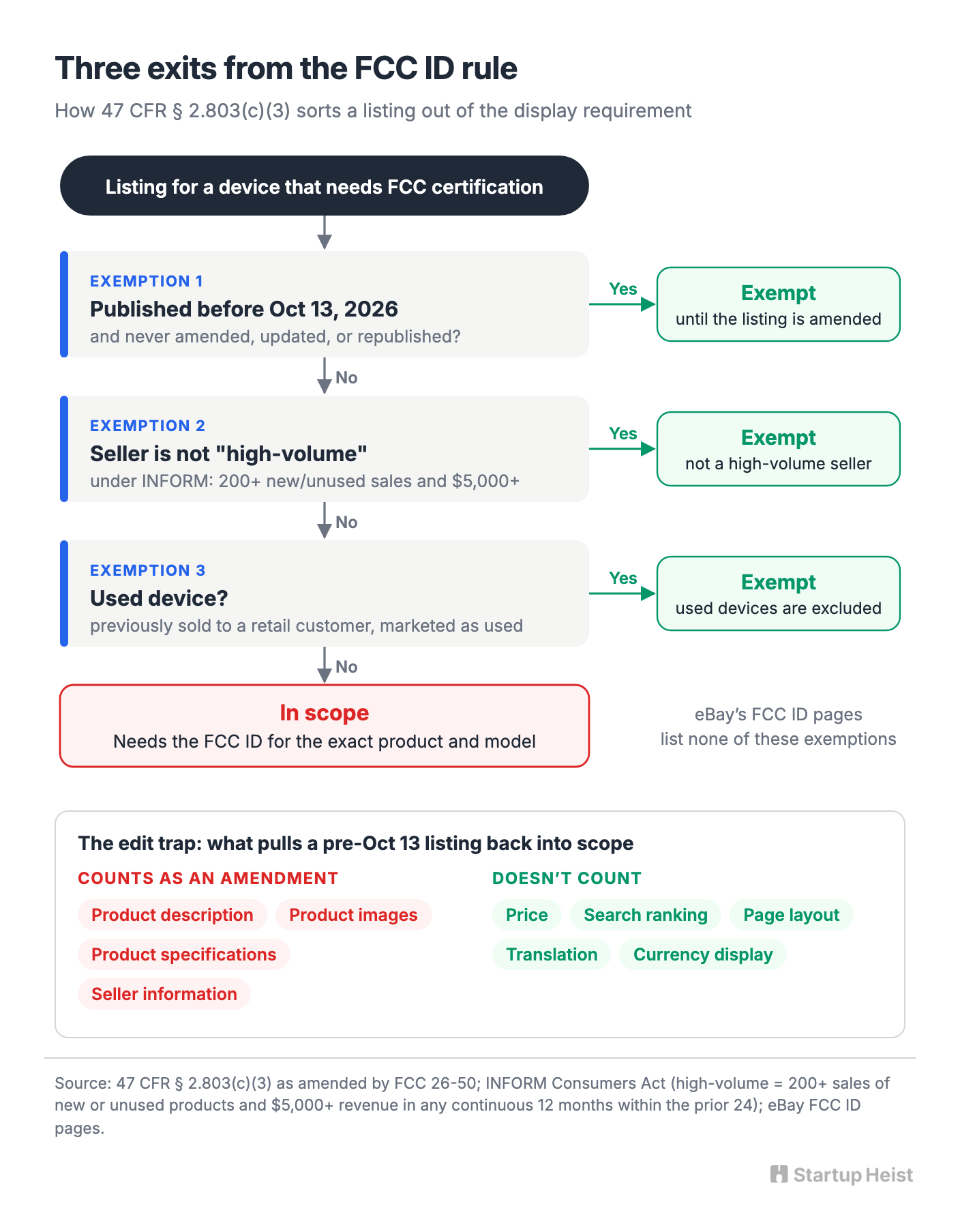
eBay's published FCC-ID pages list none of these exemptions, and what sellers hear from eBay is inconsistent. One seller said eBay support told them used items were exempt; an automated eBay reply quoted in a community thread said the requirement covered new units. Sellers report the FCC ID field appearing on CB radios and ham gear that never needed one, and missing from devices that clearly do. On October 16, the ARRL reported that eBay exempts equipment that operates only on amateur-radio frequencies, and that sellers whose listings are restricted by mistake should inform eBay, which will assess whether to lift the restriction.
A single seller can therefore face three different problems at once. Some listings need exact IDs. Some are probably exempt and should be left untouched, because a well-meaning edit to the photos or description would pull them into scope. Others are flagged in error and need a case made to eBay. A bulk-fill script treats all three the same way.
Who Actually Pays
eBay's $79.6 billion in 2025 gross merchandise volume says nothing about how many sellers will pay for FCC-ID help.
The paying customer sits at a narrow intersection: professional sellers of new, unused, or open-box wireless electronics who move repeated models in volume. Think closeout distributors, surplus-electronics merchants, new-in-box liquidators, and retailers clearing excess consumer-electronics inventory. These sellers almost certainly clear the high-volume threshold, and their inventory is new by definition, so the federal exemptions protect them least.
Condition is where the audit earns its fee. "Open box" is a commercial label with no standing under the FCC rule. A customer return resold as new may fall inside the rule. A sealed 2012 Bluetooth speaker from a warehouse lot was never sold to a retail customer, so it may not qualify as used despite its age. A sharp operator flags these cases with evidence instead of guessing.
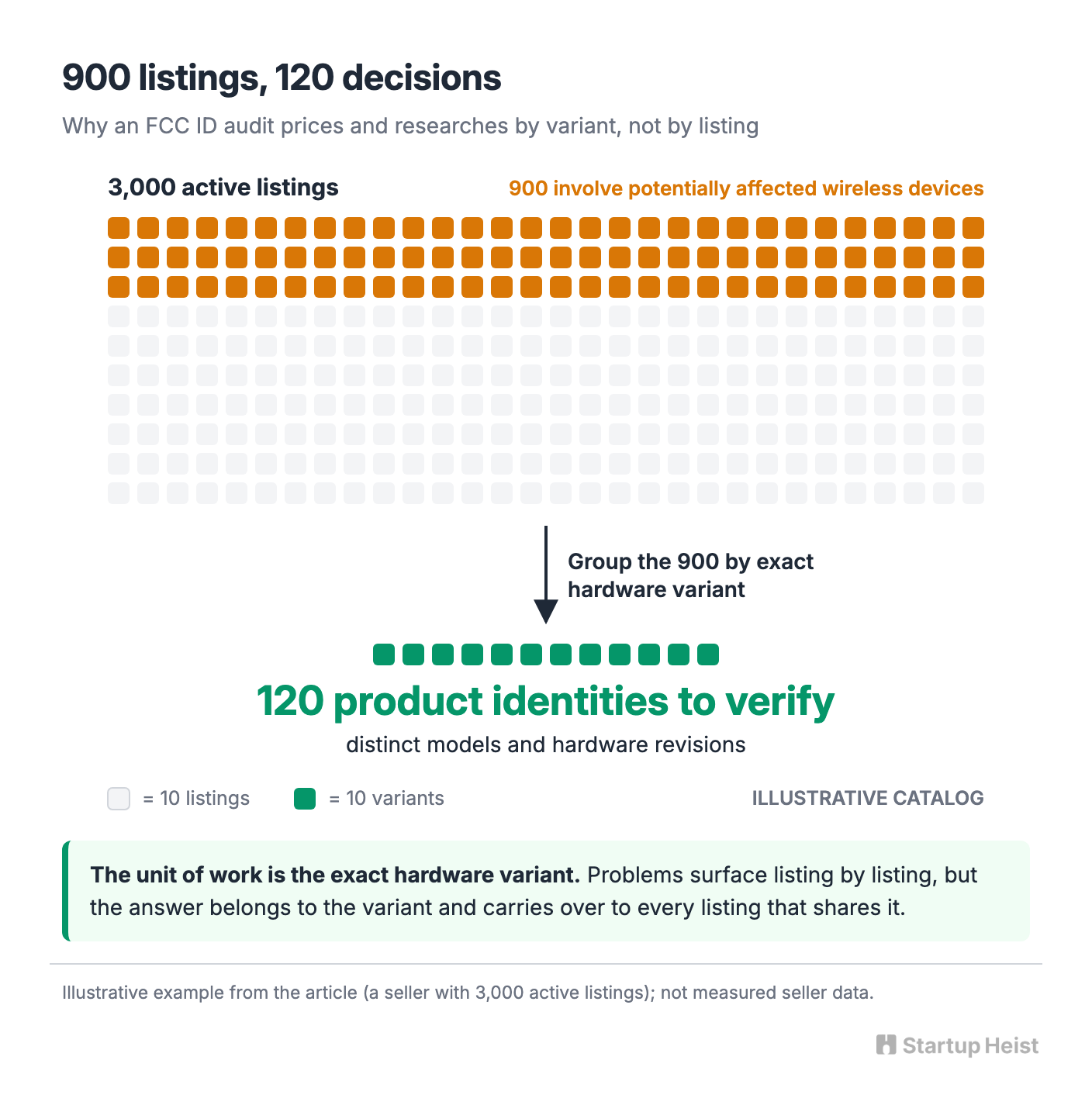
The economics turn on one ratio. Take a seller with 3,000 active listings, 900 of which involve potentially affected wireless devices. Those 900 listings might represent only 120 distinct models and hardware revisions. Research each listing separately and the service becomes a labor trap; collapse the 900 into 120 verified product identities and one well-documented match resolves dozens of listings at once.
The core design decision follows from it: the unit of work is the exact hardware variant. Problems surface listing by listing, but the answer belongs to the variant and carries over to every listing that shares it.
A Valid FCC ID Can Still Be the Wrong One
FCC authorization records are public. The FCC's own search tool and third-party sites like FCCID.io let anyone run an FCC ID lookup by number, company, or model. Bulk editing is just as crowded. SixBit's plans run from $29.99 to $184.99 a month, all with batch item editing, and WonderLister, 3Dsellers, and eBay's own tools cover similar ground. ListForge, an AI listing assistant, now helps sellers capture the ID from product photos and says plainly that its goal is not to guess the number.
Unlock the Vault.
Join founders who spot opportunities ahead of the crowd. Actionable insights. Zero fluff.
“Intelligent, bold, minus the pretense.”
“Like discovering the cheat codes of the startup world.”
“SH is off-Broadway for founders — weird, sharp, and ahead of the curve.”


