


The Pottery Studio's Missing Second Sale
A $49–$99/month software opportunity hiding in the gap between a beginner's first wheel-throwing course and the decision to come back.
A pottery studio knows exactly who enrolled in its beginner wheel course, what they paid, and whether their bowls are out of the glaze kiln. Ask the owner which of those beginners are ready for the intermediate course, and what would get them to sign up, and the answer gets vague.
Take a six-week wheel course. A student shows up unable to center clay and leaves with a few bowls, a dozen collapsed cylinders, and maybe one mug they're proud of. The studio has a clean record of the transaction and no record of the progression: what clicked, where the student stalled, and what they should take next.
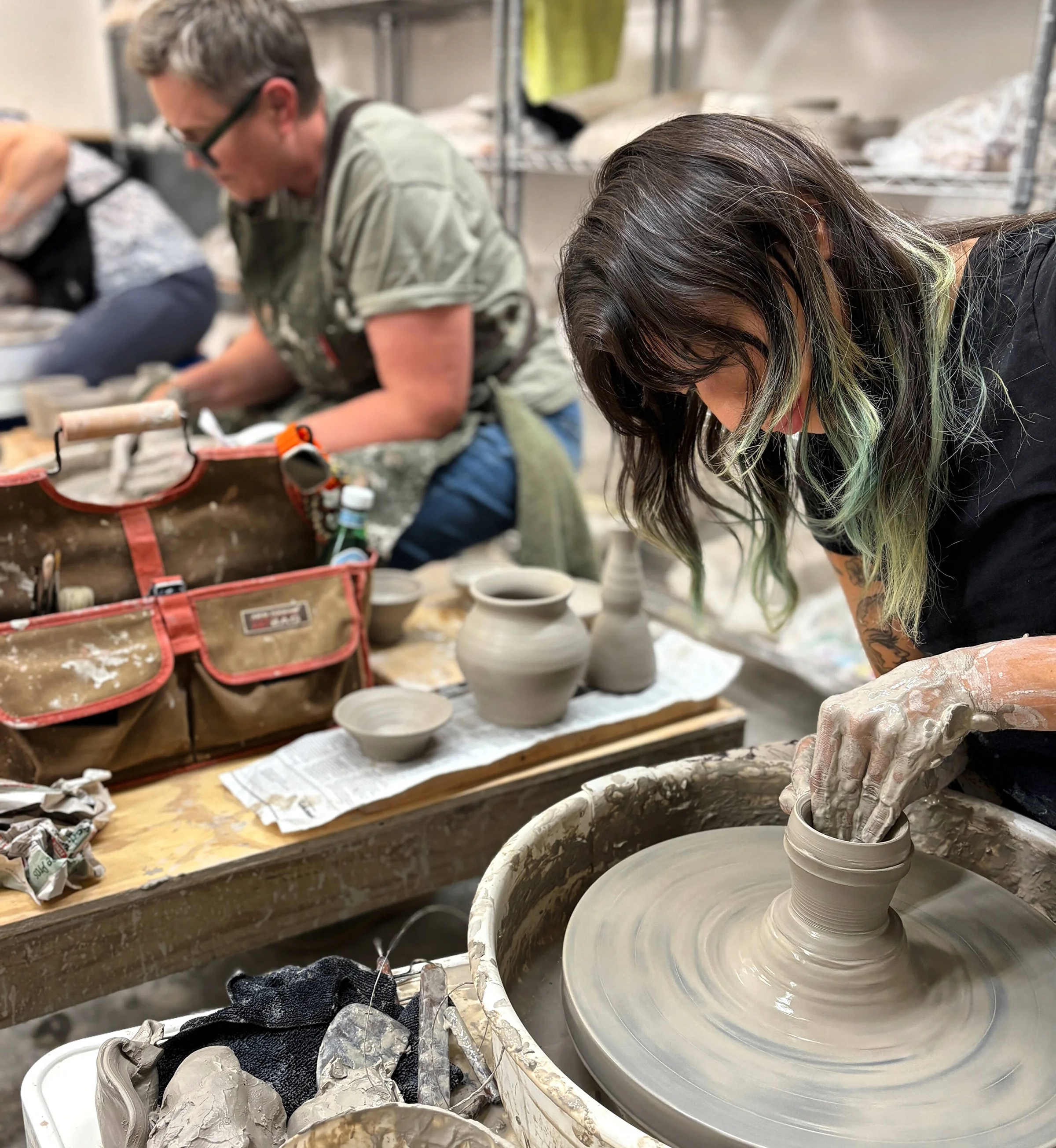
The prices show what that blind spot costs. Outlaw Arts in Philadelphia charges a $340 basic fee for its six-week wheel-throwing series, on a sliding scale from $190 to $350-plus. Main Line Art Center listed its winter 2026 Beginner/Intermediate Wheel Throwing course, ten Tuesday sessions, at $496.50 for nonmembers. YAY!Clay in Philadelphia's Port Richmond neighborhood sells 24-hour studio memberships at $150 a month, with glaze firings and clay billed separately. A graduate who moves into a second course or a membership is worth hundreds of dollars a year, and the studio never has to find a new customer to get it.
Pottery studio software has grown up around registration, payments, memberships, and tracking pots through the kiln. Nobody owns the moment a beginner decides whether to come back. The opening is a narrow layer, priced at $49 to $99 per location per month, that helps students see their progress, helps instructors pick the next step, and turns that step into a paid enrollment. It has to prove one hard thing: that it produces bookings the studio wouldn't have gotten anyway.
Here's the opportunity in brief:
The money: 100 studio locations at $79/month = $7,900 MRR. Philadelphia alone has dozens of studios publishing multiweek course ladders and membership pricing.
Inside:
• Seven-capability MVP and SMS consent setup
• Concierge pilot plan with outreach email
• Randomized rebooking test and sample sizing
• Rebooking math and $49 to $99 pricing tiers
The research: asking changes the experience
On September 30, 2026, Stephanie Hong and Ed O'Brien published an advance article in the Journal of Consumer Research titled "Rating an Experience Makes People Notice How It Is Changing: Consequences for Hedonic Adaptation and Consumer Enjoyment." Across sixteen studies with 16,311 participants, using games, foods, songs, videos, and artwork, they tested what happens when people repeatedly rate an experience while they're having it.
The act of rating turned out to shape the experience. Repeated ratings draw attention to how an experience is changing, and that attention amplifies whatever change is already underway. A declining experience gets boring faster and people disengage sooner; an improving one becomes more enjoyable because the gains are easier to notice.
Apply that to an adult learning pottery. In week one a lopsided bowl feels like a win. By week five the same student may be fixated on walls that still come out uneven, even though their technique has improved. A well-timed progress check, paired with instructor feedback, could point their attention at how far they've come. It cuts both ways: if the student genuinely is stuck, a prompt about improvement could make the frustration louder. Whether a progression prompt lifts rebooking at a pottery studio is still a hypothesis, and the business is built on testing it.
Why independent pottery studios
Fitness and hospitality are bigger retention markets, but pottery makes the better first wedge.
Progression is the product. Wheel throwing moves through visible stages: centering, opening, pulling walls, trimming, glazing, then harder forms. The student carries the proof home.
The rebooking moment is built in. A course ends, and the studio has another course or a membership to sell. That moment is far easier to measure than brand loyalty.
Instructors already know the diagnosis. A teacher usually knows exactly why a student's walls collapse, and that knowledge evaporates when the course ends.
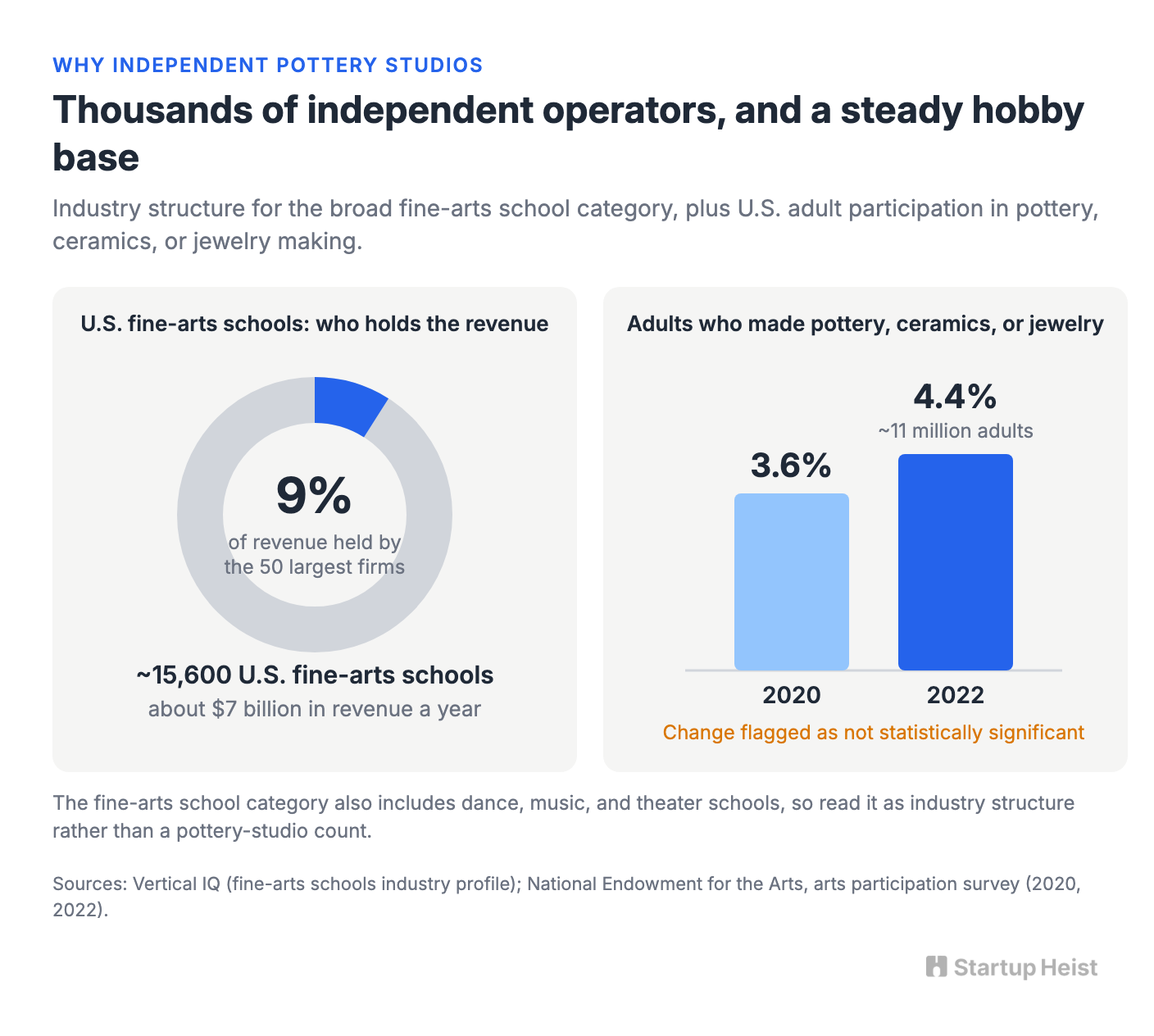
The industry is fragmented. Vertical IQ counts roughly 15,600 U.S. fine-arts schools generating about $7 billion a year, with the 50 largest firms holding only 9% of revenue. The category also includes dance, music, and theater, so read it as industry structure: thousands of independent operators making their own buying decisions. The National Endowment for the Arts found that 4.4% of U.S. adults made pottery, ceramics, or jewelry in 2022, roughly 11 million people, up from 3.6% in 2020, a change the agency flags as not statistically significant. It's a steady hobby market, with no evidence of a boom.
The kids'-activities world has built half of this pattern. iClassPro, the class-management platform for swim, gymnastics, cheer, and dance schools, ships skill evaluations entered from a phone, customizable progress reports in a parent portal, and branded completion certificates. Even there the workflow stops at the report: rival platform Jackrabbit says in its own help center that it can't limit enrollment by skill prerequisite, and neither platform advertises turning an evaluation into a next-level recommendation or a re-enrollment. So the parent of a seven-year-old swimmer gets a progress report, while an adult who paid $340 for a pottery course gets a reminder that their mug is ready for pickup.
The buyer is defined by business model: owner-operated studios running sequential beginner and intermediate wheel courses, with enough enrollment for student retention to matter. The definition rules out a studio living on birthday parties, which sells a one-time experience, and a studio with a six-month waitlist, which has no reason to pay for demand. The sweet spot is a studio where students have a reason to return, the owner wants them back, and the next course still has room.
The product: turn progress into the next enrollment
Call it NextWheel. The promise to the owner: know which students are ready for what's next, help them get there, and see whether more of them rebook. It has four moving parts.
Unlock the Vault.
Join founders who spot opportunities ahead of the crowd. Actionable insights. Zero fluff.
“Intelligent, bold, minus the pretense.”
“Like discovering the cheat codes of the startup world.”
“SH is off-Broadway for founders — weird, sharp, and ahead of the curve.”


