


The Gap Between "I Canceled" and "The Billing Stopped": A Service Play on NYC's Click-to-Cancel Rule
New York City started enforcing its Click-to-Cancel rule on October 1, 2026. Every gym, studio, and membership business in the five boroughs now owes its customers a straightforward way out, and owes refunds when a cancellation attempt gets ignored. Plenty of founders will respond by building another cancel button. The stronger business is a small, dependable service that makes sure a cancellation request actually stops the billing, and that the merchant can prove it did.

Call it cancellation operations: done-for-you setup plus request-to-billing reconciliation for independent membership businesses. Realistically, it tops out as a founder-operated service business with micro-SaaS economics, which is a fine outcome for something that never needs venture money.
The opportunity at a glance:
The money: 250 locations at $39/month = $9,750 MRR, plus $249 setups up front. The city already sent warning letters to 187 gyms.
Inside:
• Cancellation case workflow and evidence log
• MVP scope, stack, and build timeline
• $249 setup + $39/mo pricing logic
• 30-day playbook, outreach email, scorecard
The Thursday email nobody owned
Take a Pilates studio in Queens with 180 members on monthly autopay. Membership admin runs through scheduling software, a shared inbox, and whoever is working the front desk.
A member emails on a Thursday to cancel. The instructor sees it and assumes the manager will handle it, but the manager is out until Monday, and by then the membership has renewed for another month. Nobody at the studio meant to charge a customer who had quit. The request simply never reached the billing system.
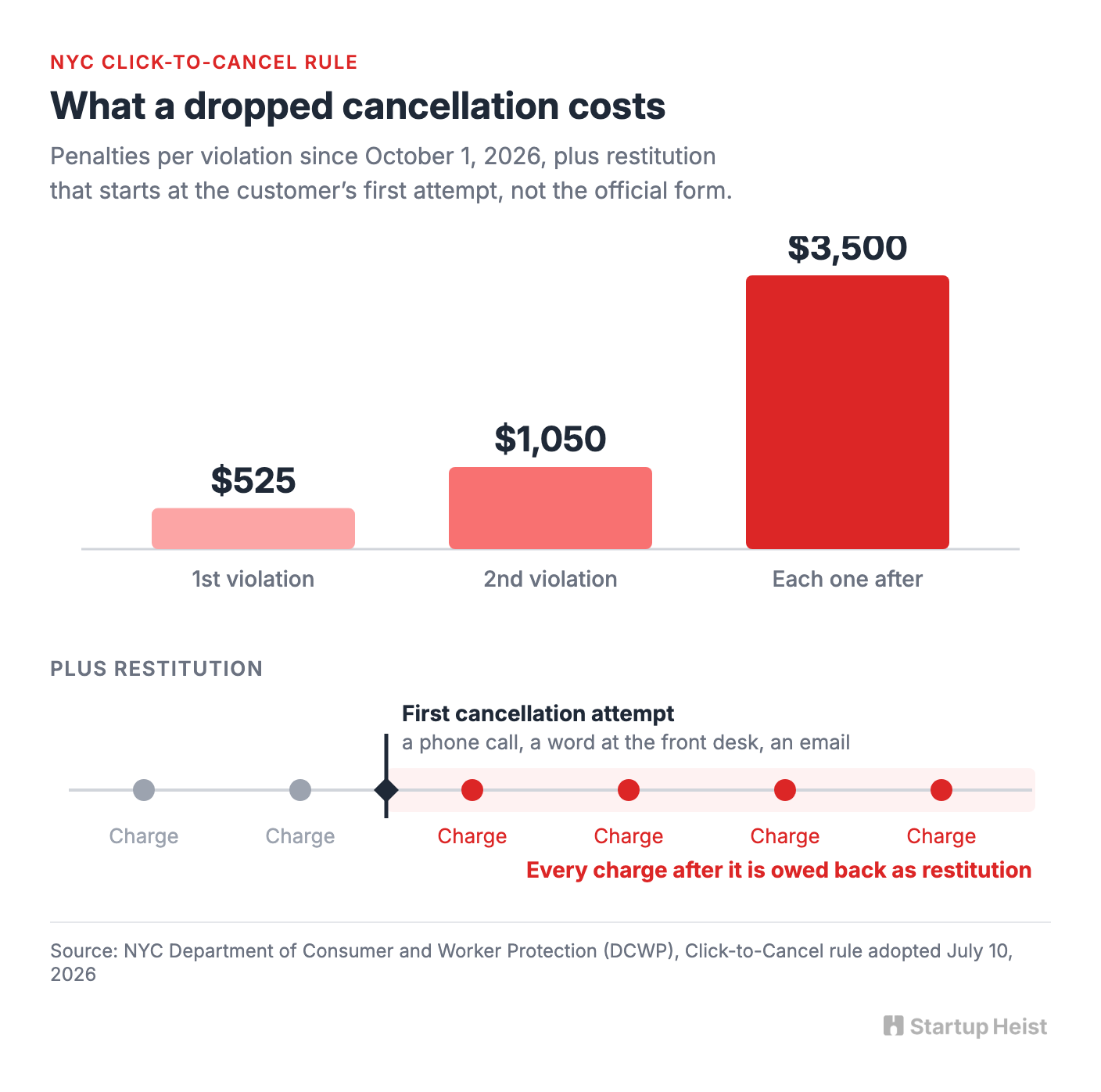
Until October 1, that was an awkward customer-service problem with no price attached. The city's Department of Consumer and Worker Protection (DCWP) adopted the Click-to-Cancel rule on July 10, 2026. It requires cancellation through the same medium a customer used to enroll, and through every medium the business accepts for enrollment. Customers who signed up in person must also get an online route, and DCWP names email as a qualifying one. Businesses can't obstruct cancellation, unreasonably delay it, or refuse to acknowledge a request. Penalties run $525 for a first violation, $1,050 for a second, and $3,500 for each one after that. The provision that matters most for this business is restitution: violators owe back whatever they charged after the consumer's first cancellation attempt.
That first attempt might have been a phone call, a word at the front desk, or a Thursday email nobody owned. It doesn't have to be the official form. A studio's liability starts the moment a customer tried, and most small operators have no record of when that was. This business lives in the gap between a customer's request and the merchant's billing action.
The city already picked its first targets
DCWP didn't wait for the rule to start pressing gyms. On February 19, 2026, seven weeks before the rule was even proposed, the agency sent compliance warning letters to 187 gyms and health clubs, including PureGym, Planet Fitness, and Equinox. The letters followed a January executive order from Mayor Zohran Mamdani directing the agency to go after "subscription tricks and traps," with hard-to-cancel gym memberships named specifically. DCWP said it received dozens of complaints in 2025 from New Yorkers struggling to cancel gym memberships, and more than 100 subscription-cancellation complaints overall. The city cites Roosevelt Institute estimates that the rule will save New Yorkers $21.5 million to $162.5 million a year.
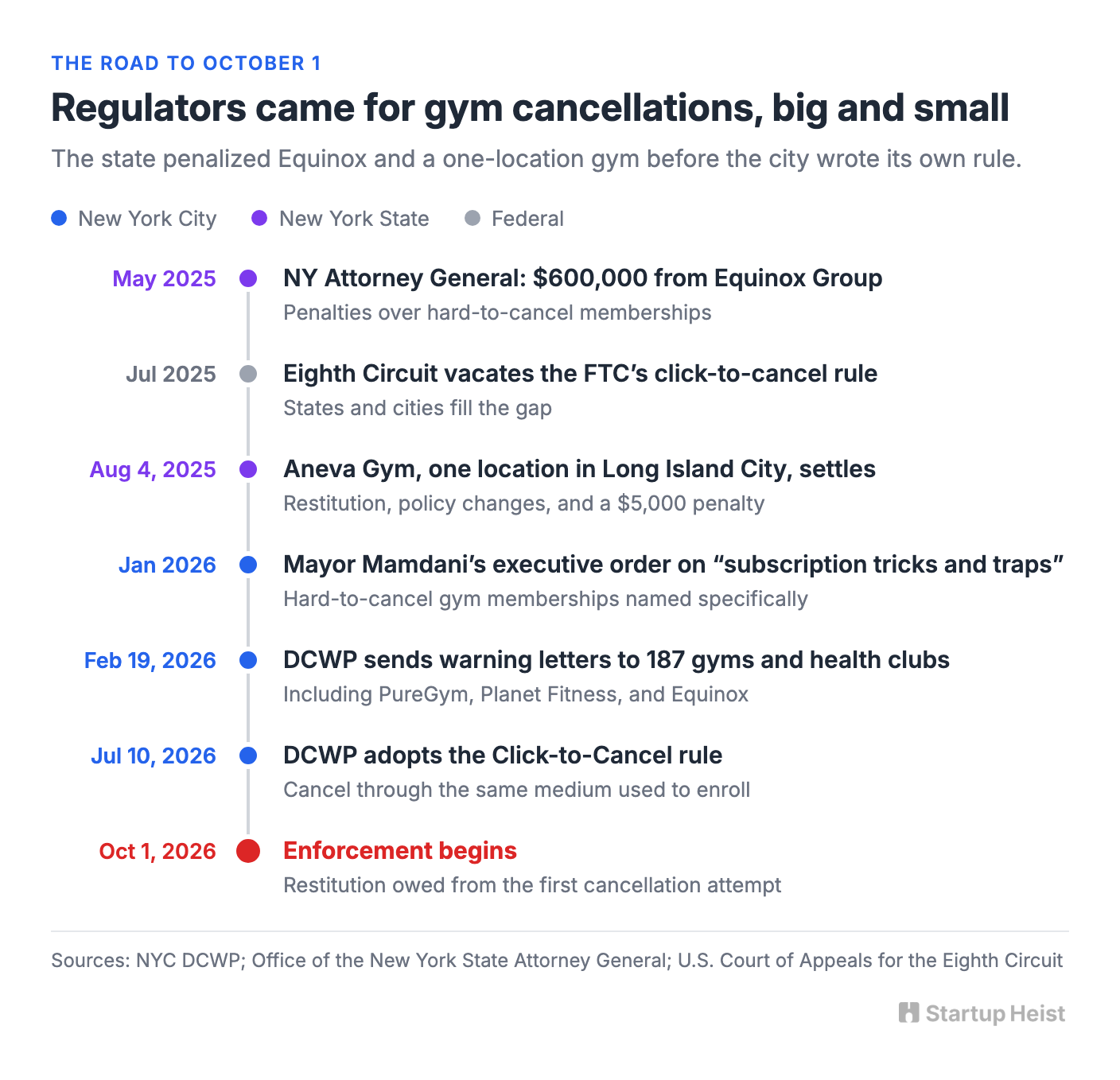
The state was already moving. In May 2025, New York Attorney General Letitia James secured $600,000 in penalties from Equinox Group over hard-to-cancel memberships. The case that should worry small operators came on August 4, 2025, against Aneva Gym, a single-location gym in Long Island City that opened in 2022. Aneva required members to cancel in writing, in person, and with 30 days' notice, even though New York's health club law lets members cancel by website, email, mail, phone, or in person. The settlement brought restitution, policy changes, and a $5,000 penalty. Regulators are watching independent operators too, and a one-location gym can end up in an Attorney General press release.
Nationally, the pressure runs the same way. The Eighth Circuit vacated the FTC's federal click-to-cancel rule in July 2025, and states and cities have filled the gap: California, Colorado, Vermont, and Virginia all have their own auto-renewal and cancellation laws. NYC is the sharpest edge of a widening patchwork, and the operational problem it exposes exists everywhere memberships renew automatically.
Who actually buys
The membership economy is enormous. The Health & Fitness Association reports that 81 million Americans belonged to a gym, studio, or fitness facility in 2025, up 5.2% from the year before, and New York City counts more than 183,000 small businesses. Neither number is your market. A large share of fitness members belong to chains with legal departments, and the great majority of small businesses don't run autopay memberships at all.
Your customer is narrower: an independent business that bills consumers on a recurring basis, accepts cancellations through several channels, and can't reliably show that each request produced the right billing action. Three illustrative profiles show where the money is:
| Business | Existing process | Fit |
|---|---|---|
| Solo instructor, 25 recurring clients | Personal email, subscriptions updated by hand | One-time setup; unlikely to need ongoing software |
| Independent studio, 250 monthly members | Front desk, manager inbox, separate billing system | Strong candidate for setup plus reconciliation |
| Multi-location operator, 2,000 members | Dedicated ops staff, established membership platform | Valuable, but heavier integration and support |
Aim at the middle row. Those studios have enough moving parts to drop requests and too few cancellations to justify a dedicated membership-ops hire. Start with independent fitness and Pilates studios on recurring autopay, then move into children's activity programs, swim schools, and recurring pet services once the process works for one category. Check the billing model before you pitch: prepaid class packs and fixed-term programs aren't automatic renewals, and the rule follows the billing arrangement regardless of what kind of shop sits in front of it. Qualify on pain too. A confusing cancellation page doesn't mean a studio mishandles cancellations, and a perfectly visible cancel email can still fail to stop billing. The best prospect already feels the operational problem.
The competitor already installed
You could build a cancellation page this weekend, and your customer may already own a better one. Square Subscriptions charges no monthly fee and includes a "Manage subscription" link that lets members cancel on their own. Stripe's hosted customer portal handles cancellation too, included in Stripe Billing's pay-as-you-go rate of 0.7% of billing volume on top of card processing. Mindbody manages membership contracts and autopay schedules natively. Gym software vendors like Gymdesk now market click-to-cancel compliance features directly. For a ten-member studio, the cheapest competitor of all is a dedicated cancellation email address, which the rule accepts as an online method, backed by a disciplined checklist.
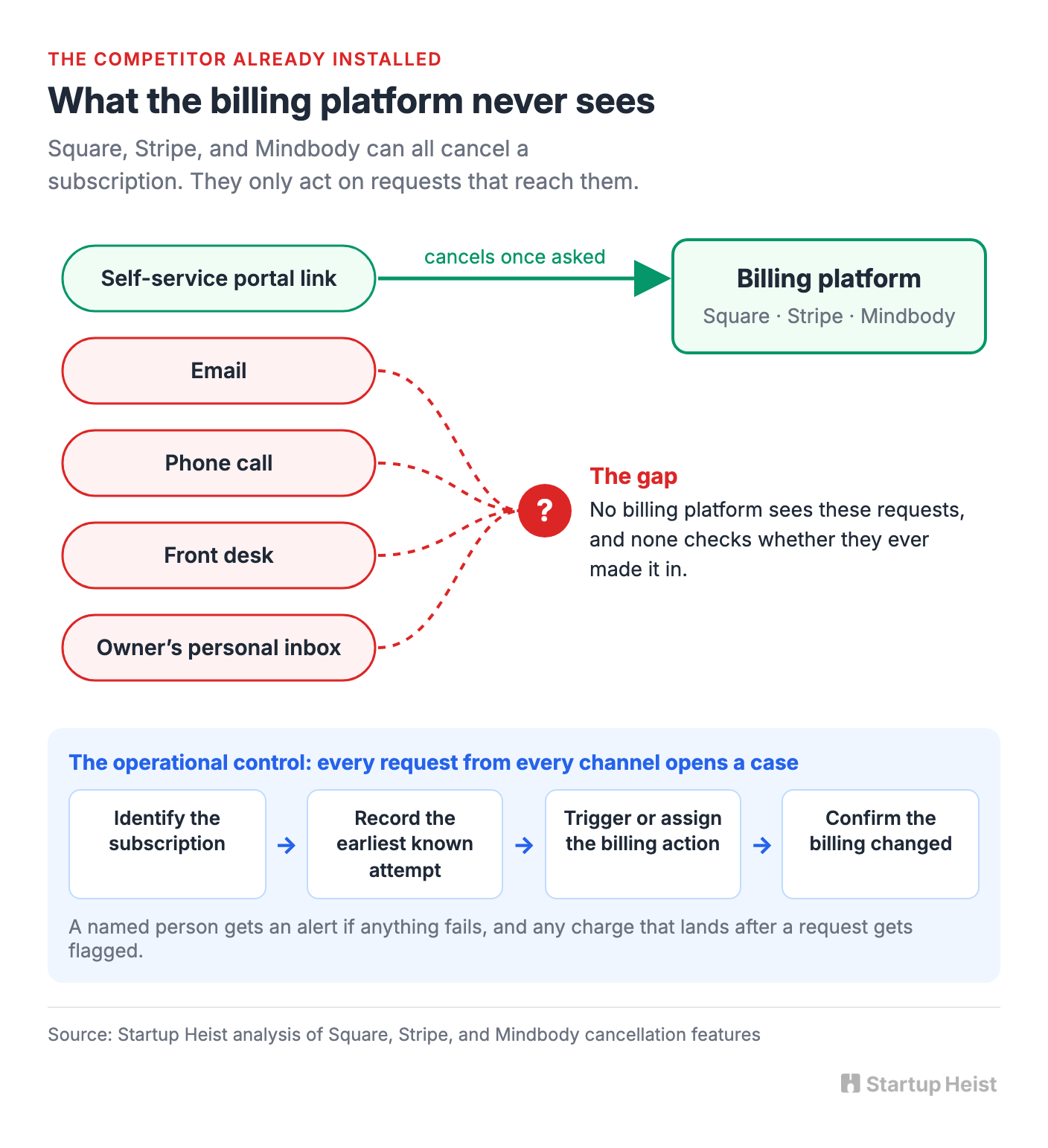
Every billing platform can cancel a subscription once someone asks it. None of them sees the request that arrived by phone, at the front desk, or in the owner's personal inbox, and none checks whether that off-platform request ever made it in. Use that as the test for every prospect. If their existing tools already receive, execute, and document cancellations reliably, configure those tools and leave. The product earns its fee only where a real gap sits between those steps.
Compare two setups. In the first, a customer submits a form, gets a confirmation email, and the manager sees a notification and cancels by hand. Any competent developer can rebuild that in an afternoon. In the second, every request from every channel opens a case: the system identifies the subscription, records the earliest known attempt, triggers or assigns the billing action, and confirms the billing actually changed. A named person gets an alert if anything fails, and any charge that lands after a request gets flagged. The technology is ordinary, but the second setup is an operational control aimed at the exact failure that triggers restitution, and merchants will pay for that.
The product: a cancellation operations layer
The product gives customers an easy way out, makes sure every request triggers the correct billing action, and keeps an accurate history of both.
Unlock the Vault.
Join founders who spot opportunities ahead of the crowd. Actionable insights. Zero fluff.
“Intelligent, bold, minus the pretense.”
“Like discovering the cheat codes of the startup world.”
“SH is off-Broadway for founders — weird, sharp, and ahead of the curve.”


