


The Anti-Checkout Business: Selling Shoppers the Pause Amazon Removed
Retailers spent two decades deleting the pause between wanting and buying. A small browser extension can sell it back to the shoppers who want it.
In June 2026, CouponFollow surveyed 1,010 Americans about late-night shopping. Three in four said they make unplanned purchases during late-night sessions. Fifty-six percent said those purchases happen on Amazon. And 13% said they had woken up to an order confirmation for something they had no memory of buying.
The business lives in that last number: someone made a decision at 1 a.m. that their morning self never signed off on.
Amazon patented one-click ordering in 1999 and has spent the years since removing every remaining step: saved cards, Buy Now, fast delivery, recommendations tuned to the moment of weakness. Every major retailer followed. Checkout pages are among the most heavily tested surfaces on the internet, and all that testing serves one party.
The opportunity is a lightweight Chrome extension that curbs impulse buying by enforcing rules the shopper set while thinking clearly, such as no discretionary buys after 9 p.m., a 24-hour wait on anything over $75, or stricter rules for Amazon than for the grocery site. It never touches a bank account and never lectures. It holds the shopper to their own word and then gets out of the way.
A solo developer can build it in three weeks. The harder question is whether enough shoppers will pay for it, and the playbook below is designed to answer it cheaply. The short version:
The money: Freemium with a $19 one-time upgrade: 500 buyers net about $8,600, and 2,000 net about $34,400. Eighty-one percent of U.S. shoppers impulse-bought in 2026.
Inside:
• Three-retailer MVP scope and detection traps
• Freemium pricing plus a $150 coach license pack
• Eight-week beta timed to Black Friday
• Outreach email for no-buy communities
Commerce Has an Incentive Problem
Retailers run constant experiments on button colors, shipping thresholds, urgency banners, and checkout sequences, because every point of conversion is revenue. A 2019 University of Michigan study cataloged impulse-driving features across 200 top U.S. e-commerce sites and found them common. Consumers have no equivalent machine working in the other direction. Their budget and their no-buy commitment sit in a spreadsheet or a notes app, while the retailer owns the interface at the moment of purchase.
Shoppers want a counterweight. A PartnerCentric survey of 1,007 U.S. consumers, fielded in late March 2026, found:
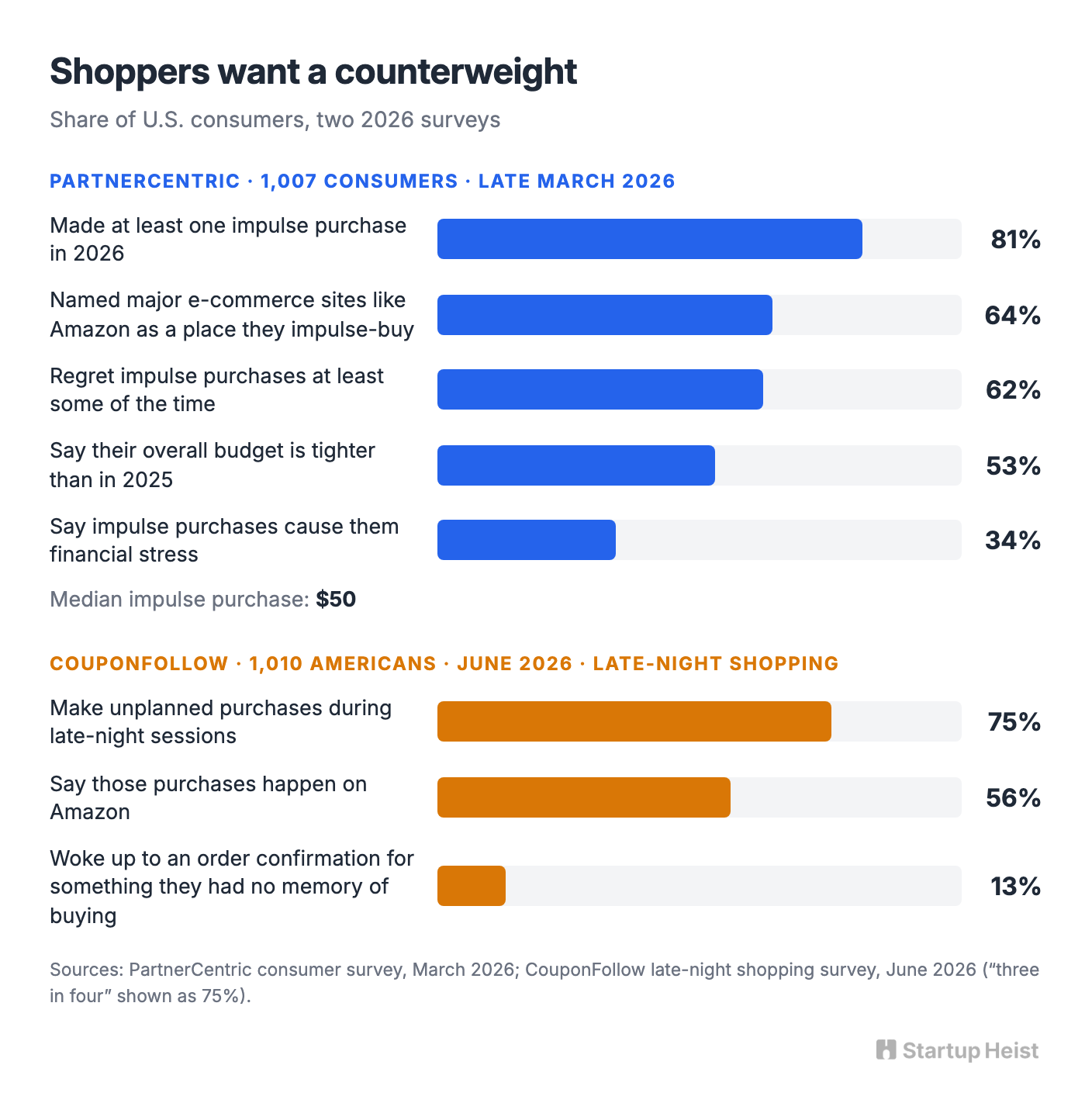
The median impulse purchase was $50, and 64% named major e-commerce sites like Amazon as a place they impulse-buy. Boredom drove 21% of them; one in six bought to relieve stress or anxiety. GWI's 2026 retail research adds that 71% of people now prefer to save up and wait for a product rather than buy it immediately.
Taken together, these numbers describe shoppers who already know the $50 gadget is unnecessary. Their problem is timing. The decision gets made by a tired, bored version of the person at the hour their defenses are lowest. When the Michigan researchers surveyed shoppers about the tools they wanted, the answers lined up around postponing purchases, adding checkout effort, and enforcing spending limits. Respondents wanted a speed bump they controlled and showed little interest in guilt or social accountability.
The Graveyard of Pause Buttons
The idea is old, and its history is the most useful research a builder can do. Finder launched Icebox in late 2017, swapping the buy button on major retailers for a "put it on ice" option. Its Chrome listing still claims 400-plus stores; reviews from 2021 and 2022 say it no longer works. Pause, a free extension that blocks 200-plus shopping sites for 30 seconds, shows 234 users and hasn't been updated since October 2021. Less, built for a research study at the IT University of Copenhagen, imposes a three-hour wait and shows 54 users. Checkout Snooze has 39. Impause, which converts prices into work hours, has fewer than 40 and earns affiliate commissions when users invest through its partners. Cartinel, a Chrome and Firefox extension, is launching with an AI layer at a $4.99-a-month founding-member price. On mobile, CartPause runs a share-sheet wishlist with a 72-hour timer for $1.99 a month, $19.99 a year, or $39.99 once, Need It? sells a similar iPhone app at $3.99 a month, and Spense, Buy or Bye, Waity, and others crowd the same waiting-list format.
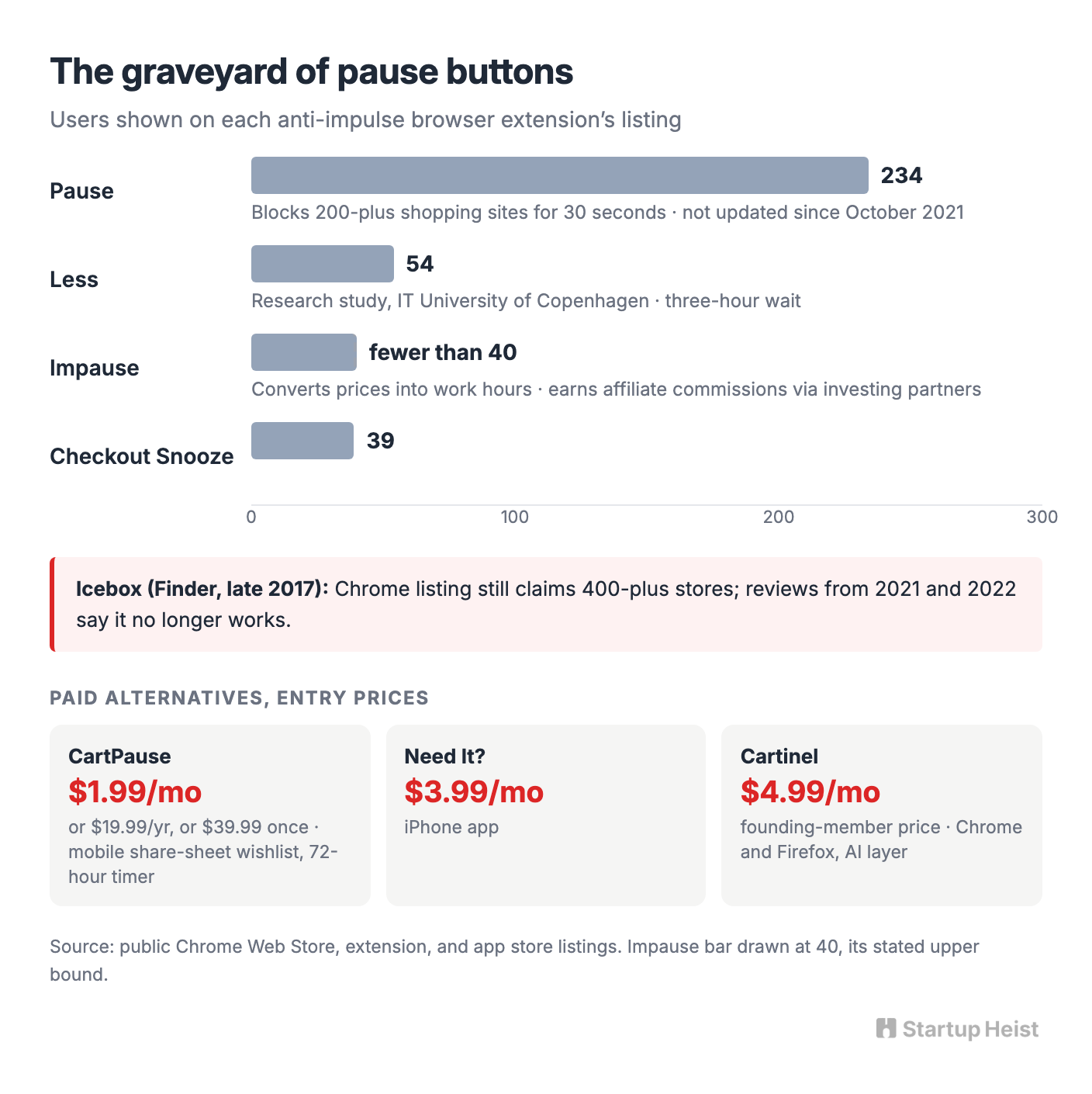
The early tools quietly broke because nobody maintained the retailer integrations, and the extensions stalled at double- or triple-digit installs because nobody owned distribution. The mobile apps carry a different flaw: they depend on voluntary capture, so the shopper has to choose to share the item to a waiting list, which is exactly the step a 1 a.m. shopper skips. That leaves an open position for a tool that intercepts automatically, on a few retailers it supports flawlessly, according to rules the user wrote in daylight.
The Wedge: A Personal Checkout Policy
Generic blockers interrupt every shopping visit and tend to get uninstalled fast. The stronger product is a policy engine. The user writes a handful of rules once:
- The curfew. Supported checkouts between 9 p.m. and 7 a.m. pause until morning.
- The threshold. Anything over $75 waits 24 hours.
- The store tiers. Amazon gets the strict rules; the grocery and pharmacy sites get none.
- The escape hatch. An urgent replacement or work purchase goes through with one click, and the override is logged privately.
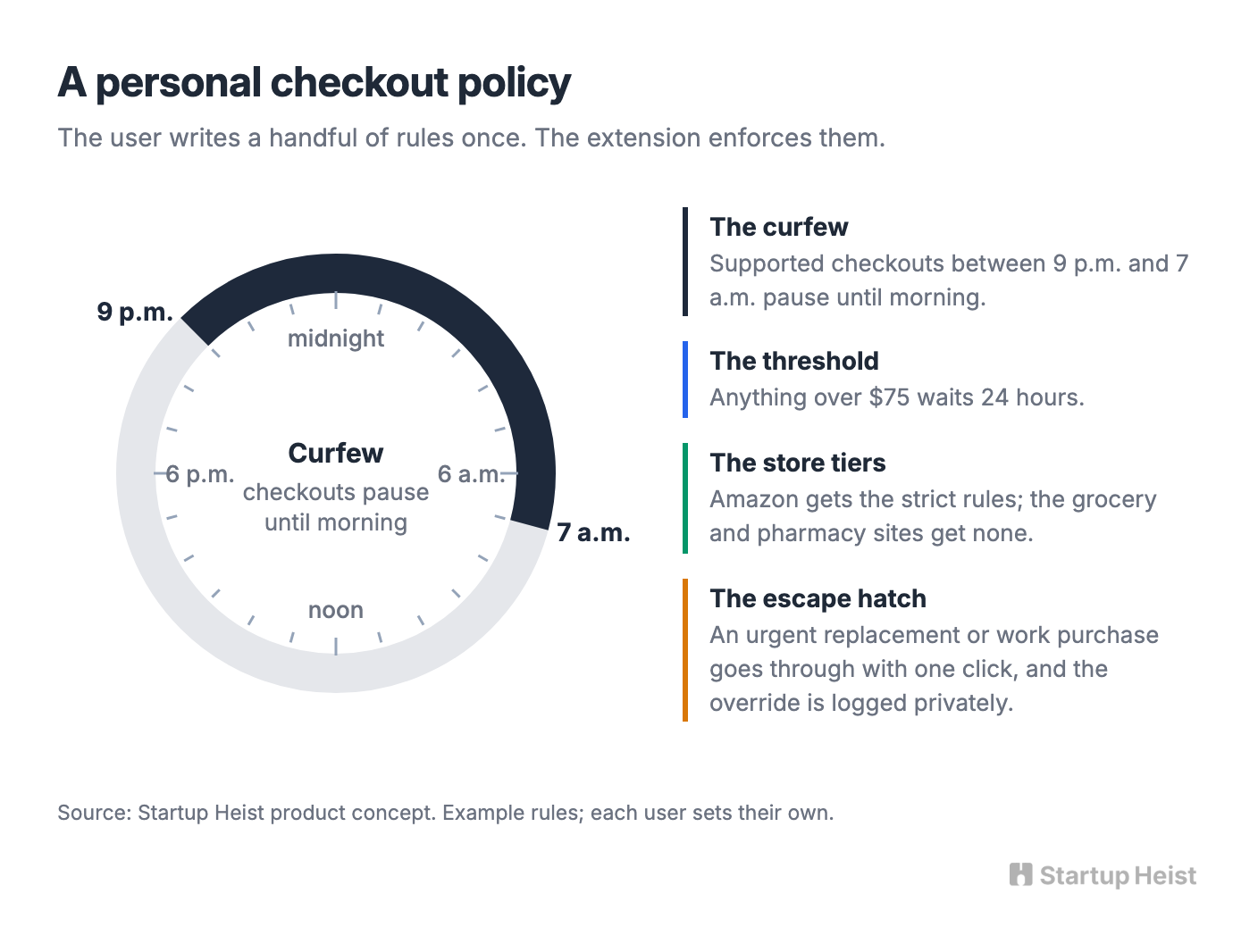
This is a commitment device. The user delegates enforcement of a decision they already made, and the judgment stays with them. The framing carries commercial weight as well. A free 30-second timer competes with dozens of hobby projects, while "follow the spending rules you already chose" is a specific promise a shopper can evaluate and pay for.
Who Buys First
"People who want to save money" is too broad to market to. The first customer is narrower: an adult, roughly 28 to 45, who shops on desktop, buys from Amazon and a few favorite retailers in the evening, has tried a no-buy challenge or a 24-hour rule, and refuses to connect a bank account to another budgeting app. This is a behavioral profile, and the age band is a starting guess. These shoppers already understand their problem and need help acting on their own intentions.
The qualifying question is "Can you remember a recent online purchase you wish you'd waited until morning to make?" A real prospect answers with a specific story, including the retailer, the dollar figure, and the workaround that failed. General agreement that impulse buying is bad doesn't qualify anyone. The audience also includes adults with ADHD, a community that already talks openly about the "ADHD tax" of impulse spending. Market a shopping utility to them and make no treatment claims; there's no evidence the tool has a therapeutic effect.
With a clear customer and weak competitors, the business comes down to whether one developer can intercept checkouts reliably, keep the data private, and charge enough to fund the maintenance that killed Icebox.
The Product: A Checkout Curfew That Respects Its Owner
During onboarding, the user picks Amazon and two other supported stores, sets a 9 p.m. curfew and a $75 threshold, and marks the stores that should never be interrupted. At 10:45 p.m., they click Buy Now on an $89 pair of sneakers. The extension intercepts:
Unlock the Vault.
Join founders who spot opportunities ahead of the crowd. Actionable insights. Zero fluff.
“Intelligent, bold, minus the pretense.”
“Like discovering the cheat codes of the startup world.”
“SH is off-Broadway for founders — weird, sharp, and ahead of the curve.”


