


The Last-Hour Estate Sale: Turn Leftovers Into a Second Payday
An on-site clearance service that helps estate-sale operators recover cash from unsold inventory using $5–$20 baskets, final-day economics, and a local buyer list you own.
Every estate sale ends the same way. By the last afternoon the antique furniture has been haggled over and carried out, the collectibles are gone, and the good kitchen equipment disappeared in the first two hours. What remains is a few hundred usable, low-value things: paperbacks, mugs, picture frames, craft supplies, linens, a closet of clothes nobody wants to price one by one.
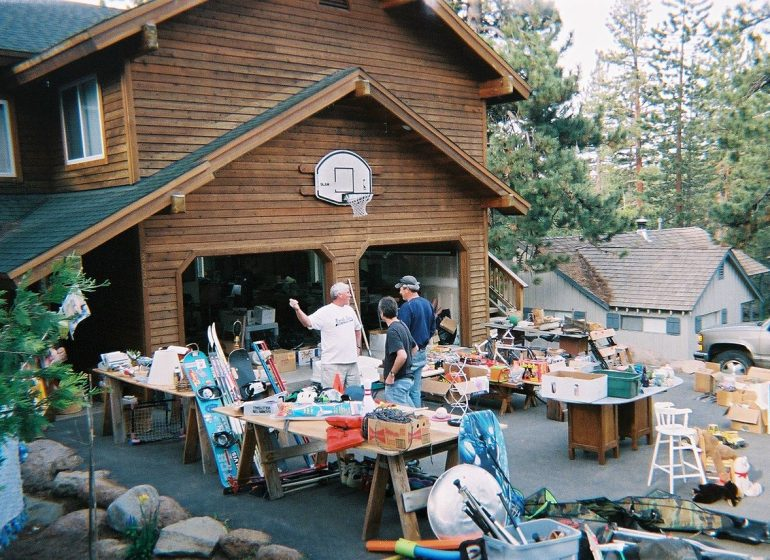
The operator has already paid for advertising, staging, and staff. The family wants the house empty. Whatever doesn't sell gets donated, bought out for a lump sum, or hauled off by an estate cleanout crew that HomeAdvisor says averages $1,250 a job, with a normal range of $275 to $4,000.
There's still money in that pile. Collecting it one $2 transaction at a time just costs more than the merchandise is worth.
The business is a service built around the final hours of an estate sale, when the goal shifts from maximizing price per item to maximizing cash recovered from everything left.
The money: Four 150-basket events a month contribute about $1,970 before your pay; eight bring roughly $3,940. Operators already run $20 fill-a-bag sales themselves.
Inside:
• Four-tier $5 to $20 basket MVP
• Break-even tables for a $1,000 pilot
• 30-day supplier playbook and outreach email
• Contract traps: authorization and cleanout
You don't open a thrift store, buy liquidation pallets, or own inventory. You need relationships with estate-sale operators, a clearance format that moves volume fast, and a list of local buyers who show up for the last round. The starting product is a plastic basket with four painted lines.
The Basket That Does the Pricing
On October 15, 2026, SoraNews24 sent a reporter to Recycle Gallery, a secondhand shop in Fujisawa, Kanagawa, that runs on a system called tsumehodai, roughly "stuff in as much as you can." Customers get a large basket with colored fill lines. Fill to the blue line and pay 250 yen. The gray line is 500 yen, the pink line 750. Pack it to the brim and it's 1,000 yen, about $6.30. Anything with a price tag is excluded, and the reporter estimated 90% of the store qualified. He left with 16 items, including an unused clay donabe pot, two DVDs, a coloring book, a handkerchief, and a bento box set.
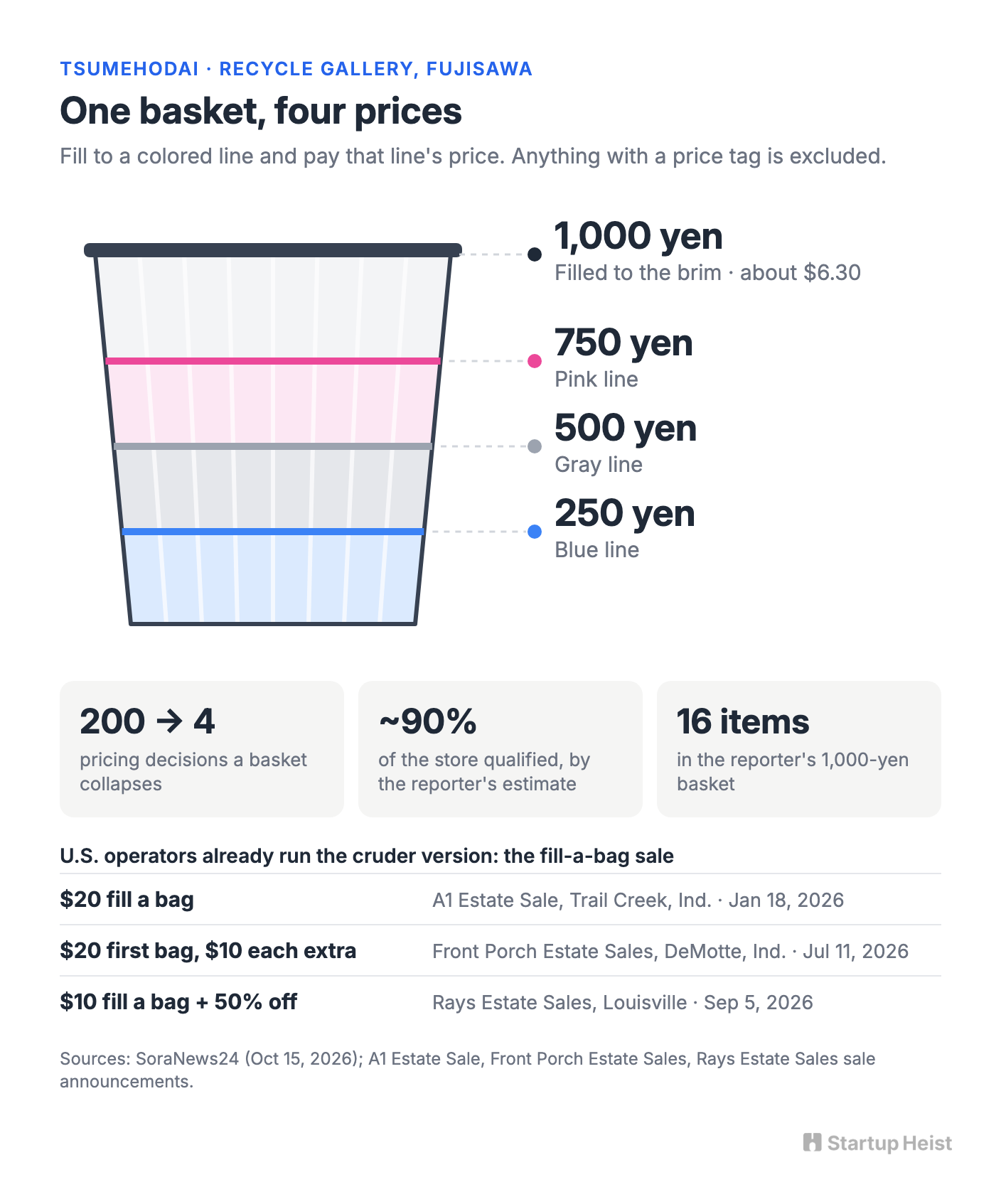
The low price gets the headline. The bigger gain is the labor the format removes. A normal thrift sale needs someone to assess each item, tag it, display it, and ring it up. At $1 to $3 per object, that handling costs more than the item earns. A basket collapses 200 pricing decisions into four, and the buyer does the sorting, assembling a bundle that makes a markdown feel like a treasure hunt. The seller stops optimizing price per item and starts optimizing cash recovered per remaining hour.
American estate-sale operators already run a cruder version, the fill-a-bag sale. A1 Estate Sale in Trail Creek, Indiana, advertised a "$20 FILL A BAG" sale on January 18, 2026. Front Porch Estate Sales in DeMotte, Indiana, closed a four-day sale on July 11, 2026, with "FILL A BAG SATURDAY": $20 for the first bag, $10 for each additional. Rays Estate Sales in Louisville ran a $10 fill-a-bag alongside 50% off everything on September 5, 2026, with one rule: nothing more than six inches above the bag.
The bag sale is a standard final-day move, so the shopper behavior is already proven. Operators run it themselves, for whoever happens to still be around. Your business runs that moment better, with a dedicated session, a sharper pricing format, and a crowd you bring yourself. The painted basket is one experiment inside that service, and the company doesn't ride on it.
Two Customers, Two Different Problems
The operator controls the inventory. Estate-sale companies sell a household's contents after a death, a move, or a downsizing. They price, stage, advertise, staff, and collect, and they typically take 30% to 50% of gross sales; One White Orchid, citing a 2024 EstateSales.NET survey, puts the national average at 40%. On day one, a $100 dresser earns the operator $40, so protecting prices is worth the effort. By the last afternoon, the remaining items are worth a few dollars each. Another $300 in sales earns the operator $120 and means keeping staff on site, managing a thin crowd, and delaying the cleanout. Many operators reasonably pass, and if their contract includes cleanout, every unsold box becomes a cost.
Your pitch fits that gap: "Let us run a dedicated clearance session on your remaining eligible inventory. We handle merchandising, customer flow, and checkout. You get an agreed share of the proceeds without running another sale." Some operators already handle the final stage well with their own bag sales or charity pipelines, and they aren't your customers. Your best early partners have sellable leftovers and a process that doesn't justify another round of selling.
The bargain hunter supplies the cash. ThredUp's 2026 Resale Report, released April 2, 2026, with GlobalData, projects the U.S. secondhand apparel market will reach $78.8 billion by 2030 and found that nearly 50% of shoppers now discover secondhand finds through social media. Those figures cover apparel, so treat them as evidence that bargain discovery has become a mainstream, visual habit rather than proof that estate leftovers will draw a crowd. Your buyers are thrifters, resellers, students, crafters, and budget households who need a visit to be obviously worth the drive.
One rule governs the whole business: cheap inventory is not automatically desirable inventory. If the leftovers are junk, a lower price won't save the event. You screen the estate before you accept it.
The Competition Is Real, and It Points to the Opening
A shopper with $20 for secondhand goods has options. Goodwill's outlet stores in Cleveland and North Canton, Ohio, post prices of $1.89 per pound for most goods, $0.89 per pound for glass and dishware, and $0.99 each for books and media. Where Ya Bin, a bin store, runs a weekly cycle that starts at $10 an item on Friday and drops daily until everything costs $0.25 on Thursday, then restocks. Both have built repeat crowds around falling prices and the hunt.
You won't beat them on price or variety, and you don't need to. Both depend on dedicated retail infrastructure: leases, sorting labor, and a constant inventory supply. Your inventory is already sorted, staged, and sitting in a house that has been advertised for a week. You're monetizing the end of someone else's retail process, which keeps your capital requirement near zero, provided the contract is written properly.
No U.S. company appears to sell this as a standalone service to estate-sale operators; today the substitutes are the operators' own last-day markdowns, lump-sum buyouts, and cleanout crews. Anyone can paint lines on a basket tomorrow, though, so the advantage has to come from execution, supplier trust, and a buyer list that shows up.
Where the Money Is: Recovering What's Left
Resale usually means buying low and selling high. This business shouldn't buy anything at first. You negotiate a limited right to run a clearance sale on eligible goods that remain the estate's property, and you earn a share of receipts or a fee. You sidestep the classic inventory risks of buying the wrong items, paying for storage, and eating what doesn't sell, and you take on a different one: your labor and setup costs are fixed whether 40 shoppers show up or 400.
Unlock the Vault.
Join founders who spot opportunities ahead of the crowd. Actionable insights. Zero fluff.
“Intelligent, bold, minus the pretense.”
“Like discovering the cheat codes of the startup world.”
“SH is off-Broadway for founders — weird, sharp, and ahead of the curve.”


