


The Furniture Store Is Dead. The Brand Doesn't Have to Be.
Family-owned furniture retailers are closing after a century in business. Liquidators sell off the sofas and the showrooms, while the name, the phone number, and the trust behind them usually just expire. Here's how to license that leftover goodwill, run it as an appointment-led sales operation on someone else's trucks, and find out within 120 days whether it still produces profitable orders.
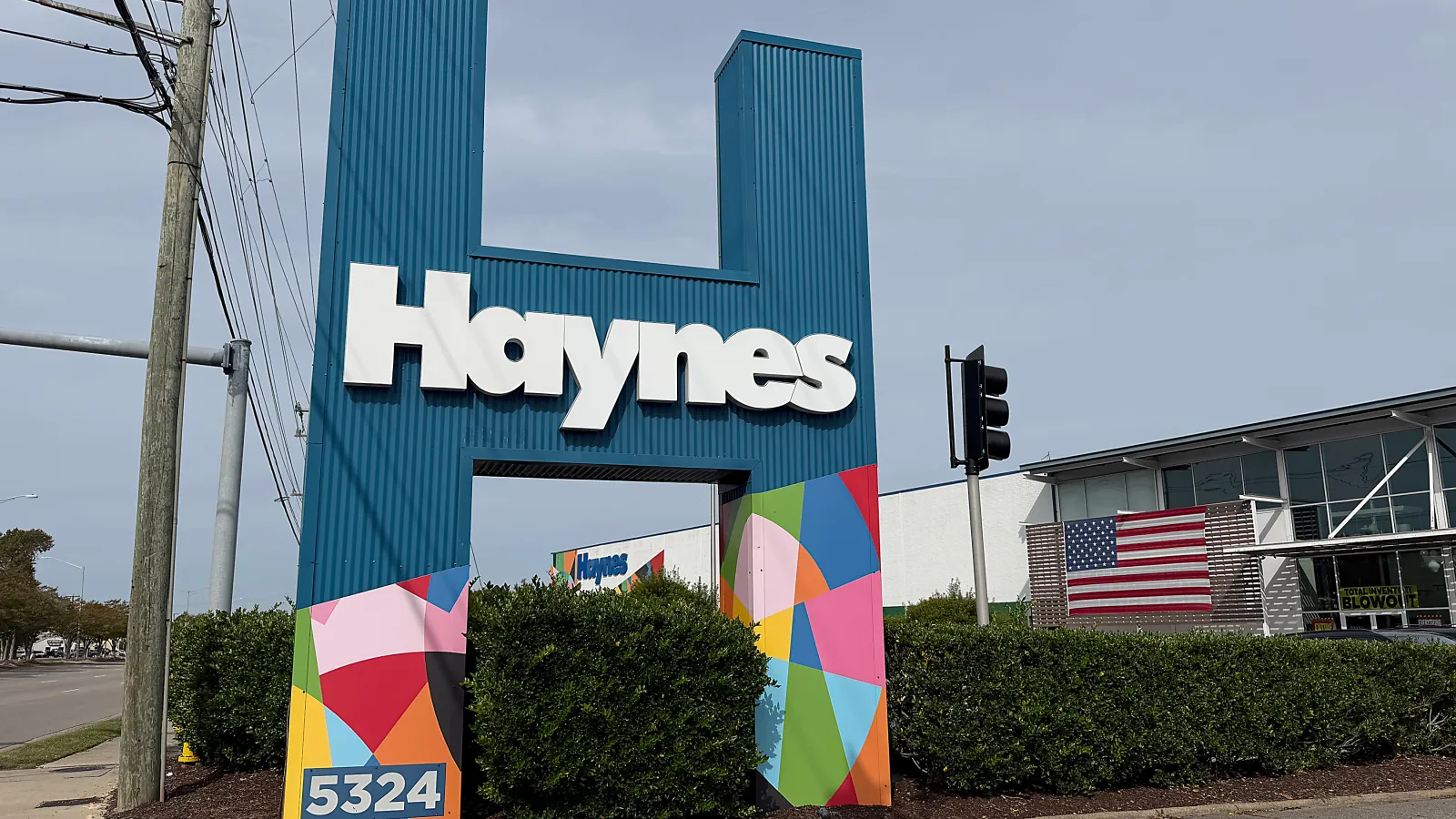
On October 8, 2026, Haynes Furniture opened the doors for its going-out-of-business sale. The Virginia retailer had run for 128 years across four generations of the Strelitz family. Its sister chain, The Dump Luxe Furniture Outlet, closed with it: four Haynes showrooms and eight Dump stores across Virginia, Arizona, Georgia, Illinois, and Texas. "Yes, Virginia, we are going out of business and closing forever," Executive Chairman E.J. Strelitz said in the announcement. SB360 Capital Partners took over the sale of the mattresses, rugs, and furniture.
Haynes had company. In Massachusetts, Pieroway's Furniture began final liquidation at its Ludlow and West Springfield stores after more than 60 years. Owner Michael Ouimette started there as a high school student in 1964 and is retiring in his early 80s. In Latrobe, Pennsylvania, Weiss Furniture started its going-out-of-business event on September 3 after 107 years, because owner Dalia Dunhoff is retiring.
Pieroway's and Weiss are closing because their owners are retiring, and nobody is lined up to take over. Haynes's end arrives with E.J. Strelitz's retirement too, though The Dump's stores outside Virginia were already headed for closure after a strategic review. Family furniture store closings all run on the same script. Professionals price and sell the inventory, fixtures, and real estate. The name, the website, the phone number that rang for decades, and the residual trust built up across generations of local households have no buyer and no process, so they go dark.
Those orphaned names support a small, specific acquisition. License a retiring retailer's local identity for a few thousand dollars, sell furniture under it through an established regional partner's showroom and trucks, and measure whether the goodwill still converts. You skip the showroom, the warehouse, and the inventory, and you get a recognized name plus a short test of whether it still sells furniture. Here's the short version:
The money: About 56 completed partner sales a month at roughly $90 contribution each comes to $5,000. A realistic first outcome runs a few hundred to a few thousand dollars.
Inside:
• Option-to-buy license term sheet
• The trademark-abandonment pitch to owners
• Five-point scorecard and evidence packet
• 10-week launch, two outreach emails, budget
The Asset Nobody Liquidates
Furniture stores are a large, stagnant channel. Census data shows U.S. furniture and home furnishings stores sold $11.3 billion in July 2026, seasonally adjusted, flat against June and down about 2.7% from July 2025. Online keeps taking share. Wayfair booked $12.5 billion in 2025 revenue, $11.0 billion of it in the U.S., then grew revenue 7.4% in the first quarter of 2026 while active customers rose just 1.4% to 21.4 million.
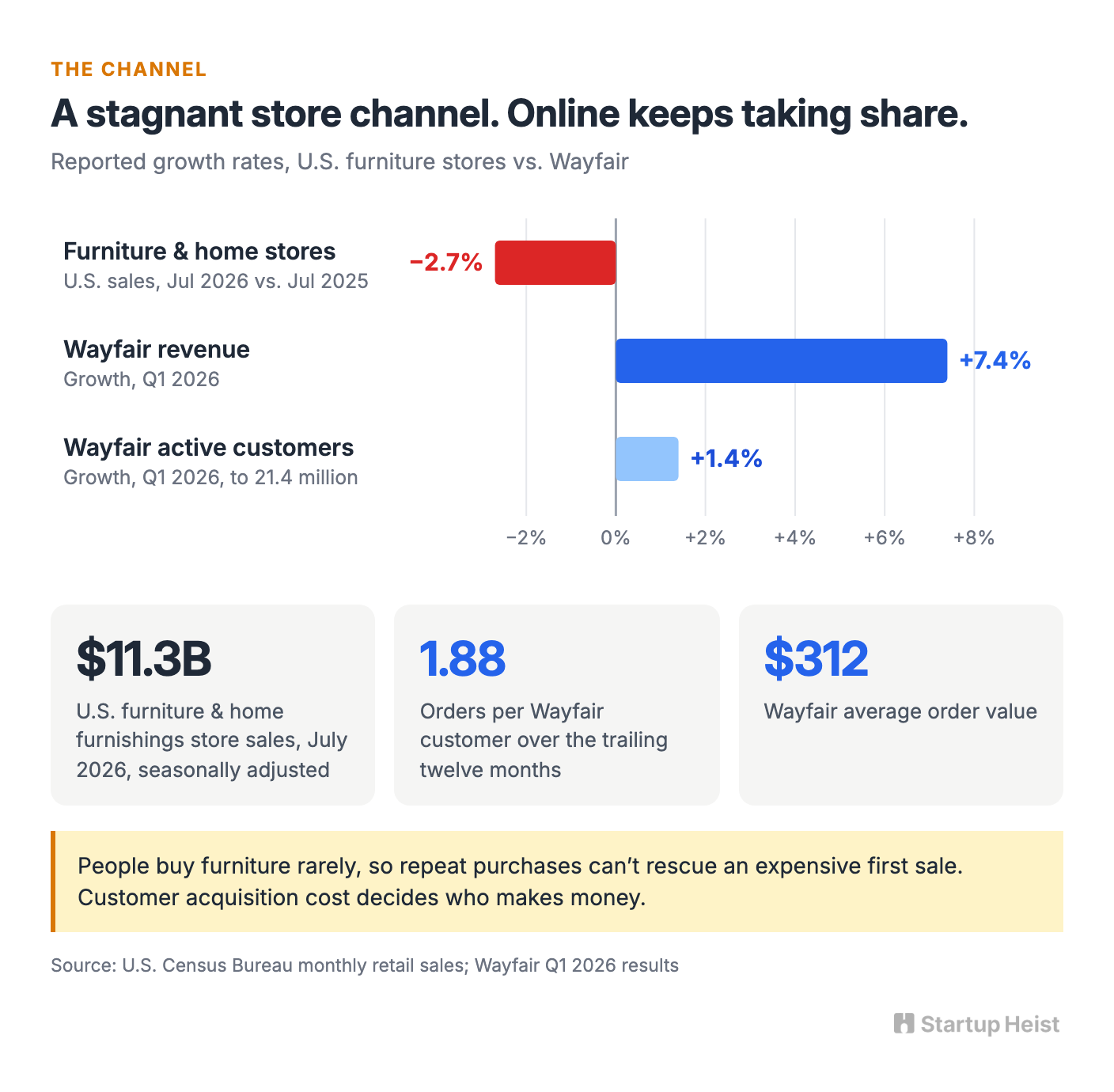
Wayfair's numbers also expose the hardest fact of the category. Its customers placed just 1.88 orders over the trailing twelve months, at an average order value of $312. People buy furniture rarely, often years apart, so repeat purchases can't rescue an expensive first sale and customer acquisition cost decides who makes money. A new local furniture site, call it "Oakfield Home," starts at zero trust and pays full price for every lead.
A licensed century-old name might start somewhere else. Residents already search for it, call its number, and remember the dining table that lasted twenty years. Three separate assets sit inside that memory, and each is harder to prove than the last. Recognition means people know the name. Purchase intent means they still search for it or call when they need furniture. Trust means they believe a business carrying that name will treat them well. Recognition is easy to observe and worthless on its own, and a store that closed after years of late deliveries leaves a liability behind. What you want is measurable, positive local demand that survives a change of owner and operating model.
What Brand Names Sell For
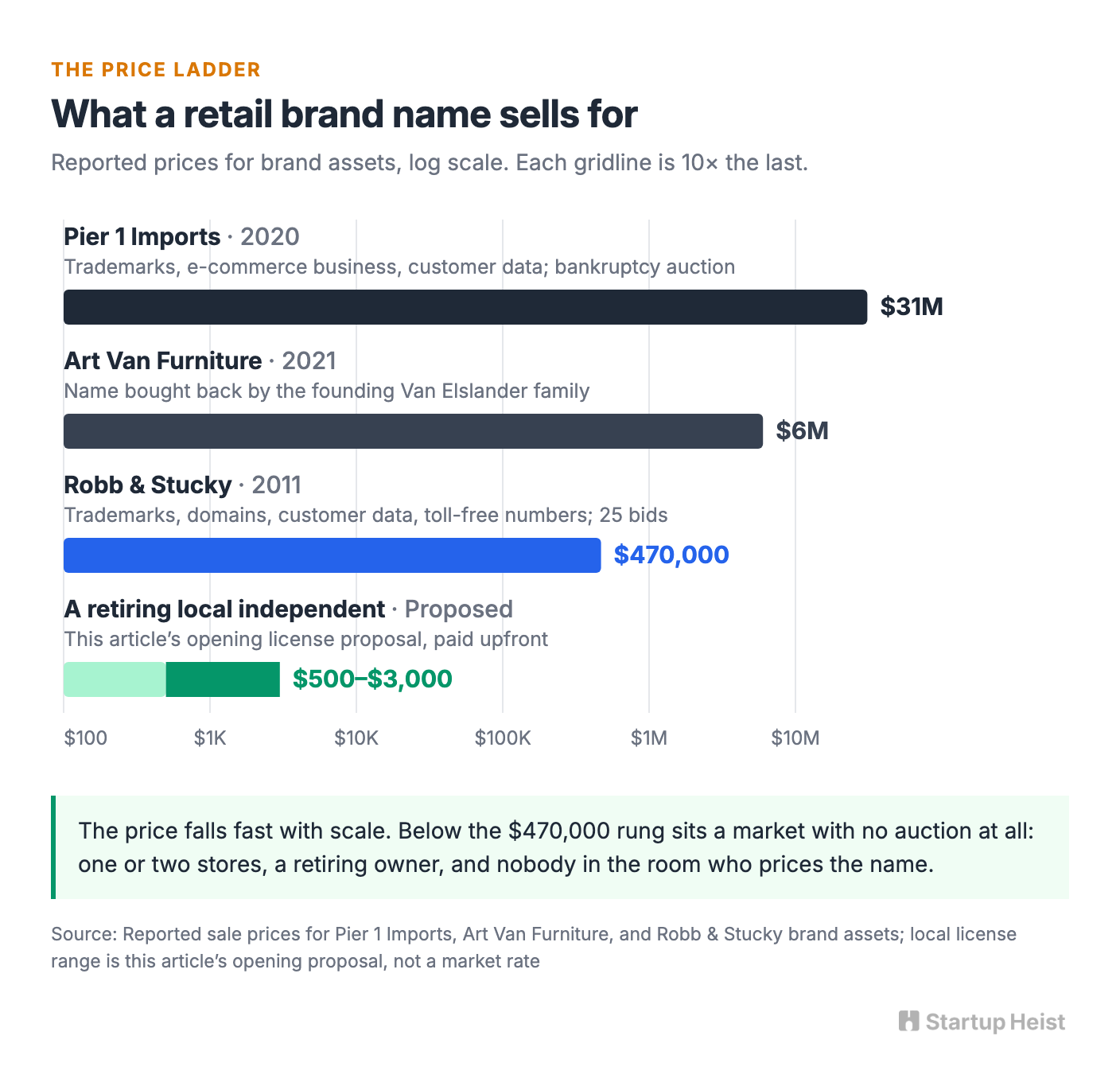
Retail brand names already trade, and the price falls fast with scale. In 2020, Retail Ecommerce Ventures won the bankruptcy auction for Pier 1 Imports' trademarks, e-commerce business, and customer data with a $31 million bid, then relaunched it online with 15 former buyers and staff. In 2021, the founding Van Elslander family paid $6 million to buy back the Art Van Furniture name, once attached to nearly 200 Midwest showrooms. Further down, Robb & Stucky, a Florida high-end furniture retailer founded in 1915, liquidated its 20 stores in 2011. Its trademarks, domains, customer data, and toll-free numbers drew 25 bids and sold for $470,000. The buyer reopened under the name with a 60,000-square-foot Fort Myers showroom in 2012 and later expanded to Naples, Sarasota, and Coral Gables.
The ladder comes with a warning attached. In September 2025, the SEC charged Pier 1's buyers with raising about $112 million through allegedly fraudulent offerings tied to the brand portfolio, alleging the businesses never turned a profit. The charges remain allegations. Even so, they're a useful reminder that a famous name and impressive revenue can't stand in for unit economics.
Below the $470,000 rung sits a market with no auction at all. Project Equity estimates that baby boomers own about 2.34 million U.S. businesses, many with no succession plan. Pieroway's and Weiss sit in that band: one or two stores, a retiring business owner, no bankruptcy, and nobody in the room who prices the name. At least one owner is already thinking about it. Dunhoff told the Latrobe Bulletin that the Weiss name may not end with the store, though she hasn't decided what comes next. The best target in this band is the one with the most transferable demand per dollar, regardless of age or size.
The Model: Keep the Name, Rent the Infrastructure
A traditional furniture store bundles six expensive jobs: attract customers, display product, pay salespeople, finance inventory, deliver, and fix problems after the sale. Only the first one depends on the name. The rest need trucks and square footage, and you can rent those.
Unlock the Vault.
Join founders who spot opportunities ahead of the crowd. Actionable insights. Zero fluff.
“Intelligent, bold, minus the pretense.”
“Like discovering the cheat codes of the startup world.”
“SH is off-Broadway for founders — weird, sharp, and ahead of the curve.”


