


The Best Concert Merch Doesn't Exist Until After the Show
Turn the moment fans remember into artist-approved merchandise within hours, with no inventory, no warehouse, and no new software.
Harry Styles's 30-night residency at Madison Square Garden runs Wednesday, Friday, and Saturday nights from August 26 through October 31, 2026. The official merch operation is enormous. An exclusive residency jersey sells for $85, and two pop-up shops in the East Village have drawn lines that wrap for blocks.
Even so, fans interviewed by Vogue in October 2026 said something that should bother every merch department in the business: some of them preferred the unofficial designs sold by street vendors outside the venue. They found them more creative, more distinctive, and more connected to the culture around the artist.
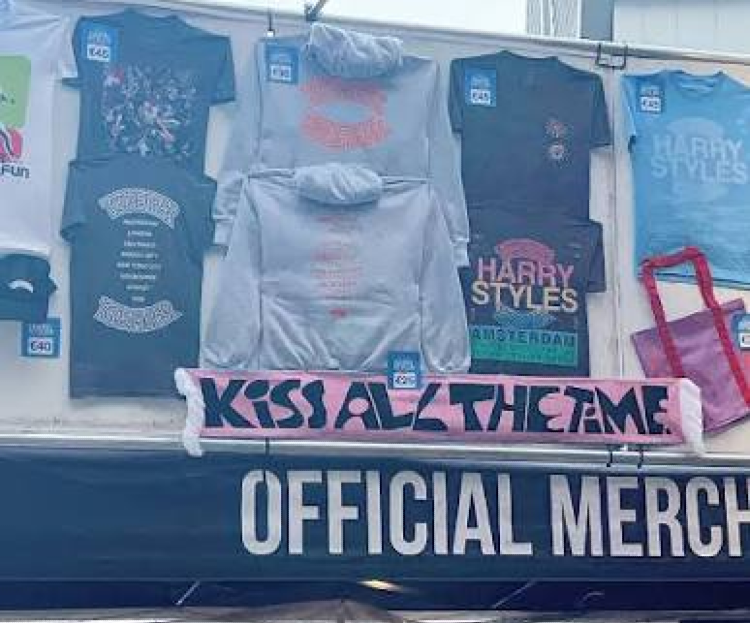
The vendors' edge in that account is relevance. Selling unauthorized designs is an intellectual-property problem, and nobody has data showing bootlegs outsell the official table. Still, the preference exposes a structural weakness.
Official merchandise is designed before the tour. The moments fans remember happen during it.
An artist can spend months approving a tour shirt. Then, on a Tuesday in Philadelphia, the crowd sings an entire chorus a cappella, or a local joke becomes the running bit of the night. By the time the audience leaves, that moment means more to them than anything on the merch table, and nobody is set up to turn it into a product.
A small creative studio can fill that gap by partnering with independent touring artists to release authorized, show-specific merch drops within hours of a performance.
The money: Four tour legs a month, three drops each, 75 orders per drop: about $5,544 in monthly studio revenue. Concert merch already averages $10.24 per attendee.
Inside:
• Per-drop revenue-share math and leg pricing
• The two-hour post-show launch timeline
• Artist outreach template and pilot terms
• 45-day pilot plan with go/no-go signals
The Model: A Merch Newsroom
Take an independent musician playing six cities over two weeks. Their standard tour merch travels with them: two T-shirts, a hoodie, maybe a poster. It stays the same from the first night to the last.
Your studio works differently. Before the tour, you and the artist build a visual system, approve product templates, and agree on what material can legally appear on merch. After a memorable show, the artist's team picks the moment. Your studio adapts a prepared design, publishes it on an official artist storefront, and opens a 48-hour ordering window. A print-on-demand provider makes and ships each order.
Artist partnership → live moment → approved design → 48-hour drop → on-demand fulfillment → shared proceeds.
Nothing gets printed on speculation, so there's never a pile of unsold city-specific shirts in someone's garage. Every piece also carries the artist's authorization, which the guy outside the Garden can never offer.
Be clear about what this sells. The design goes live within hours, but the shirt still has to be printed and shipped, so the fan gets a timely keepsake that arrives days later. It has to win the sale without the sidewalk's instant handoff.
The Merch Table Is Already a Real Business
Concert merch carries real money. According to atVenu, whose software tracks merch sales for touring artists, average merch revenue reached $10.24 per attendee in 2025, up from $9.90 in 2024. About 21% of fans bought something. T-shirts made up 56% of all units sold, at an average price of $37.
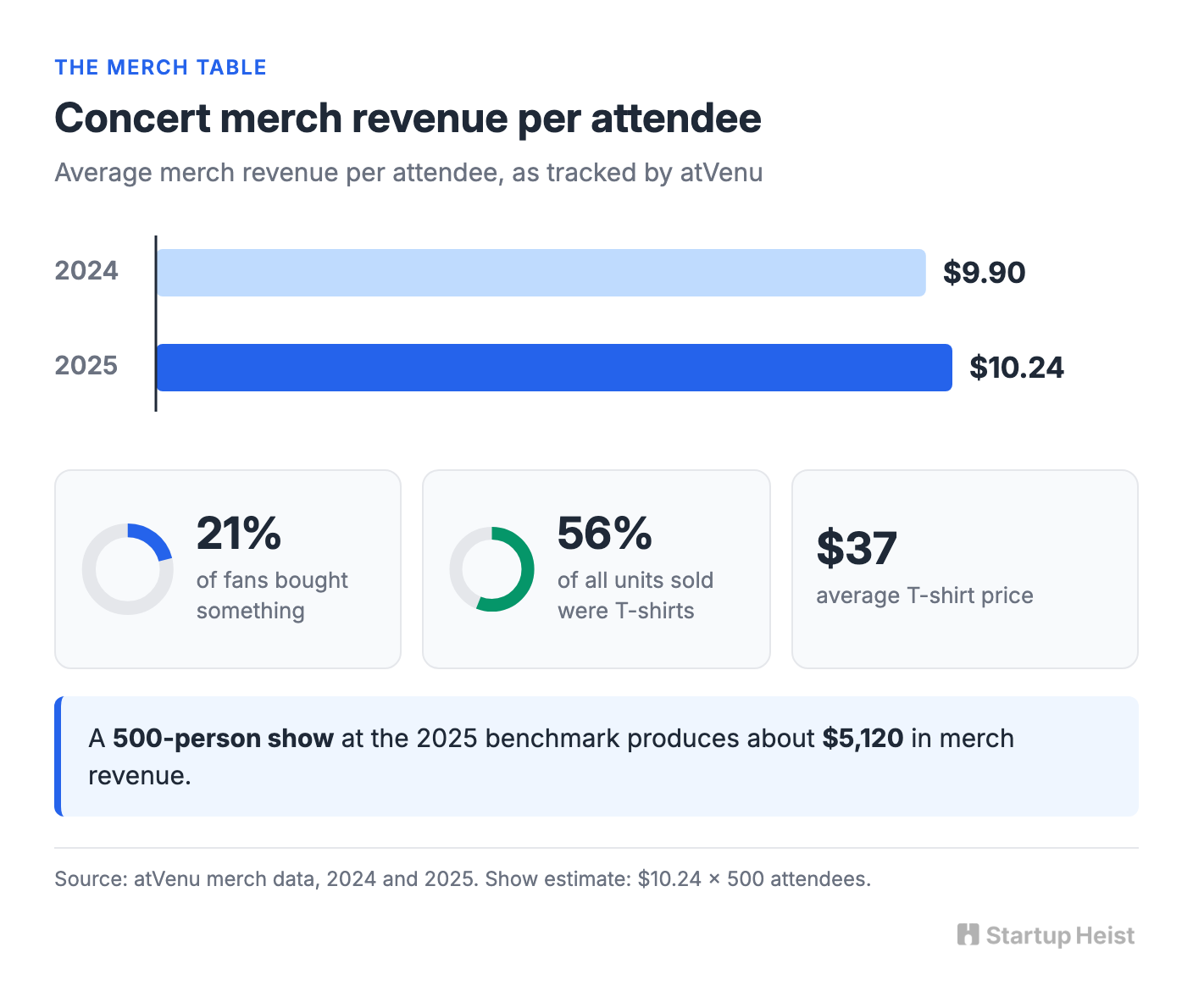
A 500-person show at that benchmark produces about $5,120 in merch revenue. None of it proves anyone will buy again after the show. A post-show drop could simply replace a sale the artist would have made at the table, and that cannibalization question decides whether this service creates value or just moves it around.
A survey MIDiA Research published in March 2026, covering 1,000 U.S. fans who had bought merch, physical music, or tickets in the past year, points toward show-specific products. Younger fans value "if you know, you know" signals over obvious artist branding, and buyers aged 16 to 24 over-index on posters, hoodies, keychains, and jewelry. A print referencing one specific encore means nothing to a stranger and works as proof of attendance for anyone who was in the room.
The same survey carries a warning. Just under half of respondents said merch is becoming unaffordable, and 39% said they sometimes feel their fandom is being exploited. A 48-hour window creates urgency, but if the design isn't worth owning, the countdown only makes the pitch more irritating. Selectivity has to be built into the model from day one.
Proof the Moment Can Be Sold
Moment-driven merch already works in sports. BreakingT, an apparel company licensed largely through players' associations, built its business on a stated mission of going from moment to market with a licensed product in 24 hours or less. In 2019, after a TV commentator called the Carolina Hurricanes "a bunch of jerks," the team's marketing staff co-designed a "Bunch of Jerks" shirt with BreakingT that went on sale within about a day at $32. The initial run of a few hundred shirts proved far too small, and BreakingT had to produce many more.
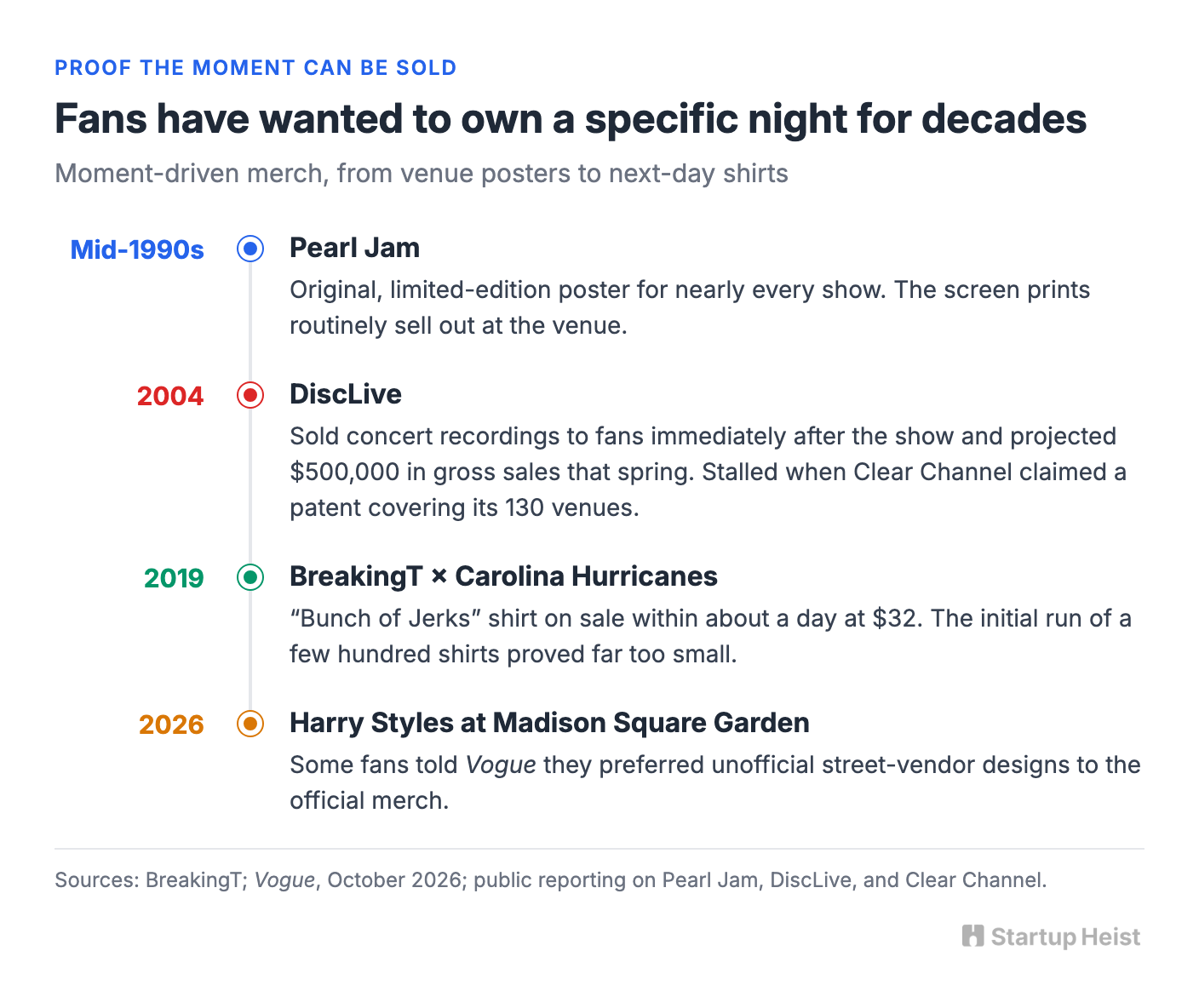
Music has its own precedents. Pearl Jam has released an original, limited-edition poster for nearly every show since the mid-1990s, and those screen prints routinely sell out at the venue. In 2004, a company called DiscLive sold recordings of a concert to fans immediately after the show and projected $500,000 in gross sales that spring. What stalled it was the venue operator: Clear Channel bought a patent on selling concert recordings right after a performance, claimed it covered its 130 venues, and told the Pixies that DiscLive couldn't burn and sell CDs on-site at its venues. Fans have wanted to own a specific night for decades. The production stack is what changed, and it's now cheap enough for one operator to run.
The tool stack is also crowded. Fourthwall gives creators storefronts, fulfillment, and customer support, and acts as merchant of record for sales tax. Printful prints on demand and plugs into Shopify. Everpress runs preorder campaigns that sell before production. None of these tools spot the moment worth printing, design it, get it approved at midnight, and convince the artist to post the link. A touring musician who finishes at 11 p.m., loads out, and drives overnight to the next city doesn't have those two hours to spare, and your studio sells them back.
The First Customer: An Artist Who Already Sells Merch
An artist with 50,000 Instagram followers and no merch sales is a worse customer than one who draws 500 people a night and regularly sells out of shirts. Screen every prospect for demonstrated purchasing behavior:
Unlock the Vault.
Join founders who spot opportunities ahead of the crowd. Actionable insights. Zero fluff.
“Intelligent, bold, minus the pretense.”
“Like discovering the cheat codes of the startup world.”
“SH is off-Broadway for founders — weird, sharp, and ahead of the curve.”


