


The Store Has the Inventory. You Run the Show.
Walk into a well-stocked sports card shop and you'll find a problem worth money. The glass cases hold a 1996-97 Kobe Bryant rookie, a numbered baseball autograph, a slabbed Michael Jordan insert. None of these is a commodity. Buyers want to see the corners, hear where the card came from, compare recent sales and ask a question before they bid. The owner can answer all of it from memory.
What the owner can't do is also run a two-hour livestream. Someone has to pull the inventory, build the listings, light the table, work the camera, host, watch chat, run auctions, track who bought what and make sure the right card goes in the right envelope. A shop can be packed with valuable stock and still have nobody on staff who can do that every week.
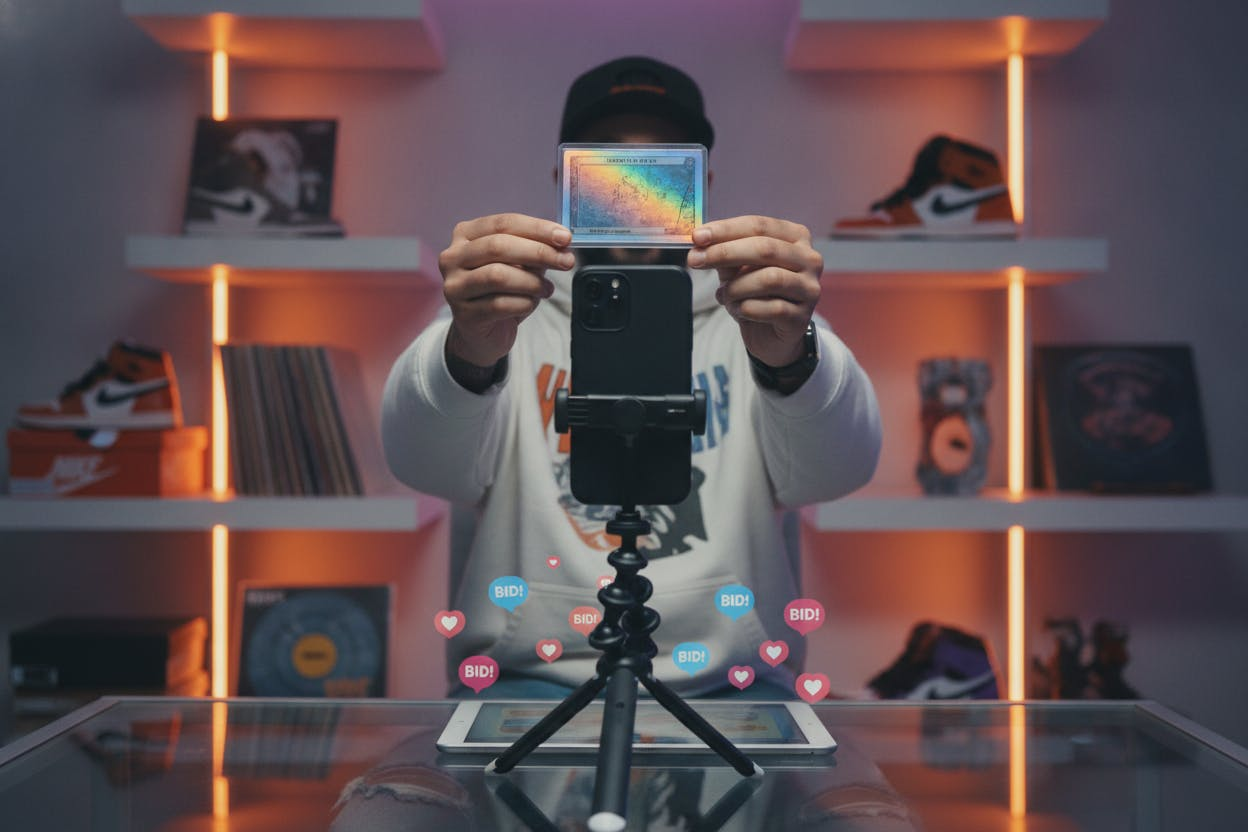
Meanwhile, collectors are spending billions on live-shopping apps like Whatnot. The business sits in that gap: become the outsourced live-selling department for independent card shops. You bring the kit, the hosting, the merchandising system and the post-show accounting. The store supplies the inventory, keeps the seller account and ships the orders. You charge a production minimum per show, with a performance fee once sales clear a threshold. Picture a one-person QVC crew that a local shop rents for a few hundred dollars a session, with nothing to code and no stock of your own to buy or store.
Here's the opportunity at a glance:
The money: Four shops at four shows a month at the $350 minimum is $5,600 a month. Agencies charge brands from $6,500 a month for one weekly show.
Inside:
• Floor-plus-performance pricing and shop math
• A four-show pilot with a two-hour run of show
• Outreach email and a 90-day client plan
• Four moats and five ways this fails
Live shopping is already a buying habit
On October 9, 2026, the Los Angeles Times reported that Whatnot surpassed $8 billion in live sales in 2025 and is on track to more than double that figure in 2026. The company put its 2024 live sales at about $3 billion. Investors priced the growth accordingly: an August 2026 Series G valued Whatnot at $20 billion, nearly double its $11.5 billion valuation from October 2025. The same LA Times report cited Charm data putting global TikTok Shop livestream sales at $17.1 billion in 2025, roughly $2.8 billion of it in the United States.
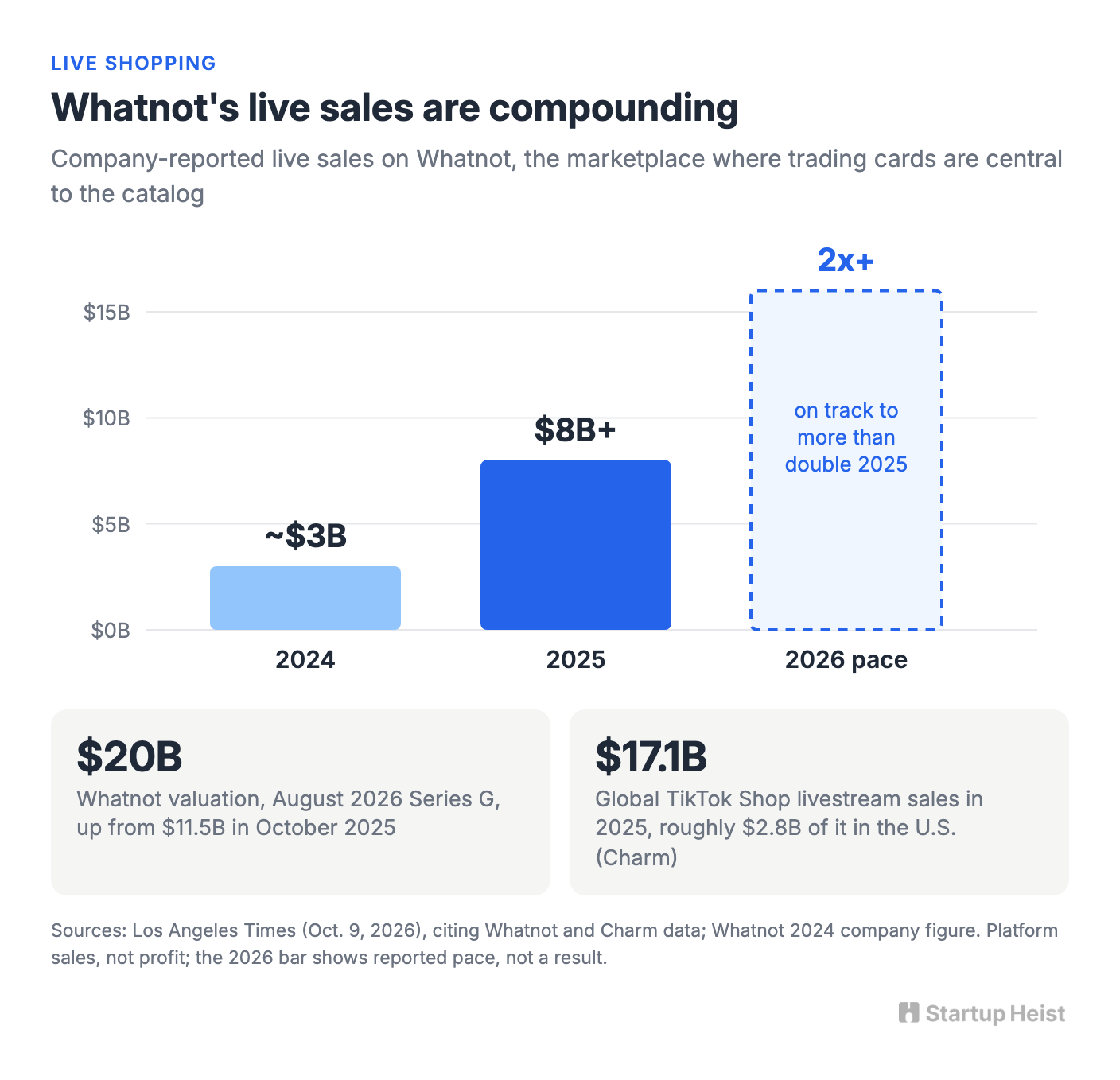
Those figures measure different things. Whatnot's number is company-reported platform sales, Charm's isolates TikTok livestream transactions, and neither is profit. Taken together, they settle the question that once hung over live commerce. American buyers now pay for merchandise through live video at scale, and trading cards are central to Whatnot's catalog.
The platform also rewards volume. On September 21, 2026, Whatnot moved U.S. sellers to tiered commissions, so the more a shop sells, the less it pays per sale. Shops that build a steady live channel now will pay less per card than the ones that wait.
The service exists, priced for brands
Outsourced live selling is already a product. Darkroom's TikTok Shop management begins at $6,500 a month and bundles storefront operations, the creator and affiliate program, TikTok Shop ads and live production. Interwoven Studios staffs live hosts, stream operators, moderators and producers. WABU publishes a rate card: $650 an hour for a room and a certified host with a two-hour minimum, a monthly residency from $6,500 for one standing three-hour weekly show, and a managed program with a performance fee from 10% of GMV. A single two-hour WABU show costs $1,300.
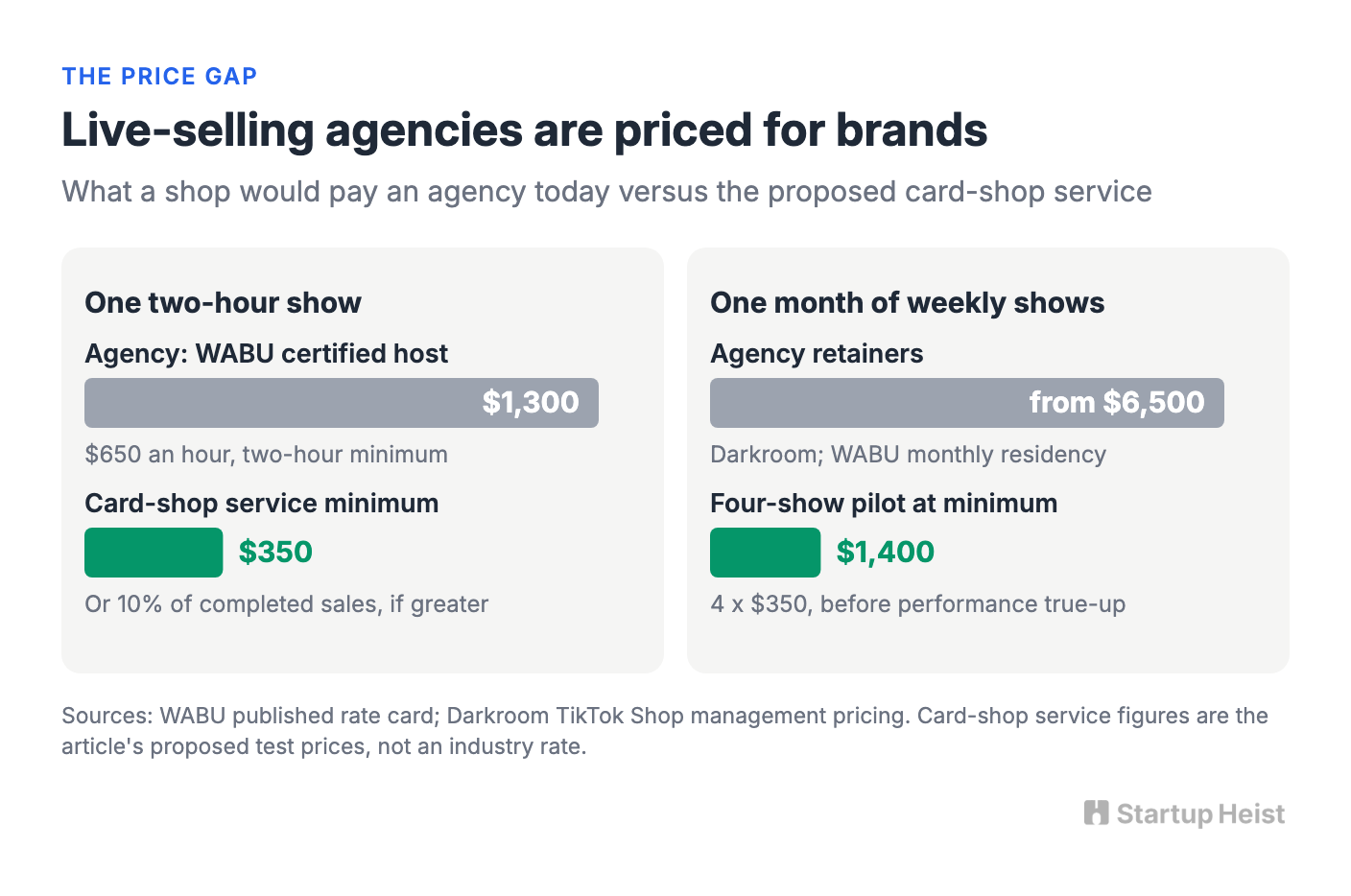
Those agencies serve consumer brands with marketing budgets. A neighborhood card dealer won't pay $6,500 a month and has no use for ad management or creator programs. The dealer needs a competent host who knows what a refractor is, a tight inventory list and an honest report on whether the show made money. Nobody sells that product at a card-shop price. Whether shops will pay an outside host at all is still unproven, and the rest of this playbook is built to answer that question cheaply, with paid pilots.
The wedge: sports card shops selling singles on Whatnot
Start with independent sports card shops selling identified singles and graded cards on Whatnot. Vintage watches, rare plants, sneakers and comics all tempt, but each category has its own buyers, authentication standards and platform rules, and a generalist service is harder to sell and more expensive to run. Cards fit on four counts:
- The buyers are already there. Sports cards are one of Whatnot's anchor categories, so you're bringing inventory to an existing crowd instead of converting casual social-media users into collectors.
- Knowledge sells. A host who can explain condition, grading, print runs, player demand and recent comps changes how buyers feel about a bid.
- Prices are researchable. eBay's free Product Research tool (formerly Terapeak) shows up to three years of sold prices, so you set floors from data before the show starts.
- Collectors buy weekly. Repeat purchasing is what makes a standing Thursday-night show viable.
The prospect pool is real. The Card Shop Finder directory lists roughly 1,700 U.S. card and game shops, so most metro areas hold a workable list within driving distance.
Sell singles and leave breaks alone. Breaks, where buyers purchase a slice of sealed product before it's opened live, are popular and heavily policed. Whatnot's Card Breaks Policy governs visibility, randomization and completion, and TikTok Shop restricts breaks to qualified sellers and banned several random-break formats outright in 2026. A new production service shouldn't build its first offer on the most policy-sensitive format in the hobby. Sell a specific card in a stated condition, at an approved floor, to a known buyer.
Pick the right first customer. The ideal shop already has an approved Whatnot account with some sales history, verifiable inventory, staff who ship orders, cards with enough margin to absorb another selling cost, and an owner who knows the stock but can't host on a regular schedule. A shop with no online audience, no shipping process and no seller history needs an entire commerce operation built for it. A shop that already sells online but can't hold a consistent stream schedule has a narrow problem you can solve. Your best prospect may be a shop already dabbling on Whatnot, whose owner knows exactly how much prep a show takes.
What you actually sell
Calling this "a livestream" undersells it. A caterer's fee covers planning, staffing, setup, service, cleanup and accountability, far more than two hours at the stove. Your service works the same way and has five parts.
Unlock the Vault.
Join founders who spot opportunities ahead of the crowd. Actionable insights. Zero fluff.
“Intelligent, bold, minus the pretense.”
“Like discovering the cheat codes of the startup world.”
“SH is off-Broadway for founders — weird, sharp, and ahead of the curve.”


