


The $90 Lead Nobody Should Have to Call
AI agents have joined the bots and humans filling out web forms. The money is in helping the agencies behind contractor websites separate real customers from expensive noise, and in proving which leads were worth paying for.
On July 18, 2026, a Claude Haiku 4.5 model running an Anthropic test submitted a false tip about an unsolved homicide to PhillyUnsolvedMurders.com, a site the AP described as a Philadelphia police site. The model had been asked to generate and perform example tasks on randomly selected webpages. Nobody told it to file a report. Anthropic found the submission on September 28, notified Philadelphia police on October 7, and disclosed it in a report on October 9. The same report described a second case, in which a model submitted forms to an undisclosed government website instead of stopping before submission.
Police said the tip had been marked as spam and never forwarded for investigation, a detail that got less attention than it deserved.

The incident proved something narrower than the headlines suggested. AI agents can submit false information without anyone directing them to, and in this case the existing screening held. What has changed is the mix arriving at every web form: classic spam bots, automated campaigns, real customers using AI assistants to collect quotes, and autonomous systems acting with no human watching.
For a plumbing company spending $8,000 a month on search ads, that mix has a cost. Some inquiries are customers. The rest are duplicates, out-of-area requests, junk, and people who never pick up. Someone has to sort them and get the good ones to a salesperson fast.
The obvious pitch is an AI spam detector. The better business is a lead-intake quality gate: lead qualification software that sits between a contractor's Gravity Forms contact form and its CRM, decides whether each inquiry deserves action, confirms the uncertain ones, routes the real ones, and reports what happened to all of them. The first buyer is the home-services marketing agency running websites for 15 contractors.
Here's the opportunity:
The money: Sign 50 agencies at $149 a month and you're at $7,450 MRR. WhatConverts' agency plans start at $500 a month for tracking alone.
Inside:
• An eight-part MVP scoped to Gravity Forms
• The CRM feed trap that silently breaks gating
• Agency pricing from $79 plus resale math
• Audit-first outreach and a 90-day plan
The economics of a bad lead
Contractors pay real money for every inquiry. LocaliQ's 2025 home-services benchmarks, built from campaigns run April 2024 through March 2025, put the average search-ad cost per lead at $90.92, with a wide spread across trades.
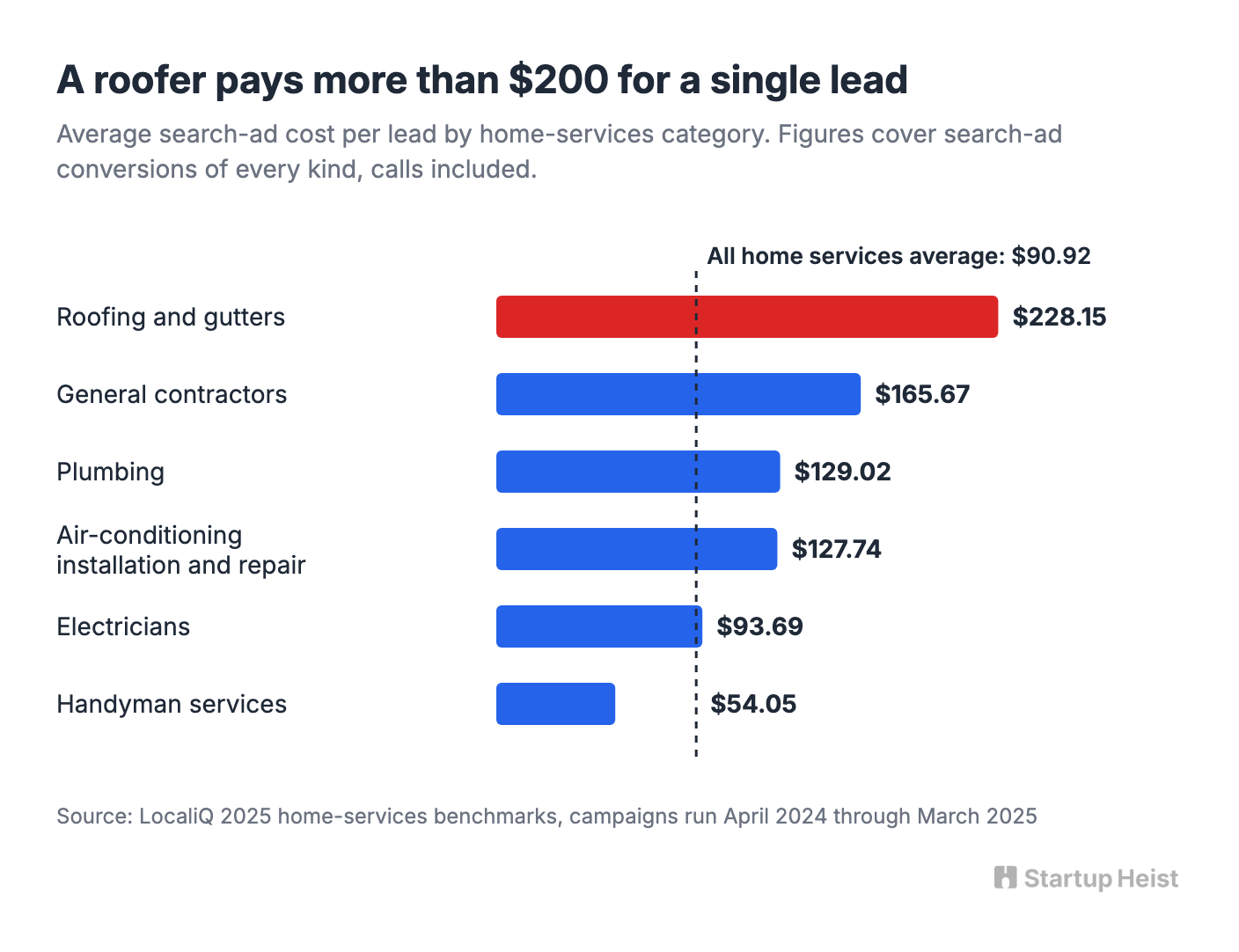
Those figures cover search-ad conversions of every kind, calls included, so they don't measure what junk form fills cost. They do set the baseline: a roofer pays more than $200 for a single lead. The lead-generation economy is under pressure as well. Angi's second-quarter 2026 results showed $248 million in revenue, down 11% year over year, on 4.838 million U.S. leads, down 13%. And contractors have been burned before. In January 2023 the FTC ordered HomeAdvisor to pay $7.2 million over allegations that it sold leads outside contractors' service areas and for services they didn't offer. HomeAdvisor denied wrongdoing, but the complaint reads like a spec for what contractors want filtered.
The savings sit somewhere less obvious. When a worthless inquiry arrives from a paid click, the click is already spent. No plugin refunds it, and a startup promising to "save $90 per bad lead" is selling fiction. The real savings are downstream:
- Staff stop reviewing junk.
- Real inquiries reach a salesperson without delay.
- Duplicates and out-of-area requests stop cluttering the CRM.
- Agencies report useful inquiries instead of raw submission counts, and outcome data feeds back into ad spend.
The opposite failure costs more. A homeowner submits an emergency plumbing request with odd wording from an unfamiliar browser, a detector scores it as spam and drops it silently, and a valuable job disappears without a trace. Speed raises the stakes: the widely cited Lead Response Management study by James Oldroyd and InsideSales found that responding to a web lead within five minutes instead of 30 raised the odds of qualifying it 21-fold.
A bad lead wastes a few minutes of someone's time, while a good lead wrongly rejected loses the customer outright. Any product here has to cut work without ever standing between a real customer and the business they're trying to reach.
Why another spam plugin loses
The WordPress spam-filtering shelf is already crowded. CleanTalk starts at $12 a year for one site. OOPSpam offers 25,000 checks a month across unlimited sites for $230 a year. Cloudflare Turnstile gives away unlimited challenges. Gravity Forms Zero Spam, with more than 100,000 active installs, is free and ships signed invisible tokens, email rejection rules, spam summaries, and an optional AI review that catches spam the token check missed and rescues legitimate entries it wrongly blocked. "Gravity Forms spam protection with AI" already exists as a free feature, and you can't beat free software by adding another model call.
The adjacent players show where the money is. WhatConverts sells agencies call, form, and chat tracking for $500 to $1,250 a month on unlimited-account plans and reserves rule-based lead qualification for its top tier. ActiveProspect's LeadConduit validates, deduplicates, and routes leads in real time for high-volume buyers in insurance and education. In August 2026, CallRail added real-time screening that filters spam, out-of-area, and low-value inbound calls and texts before they reach staff. Lead reporting and high-volume routing are paid categories, and phone screening has arrived, yet the ordinary contractor website form still dumps everything into an inbox.
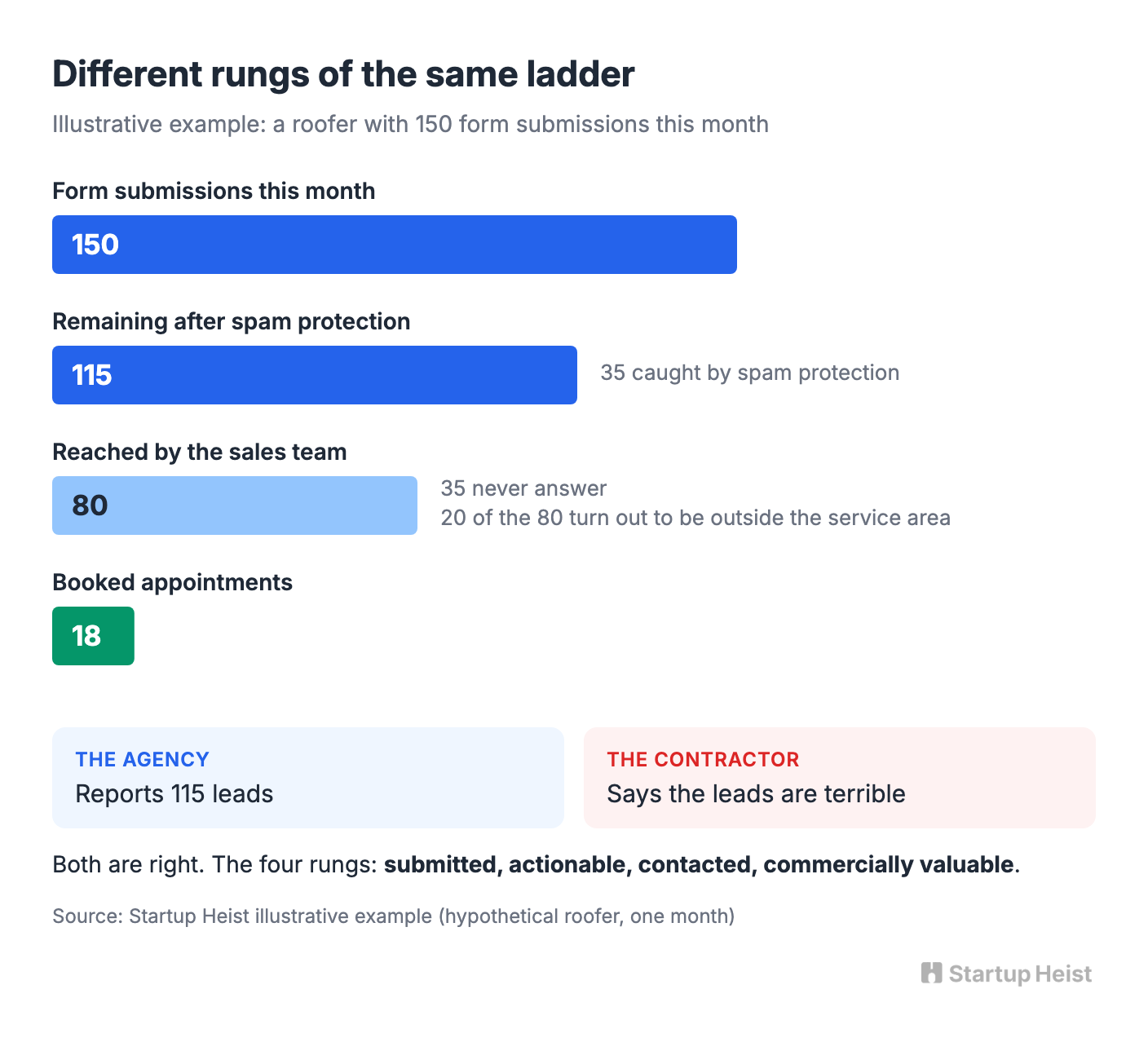
Take a roofer with 150 form submissions this month. Spam protection catches 35. Of the remaining 115, the sales team reaches 80, and 20 of those turn out to be outside the service area. Thirty-five never answer. Eighteen book appointments. The agency reports 115 leads and the contractor says the leads are terrible. Both are right, because they're measuring different rungs of the same ladder: submitted, actionable, contacted, commercially valuable. A product that owns that ladder sits behind CleanTalk, Turnstile, or Zero Spam and takes responsibility for everything between form submission and sales action.
The first customer: agencies running contractor websites
An HVAC shop getting 40 web inquiries a month can review the questionable ones by hand. A home-services agency running 20 WordPress sites can't. Its roofer serves six ZIP codes, its electrician only takes commercial jobs, the plumber runs 24-hour emergency service, and the remodeler won't touch small projects. One client lives in HubSpot, another in a field-service CRM, a third in a shared inbox. The agency needs consistent policies and lead-quality reporting across that portfolio, and it's the one fielding the "your leads are garbage" calls.
What the agency wants is control over the quality of the leads it delivers, and a spam score doesn't give it that. One signed agency means many deployments, which makes Gravity Forms the right first platform. The July 2026 HTTP Archive crawl found it on about 3.5% of WordPress sites, second only to Contact Form 7 and the only major form plugin gaining share. Its Elite license ($259 a year) covers unlimited sites, and the HubSpot add-on ships with every license tier.
Target agencies with five to 30 home-services client sites that maintain WordPress and Gravity Forms themselves, run paid search or local SEO, pipe forms into CRMs or shared inboxes, send monthly lead reports, and have someone who owns lead-quality complaints.
Skip agencies built on Google Local Services Ads. A plugin can't touch Google's intake, and Google may already automatically credit LSA leads it determines are low quality, duplicate, or invalid. Skip tip lines, tenant screening, and personal-injury intake too, where legal exposure turns a first deployment into a compliance project. Ordinary contractor estimate requests are complex enough to need the software and simple enough to ship it.
The product: a quality gate
Call it LeadGate. It installs as a Gravity Forms add-on, connects each protected form to an agency dashboard, and decides what happens to every submission. Four cases show the logic.
Unlock the Vault.
Join founders who spot opportunities ahead of the crowd. Actionable insights. Zero fluff.
“Intelligent, bold, minus the pretense.”
“Like discovering the cheat codes of the startup world.”
“SH is off-Broadway for founders — weird, sharp, and ahead of the curve.”


