


The Missing Pounds
Every HVAC company in America can tell you what it paid for refrigerant last month. Almost none can tell you where it went.
The invoices arrive at the office. The gas leaves in cylinders, rides around in vans, gets charged into somebody's condenser on a Tuesday, gets recovered from a dying system on a Thursday, comes back half-empty, sits in a corner of the warehouse, and eventually gets grabbed by whoever needs it next. Somewhere in that loop, pounds disappear. Not dramatically. A few at a time, month after month, at real acquisition cost.

For twenty years this was fine. Refrigerant was cheap enough that approximate accounting cost less than precise accounting. That trade has inverted, and the reason has almost nothing to do with the environmental headlines.
The opportunity is a narrow software layer for 8-to-25-truck contractors that answers one question an owner can't currently answer:
How many pounds did we buy that never became a documented job cost?
It isn't a field service management platform or an EPA compliance suite. It's a refrigerant accountability ledger that produces one number every week, in dollars.
The whole business fits in a paragraph.
The money: 500 shops at $129 a month is $64,500 MRR, roughly 4% of a serviceable market you can actually name.
Inside:
• Invoice-first MVP scope in eight components
• Three-tier pricing plus a $99 pilot offer
• The cold email that books four-week audits
• Why PE roll-ups are the sharpest channel
Why the accounting broke
The industry is mid-transition from R-410A to lower-GWP refrigerants, principally R-454B and R-32. New residential and light-commercial equipment charged with R-410A has been barred from manufacture or import since January 1, 2025. The original plan was a hard stop: no installing high-GWP equipment after January 1, 2026.
That deadline is gone. On May 21, 2026, EPA finalized changes to the Technology Transitions rule and removed the installation cutoff for equipment manufactured or imported before January 1, 2025. Contractors can now install pre-2025 inventory until it runs out. The rule takes effect July 27, 2026.
The reversal is what creates the opening. A clean switchover would have simplified refrigerant handling within about eighteen months. What replaced it is a decade-long mixed fleet: R-410A stock still being installed, R-454B and R-32 on new equipment, recovered gas of both types, partial cylinders of everything, and A2L refrigerant handling procedures that apply to some of it and not the rest. A service company can touch three refrigerant regimes in the same week, and the pile in the warehouse stops resembling a generic consumable and starts resembling controlled inventory that nobody controls.
What the shortage actually proved
Don't build this on the 2025 shortage. Build it on what the shortage exposed.
In spring 2025, R-454B supply collapsed. Honeywell layered a 15% increase in February, another 8% in March, a $4-per-pound base increase in April, and then a 42% surcharge on top of the new base. Twenty-pound cylinders that had been routine were selling for $650 to $700, with scattered reports above $2,000. Some distributors rationed cylinders to customers buying complete systems, which locked independent contractors out entirely.
Then it ended. Producers added capacity, and by October 2025 the industry called the crisis over with prices down 50-60% from the June peak. As of mid-2026, R-454B averages roughly $25 per pound and R-410A runs $16 to $20, and both are stocked normally.
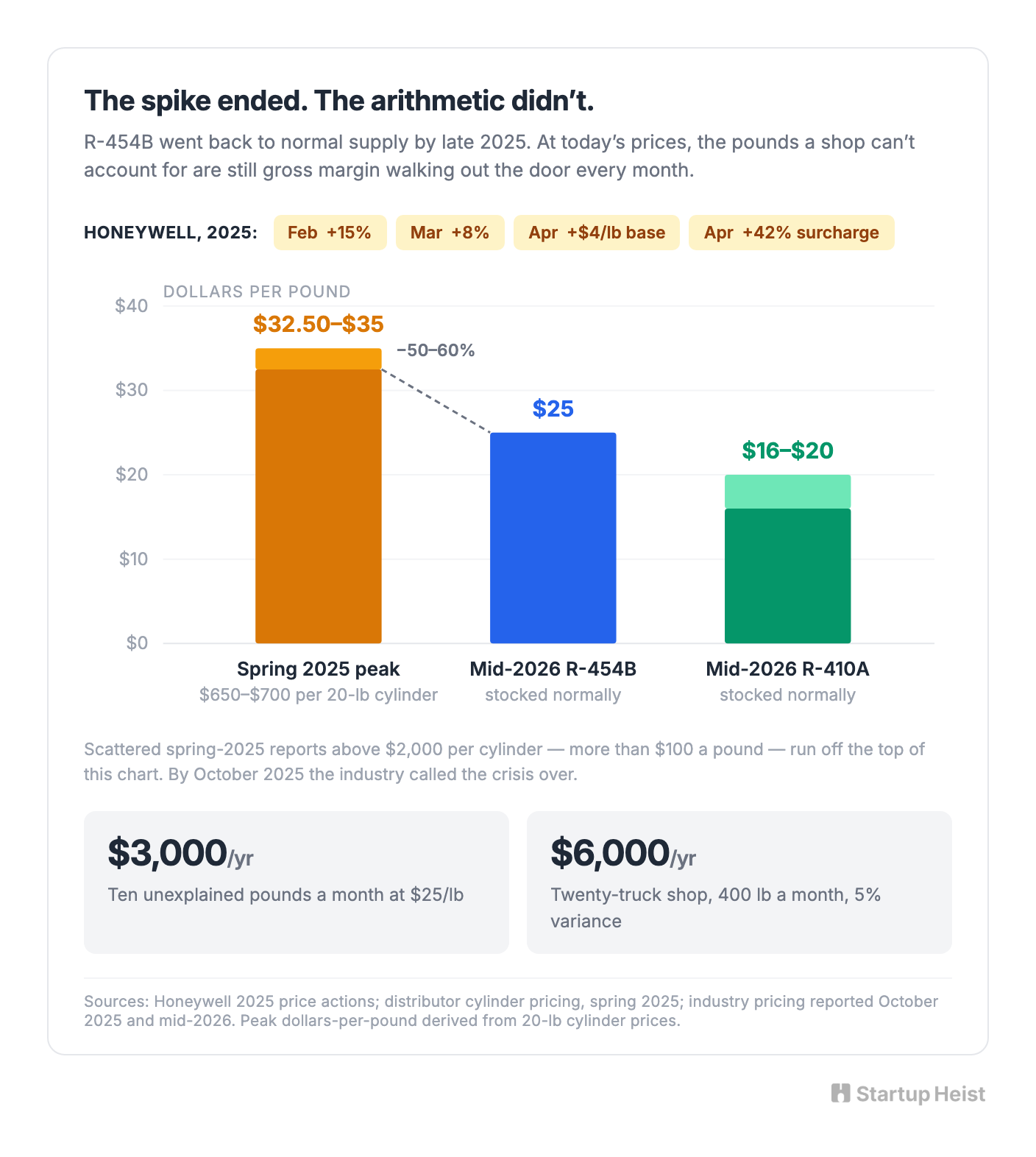
A founder who pitches this as a crisis product will get laughed out of a supply house. The durable argument is arithmetic. At $25 a pound, ten unexplained pounds a month costs $250, which is $3,000 a year of gross margin that already left the building. A twenty-truck shop burning 400 pounds a month at a 5% variance rate is losing $6,000 annually. Nobody's calling that a catastrophe. It's a permanent slow leak on a line item nobody reconciles, and it widens as the fleet grows, because a one-truck owner knows roughly what's in his van and a fifteen-truck owner has no idea.
A rate story is coming, too. When EPA relaxed the Technology Transitions limits in May 2026, it didn't touch the AIM Act production phasedown. More equipment now competes for the same shrinking pool of allocated HFCs. Prices have room to move up, and volatility is the point. When your unit cost swings between $16 and $60 a pound depending on the month, the pounds you can't account for stop being a rounding error.
The market is smaller than the pitch deck says
The Census Bureau counted roughly 111,200 employer establishments in the combined plumbing, heating and air-conditioning contractor category for 2023. IBISWorld puts the narrower heating and air-conditioning contractor market at $159.4 billion across 120,461 businesses in 2026.
Those are the numbers people put on slide four, and they're misleading here. The ideal customer needs enough trucks that refrigerant escapes the owner's personal memory and few enough that it can't afford enterprise tooling. That's roughly 8 to 25 trucks. Most of the industry sits below that line: about 70% of firms run fewer than ten employees. Strip out the plumbing-only shops, strip out the sole operators who genuinely do know where every cylinder is, strip out the hundred-truck operations already on ServiceTitan, and the realistic serviceable market is somewhere between 8,000 and 15,000 companies.
At $129 a month, 500 of them is $774,000 in ARR and roughly 4% penetration of a market you can actually name. Two thousand is $3.1 million and starts to require a real sales operation. That's an excellent bootstrapped vertical SaaS business, and it's not a venture outcome. The honest version of the pitch says so before an investor works it out.
Someone is already building this
The obvious version of this idea, that nobody tracks refrigerant cylinders, is simply false. Refrigerant tracking software is a real category with shipping products and public pricing, and the founder who discovers that in month four instead of week one has wasted a season.
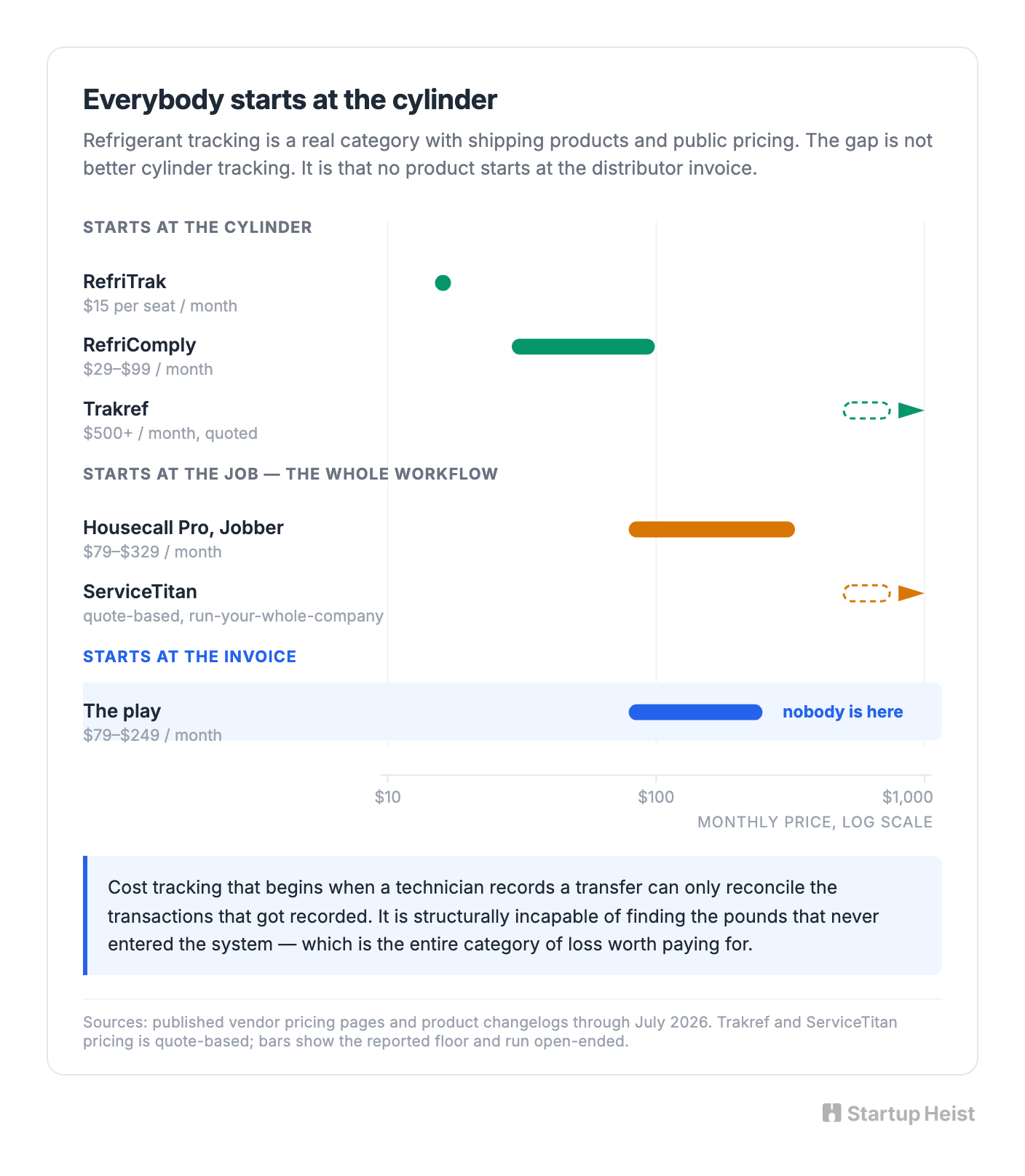
RefriTrak already sells QR-based cylinder tracking, movement history, transfers, job tracking and Section 608 workflows, at $15 per seat per month billed annually with a free tier. It's also been shipping fast in exactly this direction: automatic loss detection on cylinder replacement in February 2026, full physical inventory sessions with gross-weight entry and automatic discrepancy records in March 2026, and refrigerant cost tracking applied to transfers in May 2026. RefriComply targets 6-to-25-technician commercial contractors at $29 to $99 a month. Trakref sits at the enterprise end with quote-based pricing north of $500. Below them, Housecall Pro at $79 to $329 a month and Jobber own the daily workflow of small operators, and ServiceTitan bundles HVAC inventory management, warehouse and truck stock with serialization, for anyone willing to run their whole company on it.
One gap survives that competitive set. Every one of these products starts at the cylinder and works forward. None starts at the invoice. RefriTrak will hold an invoice as a file attachment on a unit page, and that's the extent of it. Nothing in its changelog through July 2026 parses a purchase document, extracts line items, or reconciles them against the ledger. Cost tracking that begins when a technician records a transfer can only reconcile the transactions that got recorded, which makes it structurally incapable of finding the pounds that never entered the system, and that's the entire category of loss worth paying for.
So the wedge isn't better cylinder tracking. It's refrigerant reconciliation run from the accounts-payable side, with the gap reported in dollars.
Build an accountant, not an inventory system
Unlock the Vault.
Join founders who spot opportunities ahead of the crowd. Actionable insights. Zero fluff.
“Intelligent, bold, minus the pretense.”
“Like discovering the cheat codes of the startup world.”
“SH is off-Broadway for founders — weird, sharp, and ahead of the curve.”


