


The Evidence Layer for Vanishing Federal Data
Build the system that proves exactly what FEMA, NOAA, or the EPA published on the day an engineer relied on it.
In August 2025, three former National Oceanic and Atmospheric Administration employees started rebuilding a website the federal government had just taken apart. Rebecca Lindsey had run Climate.gov as a program manager. She recruited Anna Eshelman and her older sister Mary Lindsey, crowdfunded roughly $280,000, and enlisted about 80 volunteer scientists to fact-check the material. In June 2026, Climate.us went live carrying fifteen years of climate maps, indicators, explainers, and classroom material that used to live on a federal domain.
It's an impressive piece of public service. It's also a warning, though not the one most people take from it.
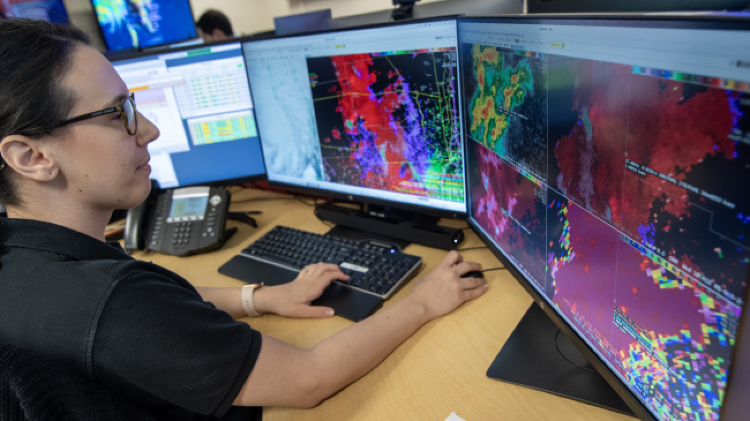
By the project's own accounting, most of the underlying data remains technically accessible on government servers. It didn't get deleted. It got hard to find. The website that organized it, explained it, and gave it a stable address is what disappeared. The opportunity lives in that gap.
Here's the opportunity:
The money: 100 engineering firms at $900/month is $90K MRR. ACEC alone counts 5,500 member firms, so the base case needs under 2% of one association.
Inside:
• Four-part product spec, capture through export
• Pricing indexed to state statutes of repose
• The citation exposure scan that opens doors
• 90-day build plan and four compounding moats
Public information rarely vanishes because the science stopped being true. It becomes unreachable because a contract ended, a program lost funding, an agency reorganized, a URL changed, or a publishing system got retired. The bytes may survive. The citation doesn't.
A homeowner can shrug at a broken climate-data link. A civil engineer who used the rainfall table behind that link to size a storm drain has a different problem. So does an environmental consultant whose permit analysis rested on an EPA download, an insurer whose model ingested federal flood data, or a lender that cited an agricultural risk series in a credit memo.
Six years later the source may be gone. Worse, it may still be sitting there at the same address, quietly containing different historical values than it did the day it was used.
The opportunity isn't another climate archive. Volunteers proved they can build those. You aren't selling access to data. You're selling the answer to one expensive question:
What information did your firm rely on at the time?
The hidden dependency inside signed work
Data.gov lists 364,126 datasets. It's a metadata catalog, which means it's an index. It doesn't host the files, control their availability, repair broken links, or promise that any agency will keep an earlier version around. It harvests what agencies publish and reflects the latest state of the catalog. Fine for discovery, useless for evidence.
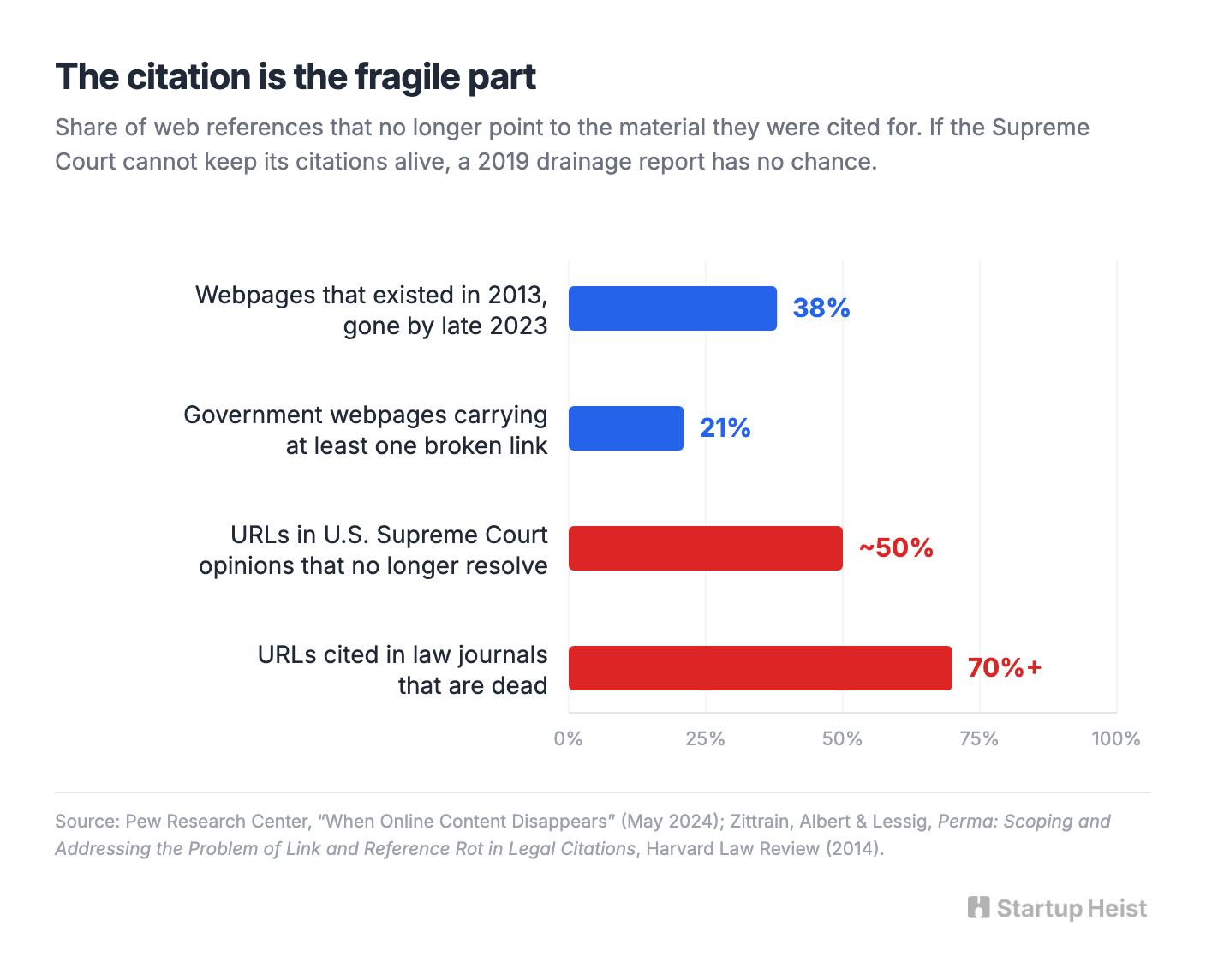
The numbers on link rot make the gap plain. Pew Research found that 38% of webpages that existed in 2013 were gone by late 2023, and that 21% of government webpages carry at least one broken link. A 2014 Harvard Law Review study by Zittrain, Albert, and Lessig found that roughly half the URLs cited in U.S. Supreme Court opinions no longer point to the material they were cited for, and that more than 70% of URLs cited in the law journals are dead. If the Court can't keep its citations alive, a drainage report from 2019 has no chance.
The good sources move even when they don't break. FEMA's National Flood Hazard Layer holds the current effective flood-hazard data behind the National Flood Insurance Program, continuously updated as Letters of Map Revision fold new geometry into the layer. EPA's Enforcement and Compliance History Online refreshes weekly, exporting more than 1.5 million regulated facilities in a single zip, with a lag of a week to three months between a record entering the source database and surfacing in ECHO.
Read the phrase current effective data again. It describes what's valid right now and says nothing about what a consultant downloaded four years ago, whether the geometry matched, or whether an attribute got corrected in the meantime.
Meanwhile the profession already expects firms to keep this material. The joint document-retention guidelines that NSPE and ACEC risk-management committees published in 2016 tell firms to retain the data supporting a report's conclusions, and to hold reports and studies indefinitely. Retention periods key off the statute of repose, the clock that actually matters here: six years in Colorado, seven in Florida, ten in Texas, Illinois, and Missouri, twelve in Pennsylvania, and effectively none in Kentucky, where the courts struck the construction repose statute down. Illinois practitioners are advised to hold project records fifteen years.
That clock moves, too. Florida's window was ten years until the legislature cut it to seven in 2023. So the obligation runs for a decade or more, it gets rewritten by state legislatures mid-career, and the retention method is someone remembering to save a zip file to a project folder.
Why this works now
Public data has always drifted. The commercial trigger is that a decade of drift is about to land on every stormwater design in the country at once.
NOAA Atlas 14 is the precipitation-frequency standard written into engineering design standards and floodplain regulations across the United States. Engineers size drainage infrastructure with it. Its successor, NOAA Atlas 15, refreshes source data that is ten to twenty years old in places, and it abandons the stationary-climate assumption Atlas 14 was built on.
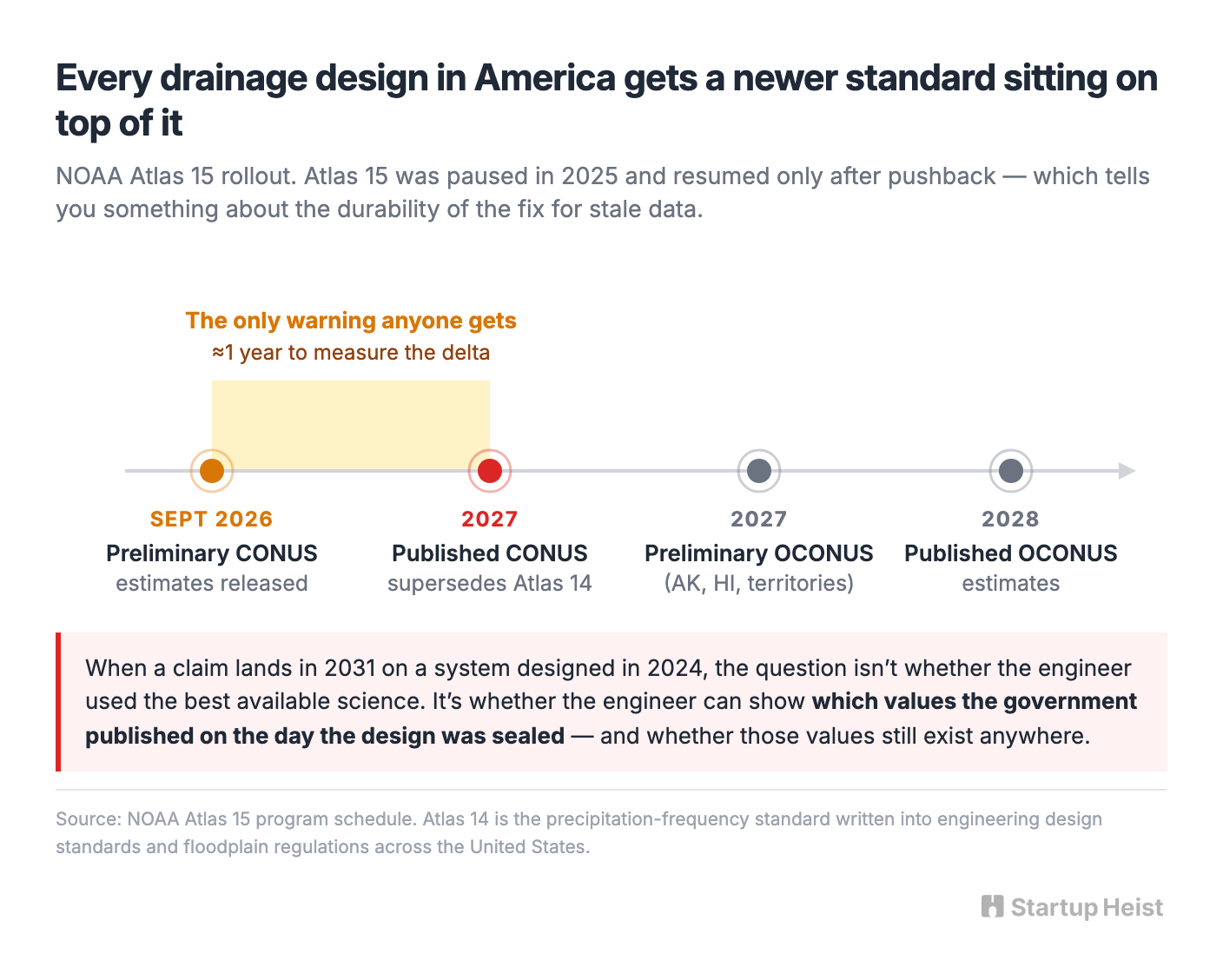
The schedule is the part to mark. Preliminary Atlas 15 estimates for the continental U.S. go out for peer review in September 2026. Published estimates arrive for use in 2027. Alaska, Hawaii, and the territories run a year behind on both. That leaves a visible window where engineers can see the delta between the old rainfall values and the new ones roughly a year before the new ones become the standard they're held to. Atlas 15 itself spent part of 2025 paused by the administration and resumed only after pushback, which tells you something about the durability of the fix for stale data.
Every design sized against Atlas 14 is about to have a superseding standard sitting on top of it. When a claim lands in 2031 on a system designed in 2024, the question won't be whether the engineer used the best available science. It'll be whether the engineer can show which values the government published on the day the design was sealed, and whether those values still exist anywhere.
The budget picture adds pressure. NOAA's FY2026 request proposed a $1.7 billion cut, roughly 27%, eliminated its research arm as a line office, and carried the literal line "Total, Climate Research: $0." Congress refused. The FY2026 Commerce-Justice-Science appropriations act became law on January 23, 2026, funding NOAA at $6.14 billion, some $1.64 billion above the request. The Senate passed it 82-15. Research survived as a line office, with a subset of its programs moved to the National Weather Service, and climate research got $224 million.
Read that as a reprieve. Climate research survived because appropriators voted to fund it, and no statute protects it from the next request. Its continuity is now an annual political outcome, re-litigated every budget cycle. A risk committee can't call a source durable when its funding gets renewed yearly by vote. Once that committee has watched a federal publication system get dismantled, rebuilt by volunteers, and rescued in an appropriations fight, treating a government URL as a permanent citation stops being defensible practice. The old workflow assumed a `.gov` address would always be there. The new one has to treat it as a third-party dependency with no SLA.
Why existing products leave an opening
The adjacent players all solve a neighboring problem and none of them own this one. Climate.us preserves and republishes climate information beautifully, and it builds nothing resembling a project-specific audit trail. Visualping and Hexowatch flag that a page changed, which is useful reconnaissance and blind to twelve revised rows inside a CSV or a shifted floodway boundary. Fathom and the flood-risk modelers sell proprietary hazard intelligence to insurers, answering what the risk is rather than what the federal source said.
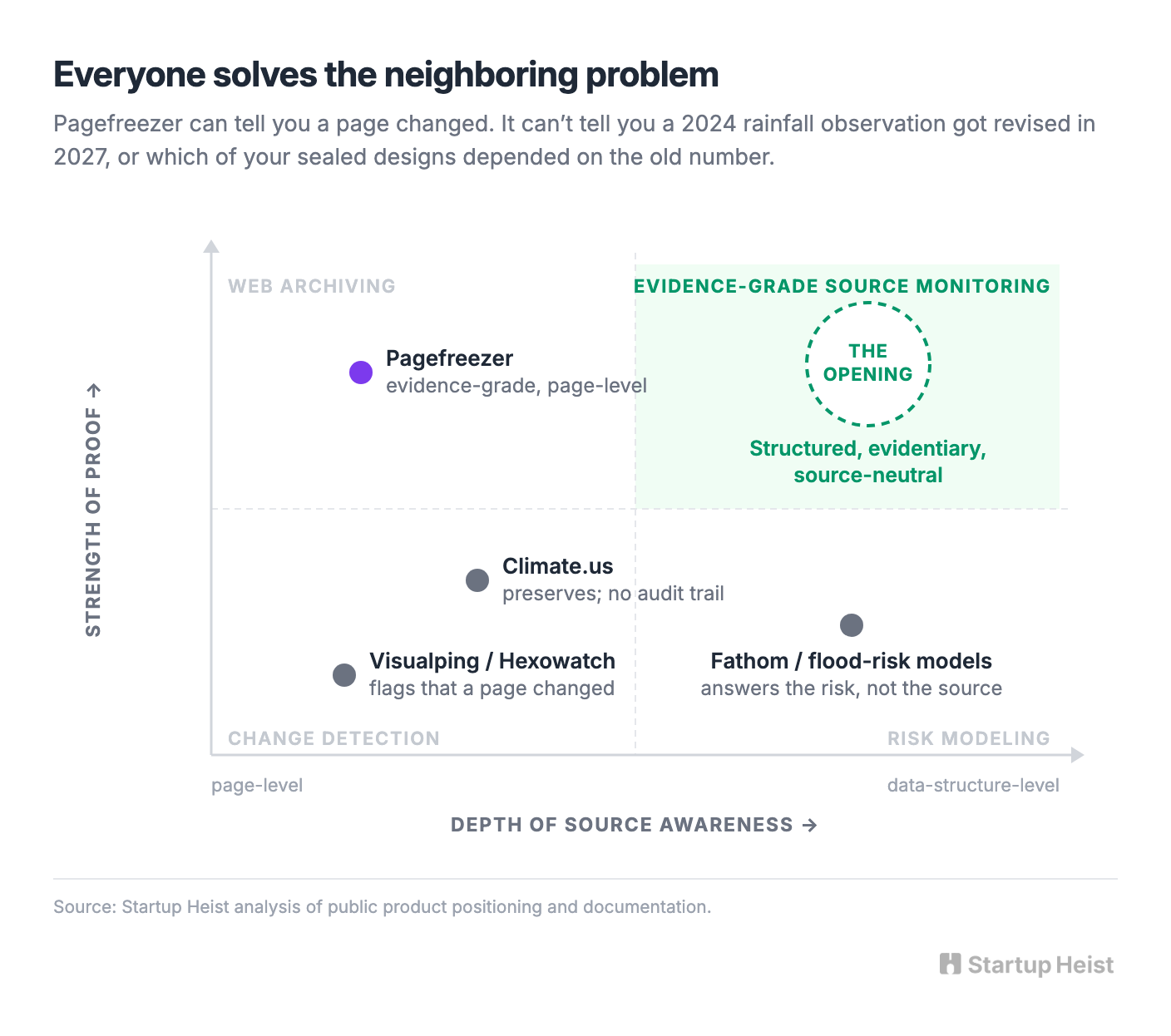
Pagefreezer comes closest, and the gap is instructive. It archives websites for legal, compliance, and e-discovery work using WORM storage, SHA-256 hashes, digital signatures, and FedRAMP authorization, and it sells into FINRA and SEC recordkeeping. The architecture is built around web pages and communications. Source-aware comparison of federal tables, GIS layers, APIs, and historical time series was never the design target. Pagefreezer can tell you a page changed. It can't tell you a 2024 rainfall observation got revised in 2027, or which of your sealed designs depended on the old number. The opening sits in that seam: more structured than web archiving, more evidentiary than change detection, more source-neutral than a risk model.
The product: evidence-grade source monitoring
Don't promise to monitor every federal dataset. That's a maintenance trap wearing a large market as a costume.
Unlock the Vault.
Join founders who spot opportunities ahead of the crowd. Actionable insights. Zero fluff.
“Intelligent, bold, minus the pretense.”
“Like discovering the cheat codes of the startup world.”
“SH is off-Broadway for founders — weird, sharp, and ahead of the curve.”


