


The Thrift Aisle Copilot
A professional reseller walks into a thrift store with two hours and four thousand items. Most of them are worthless to her. Maybe forty are worth money. Six might clear $50 in profit. Her entire job is finding those six before the guy in the next aisle does.
The current method goes like this: spot something promising, read the tag, open eBay, type a query, filter to sold listings, squint at the range, subtract fees, subtract shipping, guess at condition, decide. Put it back or put it in the cart. Then start over, one hundred and fifty times.

Google can already tell her what the item is. That was solved years ago. What nobody has solved is the sixty to ninety seconds between "I see a jacket" and "I know whether to buy this jacket," multiplied by 150 items, in a store where the good stuff gets picked over by noon.
The gap is a decision-speed problem, and mistaking it for a computer vision problem is what produces the forty-seventh disposable thrift scanner app. Here's the opportunity:
The money: 2,000 Pro subscribers at $15 a month is $30,000 MRR. Working resellers already pay $44 to $69 for tools that change one decision.
Inside:
• Three-mode copilot spec and MVP scope
• Four legal paths to resale comp data
• Pricing ladder from free to $129 team tier
• 90-day plan and first-100-users outreach
The Heist
What's worth stealing here is the minutes.
Run the arithmetic on a thrift store sourcing trip. 150 items examined at 60 to 90 seconds of research each comes to two and a half to nearly four hours of phone time inside a two-hour trip. It doesn't fit. So experienced resellers develop compression algorithms of their own: memorized brands, familiar categories, visual pattern recognition, gut.
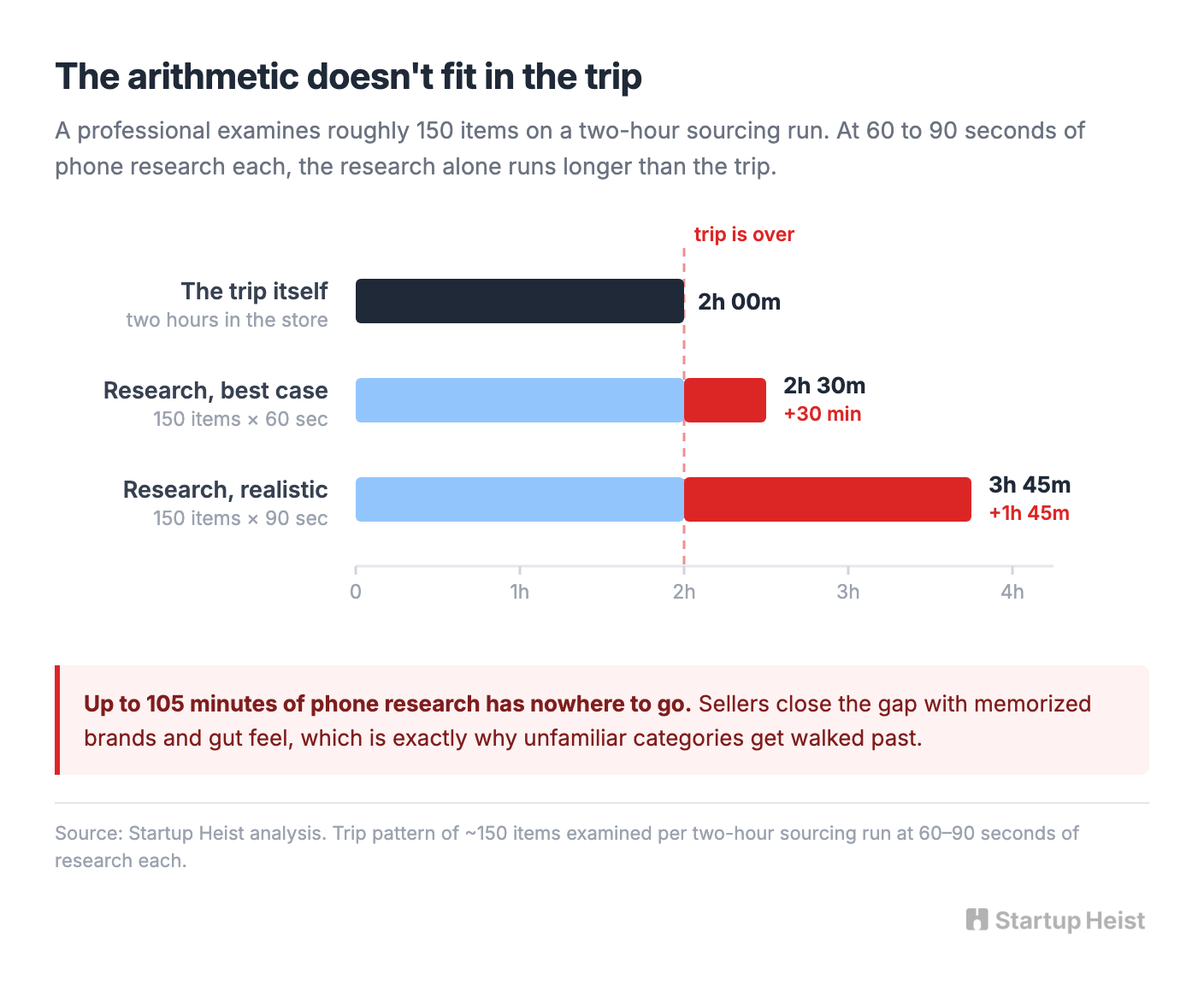
Those shortcuts work. They also function as a cage. Sellers skip unfamiliar categories because the research tax is too high, which means they walk past unusual editions, obscure model numbers, and rising brands sitting three feet away.
A sourcing copilot's job is to extend that expertise, never to replace it. The useful version says things like: this tag has a style number on it, worth a closer look. These three jackets are generic, keep walking. This model has a $30 to $300 spread depending on the year, so check the interior tag. The comps here are thin, don't trust the estimate. This one clears your margin only if the condition grades optimistically.
It's a much smaller promise than "point your phone at anything and know what it's worth," and it's the only one you can actually keep.
The Market Is Real, and Smaller Than the Headlines
ThredUp's 2026 resale report puts the global secondhand market at $393 billion by 2030, growing roughly twice as fast as apparel overall. Secondhand fashion grew 13% in 2025 while new apparel sales stayed close to flat. US resale is on track for $78.8 billion by 2030. Poshmark alone reports more than 130 million community members, 350 million items sold, and $8 billion earned by its sellers.
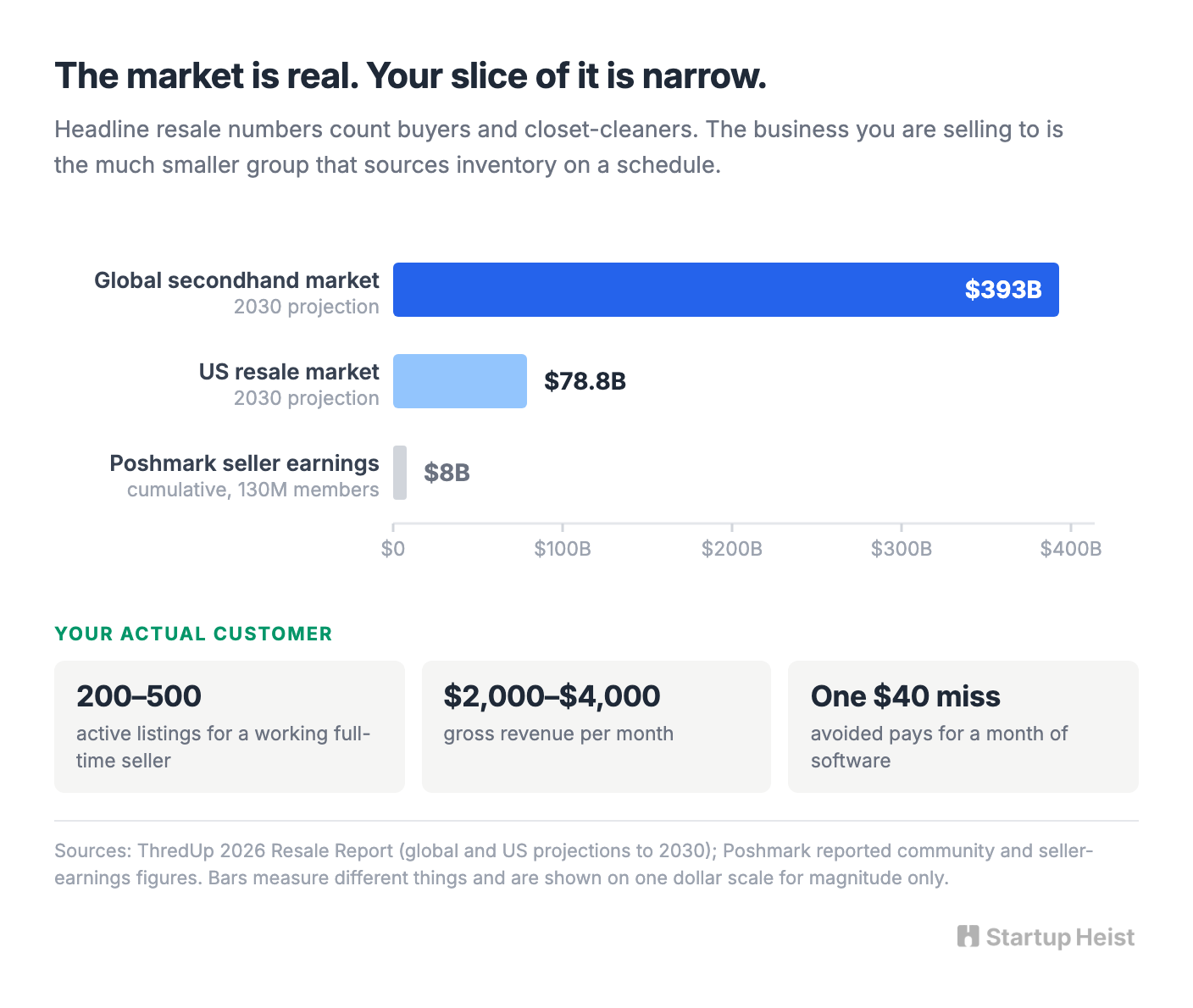
None of that means 130 million SaaS customers. Most marketplace users are buyers or closet-cleaners. Your actual market is the much smaller group that sources inventory on a schedule and treats resale as a business. Only a small fraction of the people selling across eBay, Poshmark, and Mercari reach consistent five-figure monthly profits. The working pattern among full-time sellers is 200 to 500 active listings generating $2,000 to $4,000 a month in gross revenue.
That's your customer. Narrow, with unusually legible economics. Software gets judged against four numbers she can feel: time saved per trip, profitable inventory discovered, bad buys avoided, turnover improved. One prevented $40 mistake or one extra $50 flip pays for a month.
The behavior is ready too. Circle to Search now ships on more than 580 million Android devices, and Google upgraded it in February 2026 to reason across multiple objects in a single image. Pointing a camera at the world and expecting an answer is normal. What's missing is a workflow built for this particular job.
Everybody Automated the Wrong End of the Job
eBay's Magical Listing tool takes a photo and generates a title, description, category, item specifics, and a suggested price. CEO Jamie Iannone announced the next generation of it on the company's Q4 2025 earnings call, reporting a better-than-50% lift in new listings during early testing. A bulk version turns hundreds of photos into draft listings at once. All of it happens after the item is already in your car.
Amazon automated listing too, and so does every crosslisting tool on the market. Nobody automated the aisle, where the money is actually made or lost, because the aisle is where the data is worst and the stakes are highest. The sourcing research eBay does offer is Terapeak, folded into Seller Hub as Product Research: free to every seller, three years of sold data, and a dashboard rather than a workflow. No public API, no individual sold items with exact prices and dates, and an interface built for sitting at a desk instead of standing in an aisle steering a cart one-handed. Your real competition is that free tool, used badly, sixty seconds at a time, under fluorescent light.
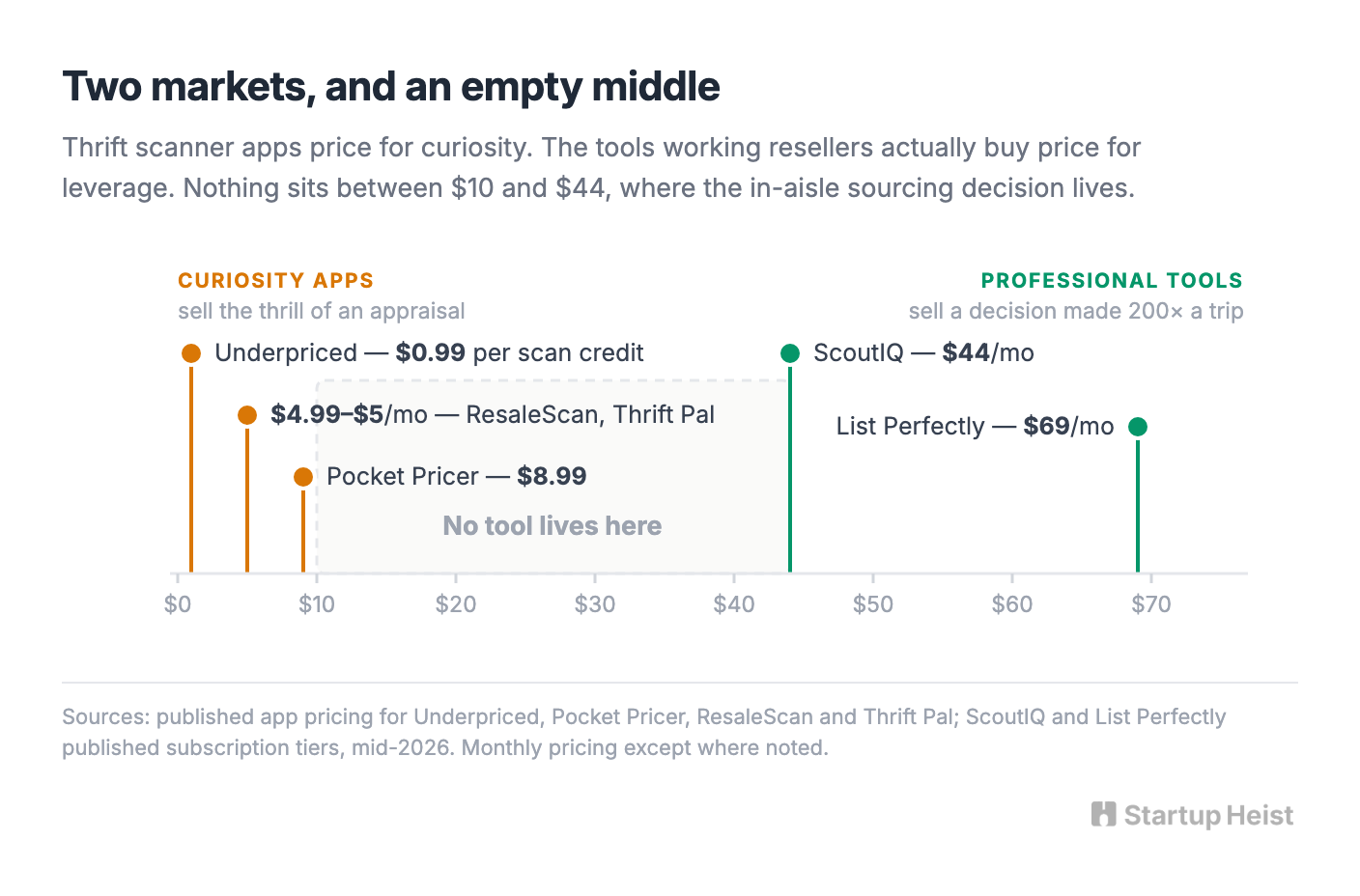
The AI thrift scanner apps went the other way and priced themselves out of the job. Underpriced, Pocket Pricer, ReSell AI, ResaleScan, Thrift Pal, ThriftValue AI, and a long tail of near-identical entrants all promise photo identification, sold comps, fee math, and buy scores. Underpriced starts at $0.99 for a single scan credit or $5 a month for twenty scans. Pocket Pricer runs $8.99. A cluster of others sit at $4.99. That's curiosity pricing, aimed at someone who found a vase at a yard sale and wants to know if it's special. Their reviews show the predictable failure: the app names the general product and misses the variant that sets the price.
Now compare the tools professionals already buy. ScoutIQ does one thing, scan a book barcode and tell an Amazon seller whether to buy it, for $44 a month. List Perfectly's tier that working resellers need runs $69. Two markets behind similar-looking interfaces: the cheap apps sell the thrill of an appraisal, the expensive ones sell a decision a professional makes two hundred times a trip.
The opening is narrow and specific. Build the fastest, most trustworthy pre-filter for serious in-store sourcing, and win on workflow and evidence rather than feature count.
Don't Build the Green-Box Oracle
The seductive demo is an always-on camera. Pan across a rack and the software boxes every item, checks sales, calculates profit, and glows green on the winners. Great video, terrible first product.
A clothing rack is a computer vision worst case: hidden labels, overlapping garments, inconsistent lighting, near-identical products, camera and items both moving, and the one detail that sets the price stitched to an interior tag nobody can see. Even with perfect identification, price stays probabilistic. A Patagonia jacket is really a family of products whose value swings on model, year, fill, size, color, condition, and whether the comp you found actually sold.
So split the job in two. Screening asks whether an item is promising enough to deserve another twenty seconds. Verification asks whether this exact item clears the margin she requires. Screening can be automated aggressively. Verification has to show its work, including when the work is thin. That split is the whole product, and it's where every scanner in the App Store is currently failing.
The Product: A Three-Mode Copilot
Mode one: live shortlist. Point the camera at a rack, shelf, or table. The app samples frames instead of reasoning over full video, hunting for high-signal identifiers: brand labels, style and model numbers, barcodes, shoe-box labels, electronics plates, logos.
Unlock the Vault.
Join founders who spot opportunities ahead of the crowd. Actionable insights. Zero fluff.
“Intelligent, bold, minus the pretense.”
“Like discovering the cheat codes of the startup world.”
“SH is off-Broadway for founders — weird, sharp, and ahead of the curve.”


