


Don't Predict the Blob. Run the Cleanup.
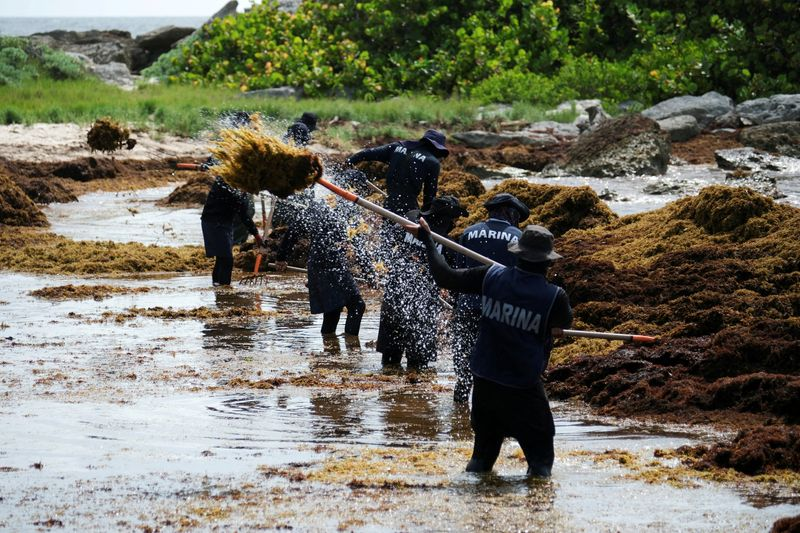
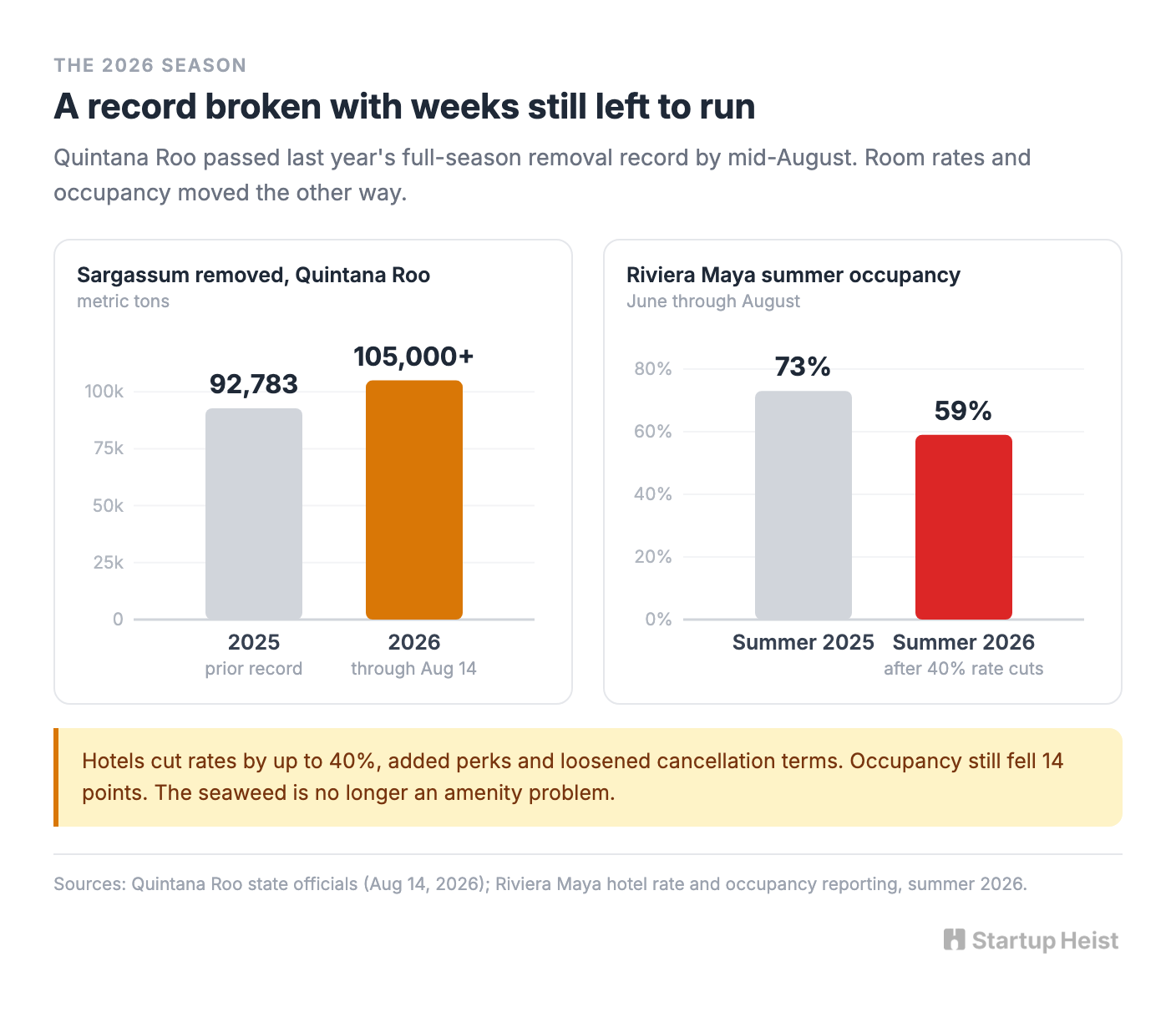
On August 14, 2026, officials in Quintana Roo reported they had pulled more than 105,000 metric tons of sargassum off Mexican Caribbean beaches so far this year. The previous annual record, set in 2025, was 92,783 tons. There are still weeks left in the season.
The commercial damage is easier to read in the room rates. Riviera Maya hotels cut prices by as much as 40% for the June-through-August window, added perks, and loosened cancellation terms. Occupancy still landed near 59%, against 73% a year earlier.
Florida is running the same problem. The University of South Florida's June bulletin put roughly 33.6 million metric tons of sargassum across all monitored regions, with the Caribbean at a record high for the month and the Gulf at 5 million tons, nearly double its 2025 record. USF's read: 2026 is the second-largest sargassum year in the satellite record, behind only 2025.
This stopped being an ugly-beach story a while ago. It's a line item. Miami-Dade taxpayers spend close to $4 million a year on the tractors alone. Fort Lauderdale spends roughly $387,000 a year cleaning its beach and running the compost pile that beach feeds, according to University of Florida economists who studied the operation. About $78,000 of that is the compost facility itself, most of it equipment: a bulldozer at $53,818 and a shaker at $10,600. The pile pays for itself several times over, saving the city around $326,000 a year in disposal it never has to buy. Landfill fees for seaweed can exceed $500 per truckload.
There's a business hiding in that spread, and it has nothing to do with removing seaweed.
The money: Five pilots at $3,500 funds the build. 125 properties at $4,000 a year is $500,000 recurring. Miami-Dade spends $4M a year on tractors alone.
Inside:
• Seven-part MVP for beach incident response
• Pricing from $3,500 pilot to $30K portfolio
• The Florida permit rules that create lock-in
• Cold email plus the 90-day validation plan
The tractors are the least interesting part of it. Everything that happens between "sargassum may be coming" and "the beach is clean, the disposal is documented, management is informed, and the guests have been handled" is still run by hand, over phones, from memory.
What's missing is a permit-aware sargassum incident-response system for private beachfront hotels, resorts, condominium associations, and vacation-rental managers. It takes regional risk signals plus property-level observations and turns them into an operational workflow: assess the beach, decide whether to act, dispatch the right crew, follow the property's approved procedure, capture before-and-after evidence, log removal and disposal, and trigger pre-approved guest communications.
It's an unglamorous product that becomes very hard to remove once it's running. Better still, you don't need to solve oceanography to build it.
The trap: building a better seaweed forecast
At first glance this reads like a data startup: pull satellite imagery, layer in winds and currents, train a model, predict which hotel gets buried tomorrow. That's the wrong end of the problem.
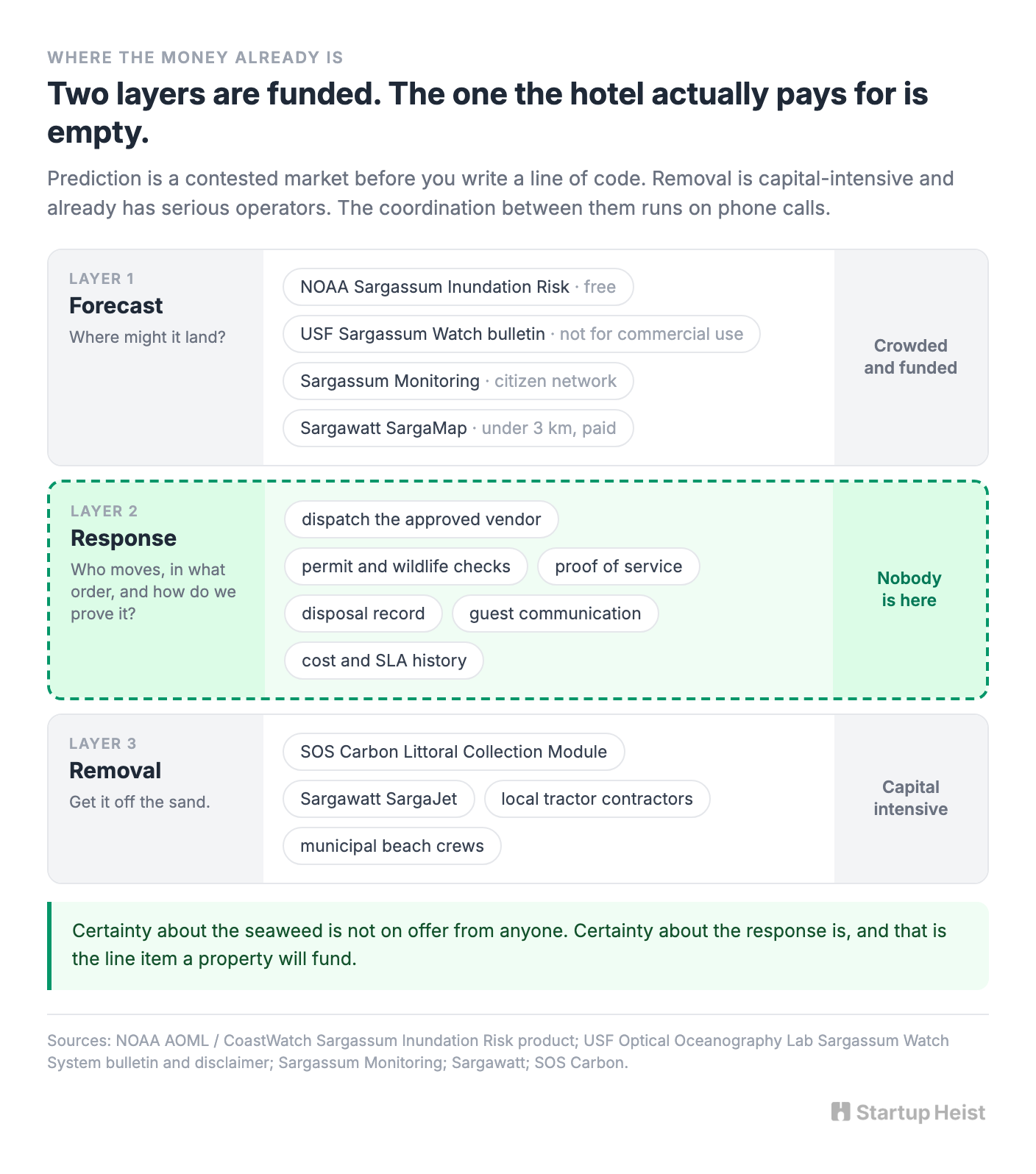
The category is already crowded and already funded. NOAA publishes a daily Sargassum Inundation Risk map covering affected U.S., Caribbean and Central American coastlines, built jointly by NOAA's Atlantic Oceanographic and Meteorological Laboratory, CoastWatch, and USF. It sorts coastal pixels into four risk tiers by comparing nearby floating-algae index values against a multiday baseline. Sargassum Monitoring runs a citizen-science network of crowdsourced photos and forecasts across dozens of affected countries. Martinique-based Sargawatt sells SargaMap, a subscription web app aimed squarely at hotels, coastal communities and marine operators, which sharpens the forecast grid from roughly 30 kilometers down to under 3 and pushes daily one-week outlooks. The map is a contested market before you write a line of code.
The deeper problem is that the last mile stays uncertain no matter who wins. Local winds, tides, waves and currents decide whether offshore sargassum actually lands on your sand. NOAA researchers found that adding shoreward wind velocity to the risk index substantially improved agreement with what people were actually observing on beaches, which is another way of saying the risk index alone didn't agree very well. USF's own Sargassum Watch System puts a hard line in its disclaimer: the bulletin should by no means be used for commercial purposes, or used for predicting bloom conditions for a specific location or beach.
The best-funded science group in the field is saying, in its own legal language, that its product can't answer the only question a hotel actually asks.
That disclaimer is also a build constraint. Don't put a commercial product on top of scraped USF bulletins. Build on NOAA's publicly distributed Sargassum Inundation Risk product, on customer-owned field observations, and on data you have clear rights to use. If USF's science later becomes material to what you sell, go get an explicit commercial license from the Optical Oceanography Lab. Input feeds change. The workflow you encode survives the swap.
That gap is the business. Certainty about the seaweed isn't on offer from anyone. Certainty about the response is, and that's what a property will pay for: when conditions deteriorate, it already knows who moves and in what order. Closer to PagerDuty than to a Bloomberg Terminal.
What the customer is actually buying
Take a 120-room independent beachfront hotel. At 6:15 a.m. the maintenance manager walks the property line and finds moderate accumulation across two zones.
Eight decisions land on him at once. Is more coming. Does this justify mechanical removal or hand crews. Which cleanup contractor is available on a Saturday. Has the turtle survey cleared. Where can the material legally go. Who signs off on an unbudgeted cleanup. Does the front desk need a script before check-out traffic starts. Was the last contractor invoice even correct.
A generic work-order system can create a task called "clean beach," WhatsApp can reach the tractor guy, and a satellite map can show offshore conditions. None of them produces the chain that runs from the 6:15 observation to a cleared beach and a verified invoice, and that chain is what the property is actually buying.
The wedge: build the incident record
Every sargassum event becomes a structured object inside the system. Property, zones affected, observed severity, regional risk tier, time first verified, approved vendor, response target, permitted cleanup method, wildlife clearance status, dispatch time, arrival time, before photos, loads removed, disposal destination, completion time, after photos, invoice amount, guest message sent, complaints logged, compensation issued.
One record is a chore. By the fiftieth, it's an asset the property can't recreate any other way.
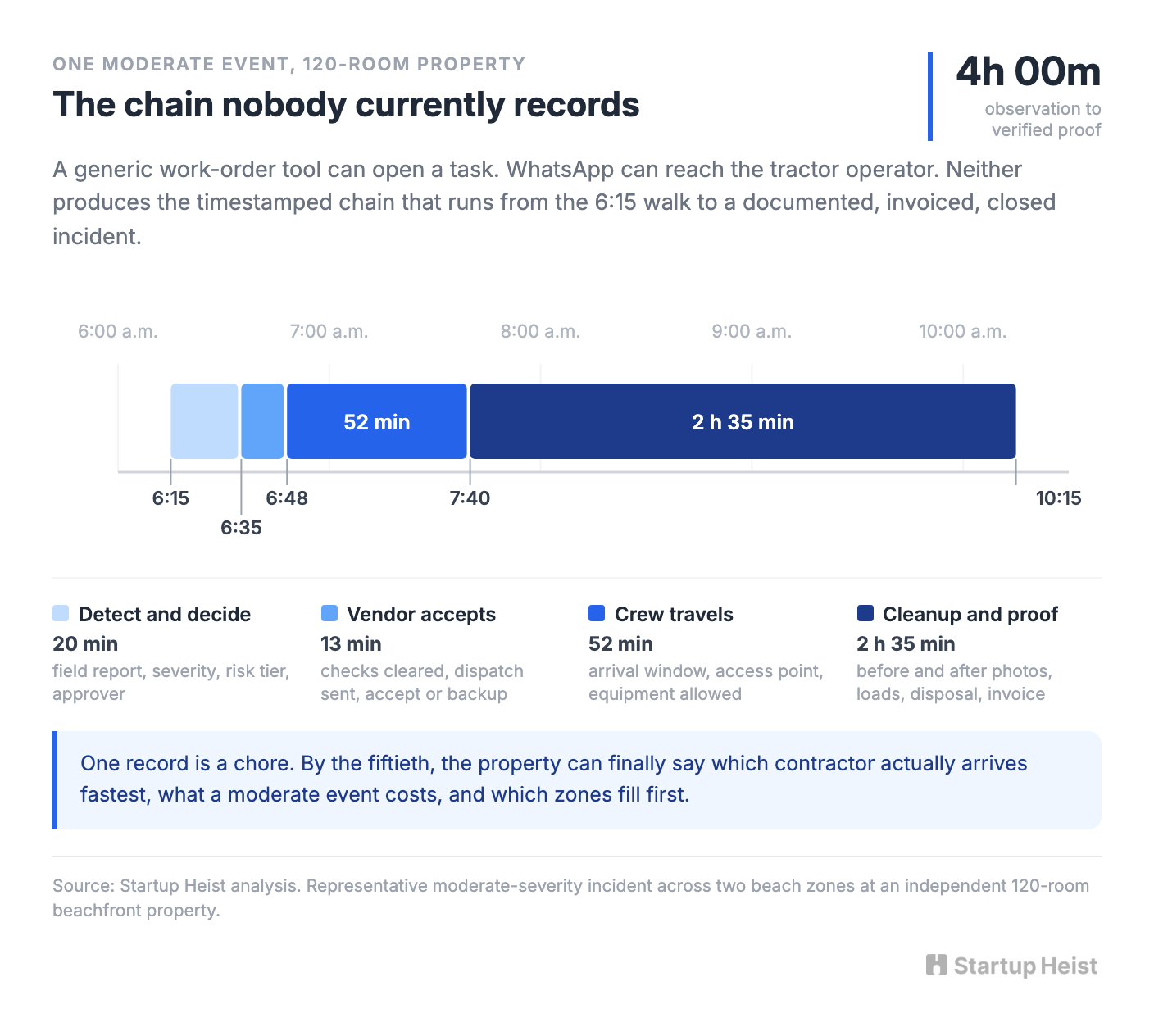
After a season, the property can finally answer questions it has never been able to answer: which contractor actually arrives fastest, what a moderate event costs on average, which beach zones accumulate first, how often emergency dispatch is required, whether cleaning at 6 a.m. reduces guest compensation compared with cleaning at 10 a.m., and which vendor consistently invoices above its own historical average.
Nobody renews software to keep a prettier map. They renew to keep four seasons of operating history they're using to build next year's budget.
Compliance is the killer feature
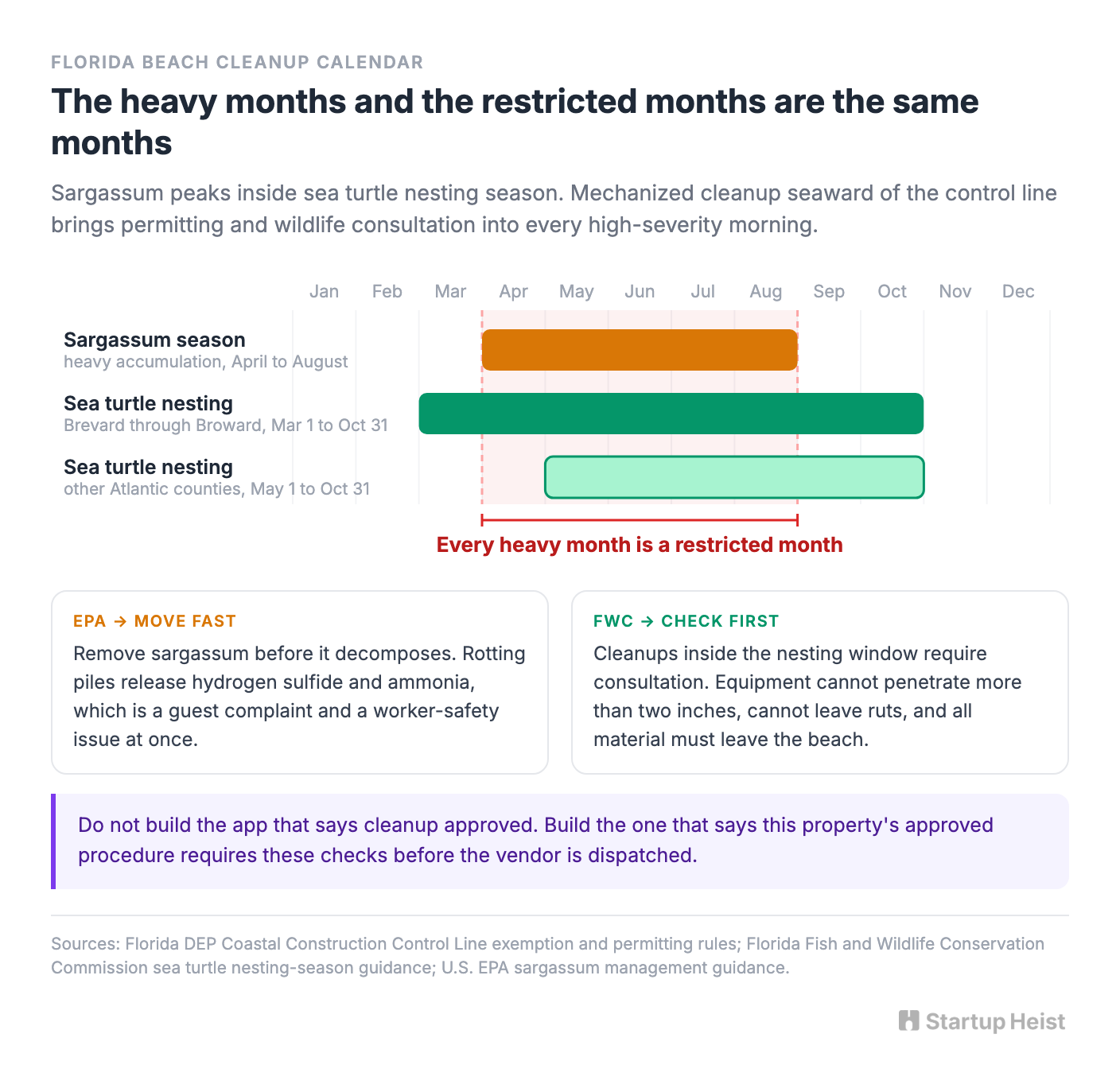
Beach cleanup in Florida involves considerably more than sending a guy with a tractor.
Unlock the Vault.
Join founders who spot opportunities ahead of the crowd. Actionable insights. Zero fluff.
“Intelligent, bold, minus the pretense.”
“Like discovering the cheat codes of the startup world.”
“SH is off-Broadway for founders — weird, sharp, and ahead of the curve.”


