


The Notch Is the Billboard, Not the Business
Every startup opportunity has a natural size. Some ideas deserve venture capital, a 40-person engineering team, and a ten-year roadmap. Others deserve a sharp landing page, two weeks of Swift, and a $24 checkout button. This is the second kind.
The MacBook notch is the black cutout at the top of every MacBook Pro screen since 2021 and every MacBook Air since 2022. Most people tolerate it. A small group of developers has started treating it as usable real estate: a natural place to drag files, stash screenshots, and trigger tiny automations. FileNotch is the cleanest demo of the behavior. Drag a file into the notch, the upload starts automatically, and a shareable link lands in your clipboard. The free plan caps you at 15 uploads a month, and Pro runs $4.99 per month for multi-file bundles, custom expiration windows, password protection, and email-gated downloads. The value is obvious before anyone explains it.
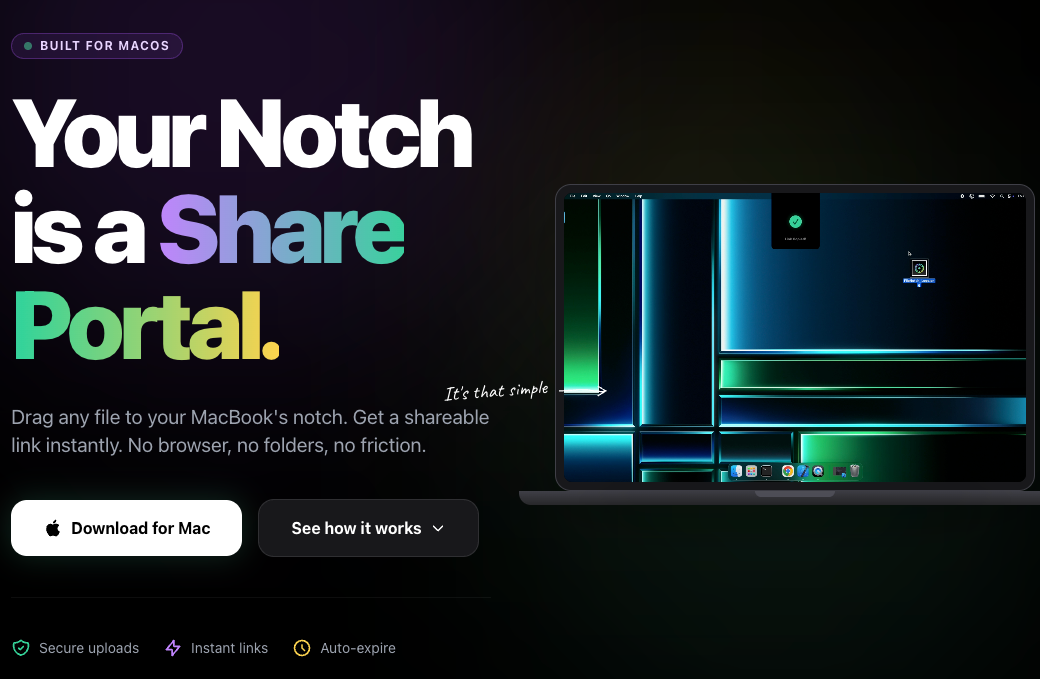
The opportunity is easy to misread, though. The market already has music controls, calendars, Pomodoro timers, clipboard managers, file trays, AirDrop buttons, battery indicators, mirrors, browsers, and AI features crammed into the top few pixels of a MacBook display. Building one more widget suite means joining that pile. The stronger heist is smaller: a native macOS utility that turns the notch into a friction-cutting drop target for one or two high-frequency workflows. Sell it as a polished paid tool, keep it local-first, and add recurring cloud features only after users prove they need them. Done well, this becomes a durable $3,000-to-$10,000-per-month indie software business with low overhead. That's plenty.
Here's the opportunity:
The money: 250 license sales a month at $24 is $6,000 gross monthly. Layer a $4.99 cloud relay tier on top, and 500 subscribers adds $2,495 MRR.
Inside:
• Full V1 MVP scope, shippable in 2-4 weeks
• Two-tier pricing: $24 local, $4.99 cloud relay
• The persona that justifies paying $24
• Bottom-up revenue model and kill criteria
The hidden tax inside a three-second task
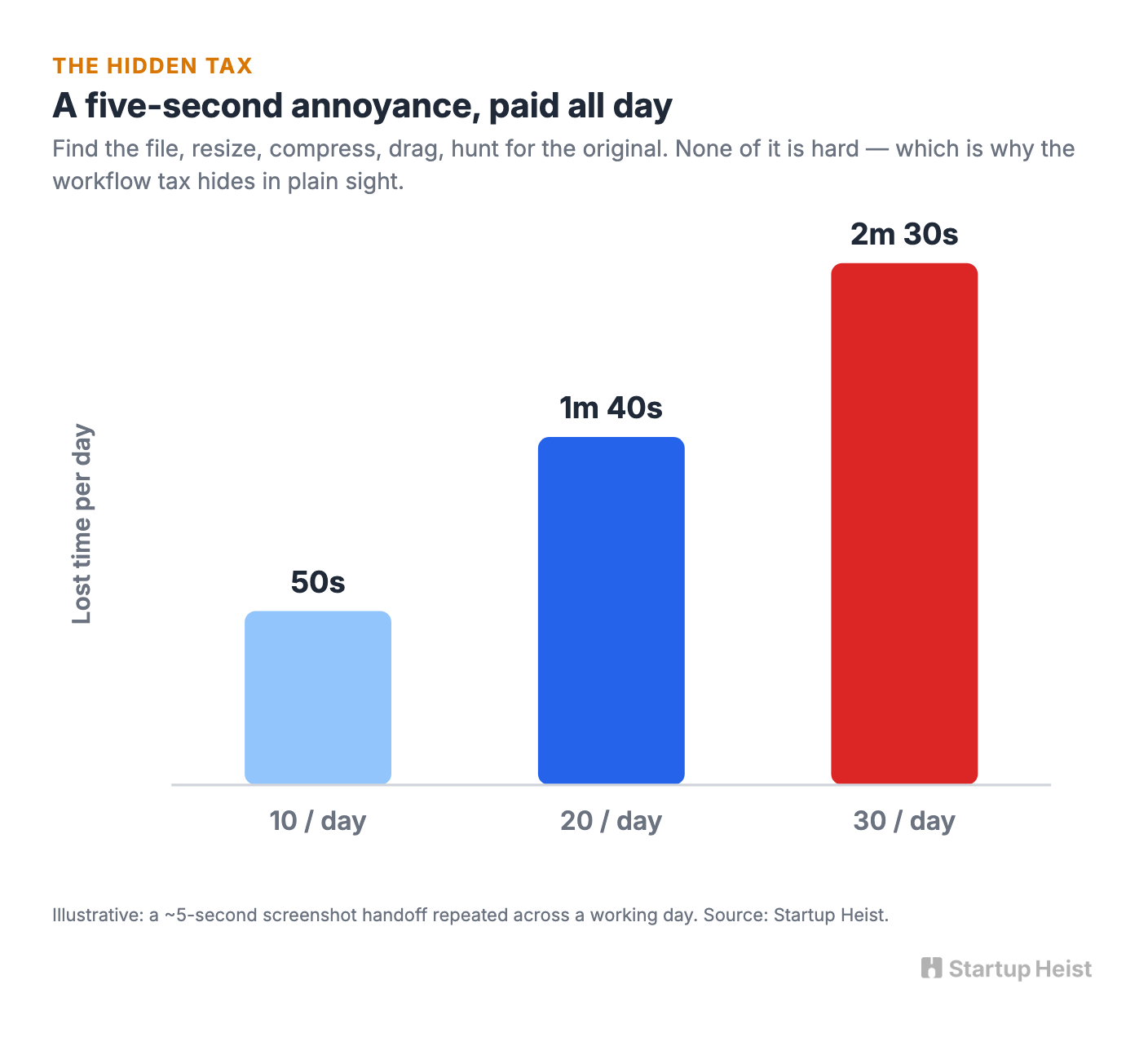
The best utility software removes tiny annoyances that repeat all day. Consider a designer or product manager. They take a screenshot, find it on the desktop, resize it, compress it, drag it into Slack, then hunt for the original because the first version was too large. Later they need to send three files to a client, so they open a cloud drive, create a folder, upload the assets, fix the permissions, and paste the link. None of these steps is difficult, which is exactly why the opportunity hides in plain sight.
A five-second interruption repeated 30 times a day becomes a workflow tax. It breaks concentration, clutters the desktop, and forces a stream of low-value decisions: where did that screenshot go, which version is current, did I copy the link.
The notch works as a fix because it is always present, visually distinctive, and sits directly in the path of a drag gesture. It behaves like a physical target built into the machine, which gives a tiny utility the one thing most tiny utilities struggle to earn: instant comprehension. A user watches an eight-second demo and understands the product completely.
A healthy market, a deliberately small niche
The spending power is real. Apple reported $33.7 billion in Mac net sales for fiscal 2025, up 12% from $30.0 billion the year prior. On June 4, 2026, Apple announced that the App Store ecosystem facilitated more than $1.4 trillion in developer billings and sales during 2025, including $149 billion in digital goods and services. Mac users demonstrably pay for software.
Those numbers set the ceiling, not the target. A notch utility addresses a subset of MacBook owners: people who work heavily on their laptops and care enough about workflow speed to buy a specialized tool. Apple publishes no installed-base figure for notch-equipped MacBooks, so treat the addressable market as constrained. That constraint should shape the business: keep acquisition cheap, make the product legible in a short video, sell direct, and skip venture capital entirely.
The hardware limit matters less than it appears. Several competitors already serve notchless desktops and external monitors with a virtual top-center drop zone. The physical notch is the hook, but the real product is a top-of-screen drop target.
The crowd at the top of the screen
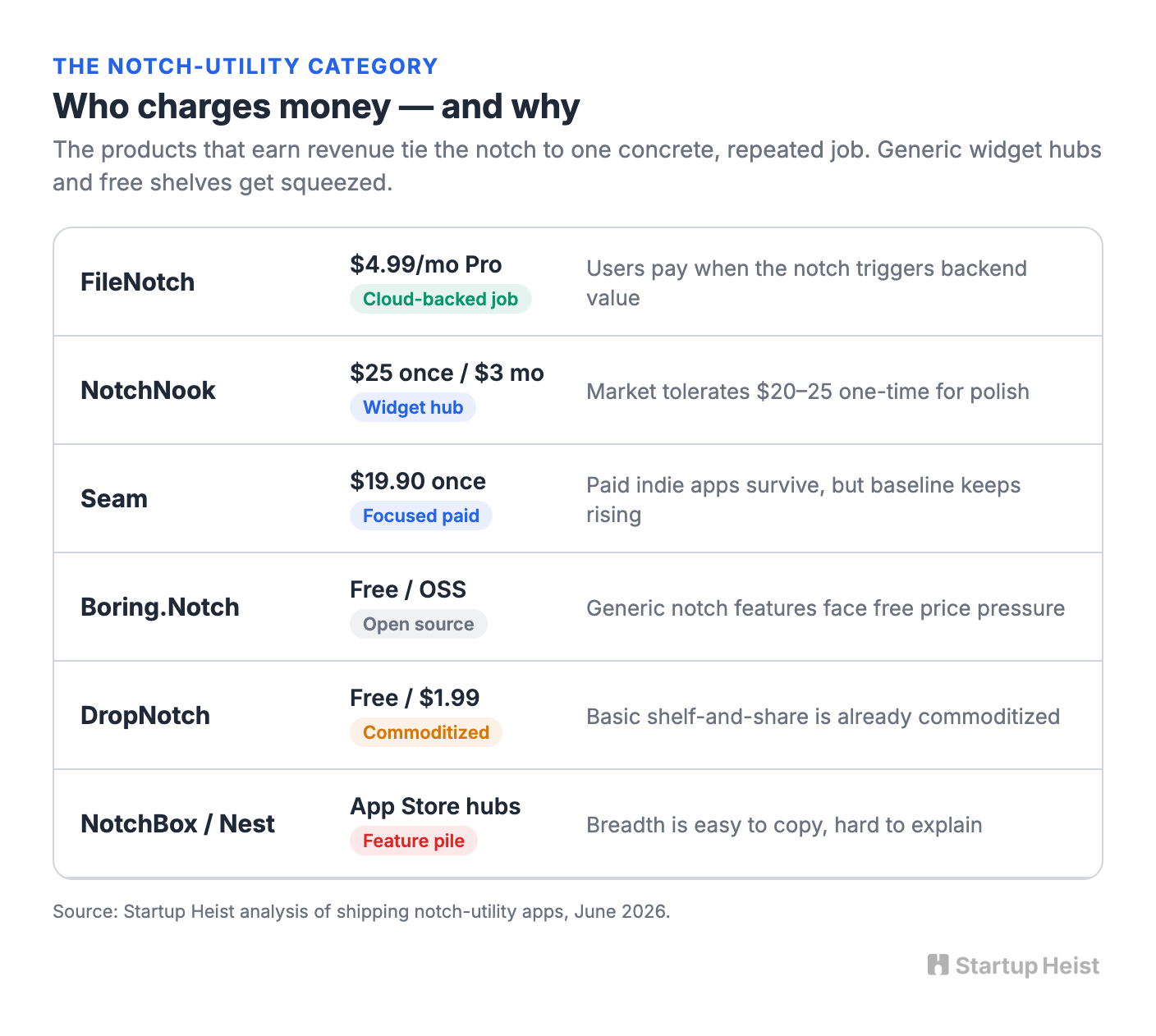
A few years ago, turning the notch into a utility surface sounded novel. That window has closed. A recognizable micro-category of notch utility apps now exists, and its shape tells you exactly where the money is.
| Product | Position | What it signals |
|---|---|---|
| FileNotch | Drag files to the notch, get a secure shareable link. Free plan, then $4.99/month Pro | Users pay when the notch triggers a concrete job with backend value |
| NotchNook | Widget hub with file shelf, live activities, controls. $25 one-time or $3/month | The market tolerates $20-25 one-time pricing for polish |
| Boring.Notch | Free, open-source: music controls, file shelf, calendar | Generic notch features face immediate price pressure from free |
| Seam | $19.90 one-time: music, calendar, timers, voice-to-text | Focused paid indie apps still compete, but the feature baseline is rising |
| DropNotch / NotchDrop | Drop zones for AirDrop and native sharing. DropNotch free; NotchDrop free to compile, $1.99 on the App Store | The basic shelf-and-share workflow is already commoditized |
| NotchBox / NotchNest | App Store hubs stacking storage, clipboard, timers, browsers, AI tools | Feature breadth is easy to imitate and hard to explain |
The pattern is consistent. Free and open-source tools have commoditized the basic shelf. Widget hubs keep adding features nobody remembers. The products that charge money successfully tie the notch to one concrete, repeated job.
So don't build NotchOS. Every additional widget adds engineering complexity while making the product less memorable. The sharper framing: find the single file-handling workflow that a specific kind of Mac user repeats often enough to justify paying $24, then build only that.
The heist: a notch-native handoff utility
Call the product NotchRelay for now. The name matters less than the promise: drag a file into your notch, get it ready to send.
NotchRelay is a small native Mac app for people who constantly move screenshots, images, PDFs, and deliverables between applications. It has two jobs.
Unlock the Vault.
Join founders who spot opportunities ahead of the crowd. Actionable insights. Zero fluff.
“Intelligent, bold, minus the pretense.”
“Like discovering the cheat codes of the startup world.”
“SH is off-Broadway for founders — weird, sharp, and ahead of the curve.”


