


For years, astrology apps have sold the same product: a daily horoscope, a birth-chart reading, a Mercury retrograde notification, maybe a compatibility report for your latest crush.
AI just changed the format.
In June 2026, Marc Zao-Sanders' annual analysis "How People Are Really Using AI," published in Harvard Business Review, placed astrology and tarot reading among the ten most popular consumer uses of AI for the first time, alongside fan fiction and AI-generated entertainment.
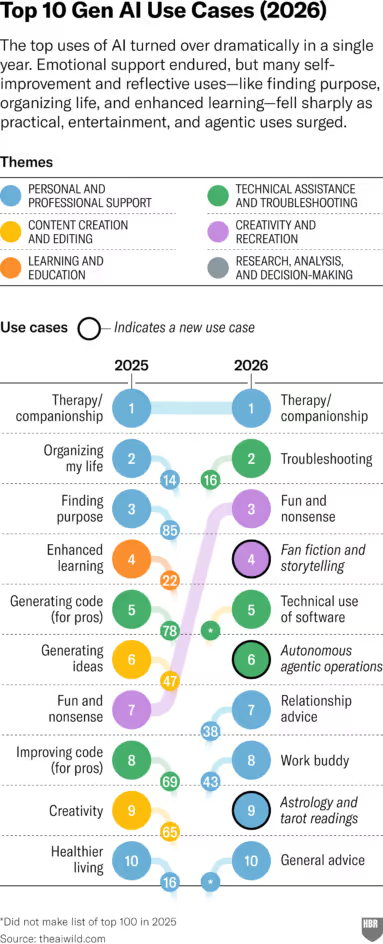
The press coverage filed it under time-wasting nonsense and missed the actual story. A chatbot interpreting a tarot card is technically trivial. What matters is that millions of people are inviting AI into a private ritual, asking it to turn uncertainty into a story that feels personal.
Here's the opportunity:
The money: 5,000 subscribers at $8.99/month is roughly $45,000 MRR. CHANI and Nebula already clear $400K-$500K monthly in the U.S.
Inside:
• Full six-week MVP scope and stack
• Five-layer moat beyond the LLM wrapper
• Pricing: hard paywall, annual trial timing
• Practitioner-first GTM with outreach templates
This is not fringe behavior hiding in a crystal shop. A Pew Research Center survey published May 21, 2025 found that 30% of U.S. adults consult astrology, tarot cards, or fortune tellers at least once a year. Most treat it as entertainment, though 10% engage because these practices give them helpful insights. Among adults under 30, the numbers jump: 37% consult astrology annually and nearly a quarter use tarot cards. That under-30 cohort is exactly the demographic already comfortable talking to AI.
There is a clean startup opportunity here, and it is easy to build the wrong thing. The wrong thing is an AI oracle that claims to know the future, a synthetic therapist in a velvet robe, or an unlimited-chat companion designed to keep emotionally vulnerable users coming back for reassurance.
The right thing is a premium ritual companion: an astrology-and-tarot app that turns symbolic prompts into short, personalized moments of reflection. A daily card pull, relevant astrological context, a few thoughtful follow-up questions, and a private journal that remembers recurring themes over time.
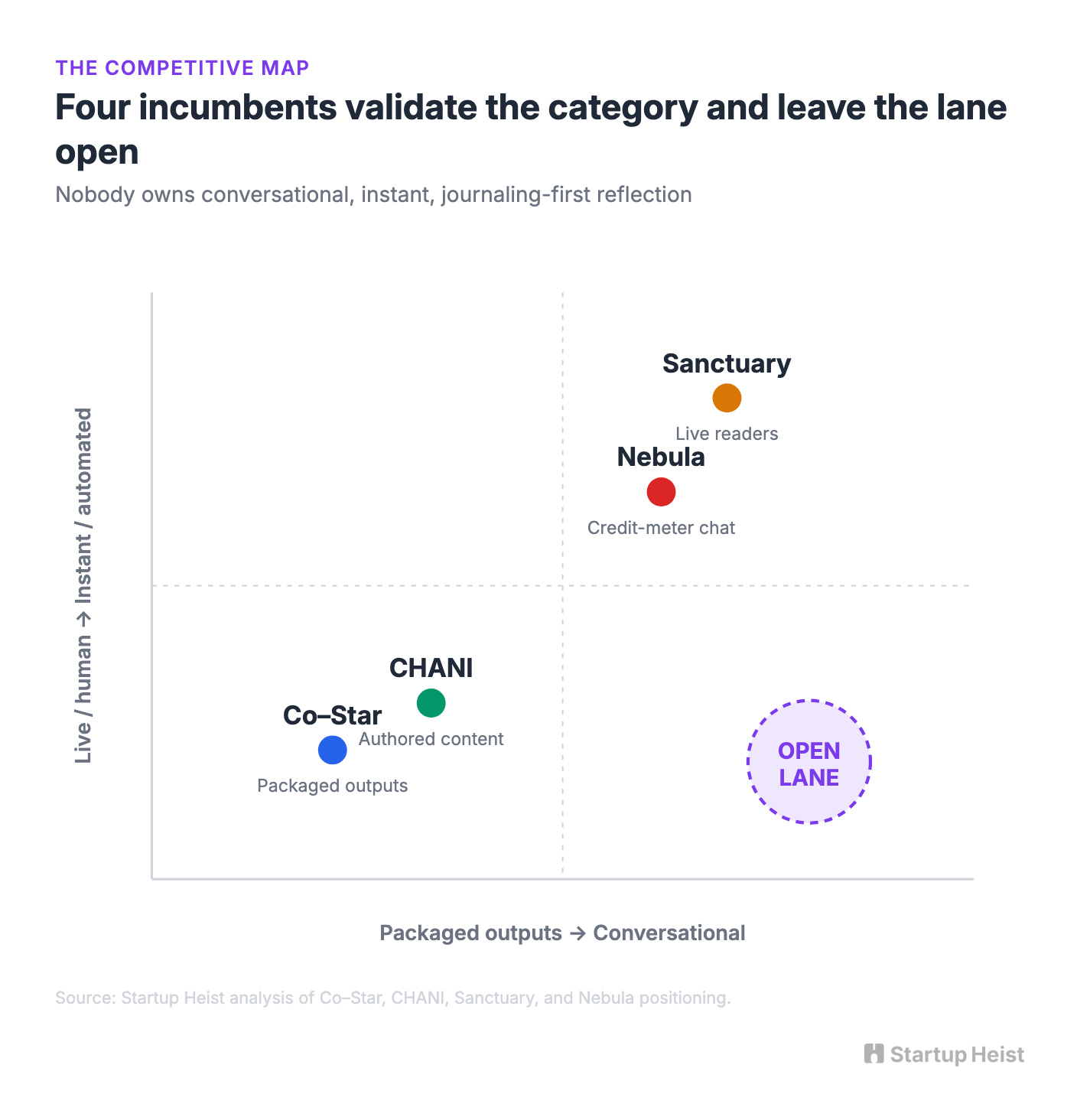
The positioning fits in one line: warmer than Co–Star, cheaper than a live reader, more conversational than a horoscope feed, less transactional than a credit-meter psychic chat.
A word on ambition. This is a plausible bootstrapped consumer subscription with a credible path to five-figure monthly recurring revenue, not an automatic venture story. The fast heist is a focused subscription app. The longer game is an operating system for reflective rituals, and you earn it by nailing the first thing.
The Category Is Already Monetized
The strongest evidence here is years of actual consumer spending, not a market-research forecast. Sensor Tower estimated that U.S. consumers spent nearly $39.7 million across the ten highest-grossing astrology apps in 2019, up 64.7% year over year, on roughly 19 million first-time installs. That was before conversational AI existed as a mainstream emotional interface.
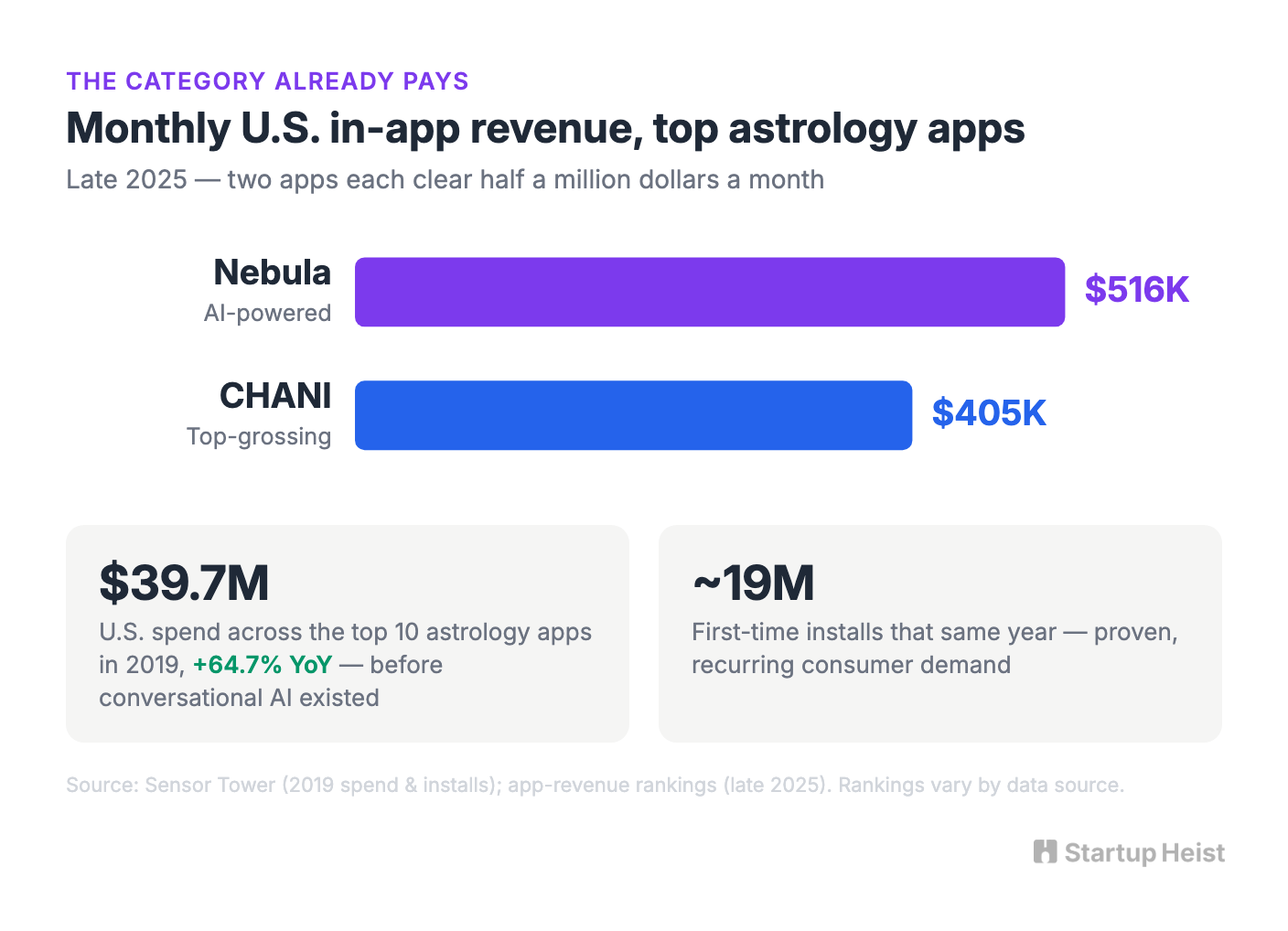
As of late 2025, two apps anchor the top of the U.S. market: CHANI, which leads in some rankings, at roughly $405,000 in monthly in-app revenue, and Nebula, an AI-powered competitor, at about $516,000 a month. Rankings shift month to month and vary by data source, but the signal holds: multiple apps in this category clear six figures monthly. One market-research vendor pegs the global horoscope-and-astrology-app market at $1.26 billion in 2026, growing to $2.16 billion by 2032. Treat the forecast as directional; the monthly revenue figures are the real proof.
| Product | What it sells | Monetization signal | The opening |
|---|---|---|---|
| Co–Star | Personalized astrology with a sharp, editorial voice | Premium tier at $8.99/month, plus one-time questions and reports | Strong brand, but organized around packaged outputs |
| CHANI | Astrology framed around self-discovery and wellbeing | $11.99/month or $107.99/year; top-grossing in some U.S. rankings | Premium ritual content validated, but authored rather than conversational |
| Sanctuary | Live astrology, tarot, and psychic readers | Intro five-minute readings from $4.99, then per-minute pricing | Human authenticity, but live labor is expensive and not instant |
| Nebula | Spiritual guidance with expert chat and daily practices | ~$516K/month U.S. revenue; credits per minute for advisor chat | Paid guidance proven, but credit meters feel transactional |
Together these four companies prove the pattern that matters. Co–Star's paid questions show users will pay for more personalized interpretation. CHANI's journal prompts and reflective practices show spiritual products live comfortably inside self-discovery. Sanctuary and Nebula show customers pay substantially more when guidance feels conversational and attentive, even when the per-minute meter makes vulnerability feel like a taxi ride. The market does not need another generic horoscope feed, and it does not need a chatbot with a moon icon and a mystical system prompt. The opportunity sits between those two products, and nobody owns it yet.
What Customers Are Actually Buying
Tarot works as a product interface because it creates a structured pause. A user arrives with a vague feeling: nervous about an interview, stuck on a decision, still thinking about an ex. A card or a transit gives that feeling a symbolic starting point. The app's job is not to resolve the uncertainty. Its job is to make the uncertainty easier to examine.
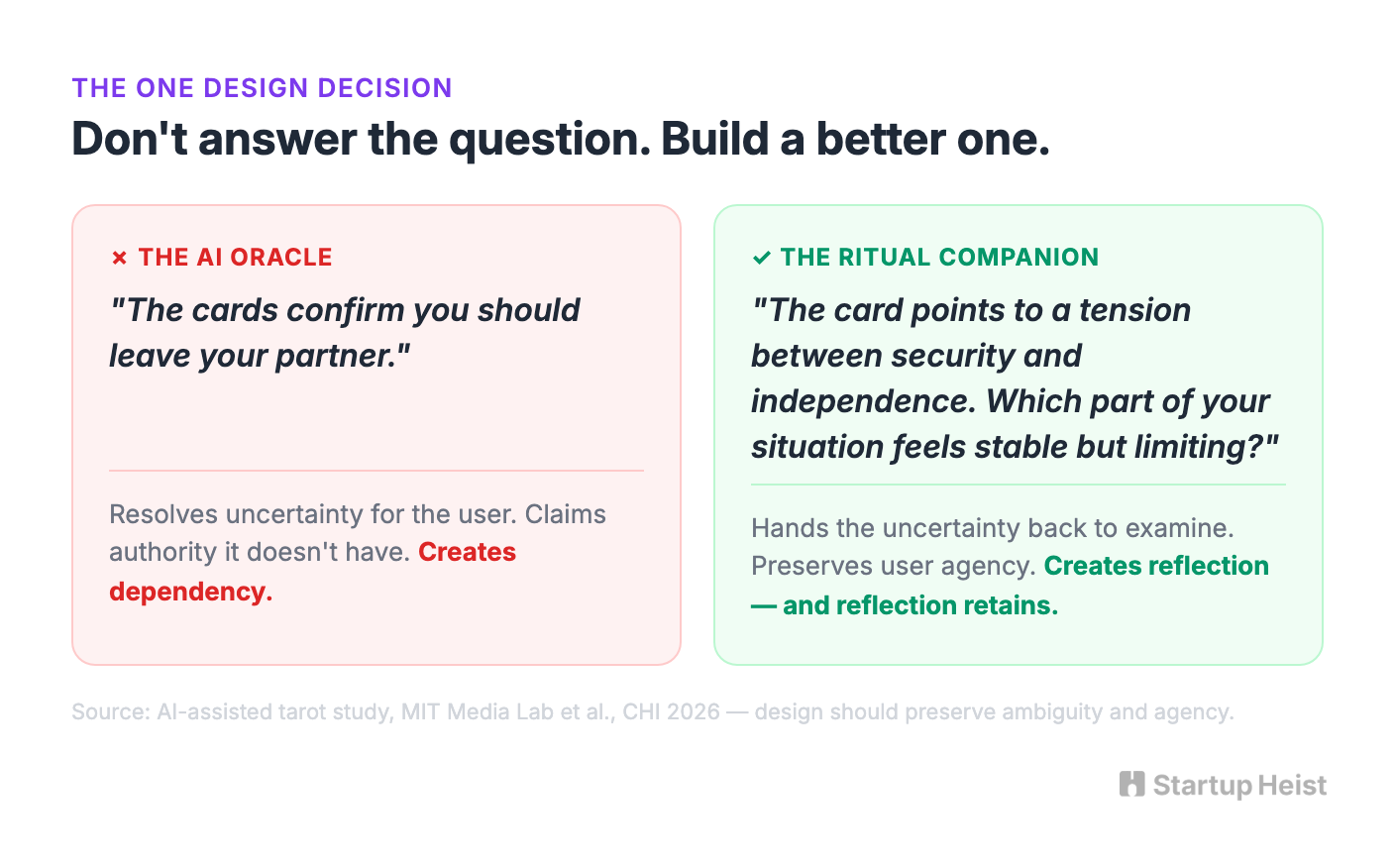
There is research behind that framing. A qualitative study of AI-assisted tarot practices, presented at CHI 2026 (the flagship ACM conference on human-computer interaction) by authors from MIT Media Lab and other research institutions, found that people use AI to navigate uncertainty, explore alternative interpretations, and extend reflective practices they already have. The researchers argued that good design should preserve ambiguity and user agency rather than collapsing the reading into one authoritative answer. The product implication is concrete. The app should never say "the cards confirm you should leave your partner." It should say "the card points to a tension between security and independence. Which part of your situation feels stable but limiting?" The first answer creates dependency. The second creates reflection, and reflection is what retains.
So the symbolic layer is not the answer engine. It is the interface for a better question. The winning app feels personal without pretending to be omniscient, remembers enough to get better over time, and keeps returning the user to their own judgment. The product loop, the moat, the pricing, the go-to-market all follow from that one design decision.
The Product: A Three-Minute Daily Ritual
The best initial product is narrow enough to become a habit. Open the app in the morning. See one thoughtfully designed card. Read a short interpretation grounded in the card, your natal chart, and your recent journal history. Answer one question. Optionally explore a follow-up or two. Close the app. At night, a brief check-in: where did today's theme appear?
That is the loop, and everything else is built on top of it.
Onboarding asks for birth date, time, and location. Users can skip the astrological layer entirely if they only want tarot and journaling. They pick a tone (gentle, practical, curious, or more mystical) and the app generates a natal-chart profile with an honest frame: "Your chart and cards are symbolic tools for reflection. They do not predict outcomes or replace professional advice."
Each day includes five elements:
Unlock the Vault.
Join founders who spot opportunities ahead of the crowd. Actionable insights. Zero fluff.
“Intelligent, bold, minus the pretense.”
“Like discovering the cheat codes of the startup world.”
“SH is off-Broadway for founders — weird, sharp, and ahead of the curve.”


