


A shopper is staring at a $240 pair of boots.
The product page already has a size guide. The return policy is one click away. A chatbot can summarize both in five seconds. None of that is what's holding up the sale. The shopper wants to know whether the boots will look too bulky with straight-leg jeans, whether someone with wide feet should size up, whether the leather softens after a few wears. That isn't a database query. It's a small judgment call, and right now nobody on the page can make it.

Now imagine a badge beside the Add to Cart button:
Not sure? Ask a real person. Average reply: 7 minutes.
While every customer-service platform races to automate more conversations, the next generation of live chat may run the other way: a deliberately human layer that brands add to their highest-friction pages as a conversion tool. A small, visible promise that a real person is available when the customer wants judgment, reassurance, or taste. Call it the human button. The code isn't especially difficult. The category positioning is where the work lives.
Here's the opportunity:
The money: 200 merchants at $750/month is $1.8M ARR; 1,000 at $1,000/month reaches $12M. Solo founder starts with one category and a paid pilot.
Inside:
• Full MVP scope for a concierge pilot
• Three-tier pricing from $499 to $3,000/month
• 90-day plan with merchant outreach template
• Three compounding moats worth building
The signal hiding inside a joke
In March 2026, a 17-year-old programmer in Puducherry, India named Mihir Maroju launched a parody chatbot called Your AI Slop Bores Me. It looks like an LLM interface, except the answers come from randomly selected humans. Users earn credits by answering strangers' prompts within 60 seconds, then spend those credits asking questions or requesting hand-drawn images of their own. Within its first week, the site recorded roughly 50 million hits and 16,000 concurrent users. By mid-April 2026, Maroju told NPR it had passed 25 million unique visitors and nearly 280 million total hits.
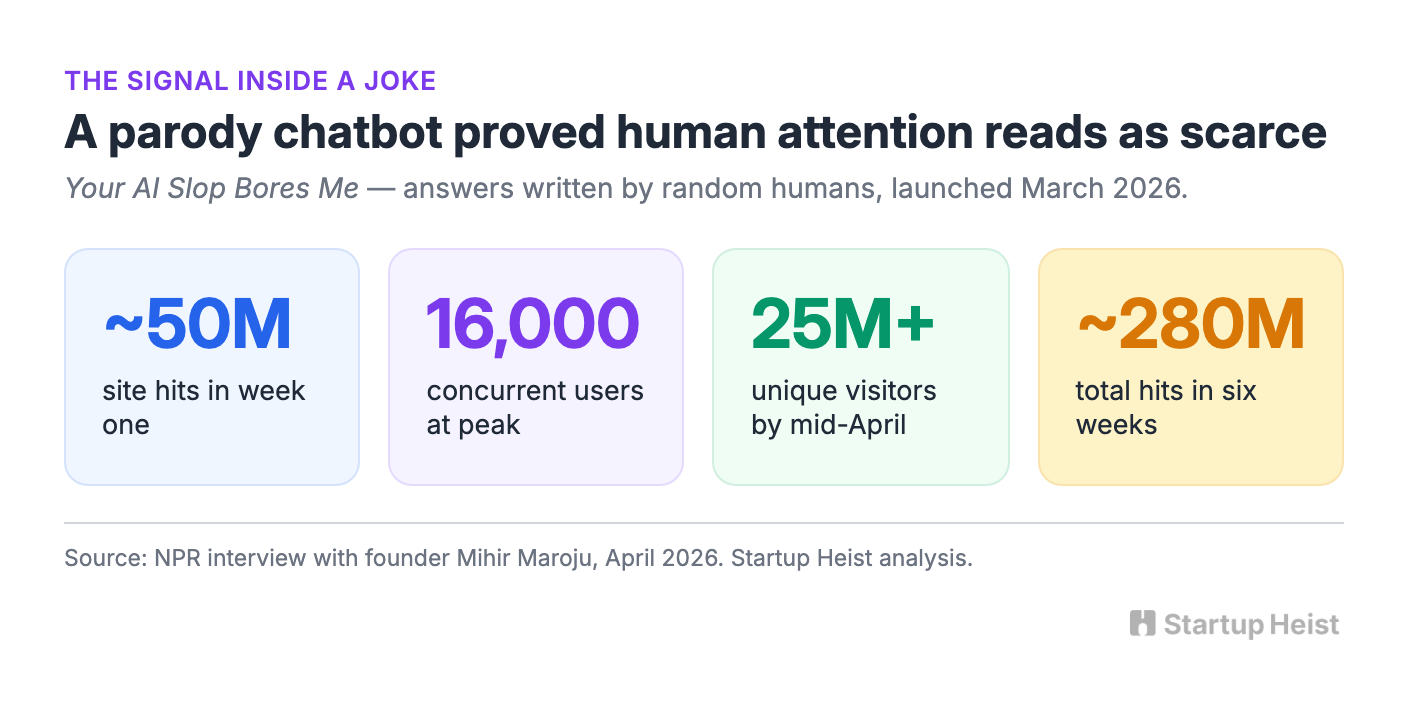
The site is entertaining because it is inefficient. The responses are messy, inconsistent, occasionally insightful, and unmistakably human. That sounds like the opposite of a scalable business, which is exactly why it works. The internet has spent three years optimizing for instant synthetic output, and the result is that verified human attention now reads as scarce.
Consumers haven't rejected AI. SurveyMonkey found that 66% of Americans had tried it by the first quarter of 2026, up from 57% a year earlier, and Stanford's 2026 AI Index found 59% of respondents saying AI offers more benefits than drawbacks. But adoption and trust are different things. Klaviyo reported that only 13% of consumers completely trust AI. SurveyMonkey found 79% of Americans prefer a human over an AI agent in customer-service situations, and 81% believe companies deploy AI primarily to save money rather than to serve them better.
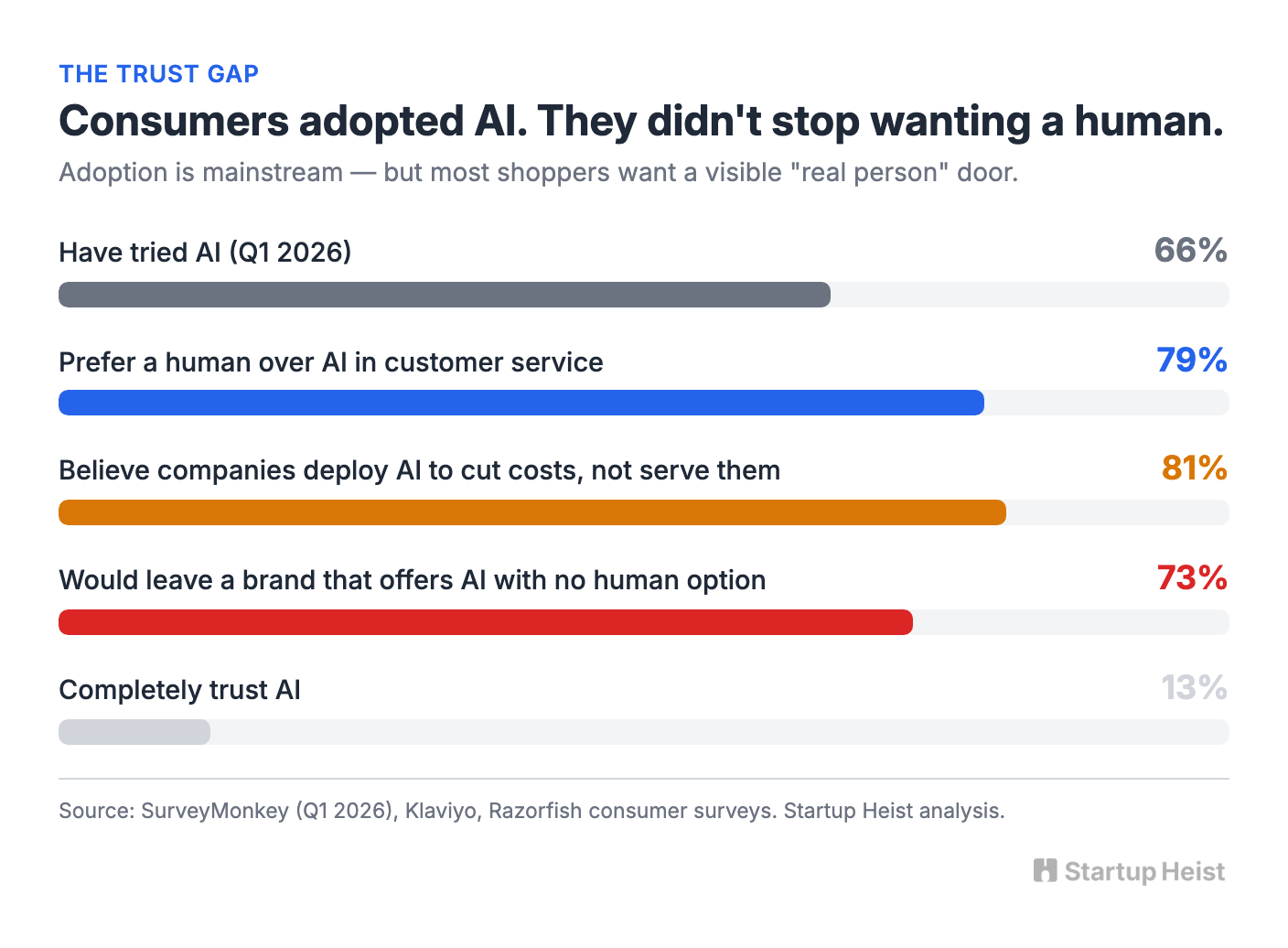
That last number is the commercially important one. Shoppers will happily let AI track a package or summarize a return policy. They get cautious when the decision involves uncertainty, personal taste, or the suspicion that a friendly chatbot avatar is hiding a cost-cutting exercise. The suspicion has teeth. A Klaviyo and Datalily survey found visible AI-generated content makes 31% of consumers trust a brand less, Razorfish found 82% would prefer a human service representative over an AI chatbot, and 73% of consumers say they would take their business elsewhere if a company offered AI with no human escape hatch. The market isn't asking brands to eliminate AI. It's asking them to preserve a door marked "real person," and almost nobody is selling that door.
Three businesses, one steal
There are three businesses hiding inside the human-response trend. The first is a consumer marketplace where people pay experts to answer questions: ask a mechanic, ask a nurse, ask five strangers whether your email sounds weird. The second is an entertainment product: human roulette in a chatbot interface, monetized with ads or virtual goods. The third is a B2B widget, a drop-in human-response layer that brands place on product pages, checkout flows, and pricing pages. The widget is the one worth stealing.
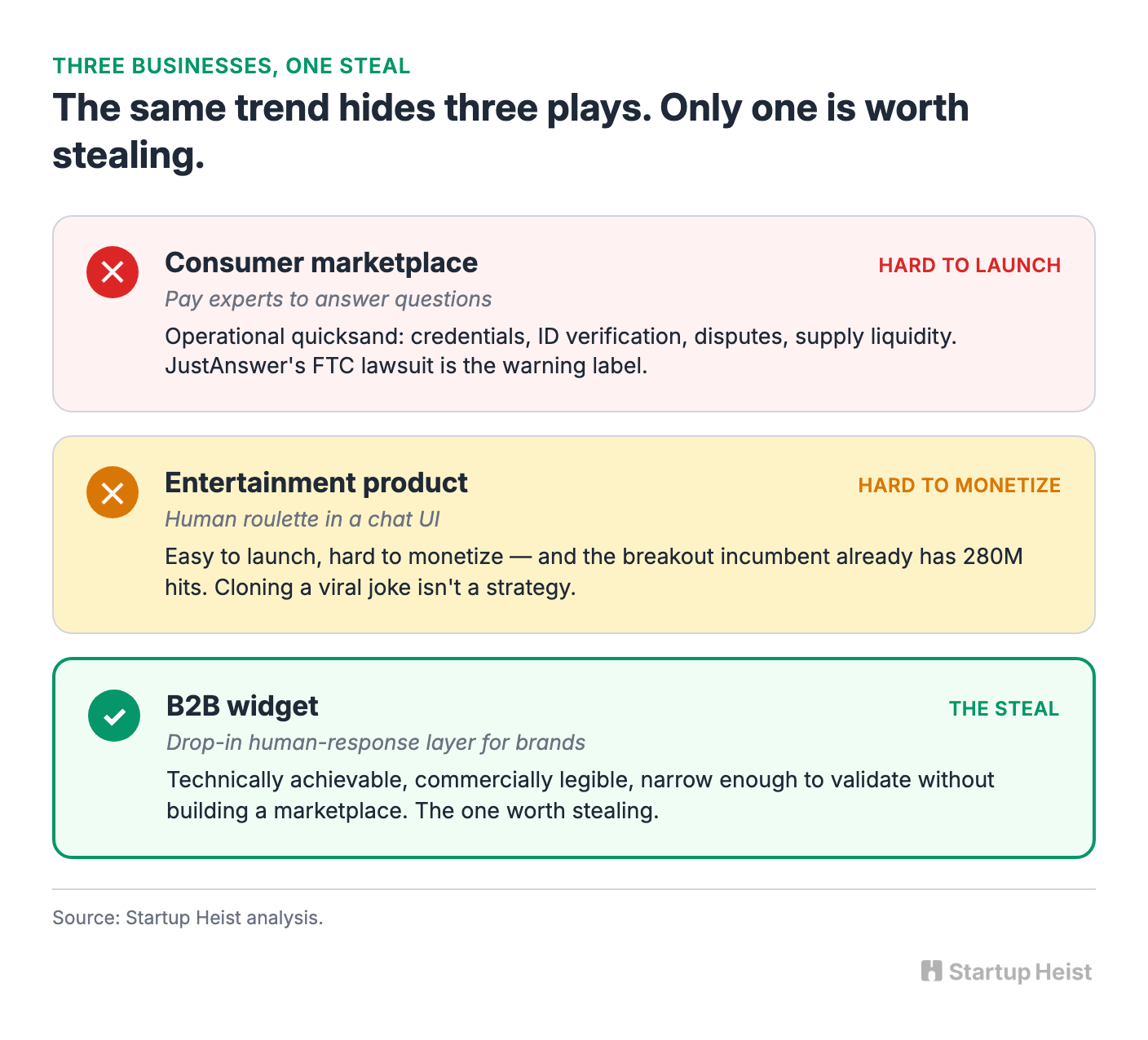
The consumer marketplace sounds compelling until you examine the operational burden: credentials, identity verification, response-time guarantees, compliance rules, dispute handling, and enough expert supply to cover unpredictable demand. JustAnswer has spent years solving exactly this, and it now serves as a warning label as much as a business. In January 2026, the Federal Trade Commission sued JustAnswer and its CEO Andrew Kurtzig, alleging that consumers lured by $1 and $5 "join" offers were deceptively enrolled in recurring subscriptions costing $28 to $125 per month. Australia's competition regulator had already filed proceedings in September 2025.
The entertainment play has the opposite problem: easy to launch, hard to monetize, and the breakout incumbent already exists. Cloning a viral joke after 280 million hits isn't a strategy. The B2B widget sits in the middle, technically achievable, commercially legible, and narrow enough to validate without building a marketplace.
Don't sell customer support
The first positioning mistake would be describing this as outsourced live chat. That market is crowded, mature, and aggressively commoditized. Tawk.to gives away live-chat software and rents trained human agents for $1 per hour. Tidio sells its Lyro AI agent at roughly $0.50 per conversation. Intercom prices Fin from $0.99 per resolution. Gorgias, the strongest e-commerce player, sells an AI agent that automates support, recommends products, and converts shoppers; its homepage promises "conversations that drive revenue, not just resolutions." These incumbents already have widgets, inboxes, routing, analytics, Shopify integrations, and human handoff workflows. A startup can't beat them with another chat bubble.
The wedge is the visible promise of human presence, positioned like a review badge or trust seal rather than a helpdesk. The pitch is "give hesitant buyers a verified human answer before they leave," sold as a revenue layer rather than a cost center. The buyer evaluates add-to-cart rate, checkout completion, and incremental gross profit instead of ticket deflection. The conversion math already favors conversation: shoppers who use live chat convert at roughly 2.8 times the rate of those who don't, and merchants report conversion gains around 20% after adding chat to high-intent pages. What nobody has done is package the human signal itself as the conversion asset.
The opening exists because Gorgias and its peers are still selling automation. Their economic story is that the cheapest ticket is the one a human never touches. The human button makes a more selective claim: most tickets should never reach a human, and the right ten percent absolutely should. AI handles routine service. People handle the moments where confidence, taste, and reassurance move money. You don't need to replace Zendesk or Gorgias to own that lane. You sit beside them on the handful of pages where a human conversation changes the outcome.
The product: a trust badge with a pulse
The initial version should be simple. A brand adds a lightweight script to selected pages, and the customer sees a compact badge:
Unlock the Vault.
Join founders who spot opportunities ahead of the crowd. Actionable insights. Zero fluff.
“Intelligent, bold, minus the pretense.”
“Like discovering the cheat codes of the startup world.”
“SH is off-Broadway for founders — weird, sharp, and ahead of the curve.”


