


The $99 AI Receptionist Needs a $2,500 Installer
A homeowner calls a plumber at 8:30 p.m. because a pipe is leaking under the kitchen sink. The owner is driving home from the last job of the day. The call goes to voicemail. The homeowner searches again and hires the next company that picks up.

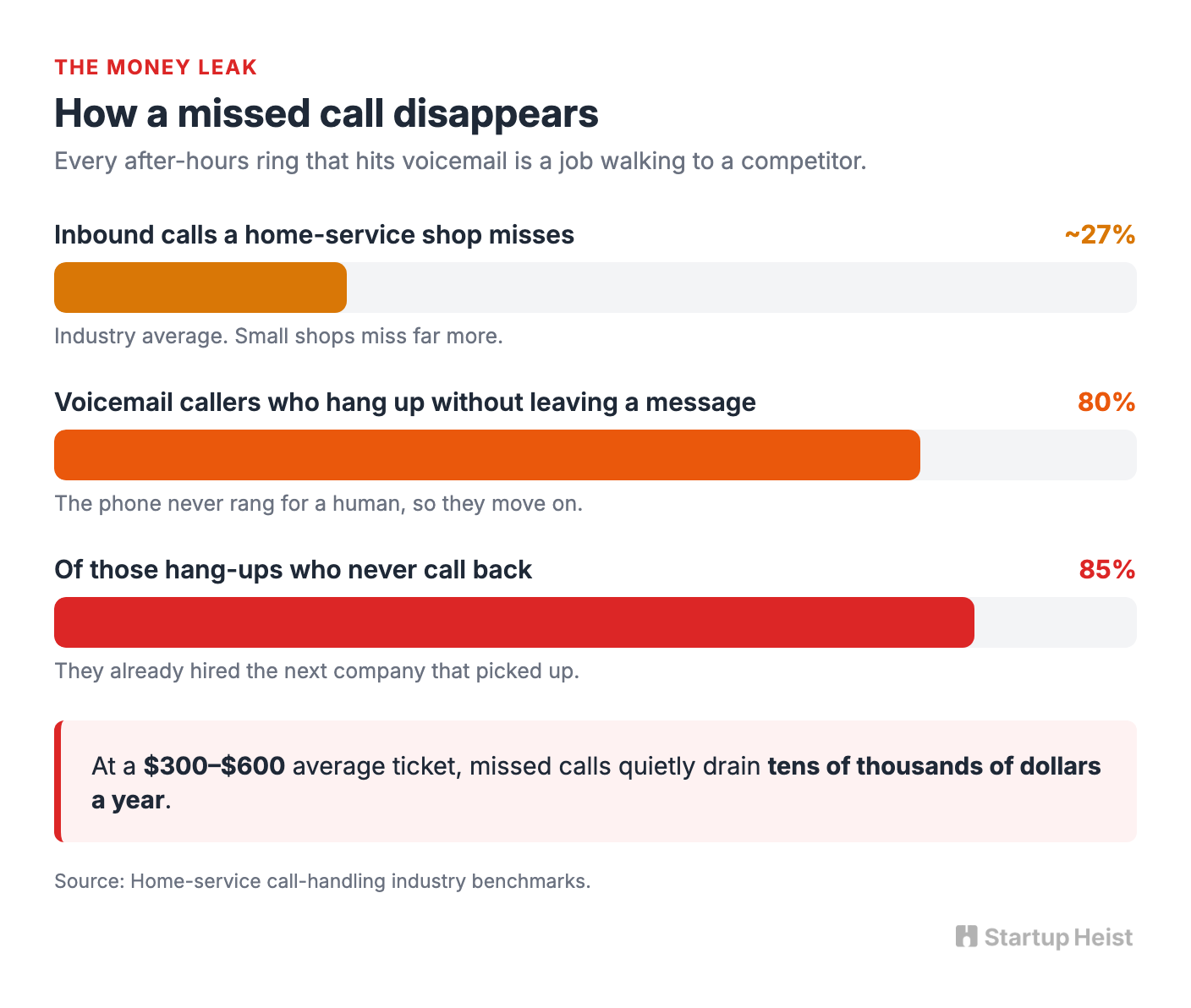
The numbers behind that scene are brutal. Home service businesses miss roughly 27% of inbound calls on average, and small shops miss far more. About 80% of callers who hit voicemail hang up without leaving a message, and 85% of them never call back. For a contractor whose average ticket runs $300 to $600, missed calls quietly drain tens of thousands of dollars a year.
The software to stop the bleeding already exists. Jobber sells an AI receptionist for $99 per month that answers calls and texts around the clock, captures job details, books visits, texts callers who hang up, and transfers to a human when it hears trigger keywords. Housecall Pro sells a built-in AI customer service rep with similar capabilities, and standalone tools like Rosie and Goodcall are multiplying fast. The opportunity isn't building one more AI receptionist for home service businesses. It's becoming the person who installs the receptionist properly, tells it what not to do, tests the edge cases, trains the owner, and keeps the system from embarrassing the business.
Here's the opportunity:
The money: Charge $2,250 per setup plus $249/month per account. 30 setups plus 30 retainers is roughly $67K upfront and $7,470 MRR, run solo with no software to build.
Inside:
• 7-day setup scope, day by day
• Plumbing AI safety-rail checklist
• Missed-call money-leak calculator math
• $249/mo AI ops retainer structure
• 30-day launch plan with pilot pricing
Why Adoption Stalls
The trades aren't ignoring AI. ServiceTitan surveyed more than 1,000 contractors in December 2025 and found 46% already using or experimenting with AI, 72% calling it relevant to their business, and 66% expecting it to transform the industry within three years. Yet in a separate April 2026 survey of 1,000 residential contractors, ServiceTitan found 74% see AI as key to efficiency while only about one-quarter actually use it. More than half remain uncertain about where to start.
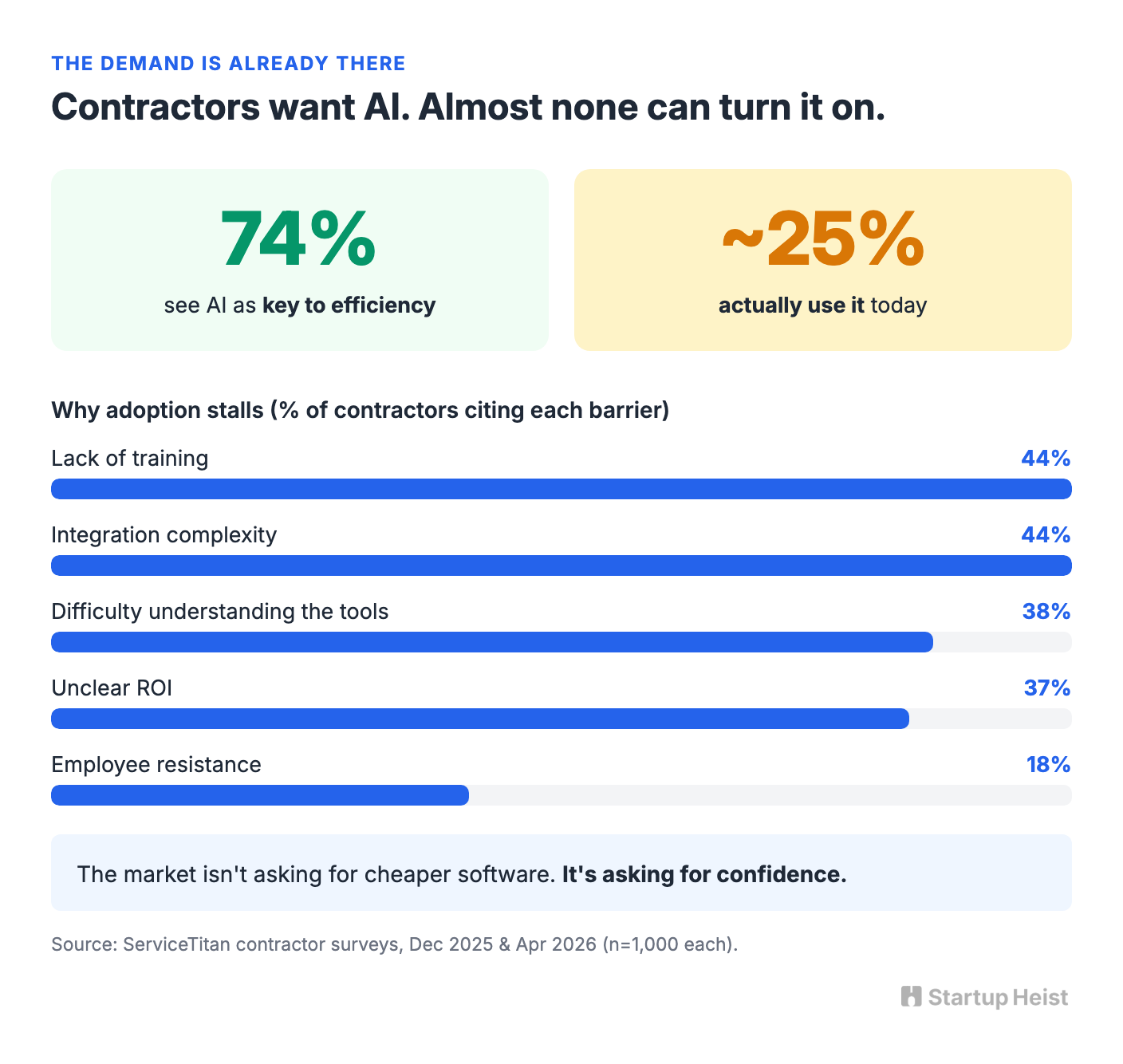
The adoption rate matters less than the reason adoption stalls. The leading barriers were lack of training and integration complexity, each cited by 44% of contractors, followed by difficulty understanding the tools (38%) and unclear ROI (37%). Only 18% cited employee resistance. One industry analysis of home-service operators points the same direction: most non-adopters say they don't understand what AI could do for them or assume their business is too small to benefit, while almost none cite cost. The market isn't asking for cheaper software. It's asking for confidence.
The owner of a two-truck plumbing company doesn't wake up wanting "agentic workflow automation." He wants to know whether the phone will be answered while he's under a sink, whether the AI will recognize a burst pipe as urgent, whether it'll accidentally quote a price it should never quote, and whether an angry customer can reach a human without fighting a robot. The AI tools are getting easier to buy. What's missing is operational trust.
The Smallest Shops Are Not Too Small
A tempting mistake here is assuming microbusiness owners are too unsophisticated to adopt AI. The data says otherwise. A Federal Reserve analysis of Census Bureau survey data found about 18% of U.S. firms had adopted AI by the end of 2025, with more than 20% expecting to use it during the first half of 2026. An SBA Office of Advocacy analysis found that the smallest businesses, those with fewer than five employees, were not the slowest adopters. Tiny companies move quickly because they have no layers of approval, and they feel administrative pain personally.
The problem isn't willingness. It's translation. A large contractor hires an operations manager, pays for a complex implementation, and trains a call center. A one-truck plumber gets a software login and a help article.
That gap is where a lean founder builds a real business. The pool is enormous: IBISWorld counts roughly 129,000 plumbing businesses in the U.S., averaging 5.8 employees each. Almost all of them are exactly the kind of company that buys software and never configures it.
Start Narrow: Plumbers on Jobber
Don't launch as an "AI automation agency for local businesses." That positioning is too broad, too abstract, and too easy to ignore. Start with one sentence:
We help 1–5 truck residential plumbing companies already using Jobber safely turn on AI answering, missed-call recovery, and follow-up workflows in seven days.
Plumbing is a strong first wedge because the pain is obvious. Calls are urgent, after-hours responsiveness decides who gets the job, and the intake process is repetitive enough to template but consequential enough that owners care deeply about safeguards. The software is cheap. The configuration isn't trivial. Jobber's setup flow asks the owner to define greetings, booking rules, escalation keywords, policies, services, and information sources, then test the receptionist, configure call forwarding, and review transcripts when it stumbles. That's exactly the work a busy plumber postpones indefinitely or rushes through on a Sunday night.
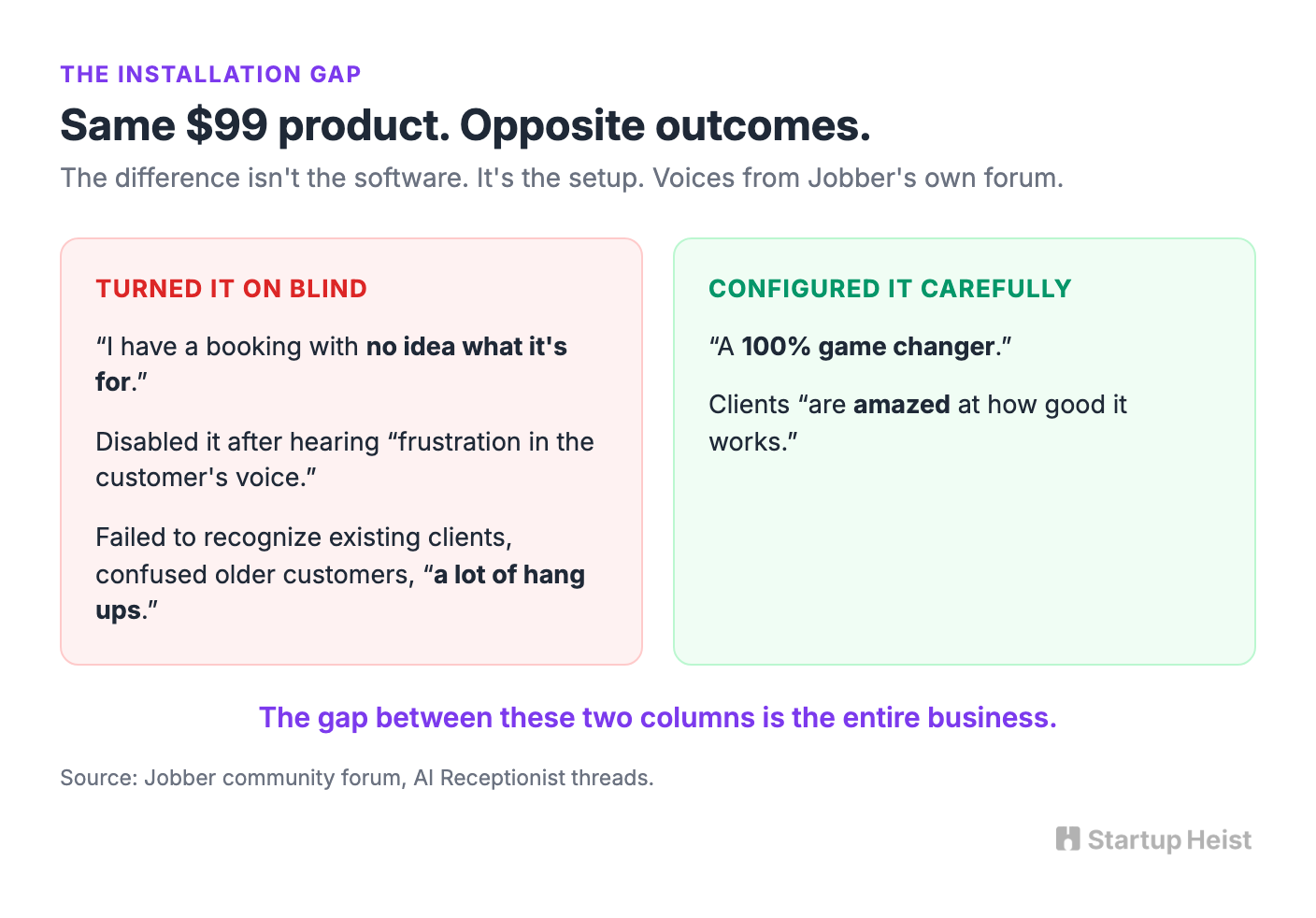
The pain shows up in Jobber's own community forum. One plumber reported that the AI receptionist captured contact information but never asked what was actually wrong: "I have a booking with no idea what it's for." Another disabled the feature after hearing "frustration in the customers voice." Others said it failed to recognize existing clients, confused older customers, and produced "a lot of hang ups." Meanwhile, a plumber who configured it carefully called it "a 100% game changer" whose clients "are amazed at how good it works."
Same product, opposite outcomes, and the difference is the installation.
The Offer: AI-Ready in a Week
The offer shouldn't sound like consulting. Don't sell API connections, Zapier workflows, prompt engineering, or "AI transformation." Sell a concrete outcome:
AI-Ready in a Week — for small residential plumbing companies on Jobber. In seven days, your business safely answers more missed calls, captures better job details, recovers after-hours leads, and follows up consistently without hiring another office employee. Here's the productized offer:
Unlock the Vault.
Join founders who spot opportunities ahead of the crowd. Actionable insights. Zero fluff.
“Intelligent, bold, minus the pretense.”
“Like discovering the cheat codes of the startup world.”
“SH is off-Broadway for founders — weird, sharp, and ahead of the curve.”


