


A family leaves a funeral home carrying a folder of paperwork, a stack of certified death certificates, and a vague instruction to start notifying people.
Then the real work begins. Someone has to report the death to government agencies, cancel a driver's license, transfer a vehicle title, file a final tax return, and contact every bank, credit-card issuer, credit bureau, insurer, utility, and subscription service the deceased ever touched. Some institutions need a death certificate. Some need court-issued letters. Some refuse to speak with the family at all until a court appoints a legally authorized executor.

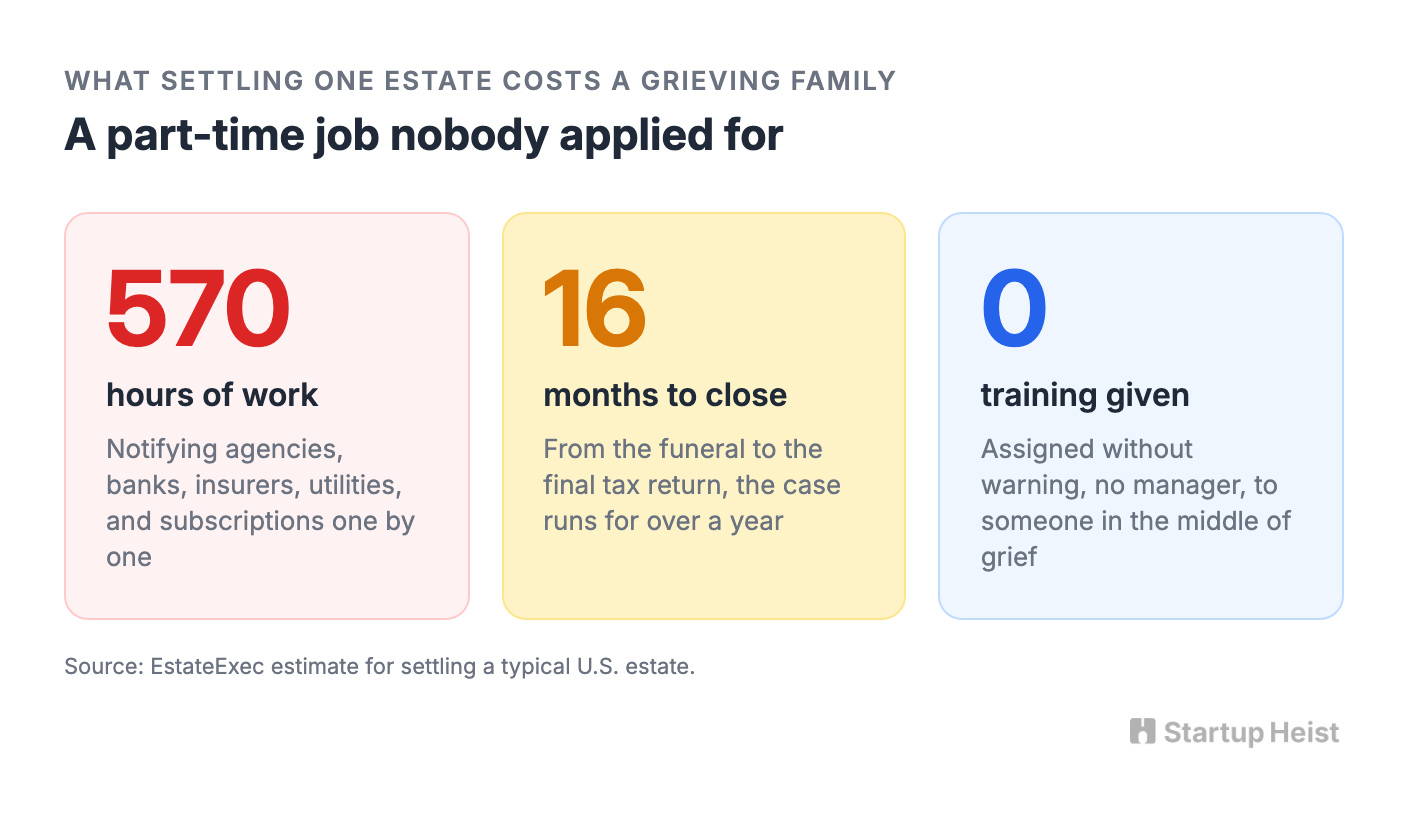
EstateExec, which sells software for executors, estimates that settling a typical American estate takes around 16 months and 570 hours of work. That is a part-time job lasting more than a year, assigned without warning to a grieving person with no training and no manager.
Here's the opportunity:
The money: Twenty funeral homes on a $149/month portal plus activated cases and concierge upgrades clears $10-20K MRR. No direct competitor owns this layer yet.
Inside:
• Full MVP scope for the aftercare portal
• SaaS plus per-case pricing that funeral homes accept
• B2B2C go-to-market with outreach scripts
• Five compounding moats and a 90-day plan
The United Kingdom has started to productize this problem. The British government runs Tell Us Once, a service that reports a death to most government organizations in a single step. Private companies go further. Settld, co-founded by Vicky Wilson and her mother Julie after a family bereavement, notifies more than 1,400 organizations from one portal; it was acquired by The Estate Registry in June 2024, a sign that institutional money is already consolidating UK death-notification infrastructure. Life Ledger, started after co-founder Ruth Blakemore spent nearly a year closing her late mother's accounts, covers more than 1,000 UK companies and passed 100,000 death notifications in 2025.

America has nothing comparable. The official U.S. experience is a government checklist: here are the institutions you should contact, now go contact them yourself.
The obvious startup idea is an American Settld. A nationwide "notify everyone" button sounds clean in a pitch deck and turns ugly the moment it touches reality. American estate administration is fragmented across 50 states, thousands of counties, probate courts, banks, insurers, and digital platforms. A third-party startup cannot casually impersonate an executor, move money, or promise that every institution will accept the same form.
The sharper opportunity is smaller, more defensible, and realistic for a two-person company:
Build a state-focused death-administration co-pilot that funeral homes and small estate-law practices give to families as a white-label aftercare service.
The product never pretends to replace the executor. It helps the executor do the job properly. It generates the workflow, organizes the documents, creates notification letters, tracks every response, flags recurring subscriptions, and produces an audit trail. It tells the family what can happen immediately, what requires a death certificate, and what must wait for the court.
This is a trust-driven vertical SaaS business with a concierge layer, and that combination is what makes it interesting.
The paperwork starts when the funeral ends
The United States recorded just over 3.07 million resident deaths in 2024, according to CDC provisional data. The long-term direction is unambiguous. In its January 2026 demographic outlook, the Congressional Budget Office projected that annual deaths will exceed annual births starting in 2030, several years earlier than prior forecasts. Morbid as it sounds, this market only grows.
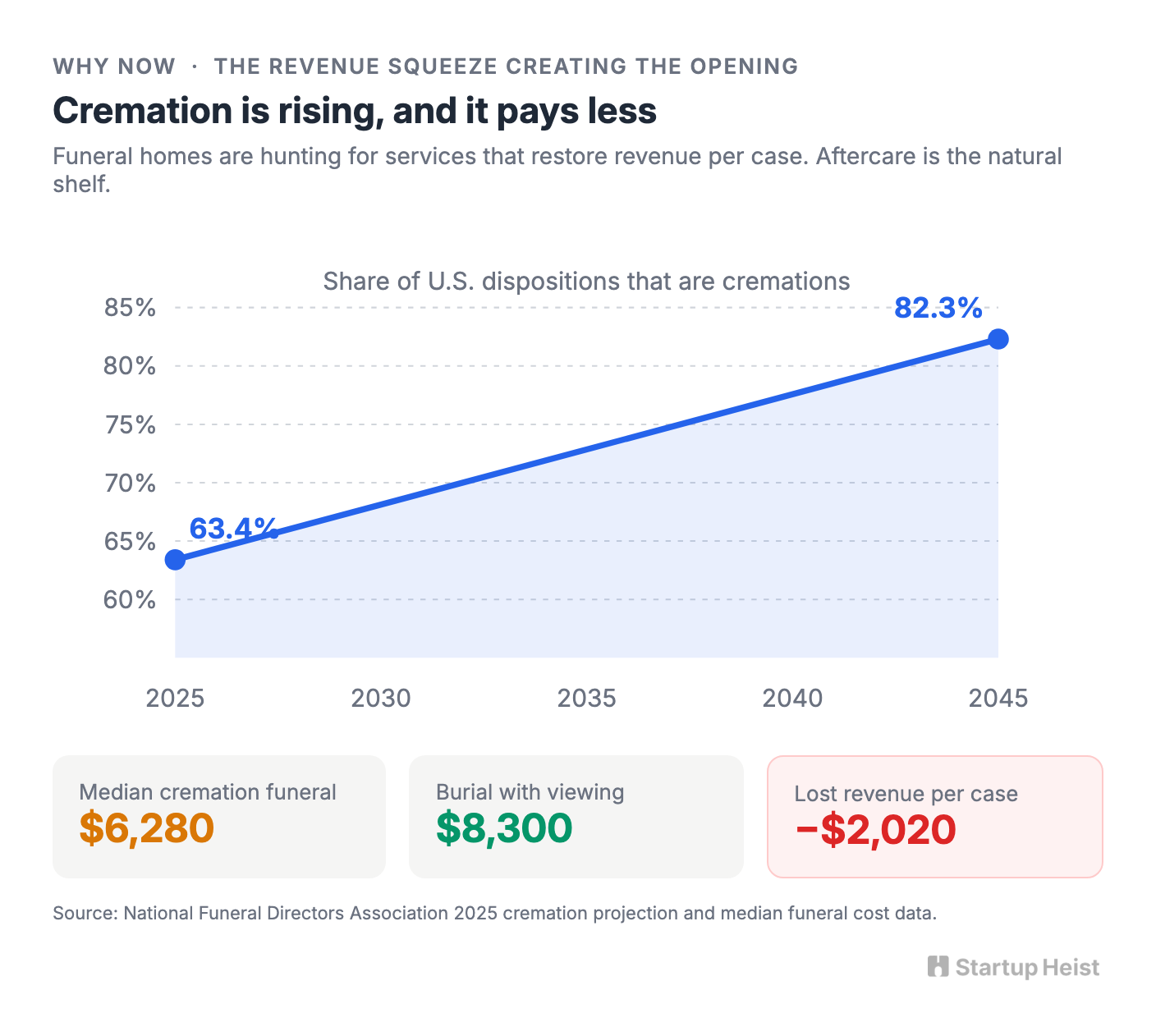
Roughly 15,400 funeral homes operate in the country, about three-quarters of them privately or family owned, generating $16.3 billion in annual revenue. Divide deaths by locations and the average funeral home handles around 200 cases per year. Funeral homes also have a quiet revenue problem. The National Funeral Directors Association projects cremation at 63.4% of dispositions in 2025 and climbing toward 82.3% by 2045. The median cremation funeral brings in $6,280 versus $8,300 for a burial with viewing, so the industry is actively hunting for services that restore revenue per case and justify its role after the ceremony ends. Aftercare is the natural shelf.
Bereavement is also an unusual customer-acquisition environment. A newly grieving family is not shopping for productivity software. They lean on the professionals already in front of them, and the funeral director sits closest. The Social Security Administration notes that funeral homes generally report deaths to Social Security, so families naturally assume the director knows what comes next. He usually does not. The funeral home's work is the disposition, the arrangements, and the ceremony. The notification maze runs for months after the case file closes.
The gap between the trust families place in funeral directors and the system those directors actually have is the opening.
Don't build "Settld for America"
The UK comparison proves death administration can become a product. It also makes the American version look easier than it is. Britain benefits from centralized public infrastructure; the U.S. has none.

Here, an estate administrator is a legal representative with specific duties. The IRS describes the role plainly: collect assets, pay creditors, distribute property, keep records, file the required returns. When probate is involved, court-issued documents such as Letters Testamentary establish the authority to act. A bank may verify the decedent's identity, determine the caller's relationship to the estate, review legal documents, and open a formal case before doing anything, and the process changes depending on whether the caller is a joint owner, beneficiary, trustee, or court-appointed executor. Digital accounts add another layer. The Revised Uniform Fiduciary Access to Digital Assets Act has been enacted in most states, yet even where it applies, an executor gets access to a catalogue of the decedent's accounts by default, not the contents of their private messages.
The wrong promise is "give us a name and we will close everything for you." The right promise is "we will show the authorized person exactly what to do, generate the correct paperwork, organize the evidence, and keep the case moving." That shift sounds modest, but it changes the feasibility of the entire business.
The market is not empty anymore
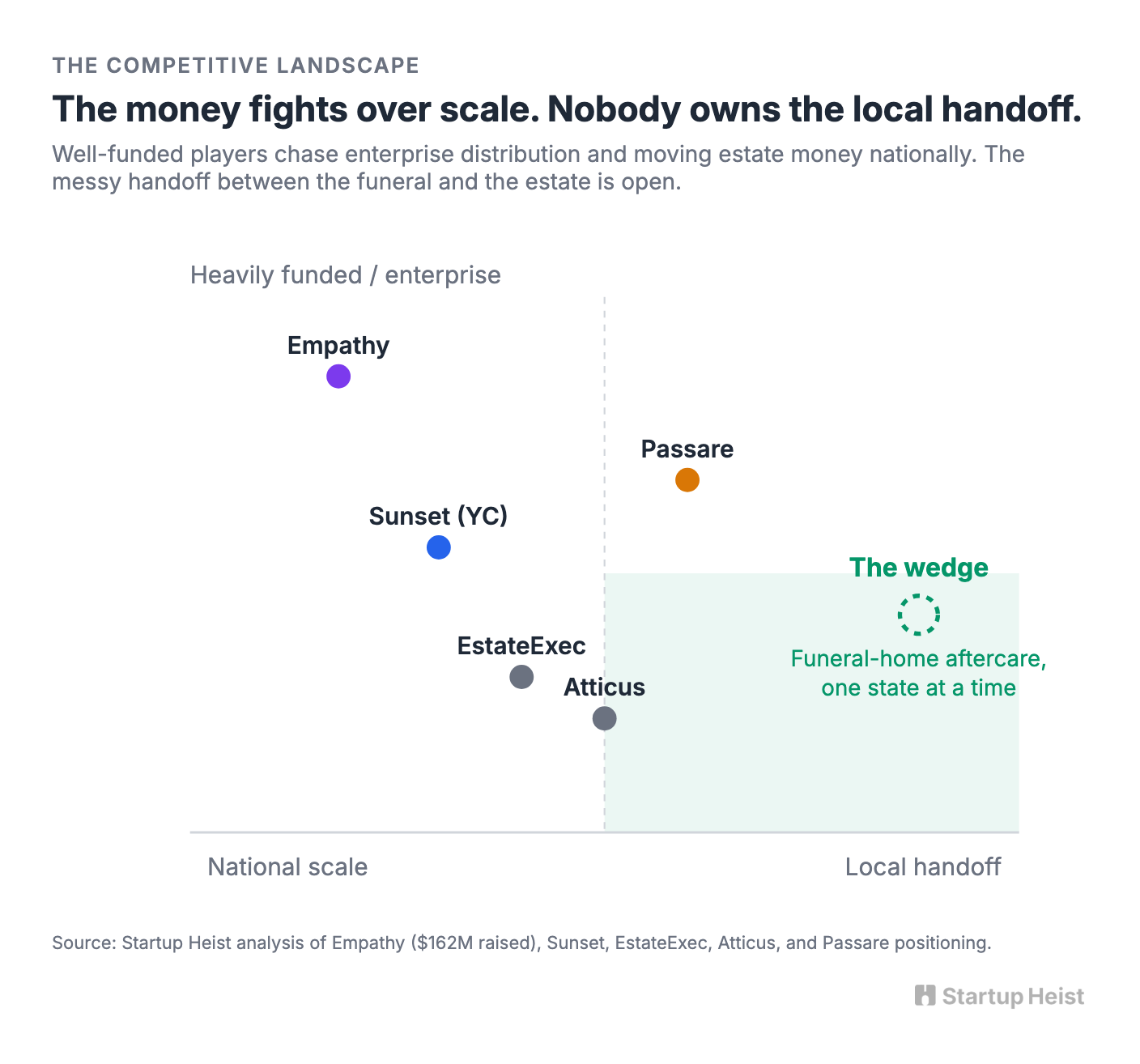
Money has already found this category. Empathy raised a $72 million Series C in May 2025, bringing its total to $162 million, and distributes bereavement support through eight of the ten largest U.S. life insurers plus more than 1,000 employers. Sunset, a Y Combinator company, is building nationwide estate settlement that is free to families; it earns interest on estate funds it temporarily holds and pays funeral directors referral commissions, though it has raised only about $500K in seed money and remains very early-stage. A cluster of executor tools, EstateExec, Atticus, and SwiftProbate among them, has made state-aware task lists table stakes. Passare runs operating software inside more than 2,400 funeral homes and could expand into adjacent workflows whenever it chooses.
Look at where these players aim and a pattern emerges. The well-funded companies fight over enterprise distribution, asset discovery, and moving estate money at national scale. Nobody owns the messy local handoff between the funeral and the estate. The funeral home wants a credible aftercare product without becoming an estate-administration help desk. The solo probate attorney wants clients to arrive organized instead of forwarding screenshots and unopened mail. The executor wants one calm dashboard. The family wants a human available when software is not enough.
That handoff is the product.
The wedge: aftercare operations for one state
Start with one state and a small cluster of counties. Local density makes the product better faster, because probate is not merely state-specific; county details matter. In Pennsylvania, the Chester County Register of Wills probates wills, appoints estate representatives, and serves as the state's agent for inheritance-tax filings.
A generic national checklist says "contact the probate court." A useful local product says whether probate is likely required, which county office handles the filing, which documents to gather before calling, which tasks can start before appointment, what must wait for Letters Testamentary, and when to escalate to an attorney. That distinction is the business. Any competitor can write a checklist; the moat comes from turning local rules into a maintained operational system with versioned workflows, institution-specific instructions, document templates, and embedded professional distribution.
The starting position sounds like this:
The aftercare portal for independent Pennsylvania funeral homes. Give every family a guided estate-administration workspace before they leave your care.
Pennsylvania is an example. The important choice is density, not geography. Here is how to build it.
What the product actually does
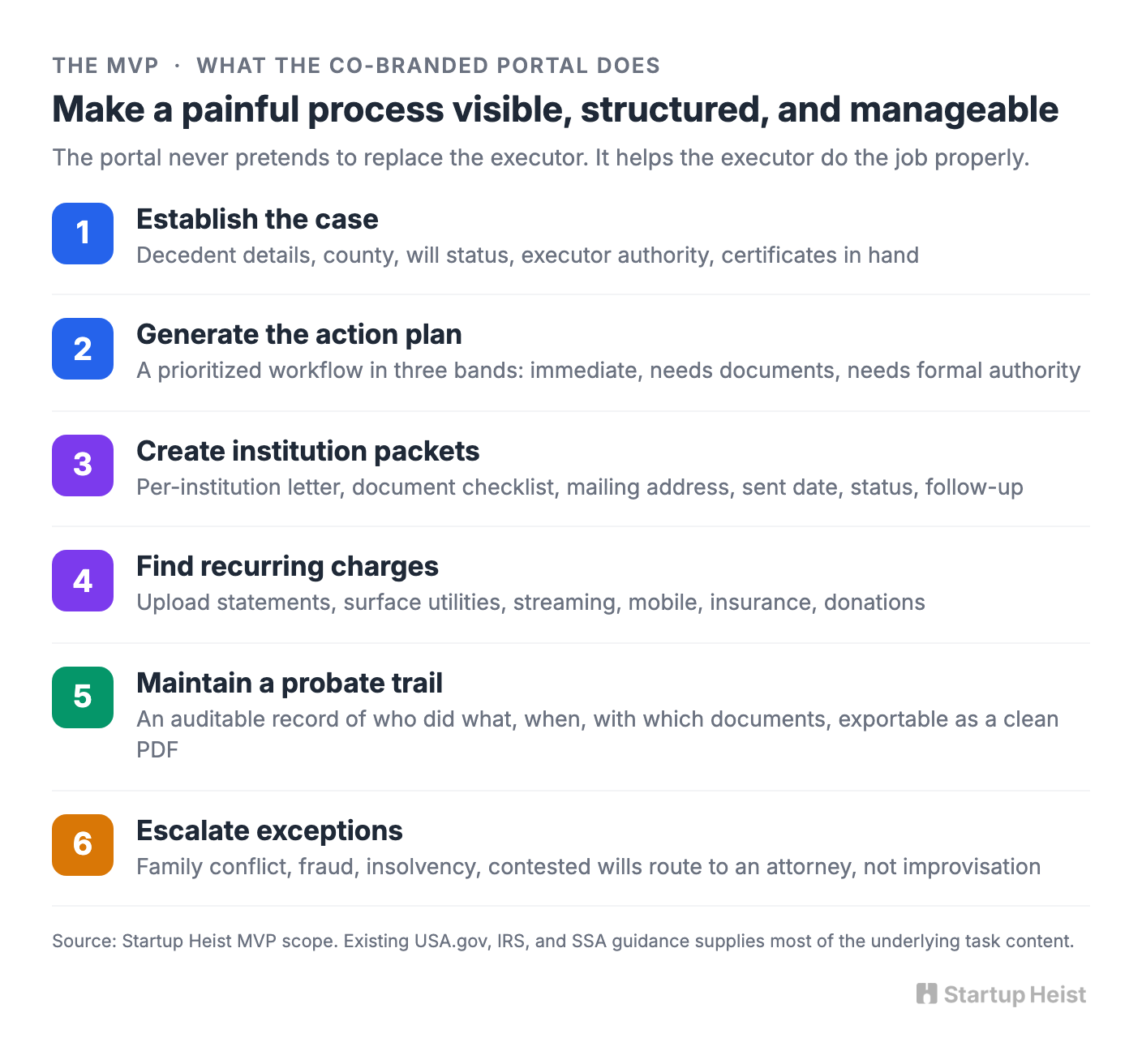
The MVP should not attempt to automate every institution in America. It should make a painful process visible, structured, and manageable. Each executor or family representative receives a co-branded portal with a simple sequence.
Unlock the Vault.
Join founders who spot opportunities ahead of the crowd. Actionable insights. Zero fluff.
“Intelligent, bold, minus the pretense.”
“Like discovering the cheat codes of the startup world.”
“SH is off-Broadway for founders — weird, sharp, and ahead of the curve.”


