


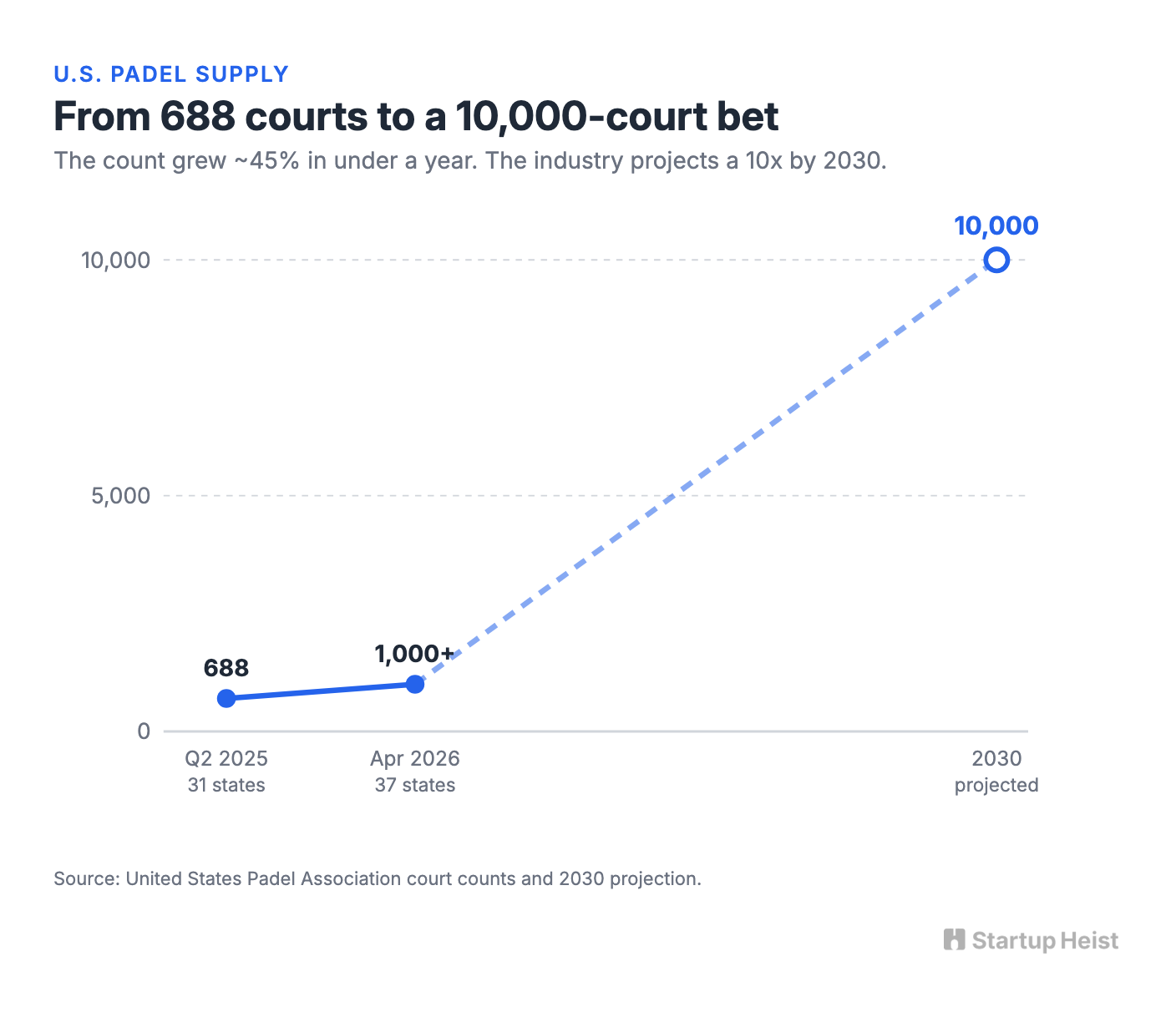
America passed 1,000 operating padel courts in early April 2026. The milestone court opened in Coral Gables, outside Miami, which tells you where the heat is: Florida alone holds roughly 41% of the national supply. The growth curve underneath is steeper than the raw number suggests. In the second quarter of 2025, the U.S. had just 688 courts across 31 states. Less than a year later, the count had grown about 45%, and the sport's footprint had spread to 37 states. The United States Padel Association says 1.073 million Americans played padel in 2025, including 238,000 who played at least eight times, and projects 10,000 courts by 2030.
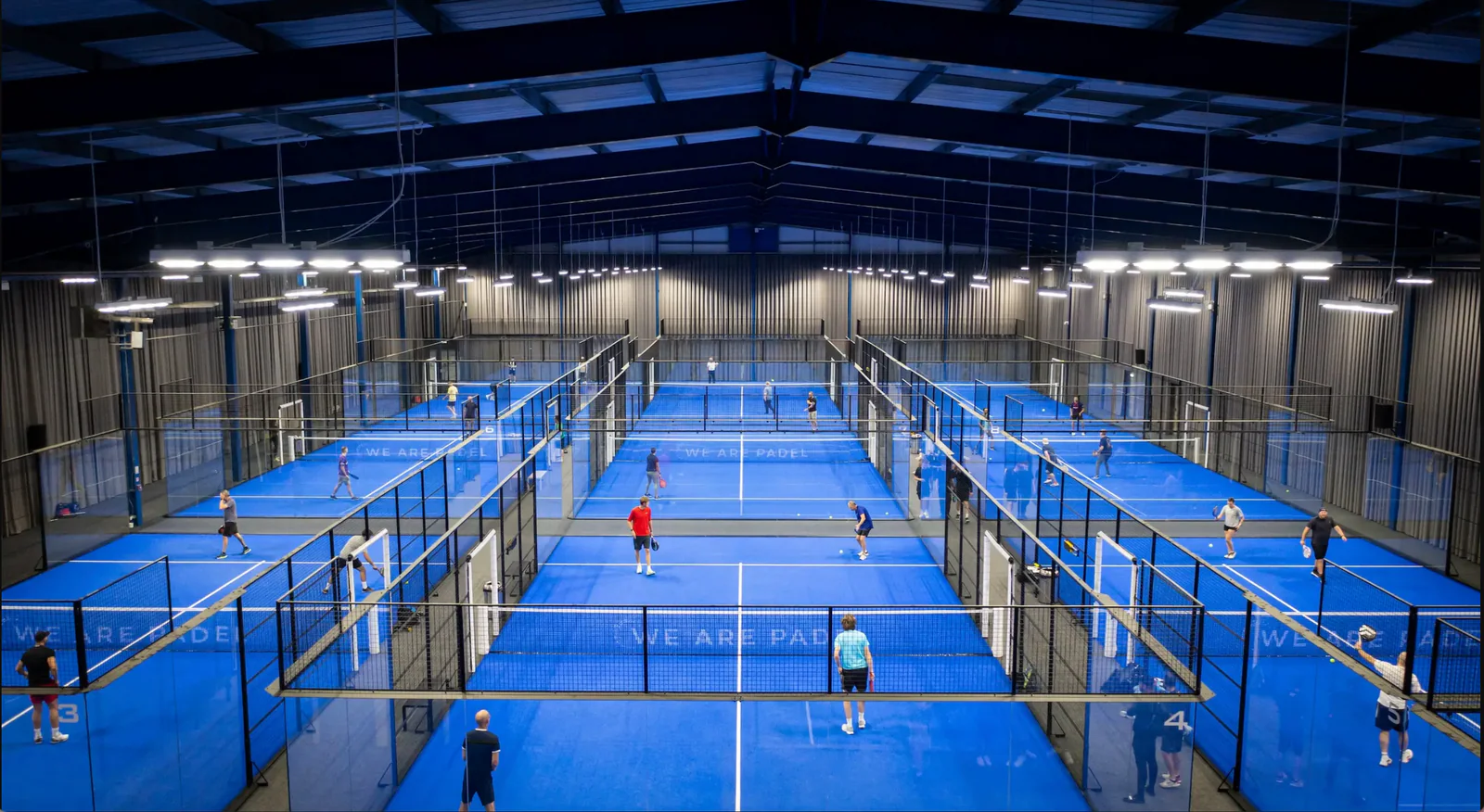
Institutional money has noticed. The Pro Padel League closed a $15 million Series A on March 24, 2026, led by Charlotte Hornets co-chairman Rick Schnall, on top of $10 million in seed funding raised the year before. Its ten-team league now spans the U.S., Canada, and Mexico. Globally, the International Padel Federation counted more than 35 million players in 2025, with clubs up 16.1% and courts up 15.2% year over year.
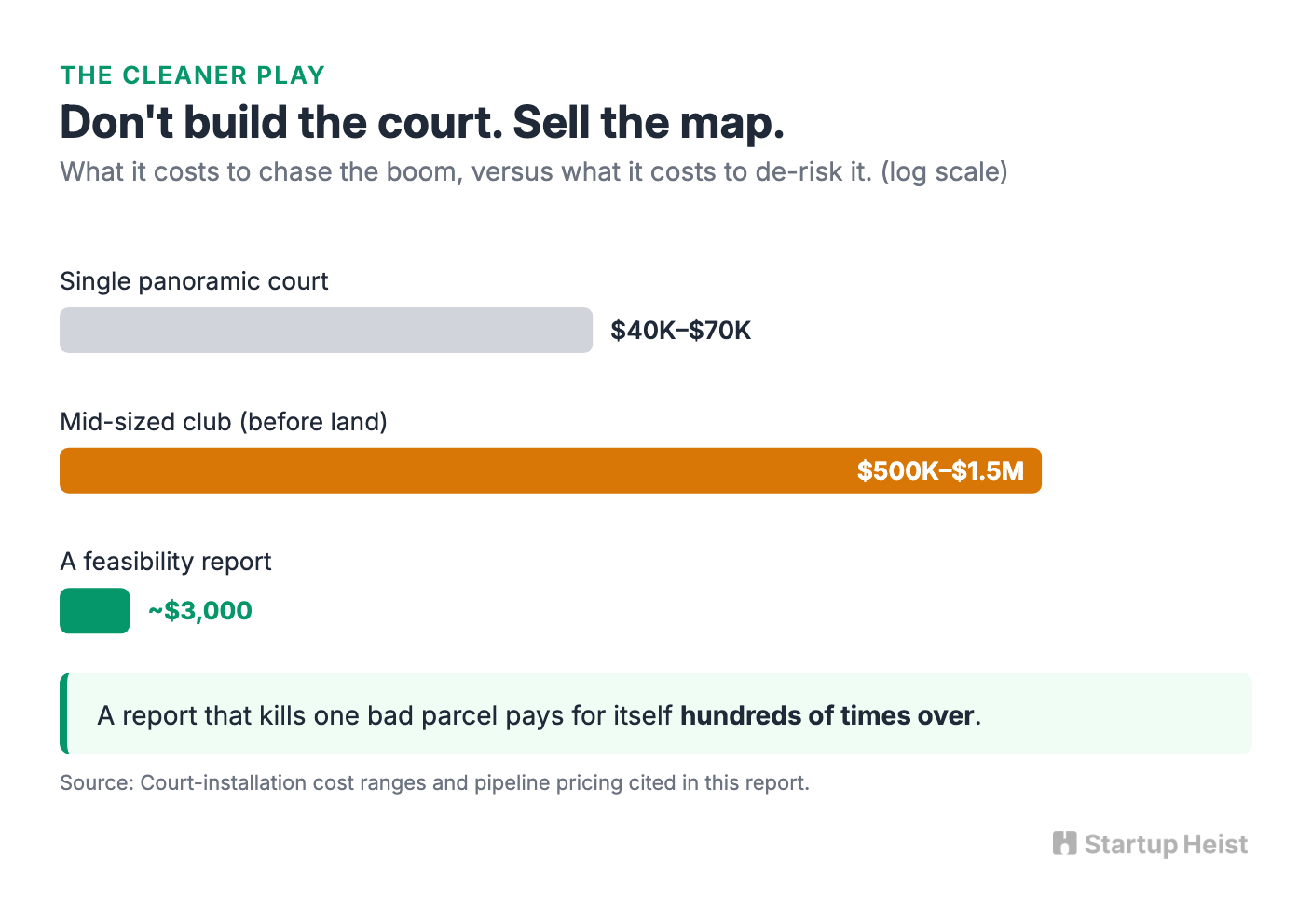
The obvious play is to build padel clubs. It is also the expensive one. A single panoramic outdoor court runs $40,000 to $70,000 installed, and a mid-sized club costs $500,000 to $1.5 million before land. Add financing, contractors, parking, lighting, staff, and a local customer base big enough to fill the courts. And before any of that capital moves, the developer has to answer a question almost nobody prices in early enough:
Will the municipality allow this project to open at all?
That question is where the cleaner business sits. You don't have to build a single court to profit from the boom. You can sell the developers a map through the swamp.
Here's the opportunity:
The money: A solo founder selling ten $3,000 feasibility reports a month clears $30K. Reports plus expansion subscriptions push toward $20K to $50K MRR.
Inside:
• Seven-part feasibility report scope
• Three-phase build: reports to screener to SaaS
• Pricing from $1,500 reports to $2K/mo
• The precedent-library moat and exit map
The Bottleneck Is Not Enthusiasm
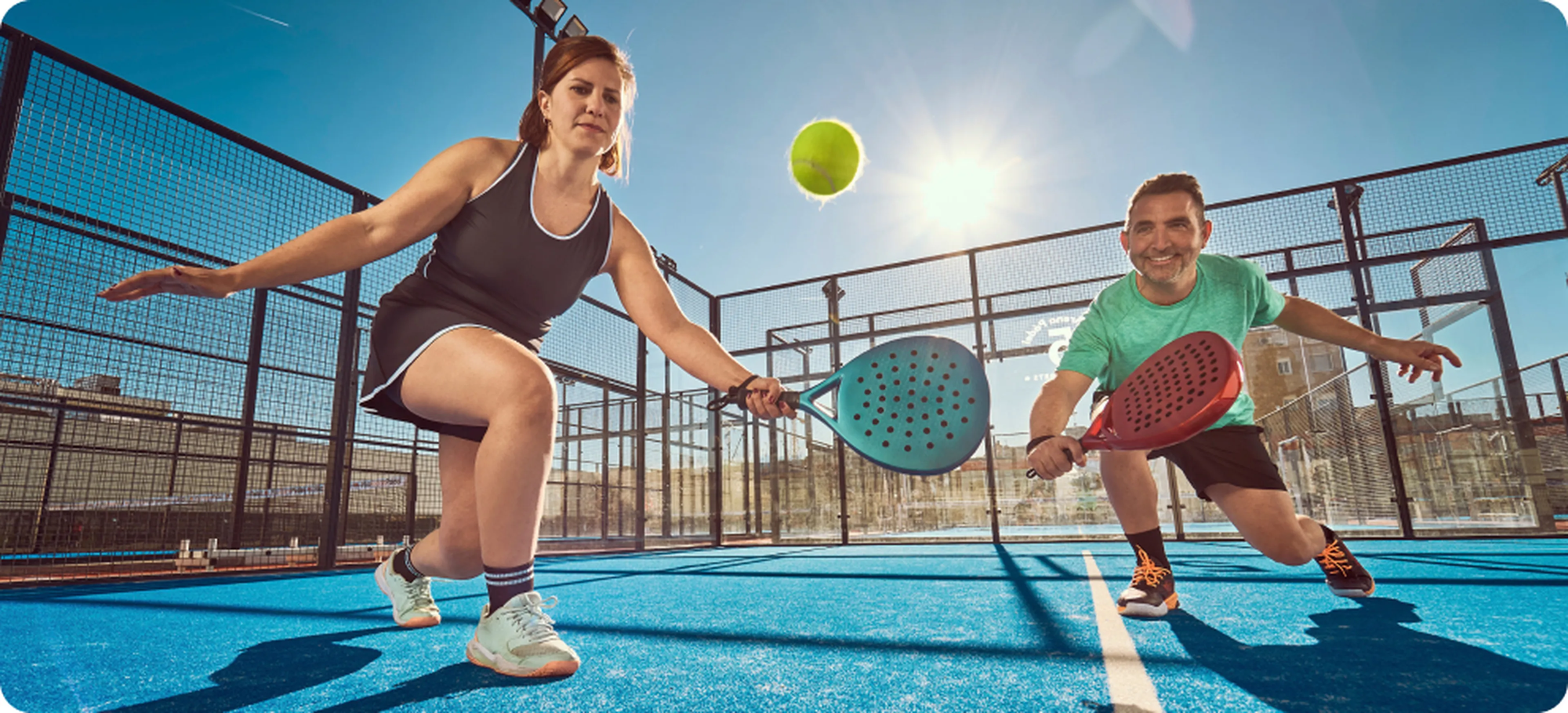
Padel is not a standard retail use. A developer can't lease an empty storefront, hang some nets, and open in 90 days. An outdoor padel court is an enclosed structure of glass and steel mesh, often with lighting, parking, food service, and spectator areas attached. Depending on the parcel, the project can trigger land-use review, conditional-use permits, parking minimums, accessibility rules, public hearings, and noise restrictions. Court manufacturers themselves warn buyers that zoning and permitting can make or break the development timeline.
A parcel can look perfect and still be unusable. The zoning code may classify an athletic club as a conditional use rather than a permitted one. Outdoor recreation may be allowed in one industrial district and banned in the next. A planning board can demand setbacks the site can't deliver. A landlord can offer plenty of square footage and not nearly enough parking. A required public hearing opens the door to neighbor objections and months of delay.
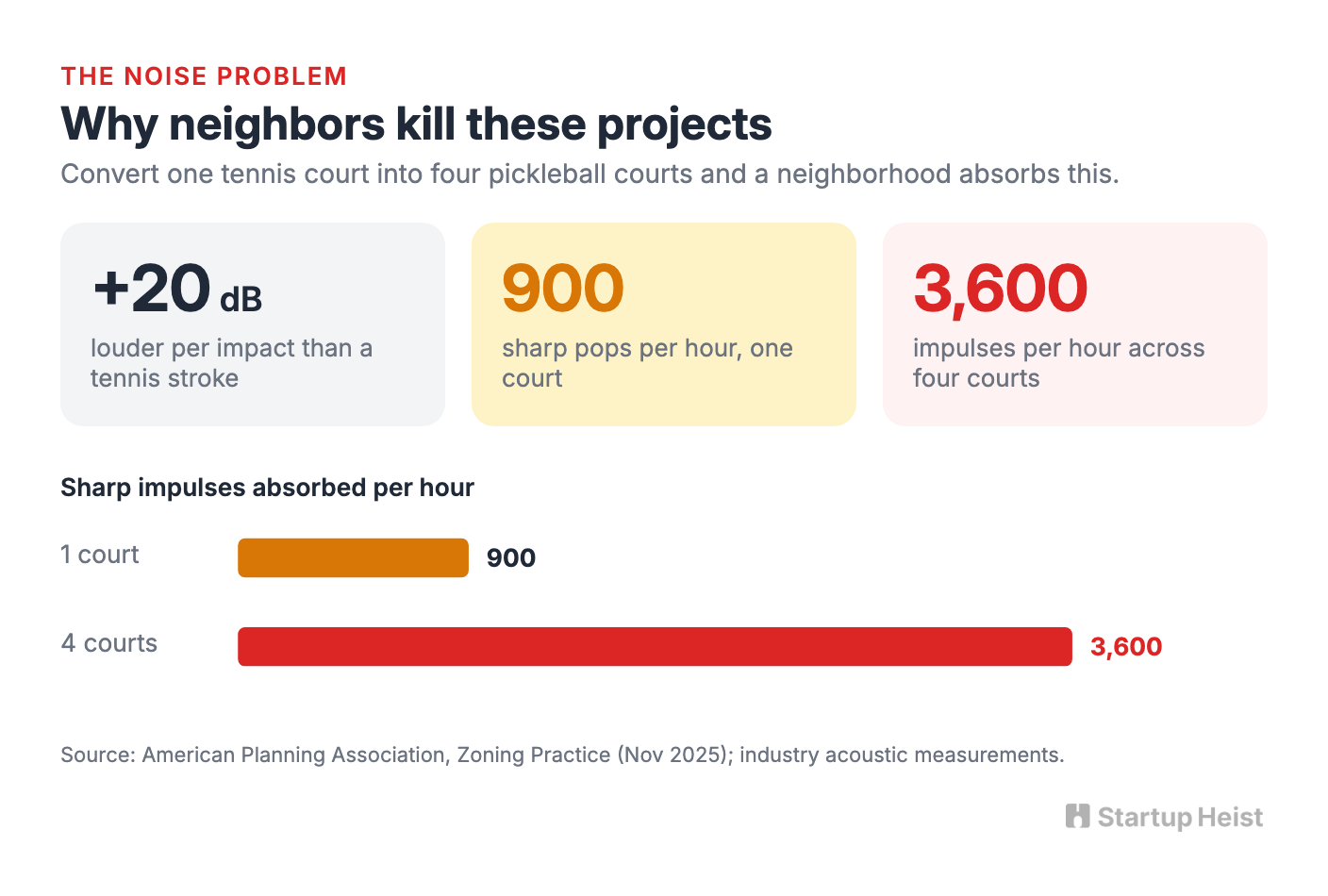
Pickleball already ran this experiment at scale. The Sports & Fitness Industry Association counted 24.3 million American pickleball players in 2025, up 171.8% in three years. The sport's signature pop is roughly 20 decibels louder than a tennis stroke and can occur up to 900 times per hour on a single court; convert one tennis court into four pickleball courts and the neighborhood absorbs 3,600 sharp impulses an hour. The result has been nuisance lawsuits, court closures, and a wave of zoning amendments in places like Park City, Utah and Torrance, California. The American Planning Association devoted its November 2025 Zoning Practice issue to the problem, recommending a three-tier framework: courts far from homes allowed by right, intermediate sites subject to discretionary review and mitigation, and the riskiest locations restricted, with setbacks of 250 to 500 feet.
Padel is a different sport, but the lesson transfers directly. The moment courts move near homes, the project stops being a construction job and becomes an entitlement problem. Sports-facility developers routinely spend two to three years getting from feasibility to opening day, and a bad site decision made in month one can poison the entire timeline. Every operator chasing this boom is about to learn that the hard way, one planning board at a time.
The Opportunity: Racket Sports Site Intelligence
The business is a site-intelligence product for padel and pickleball developers: it identifies sites with a realistic path to approval before serious capital gets committed. Not legal advice, and not a replacement for the zoning attorney, acoustic engineer, or architect. A faster first pass that tells the developer where to point those expensive professionals — and which parcels to walk away from before signing anything.
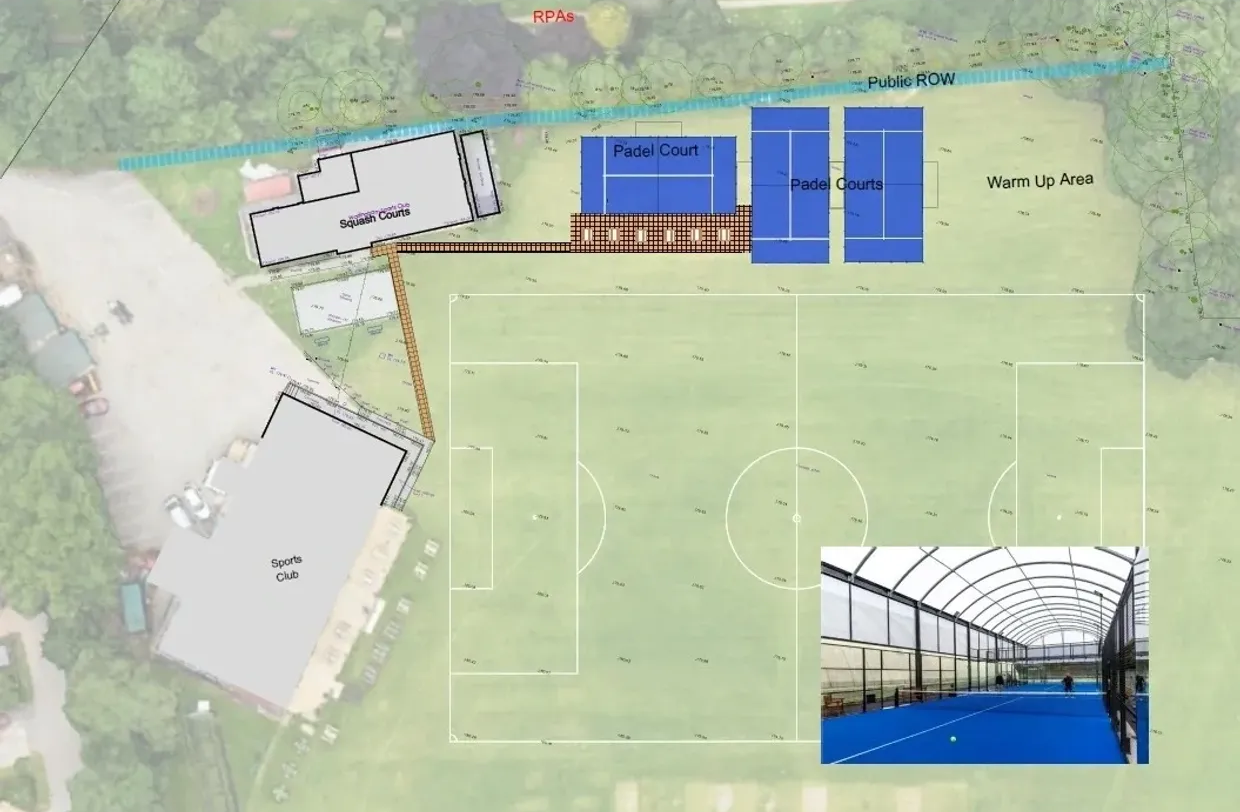
Padel is the wedge, not the whole business. The U.S. padel market is growing fast enough to create urgency and is still small enough that you can personally map every serious operator in it. But padel alone is probably too narrow to support a large software company; some operators will build one club and never need a subscription. The durable thesis is broader: an entitlement and noise-risk intelligence layer for racket sports and other noisy recreation. Pickleball is the second market, with its enormous participation base and visible noise politics. Then tennis bubbles, indoor sports hubs, soccer facilities, batting cages. The common thread isn't the sport. It's the messy translation between real estate, municipal rules, neighborhood tolerance, and facility economics.
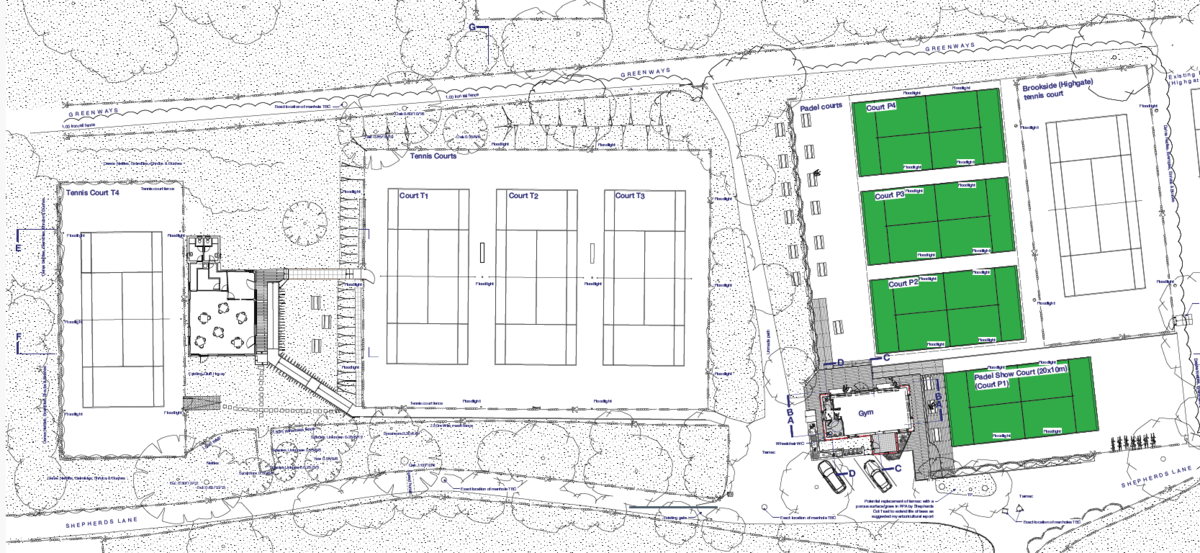
A small team can build this because the raw material already exists. The National Zoning and Land Use Database has standardized zoning-code characteristics for more than 2,600 U.S. municipalities. LightBox sells nationwide parcel-level zoning data: classifications, permitted uses, setbacks, height limits, normalized parcel boundaries, prioritized across the top 50 metros and refreshed quarterly. Many cities publish their own GIS layers. And the Urban Institute has shown that scraping, OCR, and language models can substantially shrink the manual labor of structuring zoning rules. The model is simple: software collects the raw material, humans interpret the parts that matter. Generic zoning providers can tell a developer what a parcel is zoned for. Your product tells a racket-sports operator what is likely to happen next. That interpretation layer is the whole company, and it shows up most clearly in the product itself.
The Product: A Feasibility Report Before the Lease
The first version is not a nationwide SaaS platform. It is a high-value report. A developer submits a target metro, a shortlist of parcels, or both, and gets back a structured feasibility pack:
Unlock the Vault.
Join founders who spot opportunities ahead of the crowd. Actionable insights. Zero fluff.
“Intelligent, bold, minus the pretense.”
“Like discovering the cheat codes of the startup world.”
“SH is off-Broadway for founders — weird, sharp, and ahead of the curve.”


