


The Recipe Clean Room
Recipe websites were built for one transaction: attract a human from Google, hold their attention, and monetize the visit with display ads, affiliate links, and email capture. Every design choice flows from that model, including the 900-word story about a grandmother's kitchen that sits between you and the ingredient list.
AI meal planners run on a different transaction entirely. They have no use for the childhood memories, the six display ads, or the newsletter popup. They want a predictable data object: title, yield, ingredients, instructions, prep time, cook time, nutrition, source.
The obvious startup idea falls out of this mismatch: scrape the recipe sites, strip the bloat, resell the cleaned recipes through an API. It's also the wrong business.
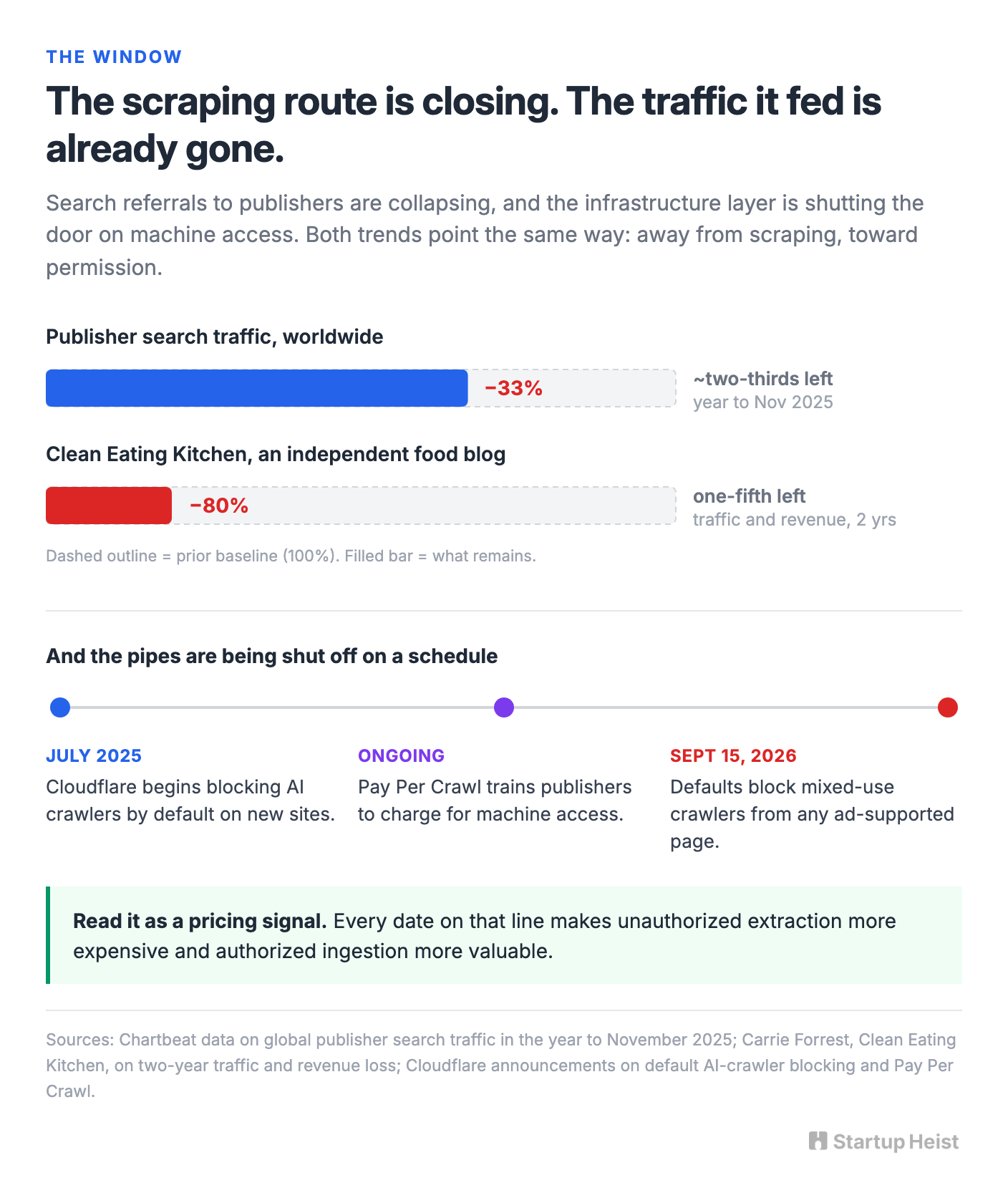
Recipe publishers live on traffic. Written instructions and editorial descriptions can be protected expression under copyright law. Site terms restrict automated collection, and the infrastructure layer is now actively hostile to it: since July 2025, Cloudflare has blocked AI crawlers by default on new sites, and starting September 15, 2026, its defaults will block mixed-use crawlers from any ad-supported page, while its Pay Per Crawl program teaches publishers to charge for machine access. The established players already reflect this reality. Edamam offers more than two million web recipes through its API but withholds the cooking instructions, requires attribution links back to the original publisher, and prohibits automated collection of its data. Those restrictions exist because Edamam doesn't own the underlying recipes. The era of quietly hoovering up recipe sites is closing.
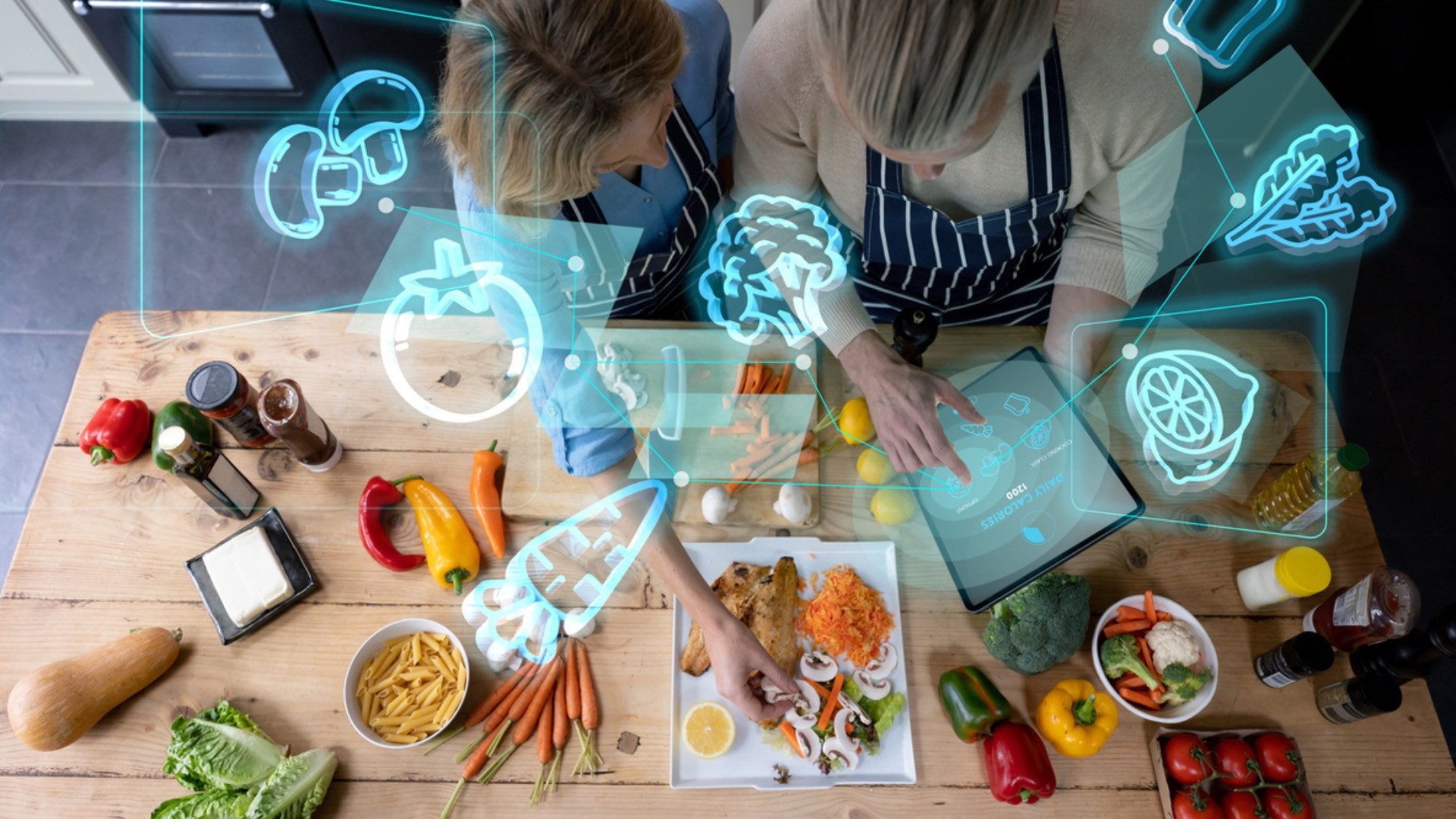
The better play is narrower, safer, and potentially more valuable: build a recipe clean-room API that converts content customers already own, license, or are authorized to process into consistent, LLM-ready JSON, with provenance, field-level confidence scores, configurable usage rules, and optional nutrition enrichment. The sale is infrastructure: the plumbing that makes legitimate recipe content usable by software. As the open web walls itself off from bots, that plumbing gets more valuable.
The heist, in brief:
The money: A 140-account mix of $49-to-$499 plans is roughly $15,900 MRR, before $1,000-to-$10,000 migration projects. Edamam already charges $1,499 a month for private recipe management.
Inside:
• Six-week MVP: schema to paid pilots
• Five pricing tiers plus migration fees
• The free audit that opens publisher doors
• Six moats, from failure corpus to rights ledger
The Data Is Already Hiding Inside the Page
This opportunity exists because recipe extraction is unusually tractable. Google has spent years pushing publishers to embed recipe structured data describing ingredients, instructions, times, yield, and nutrition as JSON-LD in the Recipe schema, because rich results drive search traffic. Many recipe pages already contain the beginnings of an API response, buried beneath the ads and editorial copy.
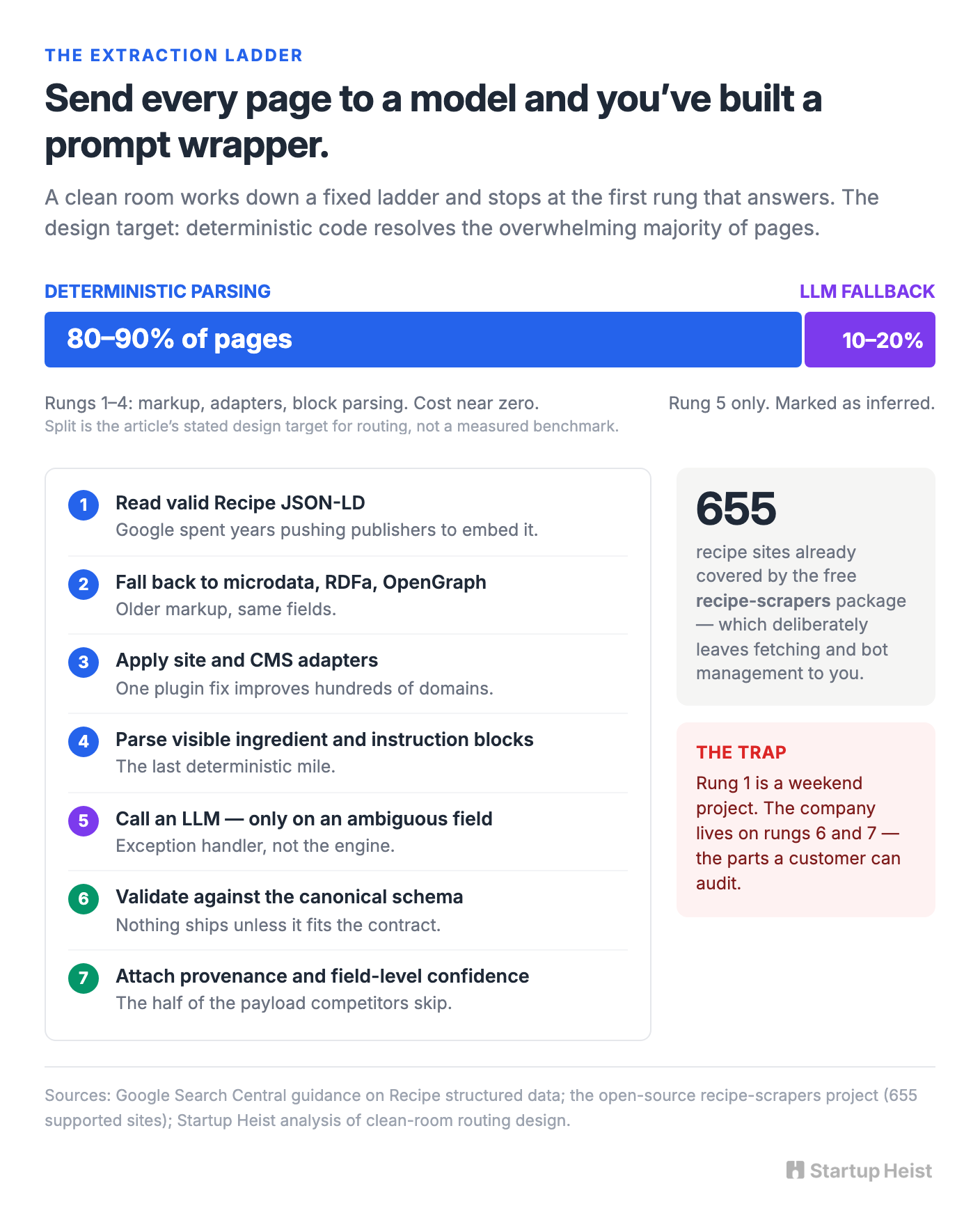
A clean-room service doesn't need an LLM to comprehend every page. It works down a deterministic extraction ladder:
- Read valid Recipe JSON-LD.
- Fall back to microdata, RDFa, or OpenGraph metadata.
- Apply known site or CMS adapters.
- Parse visible ingredient and instruction blocks.
- Call an LLM only when deterministic methods fail on an ambiguous field.
- Validate against a canonical recipe schema.
- Attach provenance and field-level confidence.
The order matters. Send every page to a large language model and you've built an expensive, unreliable prompt wrapper. Route 80 to 90 percent of pages through deterministic parsing and the LLM becomes an exception handler instead of the engine. The technical foundation is sitting on GitHub: the open-source package recipe-scrapers extracts titles, ingredients, instructions, times, and yields from 655 recipe websites, deliberately leaving fetching and bot management to the developer.
That's useful code, not a defensible company. The business begins where the library ends and the legal questions start.
Why "Paste Any URL" Is Not a Compliance Strategy
A user submitting a URL doesn't create permission to reproduce its contents. That distinction should sit at the center of the product. U.S. Copyright Office guidance draws the relevant line: a bare ingredient list is generally not protected, but substantial written directions and curated collections can be. Robots directives add a signal without resolving anything; the Robots Exclusion Protocol itself states its rules are not access authorization.
A serious clean room therefore operates in four modes.
Owned content. The customer controls the domain or archive: a food blogger migrating 3,000 recipes off WordPress, a meal-kit company normalizing its catalog, a grocery chain feeding an app, a wellness company importing its dietitians' recipes, a publisher consolidating acquisitions. The cleanest initial market, because the customer can authorize fetching, storage, transformation, and display.
Licensed content. The customer holds a contract to use recipes from a creator or data provider. The clean room attaches each source to a license record with effective dates, attribution requirements, and permitted uses. The software doesn't judge whether the license is sufficient; it operationalizes the rules the customer's counsel supplies.
Personal user import. An authenticated end user saves a recipe into a private account. Design it conservatively: human-originated requests only, recipes stay private, source and attribution preserved, nothing flows into a public index, raw source discarded after processing, publisher-level blocklists honored, paywalls never bypassed.
Unknown or restricted rights. When no valid processing basis exists, the API doesn't quietly return a storable copy of the full instructions. It returns limited metadata, a source link, and an explanation of the blocked fields. Less convenient than "extract everything," which is exactly the point. The restriction is the product, and it's the sales pitch to every publisher who has watched the AI scraping wars unfold. That pain is measurable now: Chartbeat data shows publisher search traffic down roughly a third globally in the year to November 2025 as AI summaries absorb the clicks, and food bloggers like Carrie Forrest of Clean Eating Kitchen have reported losing 80 percent of traffic and revenue in two years. Publishers in that position want control over machine access, and a clean room is built to give it to them.
The Product: An Ingestion and Governance Layer
This is less a recipe API than Stripe-style infrastructure for recipe ingestion: a customer sends a URL, file, export, or block of raw HTML, and the service returns a canonical recipe object ready for an AI assistant, grocery-list generator, fitness app, or private search engine. Version one accepts a public URL, direct HTML, WordPress XML exports, CSV and JSON batches, sitemaps on verified domains, and webhooks, wrapped in Python and TypeScript SDKs. Direct HTML submission matters most strategically: it removes the fetching problem and lets publishers process unpublished content privately.
The canonical output covers the recipe itself: title, author, source URL, ingredient lines both original and parsed, ordered instruction steps, ISO 8601 durations, yield, tags, equipment, nutrition, allergens, language, dates. Keep the original ingredient lines forever: "two large onions, finely diced" carries nuance that dies when reduced to `2`, `onion`, `diced`.
Unlock the Vault.
Join founders who spot opportunities ahead of the crowd. Actionable insights. Zero fluff.
“Intelligent, bold, minus the pretense.”
“Like discovering the cheat codes of the startup world.”
“SH is off-Broadway for founders — weird, sharp, and ahead of the curve.”


