


Put the Farmer in the Package — Without Turning the Farmer Into a Content Creator
The opportunity: build the provenance content operating system that turns one short producer interview into every story asset a distributor, food co-op, or regional grocer needs.
A picture of Japanese farmers smiling out from inside produce boxes went viral in July 2026. There was one complication. The imagery used to sell the idea was AI-generated.
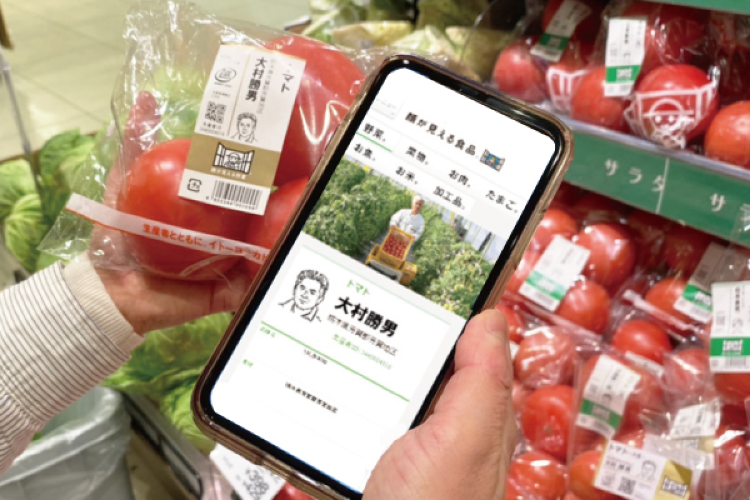
The idea underneath it is real, and much older than the viral post. In 2002, Japanese retailer Ito-Yokado launched a program it translates as "Food With a Visible Face." Produce packaging carried the farmer's name, location, and a searchable producer ID. Shoppers could scan a code and land on a page showing who grew the item and how. The program spread from fruits and vegetables into meat, eggs, seafood, and processed foods, and Ito-Yokado says it has worked with roughly 7,000 producers over two decades.
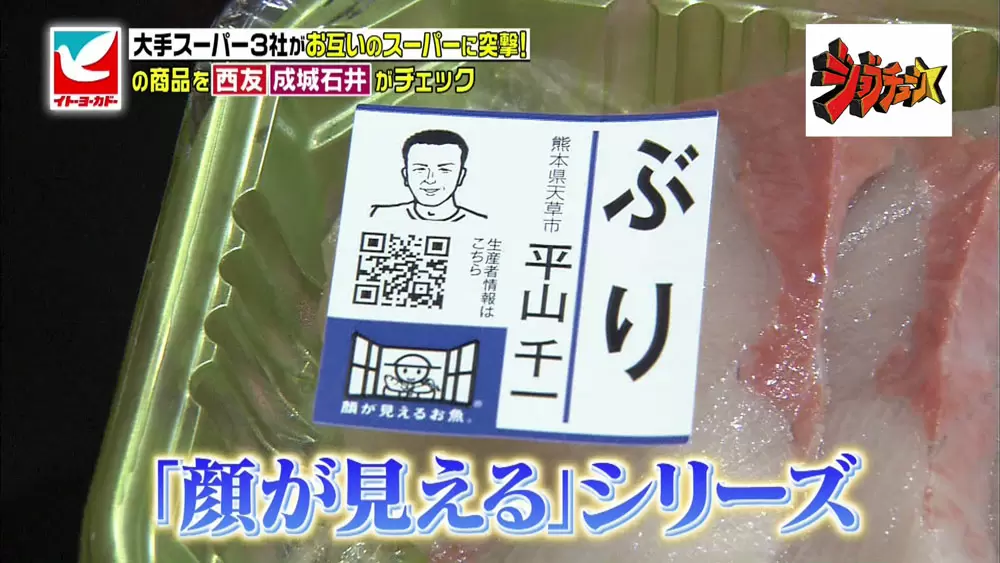
What's worth stealing here is the operating system behind that photograph, not the photograph itself.
Here's the opportunity:
The money: Thirty channel accounts at about $1,000 a month is $360K ARR, and a paid 90-day pilot runs $4,500 to $7,500 before print markup and intake fees.
Inside:
• Why the channel buys, not the farmer
• Four-week service-first MVP, then software
• Pilot plus three-tier monthly pricing
• The provenance graph: four stacked moats
Someone has to interview the producer, gather images, verify names and locations, secure permission to publish, write the package insert, translate it, resize it for shelf signage, maintain the webpage, and update all of it when the season turns. A large retailer can build that machinery in-house. A small farm can't.
The opening lives in that gap. Picture a done-for-you provenance content kit for regional distributors, food co-ops, food hubs, and premium grocery chains. A producer sits for one 15-to-20-minute interview and sends a handful of photos. The system turns that raw material into standardized package inserts, QR-linked story pages, shelf cards, wholesale catalog descriptions, social assets, and translations, across dozens of suppliers at once.
Think content infrastructure for the businesses on the hook for making local food legible at scale, not an AI copywriting tool for farmers.
The story disappears between the farm and the shelf
Small food producers rarely lack stories. They have family histories, odd growing methods, regional varieties, seasonal quirks, conservation practices, recipes, and reasons for doing hard work for thin margins. What they lack is the time and the operational discipline to turn any of that into polished retail assets. The problem compounds the moment local food moves through a middleman.
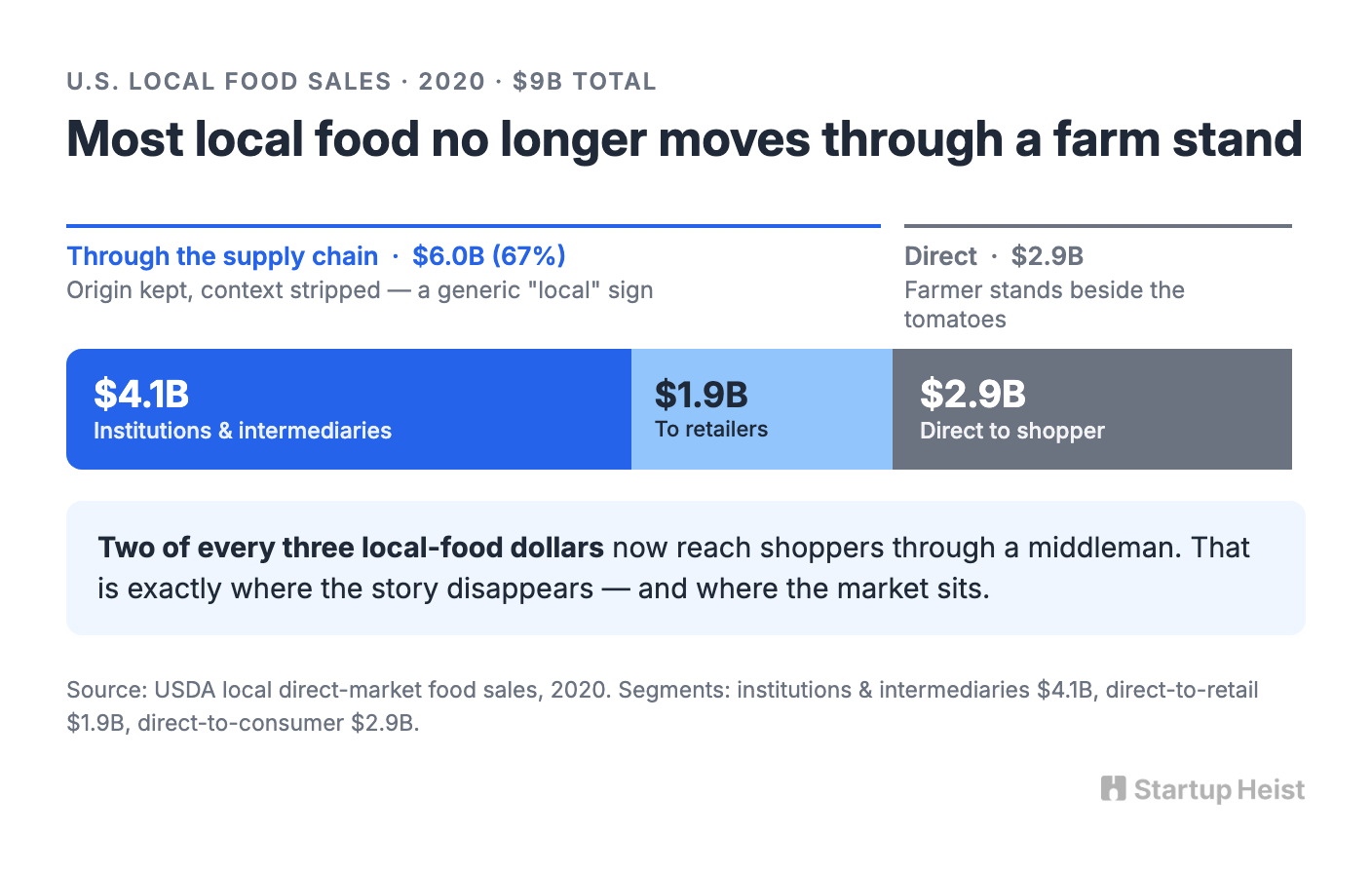
The numbers show where the food actually goes. USDA data puts U.S. local direct-market food sales at $9 billion in 2020. More than $4.1 billion of that came from sales to institutions and intermediaries, and another $1.9 billion from sales straight to retailers. Only $2.9 billion came from farmers selling directly to shoppers. Most local food now reaches people through a supply chain, not a farm stand.
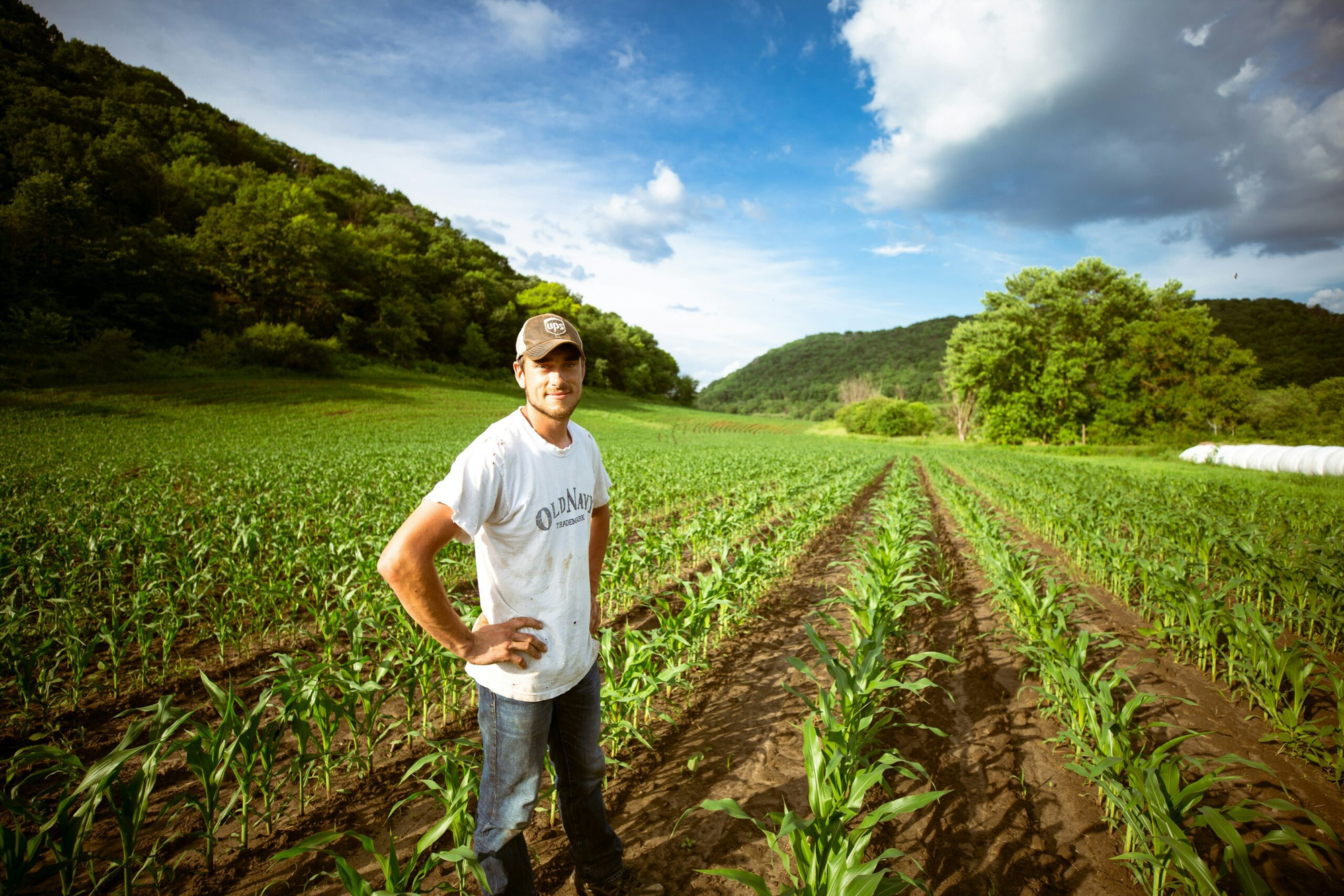
At a farmers market, the farmer stands beside the tomatoes and answers questions. At a grocery store, those same tomatoes sit under a generic sign that says "local." The product kept its origin. The supply chain stripped away the context. That loss is expensive, because regional grocers and co-ops lean on local sourcing to separate themselves from national chains, yet the proof of that difference is usually buried in spreadsheets, supplier emails, stale PDFs, and half-maintained webpages.
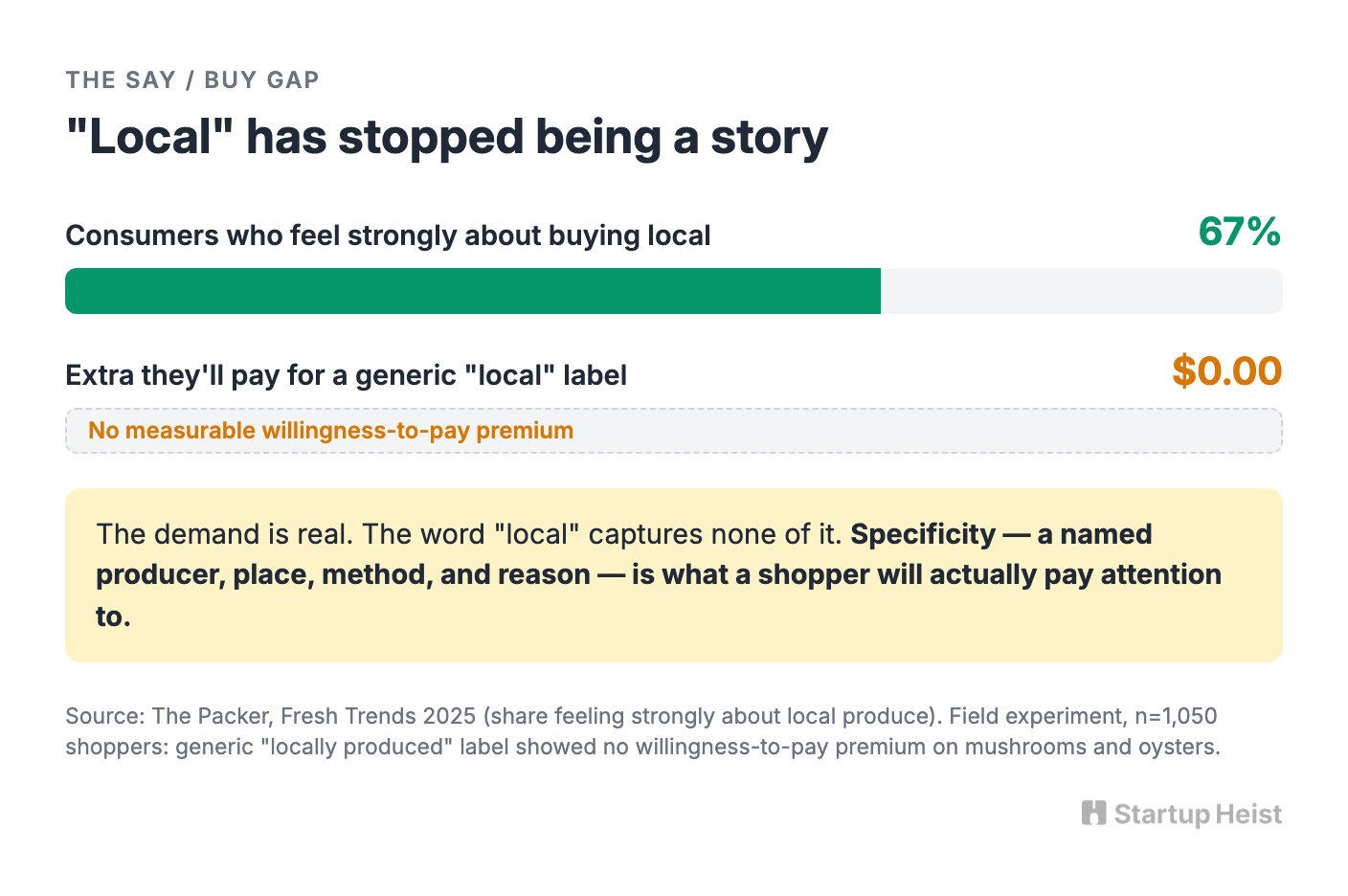
The demand is real, but read it carefully. The Packer's Fresh Trends 2025 survey found two in three consumers feel strongly about buying local produce, with the strongest pull among younger shoppers and households with kids. The same survey found a wide gap between what people say and what they buy. A field experiment with 1,050 shoppers went further: a generic "locally produced" label produced no measurable willingness-to-pay premium on mushrooms and oysters.
The whole business rests on one insight. "Local" has stopped being a story. A generic label reads as a commodity claim. A specific producer, place, method, season, and human reason for caring reads as a differentiated retail experience. The product should never promise that a farmer's face raises prices. It should promise to help a retailer explain, consistently and cheaply, why a given product deserves attention, without turning the producer into another job.
The customer is the channel, not the farmer
The obvious mistake is selling this to individual farms. A farmer might love the product, but most small producers can't support real software pricing, and acquiring them one at a time buys you a fragmented base, seasonal churn, and a heavy support load.
The buyer you want already manages a portfolio of producers: a food co-op with 40 local suppliers, a regional grocer running 10 to 50 stores, a produce or specialty distributor carrying dozens of small brands, a food hub aggregating many farms, or a premium retailer with a formal local-sourcing program. One contract unlocks 25, 50, or 100 producer profiles, and the economics finally work.
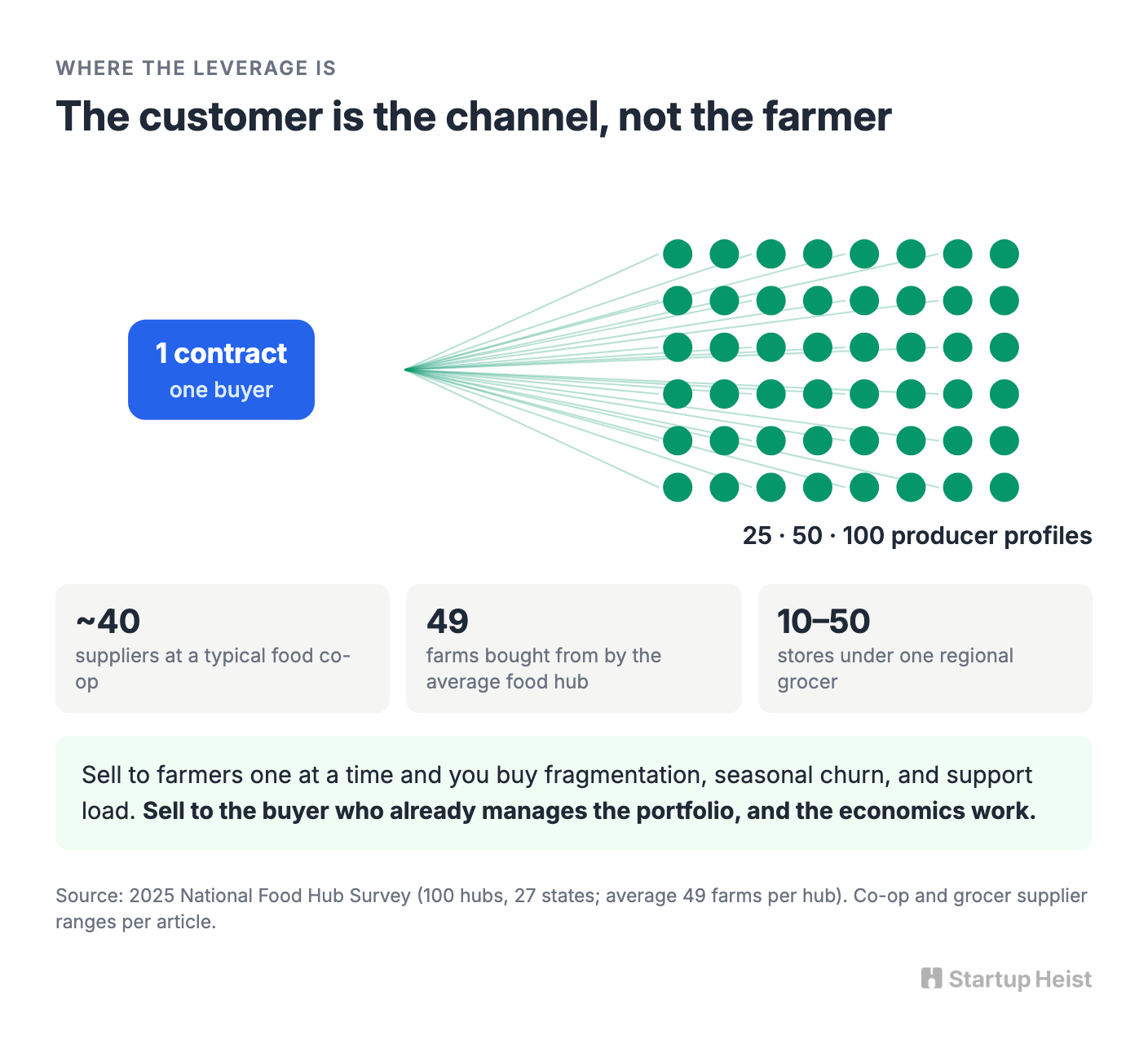
Food hubs are unusually dense sources of supply. The 2025 National Food Hub Survey drew responses from 100 hubs across 27 states; the average hub bought from 49 farms, and 85 percent said most or all of their purchases came from small or midsized farmers. The broader market isn't enormous, but it doesn't need to be. National Co+op Grocers represents 169 co-ops running 241 storefronts, the National Grocers Association speaks for roughly 21,000 independent grocers and wholesalers, and USDA has counted more than 400 food hubs with active contact information. Convert a sliver of that and you have a real business.
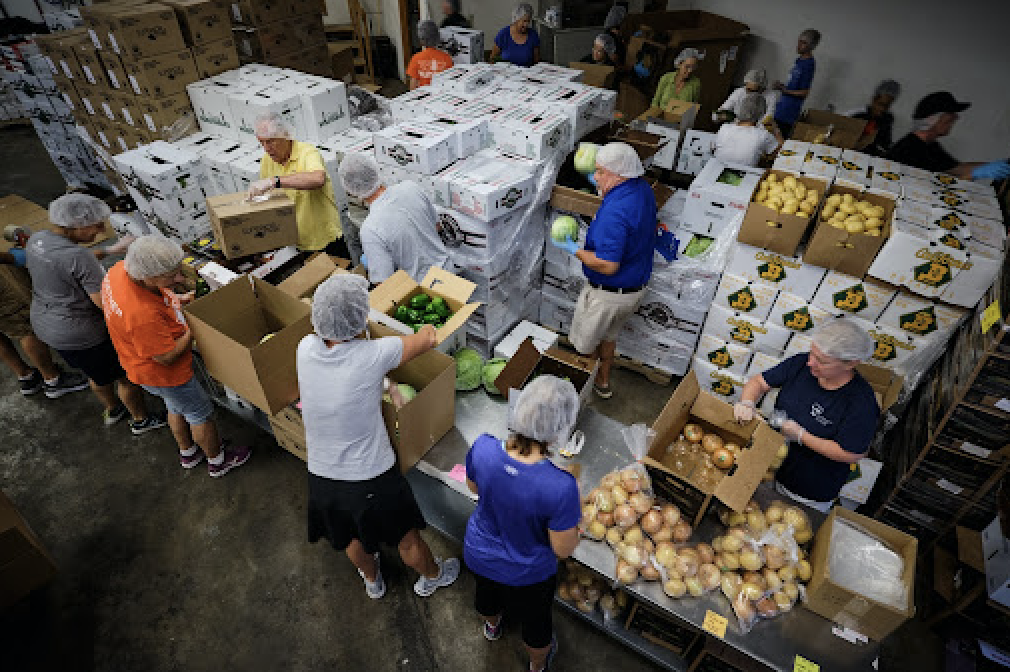
Your first customer is probably not a national supermarket chain or a grant-dependent nonprofit food hub. It's a five-to-50-store premium regional grocer or an established co-op with a visible local-food program, at least 20 recurring local suppliers, control over its own shelf signage and digital merchandising, and a marketing or merchandising employee who already spends part of every week chasing supplier photos and bios. That buyer can approve a pilot without a two-year procurement cycle, controls the retail floor, and can tie the work to both labor saved and sales moved.
Regional distributors are the second wedge. They offer more producer density, but they don't always control what appears at the final point of sale, so the distributor version has to ship retailer-ready exports, co-branded assets, and an easy way for downstream stores to request or tweak materials. Land the grocer first. It's the account that can prove the whole thesis in one summer.
What you are actually building
Unlock the Vault.
Join founders who spot opportunities ahead of the crowd. Actionable insights. Zero fluff.
“Intelligent, bold, minus the pretense.”
“Like discovering the cheat codes of the startup world.”
“SH is off-Broadway for founders — weird, sharp, and ahead of the curve.”


