


The Government Shopping List Arbitrage
On August 21, 2026, Japan starts publishing its Consumer Price Index against a freshly revised basket of household goods and services. Neckties, stockings and tights are on their way out. Protein powder, pet insurance, pineapples and bicycle helmets are on their way in.
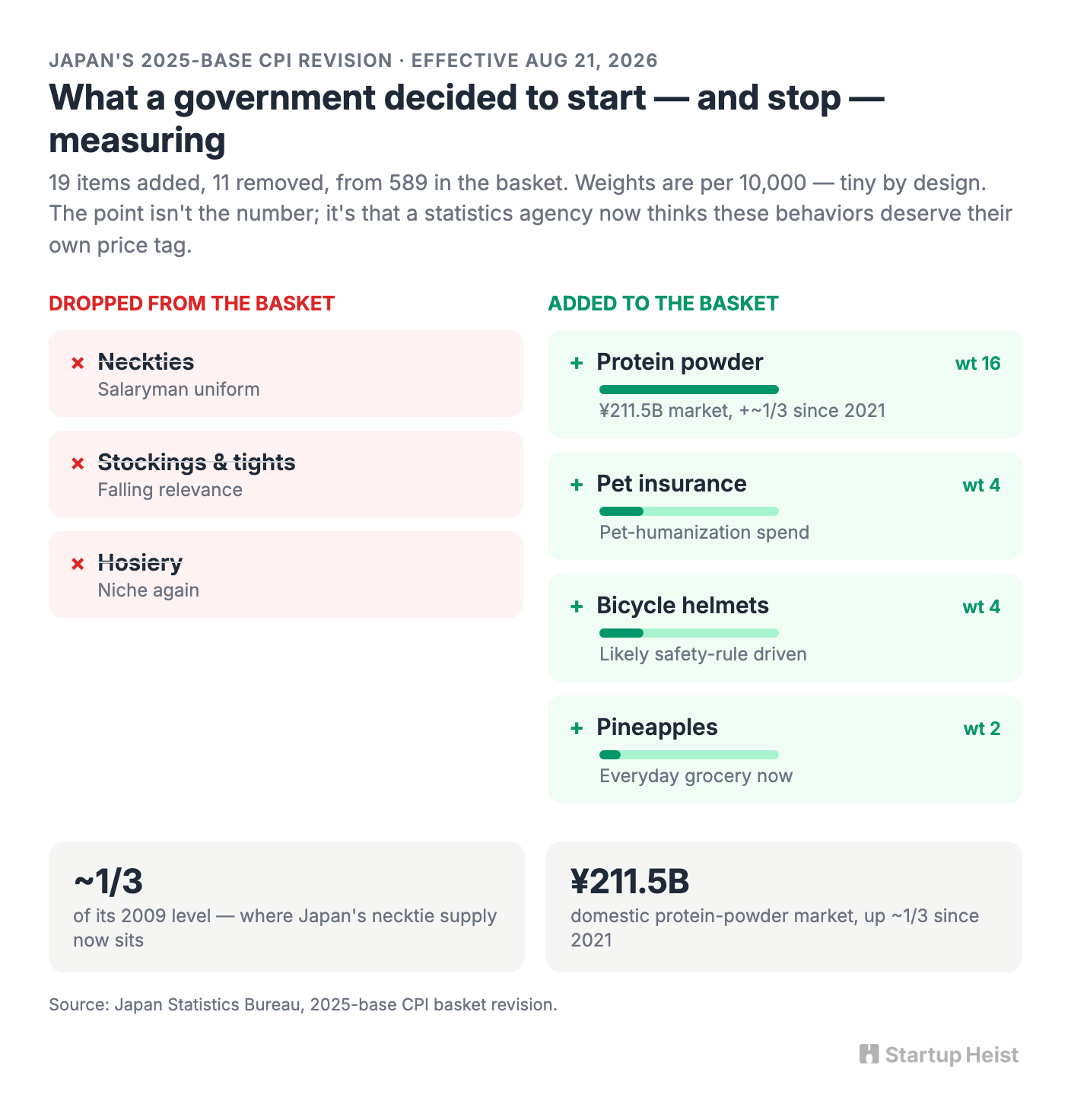
The symbolism is almost too clean. The uniform of the Japanese salaryman is losing statistical relevance while fitness supplements and pet spending become ordinary enough for a government to track. But the poetry is not what matters here. A national statistics agency just published a ranked, weighted, evidence-backed list of which consumer behaviors have crossed from niche into normal, and almost no commercial strategist will read it.

Japan's Statistics Bureau put 589 items in the new index, with 19 additions and 11 removals, chosen from products whose importance in household consumption rose or fell against 2025 expenditure data. The detailed list assigns protein powder a weight of 16 out of 10,000. Pet insurance and helmets get four each. Pineapples get two. The numbers are tiny, and their size misses the point: statisticians decided these categories now deserve their own ongoing price measurement. Over the same window, Japan's necktie supply fell to roughly a third of its 2009 level, while the domestic market for protein powders, bars and drinks reached around ¥211.5 billion after growing about a third since 2021.
There is a business hiding in that contrast.
The money: Seventy-five agency and consultant seats at roughly $350 a month is $26K MRR and $315K in annual recurring revenue; incumbents like Mintel and Euromonitor prove buyers pay.
Inside:
• Five-layer brief anatomy buyers will renew
• Four-tier pricing, free to $12K white-label
• Eight-week build plan plus MVP data schema
• Four compounding moats beyond scraping
Build a niche consumer intelligence service that watches official consumption baskets, expenditure weights and adjacent government datasets across a handful of influential countries. Translate those obscure changes into short category briefs that answer the one question commercial teams actually care about: is this a local statistical adjustment, or evidence that a product category is entering ordinary life?
This is not a Bloomberg terminal for consumer goods, nor a venture-funded attempt to out-database Euromonitor. It is a specialized market research product for agencies, consultants, consumer investors and cross-border product strategists who need credible signals but cannot justify a six-figure intelligence stack.
The Signal Hiding in Plain Sight
Every Consumer Price Index is built from a conceptual shopping basket. Agencies pick goods and services that represent household spending, track their prices, and assign weights reflecting relative importance. When spending shifts, they revise the basket, change the weights, or swap in new representative products.
Most businesses ignore this because it reads like statistical plumbing. The changes arrive as methodological notes, spreadsheets, classification tables and technical appendices, often in local product names, inconsistent taxonomies and multiple languages. A strategist researching pet care is not going to spend Friday afternoon reconciling Japanese CPI item codes with British basket revisions and Canadian expenditure weights. The information is public; the interpretation is not. That gap is the whole opportunity.

The UK shows how rich the feed gets. Its Office for National Statistics refreshes the basket every year. For 2026 it added 27 items and removed 19, leaving 760 in total, with additions including alcohol-free beer, pet grooming, motorhomes, dashboard cameras and houmous. The explanations are the commercially useful part: alcohol-free beer entered on growth in sales, range and shelf space; dashboard cameras after spending reached roughly £150 million; pet grooming to capture a growing slice of pet-care spend; houmous after estimated spending hit about £170 million. That is the skeleton of several category briefs sitting inside one government release.
Other countries fill in the rest of the map. France reweights its basket annually against household expenditure. Canada introduced new CPI weights in June 2026 using 2025 data. The United States publishes annual relative-importance tables plus the detailed Consumer Expenditure Survey that feeds them. So the product never has to wait five years for Japan's next headline revision. Japan is the launch story, and the annual weight changes, household surveys, retail classifications and import data are the recurring feed that keeps the lights on.
Do Not Sell the Raw Change
"Japan added protein powder" is a tweet, not a product. The customer pays for the analysis wrapped around the change, and a brief that earns its subscription combines five layers.
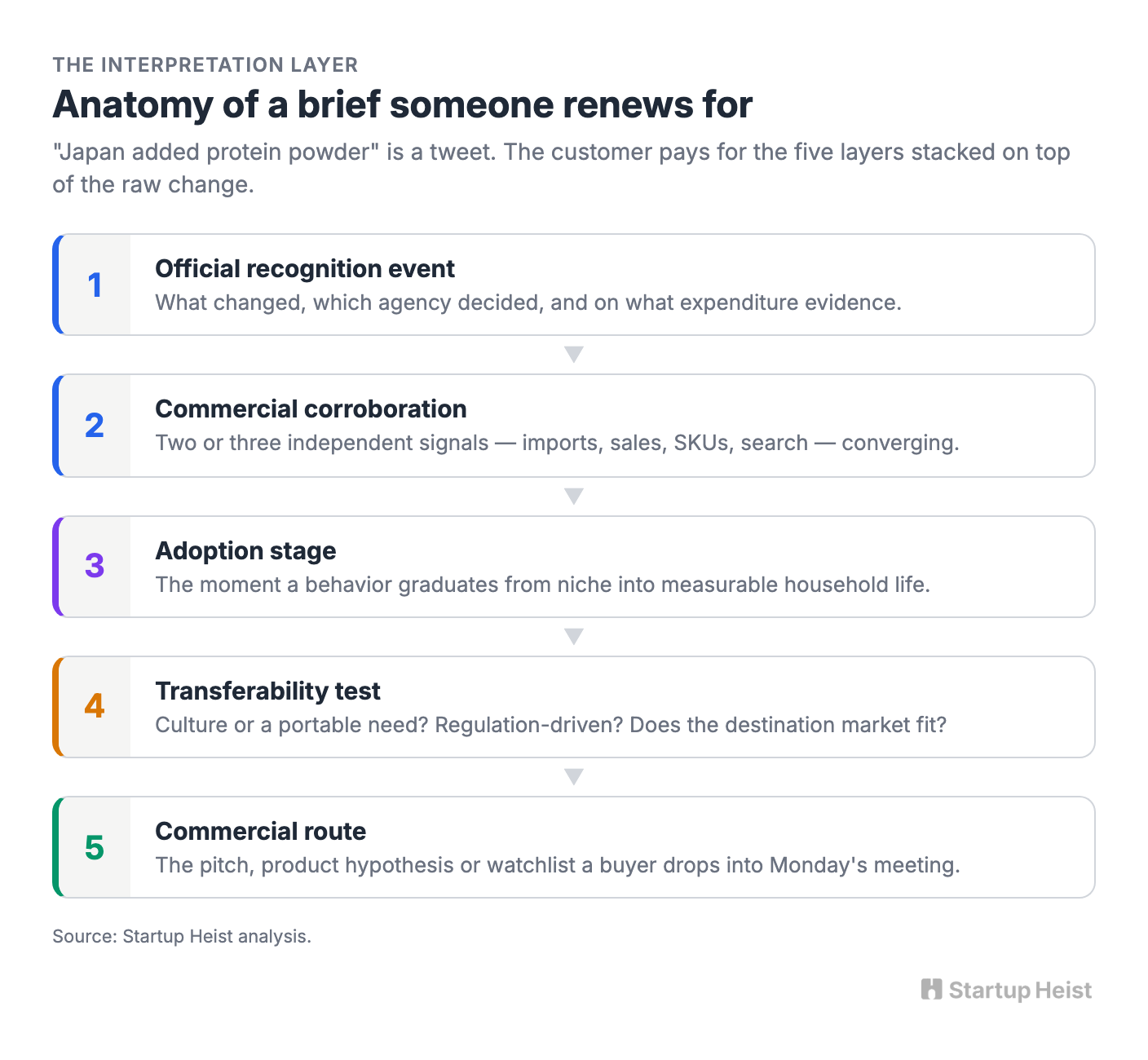
The official recognition event. What changed, exactly? Was the category added, removed, split, merged or reweighted? Which agency decided, and on what expenditure evidence? Is it genuinely new, or just a fresh proxy for an old category? A product can enter because spending grew, because prices got volatile, because classification rules shifted, or because statisticians needed a better stand-in. Those are very different signals.
Commercial corroboration. Does independent evidence back the official move? For each category, stack two or three outside indicators: household expenditure growth, import and export movement, domestic sales, retailer and SKU penetration, search activity, new product launches, regulatory shifts, public-company commentary, distribution expansion. The goal is convergence. Several unrelated signals pointing the same way matter more than one giant dashboard.
The adoption stage. An item entering a basket rarely means early. More often it means the category is already established enough to matter statistically. That is what separates this from a trend newsletter promising to spot products before anyone has heard of them. This product identifies the moment a behavior graduates from niche into measurable household life, then asks where that graduation is still commercially useful: mature in Japan but underbuilt in the US, mainstream among young Britons but poorly served by regional retailers, an opening in services, accessories, distribution or private label rather than the headline product.
The transferability test. This is the intellectual center. Is the change driven by culture or by a broadly transferable need? Is regulation manufacturing the demand? Does the destination market share the demographics, distribution and pricing structures? Is the category already saturated there? Bicycle helmets make the point: their inclusion in Japan may reflect safety rules more than organic enthusiasm, so the signal may not travel. Pet insurance may move easily to countries with the same pet-humanization and vet-cost pressures. Protein powder may signal a wider normalization of active nutrition, where the real opening is in new formats, age groups or channels rather than another generic tub of whey. Every brief lands on one of four verdicts:
- Local quirk. Economically real, unlikely to transfer.
- Late confirmation. Growing, but the obvious opportunity is already taken.
- Cross-border watch. Promising but incomplete.
- Commercially actionable. A practical product, investment or client opening.
The commercial route. Do not stop at "this market is growing." Tell the buyer what the signal supports: a client pitch, a product-extension hypothesis, a distributor search, a private-label play, an acquisition theme, a market-entry call, an investment watchlist, a positioning angle. The subscription earns its keep the moment the buyer can drop the insight into Monday's client meeting.
That is where the free reader stops and the paying customer keeps reading. Everything below is the machine that turns one government spreadsheet into a product someone renews.
The Right Customer Is Not "Every Brand"
The first mistake would be chasing general DTC founders. Most individual brands care deeply about their own category and only occasionally about the ones next door. Even at $149 a month, churn would be brutal unless every issue happened to hit their exact inventory. The better first customer is someone who has to manufacture insight repeatedly, across many clients, investments or markets.
Consumer agencies and consultancies are the strongest wedge. A ten-person brand strategy shop serving food, wellness, pet and retail clients rarely has a research department, but its strategists still need defensible observations, slides and provocative questions. One good brief gets reused across a client workshop, a new-business pitch, a quarterly trend deck, a LinkedIn post and an internal strategy session. You are not selling information; you are selling leverage.

Three adjacent buyers extend the base. Small consumer funds and family offices operate without institutional research subscriptions and will pay more for unusual signals paired with company screens and import trends, though the sale is slower and the credibility bar higher. Cross-border product and market-entry consultants already ask whether a behavior seen in Japan or Korea will travel, and this becomes their first filter before expensive primary research. Corporate innovation teams are attractive later, once the archive exists, but early enterprise deals eat founder time and trigger procurement. Start where the buyer and the user are the same person.
Position It Between a Newsletter and a Research Database
The incumbents prove businesses pay for category intelligence. Mintel lists shorter Market Dynamics reports around $695, with fuller Market Intelligence reports running several times higher. Euromonitor's Passport spans more than 100 countries and reports over 60,000 users. Do not fight them on breadth. Beat them on specificity, speed and usability.
Mintel sells a comprehensive report on a market. Your product pings an agency that pet grooming just entered the British inflation basket, shows the expenditure and retail evidence behind it, compares the signal against Japan and the US, and hands over three slides on what it means for their pet-care clients. That narrower job is exactly what leaves room for a lower-priced recurring product. The tiers:
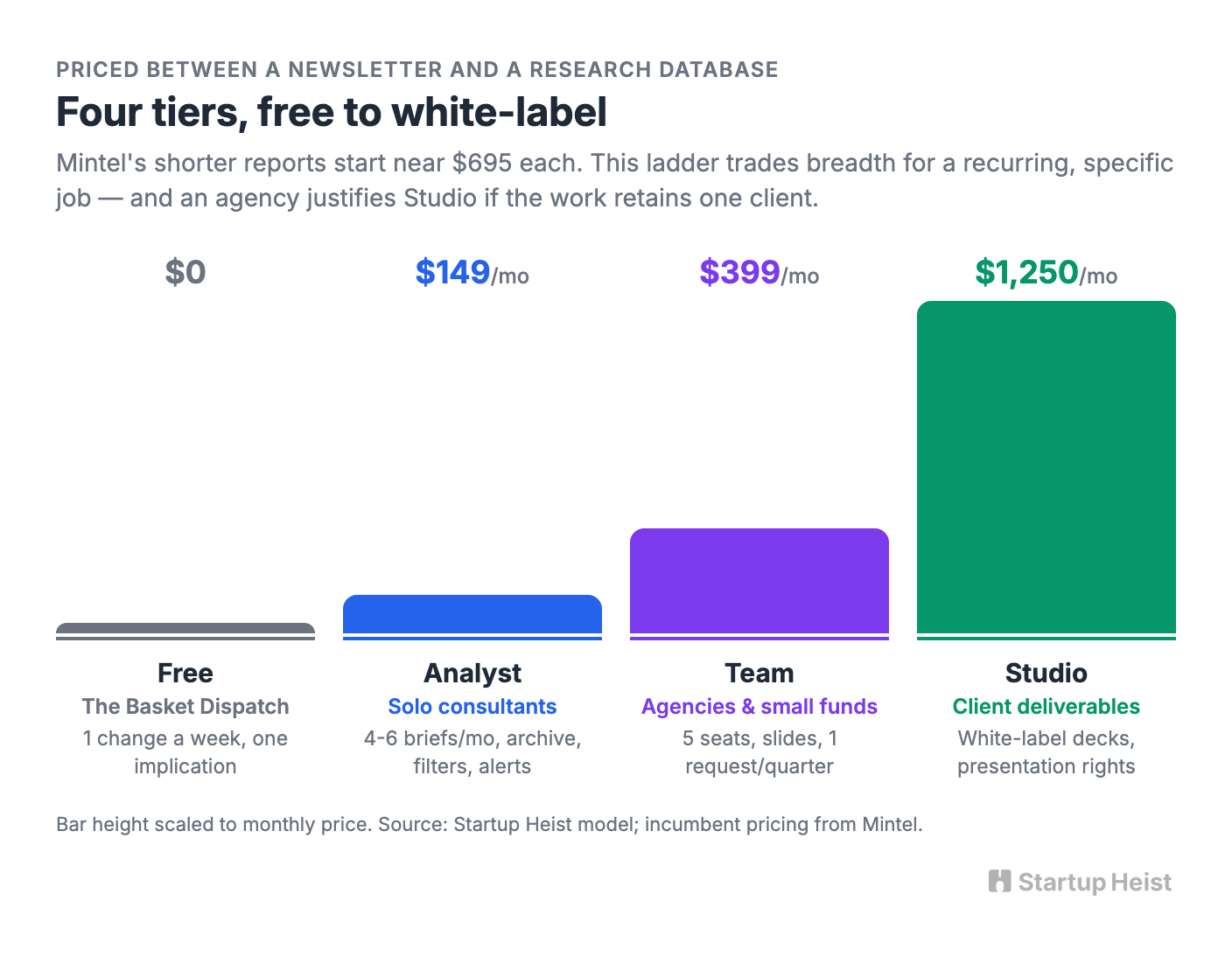
Free — The Basket Dispatch. One notable change a week. Explain the official event, offer one commercial implication, and reserve the transferability analysis, source table and client-ready slides for members. Its only job is to prove that government statistics contain useful stories.
Analyst — $149/mo or $1,490/yr. For solo consultants and independent strategists: four to six category briefs a month, searchable archive, country and sector filters, source links, methodology notes, watchlists and email alerts.
Team — $399/mo or $3,990/yr. For agencies, boutiques and small funds: five seats, everything in Analyst, downloadable charts and slides, saved sector watchlists, a monthly roundup, internal usage rights, and one research request per quarter.
Studio — $1,250/mo or roughly $12,000/yr. For agencies putting the work into client deliverables: white-label slide exports, editable PowerPoint or Google Slides, client presentation rights, a quarterly analyst briefing, priority category requests, custom formatting, and early access to major revision reports. This is where the business stops being a newsletter. An agency justifies $12,000 a year if the material retains one client or wins one pitch.
You can also sell focused category sprints for $3,000 to $8,000, built on the same database and methodology so they stay productized instead of drifting into open-ended consulting.
What the MVP Actually Needs
Do not begin by building a global scraping platform. The first version is a database, a strong research workflow, a polished email and a lightweight searchable interface. Nothing more.
Start with three source systems:

Unlock the Vault.
Join founders who spot opportunities ahead of the crowd. Actionable insights. Zero fluff.
“Intelligent, bold, minus the pretense.”
“Like discovering the cheat codes of the startup world.”
“SH is off-Broadway for founders — weird, sharp, and ahead of the curve.”


