


The Proposal That Lives in a File
Proposal software is built on an odd assumption: the buyer should step inside the seller's software.
A consultant wraps a discovery call. A design studio prepares a $70,000 rebrand pitch. A commercial broker assembles a polished package for a landlord. Then, right when the seller should be removing friction, the prospect receives another link, another branded portal, another web app, and sometimes another login.
A smaller, almost contrarian product is hiding in that moment. Send the client the application itself. One self-contained HTML file that opens in any browser and behaves like a miniature website: branded cover, scope, timeline, case studies, interactive pricing, a calculator, FAQs, galleries and calls to action. The recipient can save it, forward it, drop it in the deal folder and reopen it two years later without touching the vendor's account or cloud.
When the buyer needs to do something that genuinely requires the internet (sign, pay a deposit, book a call, watch a long video), the file hands off to Stripe, DocuSign, Calendly or Loom. The presentation works offline and the transaction happens online. That split is the whole product, sold as a portable interactive proposal: send a mini-site, not a PDF or a portal.
The opening is narrow, specific and buildable by one person:
The money: 300 Solo accounts at $29/month plus 100 Studio accounts at $99/month = $18,600 MRR. Agencies already pay Qwilr $275 a month for five seats.
Inside:
• A four-to-eight-week MVP and what to leave out
• Three delivery modes that get past email filters
• Pricing from $29 Solo to $199 White Label
• The outreach email for your first 100 agencies
The File Became Software
The trigger is Bento, an open-source presentation tool that hit Hacker News in July 2026 under the headline "An entire PowerPoint in one HTML file." The launch post cleared 1,033 points, and the GitHub repo has since passed 5,400 stars. Its creator built it in about a week with Claude Code.
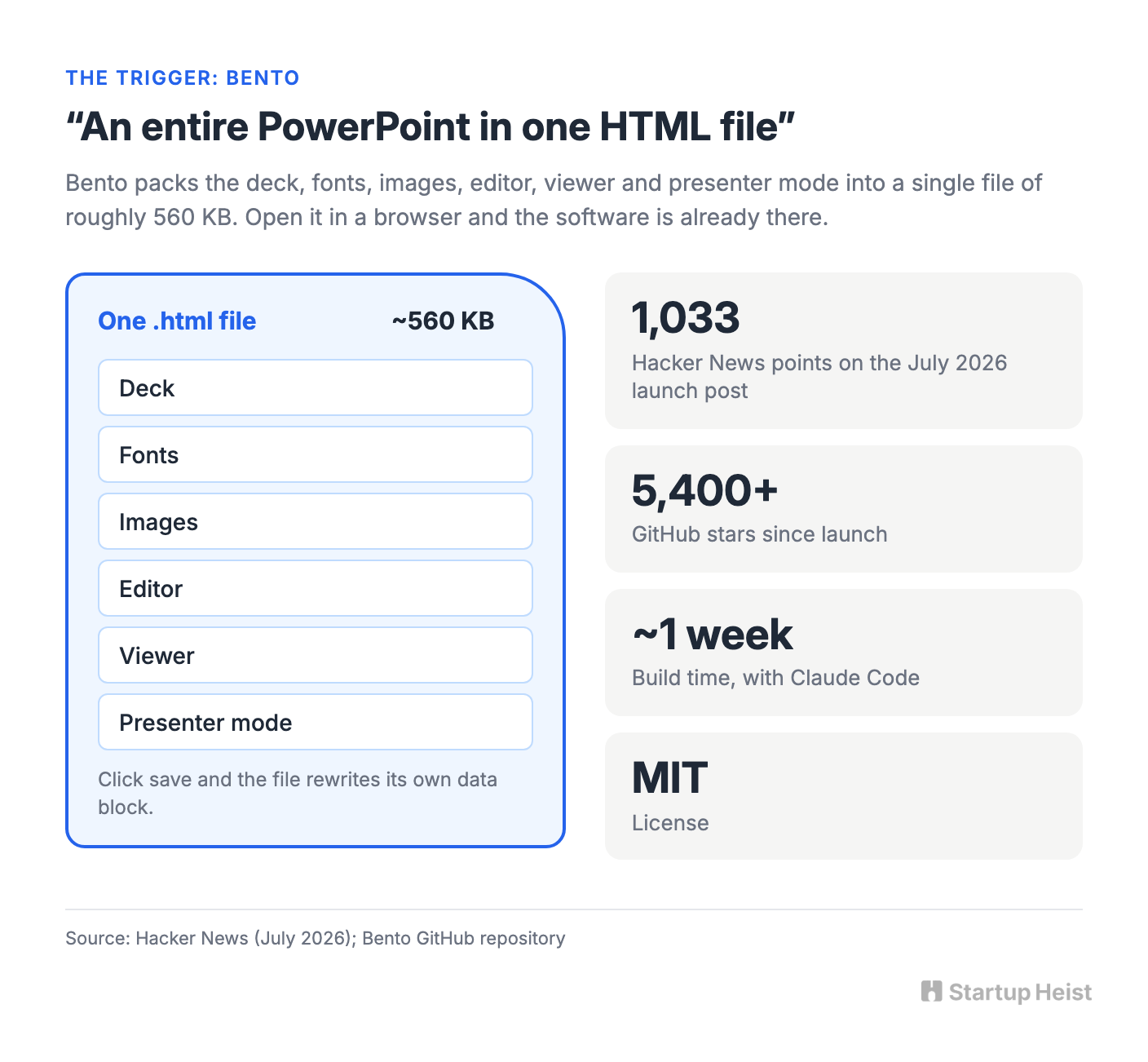
Bento packs the deck, fonts, images, editor, viewer and presenter mode into a single file of roughly 560 KB. Open it in a browser and the software is already there. Click save and the file rewrites its own data block. It's MIT-licensed, and it even ships optional end-to-end encrypted collaboration with keys that live inside the file. For a founder, the takeaway is simpler than the feature list: a polished, interactive single-file app can now travel as an email attachment.
Proposals suit this architecture unusually well. A proposal doesn't need to sync continuously with dozens of collaborators, and it doesn't need a live database connection to do its job. For boutique service firms it's a sales artifact. The seller spends days on strategy and packaging; the buyer spends a few minutes deciding whether this team can handle a six-figure engagement.
Today that buyer gets one of two formats. The PDF goes everywhere and does nothing once it arrives. The hosted proposal platform is interactive and measurable, but it lives in someone else's cloud and keeps accumulating CRM syncs, approval chains and governance features a five-person studio barely touches. The gap between them leaves room for something deliberately less sophisticated.
The Incumbents Prove the Spend
The proposal software category is crowded and well paid. PandaDoc's Business plan costs $49 per seat per month on annual billing. Qwilr's Starter plan is $35 per user per month and Growth is $275 a month for five seats, both billed annually, and Qwilr bundles interactive quotes, ROI calculators, e-signature and payments. Proposify's Team plan is $35 per user per month billed annually. At the transaction-heavy end, DocSend's Advanced plan runs $150 a month and Advanced Data Rooms $180, both billed annually, paying for visitor authentication, NDAs, watermarking, granular permissions and audit logs. Fortune Business Insights sizes proposal-management software at $3.66 billion in 2026, heading to $9.19 billion by 2034. Read that as evidence that buyers already budget for this category; it says little about your own addressable market.
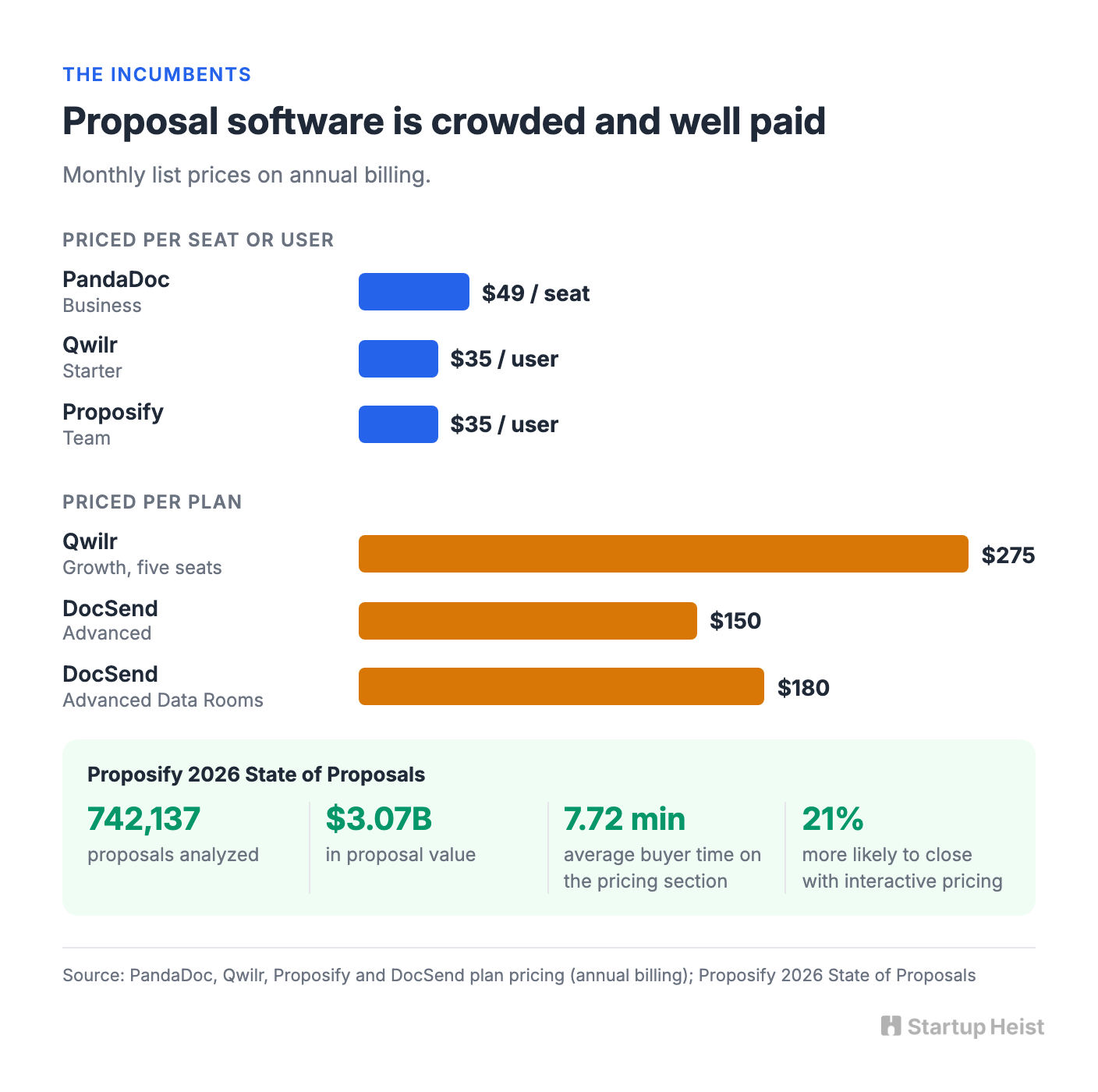
The more useful numbers come from Proposify's 2026 State of Proposals report, built on 742,137 proposals worth $3.07 billion. Buyers spend an average of 7.72 minutes on the pricing section alone, and companies using interactive pricing are 21% more likely to close. Interactivity tracks with closed deals, and the incumbents have welded it to a hosted platform, a per-seat bill and a stack of features a small studio never opens.
The instinct is to build a cheaper PandaDoc. Do the opposite. Strip almost everything out, keep the interactivity, and hand the buyer an object instead of a login.
Who Actually Wants This
Enterprise sales teams sending thousands of proposals are the wrong customer. They need exactly what a standalone file is bad at: identity verification, revocable access, centralized permissions, audit trails, view analytics and CRM sync.
The sweet spot is the relationship-led seller who closes a small number of valuable deals: boutique brand agencies, fractional CMOs, architecture studios, product consultancies, web shops, specialist recruiters, commercial brokers. They juggle a modest pipeline of live prospects, the principal often presents the work personally, and the buyer has usually met them before the proposal lands. For these firms the proposal is packaging, closer to a lookbook than a workflow.
Start with creative and design agencies. They already believe aesthetics drive perceived value, their agency proposals are full of imagery, timelines and tiered pricing, and a beautifully built mini-site turns the proposal itself into evidence of craft. Brokers may come around to the format later, but an agency founder gets it in ten seconds, which makes agencies the beachhead.
The Product: Offline Presentation, Online Transaction
Unlock the Vault.
Join founders who spot opportunities ahead of the crowd. Actionable insights. Zero fluff.
“Intelligent, bold, minus the pretense.”
“Like discovering the cheat codes of the startup world.”
“SH is off-Broadway for founders — weird, sharp, and ahead of the curve.”


