


The Permission Layer Hiding Inside Youth Sports Video
Build the rights-safe clip factory that turns one recorded game into dozens of creator posts, with sponsor rules, posting permissions, and trackable links attached.
The NBA has handed every smaller sports property a blueprint for modern distribution.
On July 16, 2026, TikTok, the NBA, and the WNBA announced a multi-year global content partnership. It goes well beyond putting more highlights in the feed. The deal combines official footage, approved creator access to marquee events, advertising inventory through TikTok Pulse Premiere, and a direct route from short-form clips to live-game viewing. During the 2026 NBA Finals, the league's TikTok GamePlan activation generated 497 million impressions, and a Finals search hub drove 426,000 referrals to watch games. TikTok's own research found fans are 42% more likely to tune in to a live game after watching sports content on the platform.
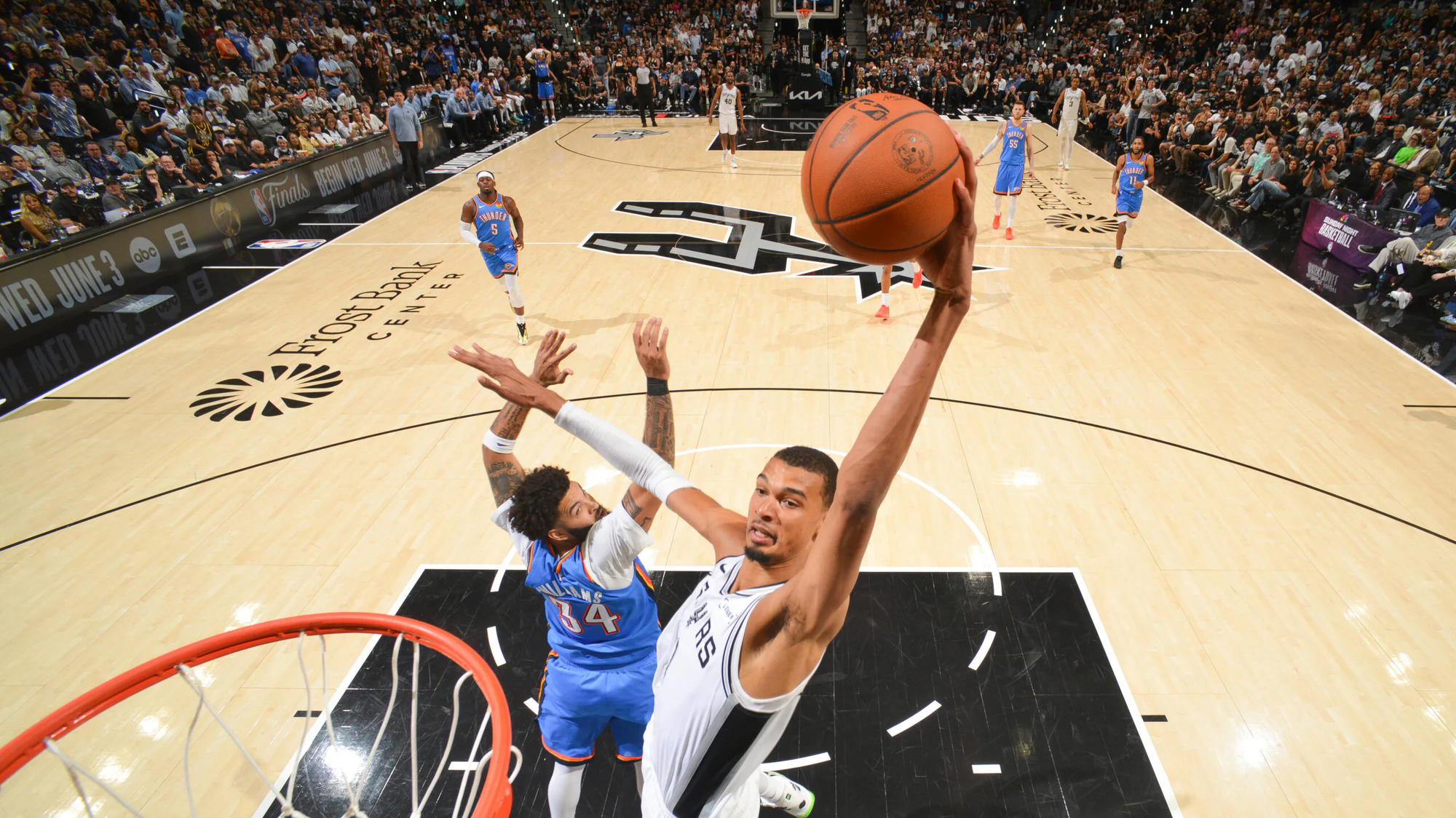
The machine works because the NBA controls every piece of it. It knows who owns the footage. It has agreements with athletes, broadcasters, sponsors, venues, platforms, and creators. It can decide which moments get distributed, which logos must appear, where content can run, and how viewers get pointed toward a game.
Now move down the sports pyramid.
A privately run basketball tournament records 80 games over a weekend. A regional volleyball operator has livestream footage from six courts. A martial-arts promotion owns high-quality video of every bout. Parents, photographers, local sports pages, former athletes, and niche creators would happily publish the best moments. But the footage almost always ends up in one of three places: buried inside a two-hour replay, cut into a single recap for the organizer's own account, or reposted informally with no clear permissions, no sponsor treatment, and no attribution.
Nobody is missing an AI highlight editor. The gap is the permission and distribution layer between the footage owner and everyone who could help distribute it.
Call it ClipPass: a micro-SaaS that lets youth and amateur sports properties convert owned game footage into approved creator inventory. Organizers release specific clips, attach sponsor and usage rules, invite creators to claim them, and generate trackable links for tickets, streams, and registrations. The core asset is the permission chain: footage ownership, participant releases, approved platforms, sponsor requirements, expiration dates, and referral attribution.
Here's the shape of it:
The money: 30 seasonal operators at $2,000 a year is $5K MRR before event fees; the 250-customer base case clears $375K ARR.
Inside:
• Seven-module MVP one founder can ship
• Event-based pricing: $500 pilot to $2,400 season
• Cold outreach template for tournament operators
• COPPA-safe design rules for youth footage
This isn't obviously a billion-dollar company. It could, though, become a sharp, defensible vertical SaaS business, and potentially a strategic acquisition target for the video platforms already capturing millions of amateur games.
The footage supply already exists
Ten years ago, the first problem was recording the game. That problem is getting solved at industrial scale.
Youth sports streaming is now a $10 billion business, fueled by family viewing and recruiting. Pixellot, the AI-camera company, streamed roughly 1.5 million games across 14 sports in 2025. Hudl streamed more than 1 million games, and its users create over 12 million highlights a year.
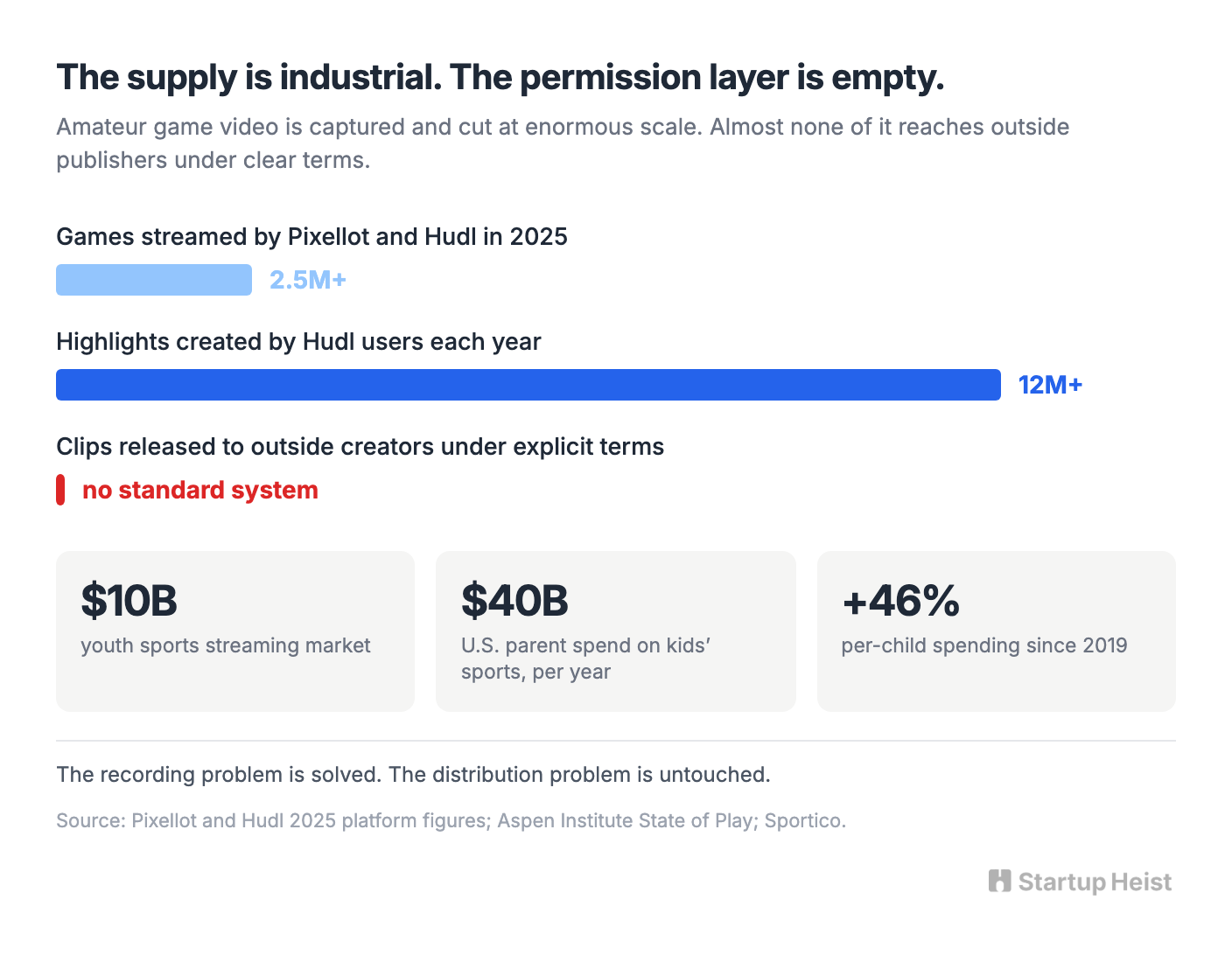
The money underneath is even bigger. The Aspen Institute estimates U.S. parents now spend more than $40 billion annually on their kids' sports, with average per-child spending up 46% since 2019. Private equity noticed: Sportico called youth sports 2025's breakout M&A theme, with firms rolling up tournament operators, facilities, and software. Yet the software layer (scheduling, payments, video, sponsorship) remains fragmented across sports and regions. Youth sports is hyper-local and operationally messy, which is exactly why horizontal giants keep failing to standardize it.
That combination points somewhere specific. The cameras are already rolling; the money is in raising the economic output of what they capture. An organizer might already pay for a streaming platform, a camera operator, a freelance videographer, social-media labor, and sponsor activation, and the final distribution strategy is still "post a highlight reel and hope people share it."
ClipPass turns one media asset into controlled inventory for 10, 20, or 50 outside publishers. A single dunk could be released to a regional basketball account, a creator covering high-school prospects, the tournament's presenting sponsor, the player's club, a local news page, a parent with a large following, and the organizer's own accounts, each with the appropriate caption guidance, sponsor treatment, usage window, and destination link.
The footage stops being an archive and becomes a distribution supply chain.
Why this is happening now
Creator-led sports media is moving from an informal side channel into official infrastructure. PwC's 2026 North America sports outlook expects leagues and broadcasters to deepen collaboration with sports content creators, with user-generated and athlete-led media rising as a complement to traditional broadcasts. The NBA–TikTok deal is the clearest top-of-market signal: creators become a measurable extension of the media operation rather than tolerated outsiders.
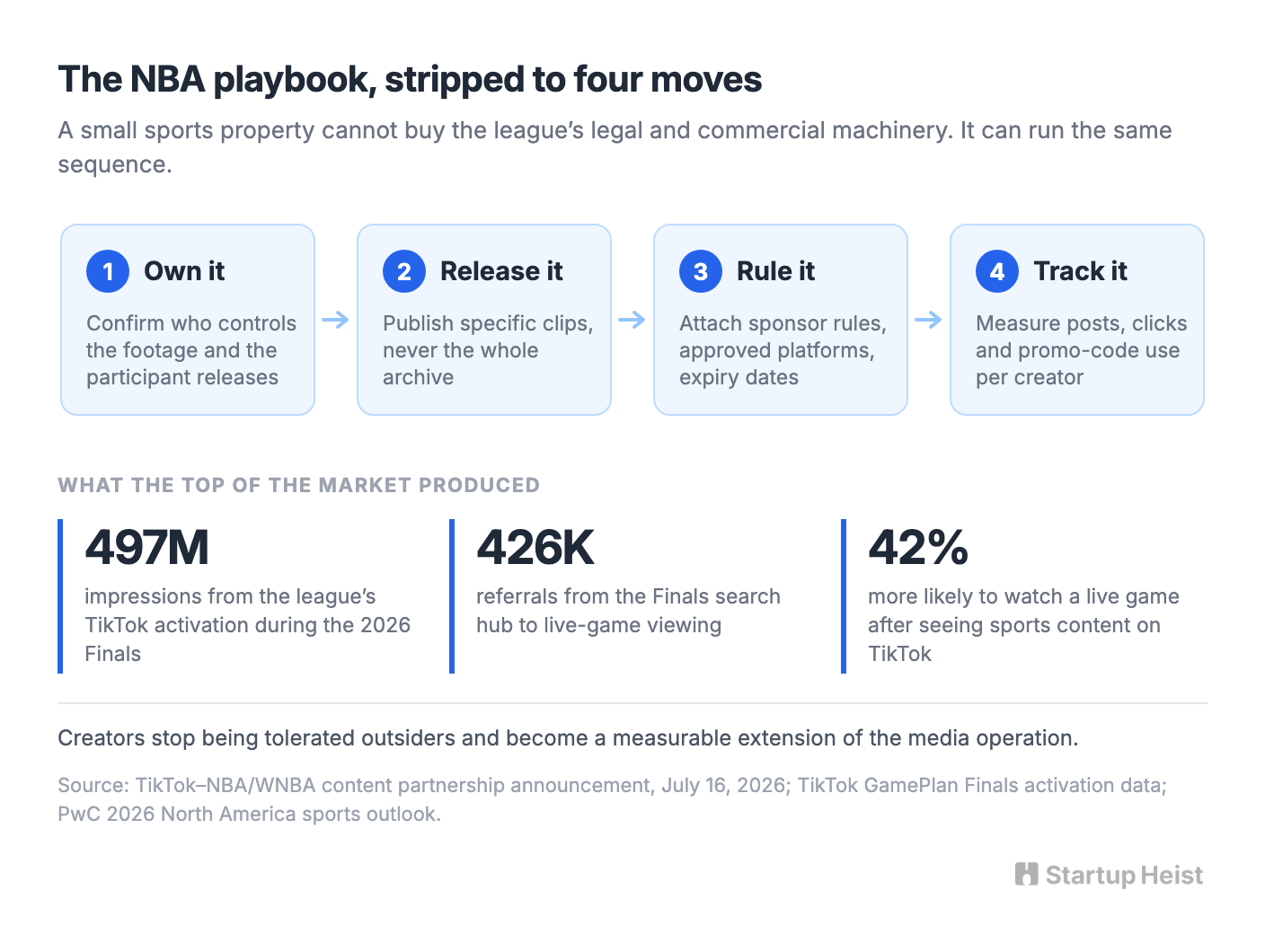
Small sports properties can't reproduce the NBA's legal and commercial infrastructure. But they can run a simplified version of the same workflow:
- Establish that the organizer controls the footage.
- Release specific clips instead of an unrestricted archive.
- Attach standardized posting terms and sponsor rules.
- Track distribution and downstream action.
The behavior already exists: parents record from the sidelines, local creators repost scores and highlights, athletes share their own clips, and sponsors ask whether their logos got exposure. ClipPass doesn't need to invent a new habit, just organize one that's already running loose.
Sell sponsor inventory, not "social engagement"
"Get more views" is a weak SaaS pitch. Tournament operators already hear it from videographers, social agencies, streaming vendors, and every teenager who can edit a Reel.
The stronger pitch: turn your existing footage into approved, distributed sponsor inventory. That changes the budget conversation. Instead of selling to a social-media manager, you sell to the person responsible for sponsorship revenue, registrations, ticketing, and event growth.
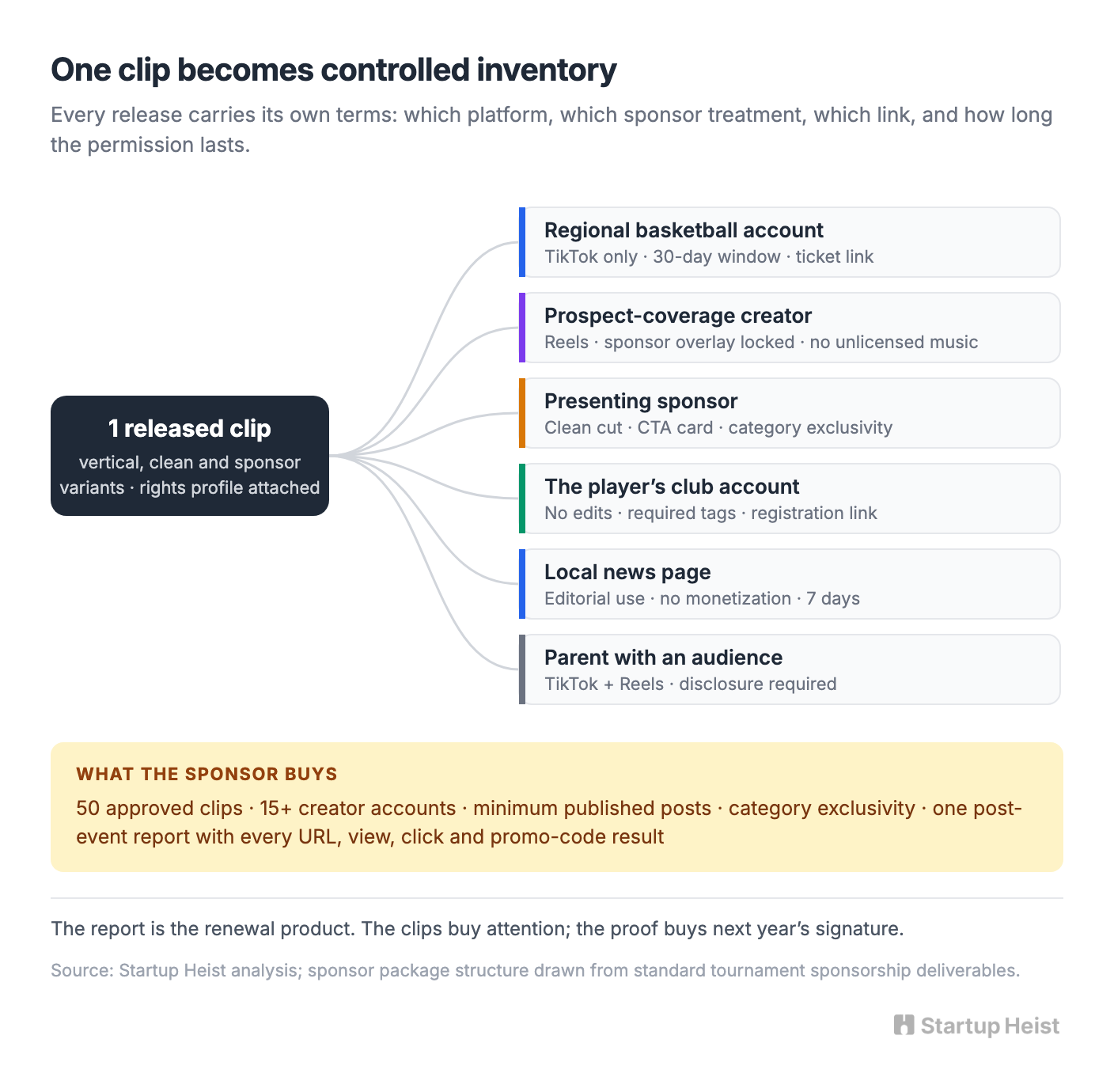
Suppose a tournament promises its primary sponsor logo placement on 50 approved clips, distribution through at least 15 creator accounts, a minimum number of published posts, category exclusivity, and a post-event report with URLs, views, clicks, and promo-code usage. Without a dedicated workflow, delivering that package means spreadsheets, shared drives, manual emails, logo files, caption instructions, and endless follow-up. ClipPass packages the obligation into a campaign: the organizer selects a sponsor template, every clip released under it inherits the approved overlay, CTA, disclosure language, expiration date, and destination link, creators accept the rules before downloading, and the organizer watches a live report showing which assets were claimed and published.
That's worth more than a clipping tool because it helps the customer sell something. Greenfly proves the category at the professional end; its platform distributes rights-managed short-form media to athletes, sponsors, broadcasters, and creators across more than 40 leagues and 500 organizations. ClipPass is the downmarket version: Greenfly-style control for an operator that will never buy Greenfly-style enterprise software.
What the product actually does
The first version should be intentionally boring. Skip the generative highlight engine, the social network, the proprietary livestream, and any marketplace where minors negotiate content rights.
It does one job: release a set of sports clips to approved adult creators, under clear rules, and document what happened afterward.
Unlock the Vault.
Join founders who spot opportunities ahead of the crowd. Actionable insights. Zero fluff.
“Intelligent, bold, minus the pretense.”
“Like discovering the cheat codes of the startup world.”
“SH is off-Broadway for founders — weird, sharp, and ahead of the curve.”


