


The Overflow Desk
Every HVAC shop in America turns away booked-intent customers during peak season. Build the brokerage that routes those jobs to vetted competitors and takes a cut of each one.
It is 4:15 p.m. in Phoenix during a heat wave. A homeowner calls a well-run HVAC company because the air conditioner is blowing warm. The dispatcher is professional, sympathetic, and completely out of technicians.
"Our first available appointment is next Thursday."

The homeowner does not wait until Thursday. They hang up and call the next company.
That contractor paid to generate the demand, staffed a person to answer it, and spent years building the local reputation that made the phone ring in the first place. All of it evaporated because a truck was not available at the right moment.
Every shop in the metro is doing this to every other shop, all week, every peak season.
The opportunity sits inside that phone call.
The money: 300 completed referrals a month in one metro is $18,900 in gross platform revenue. Baton has passed 300,000 referrals on the same premise.
Inside:
• What you can legally broker, and what you cannot
• Fixed-fee pricing tied to verifiable milestones
• The 30-day concierge pilot and its kill criteria
• Four moats that compound in one metro
Build a metro-specific overflow desk: a small, private brokerage that helps overloaded HVAC shops route booked-intent jobs to licensed, vetted peers. The original contractor collects a referral fee. The receiving contractor gets an exclusive appointment with a customer who has already agreed to a service window. The homeowner gets help today instead of next week. You manage consent, qualification, matching, payment, and accountability.
Nothing here depends on generating new demand. The business matches capacity to demand that already exists and is currently being thrown away.
The constraint has moved
The home-services market does not lack demand.
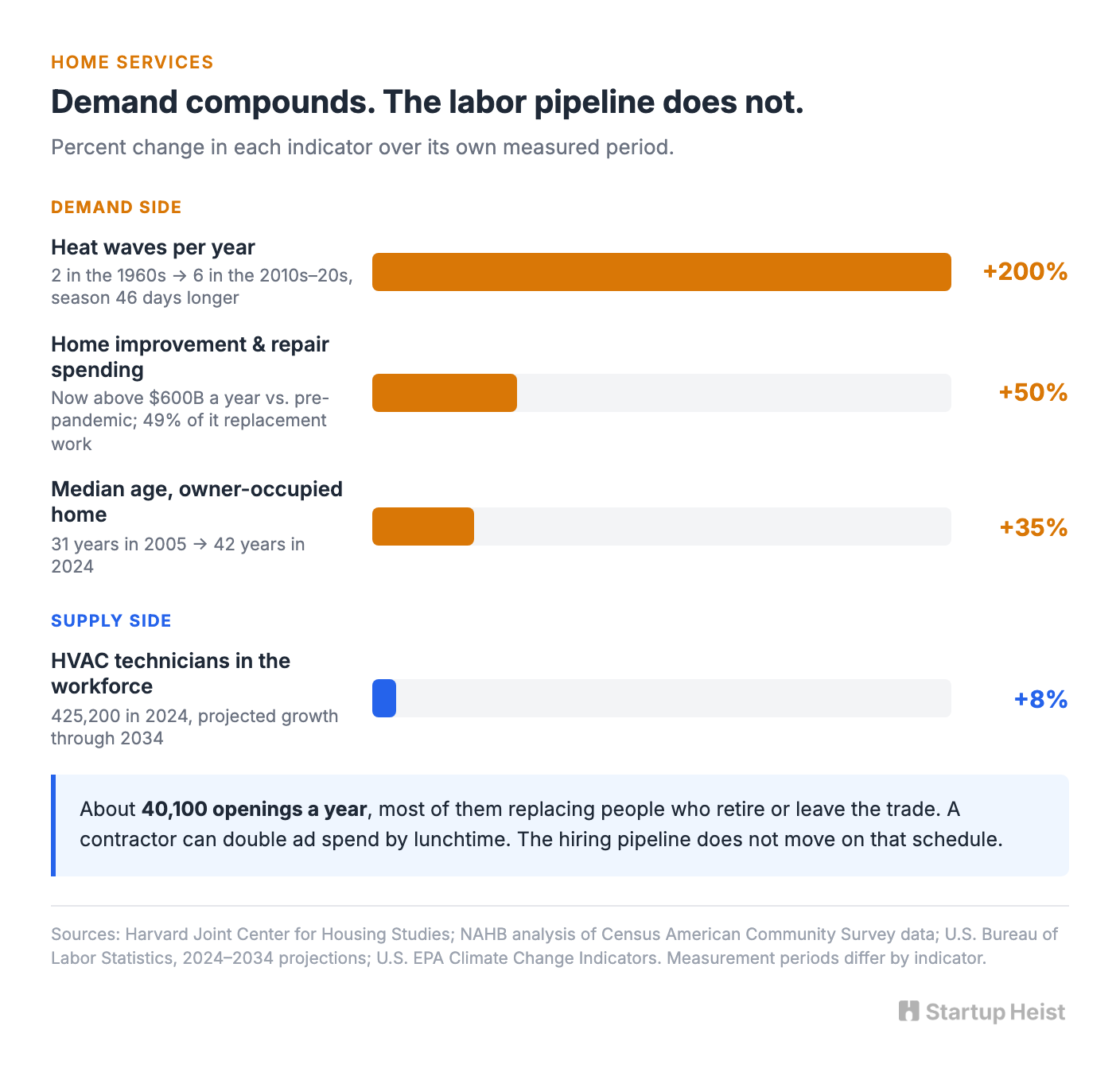
Harvard's Joint Center for Housing Studies puts annual U.S. spending on home improvements and repairs above $600 billion, roughly 50 percent higher than pre-pandemic levels. Replacement work, including roofing, windows, and HVAC, accounted for 49 percent of improvement spending in 2023. The housing stock explains the trend. The National Association of Home Builders, working from Census American Community Survey data, puts the median owner-occupied home at 42 years old in 2024, up from 31 in 2005, with 47 percent of owner-occupied homes now at least 45 years old.
Old houses do not stop breaking when the economy slows. Compressors fail, furnaces stop firing, refrigerant leaks out over a season. A homeowner can postpone a kitchen renovation for two years. Nobody postpones a dead air conditioner in July.
The supply side has no equivalent flexibility. The Bureau of Labor Statistics counted approximately 425,200 HVAC mechanics and installers in 2024 and projects 8 percent growth through 2034, with about 40,100 openings each year, many of them replacing people who retire or leave the trade. Producing a technician who can diagnose a failing system unsupervised takes months to years of training.
A contractor can double Google Ads spend by lunchtime. The hiring pipeline does not move on that schedule.
Weather makes the mismatch worse and more predictable. EPA climate indicators show U.S. cities averaging six heat waves per year in the 2010s and 2020s, up from two per year in the 1960s, with heat wave season running 46 days longer than it did then. Demand arrives in spikes that overwhelm every shop in the metro at the same time, then recedes and leaves half of them with open service windows the following Tuesday.
The missing piece is an operating layer that connects an overloaded dispatcher to a competitor with a free afternoon, in the ninety seconds before the customer hangs up.
What you are actually selling
Do not call this a lead exchange. Contractors hear "lead marketplace" and think of shared inquiries, disputed charges, tire-kickers, and five companies chasing the same homeowner.
You are selling a managed handoff. What changes hands is a documented sequence, and every step of it leaves a record:
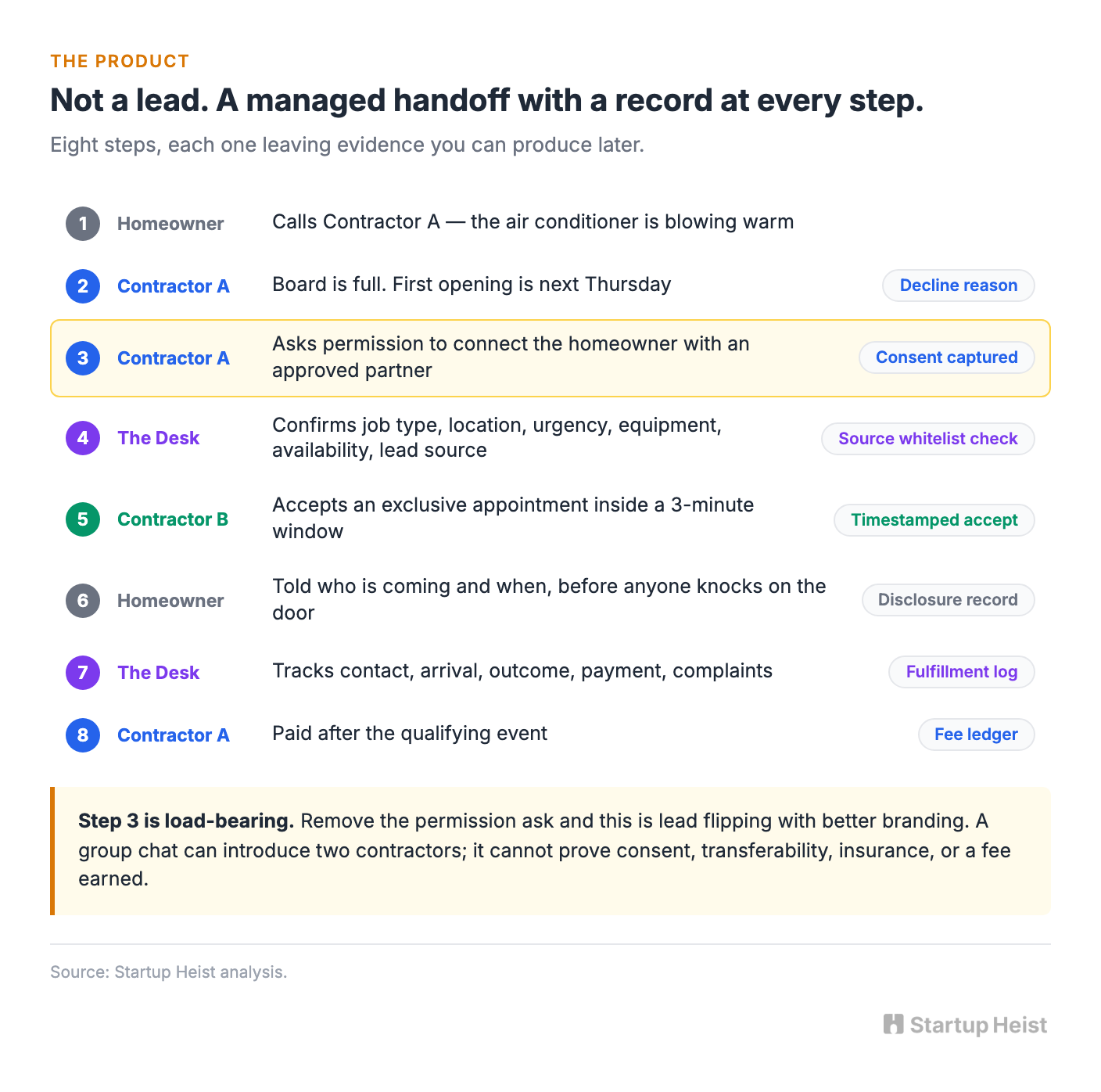
A homeowner contacts Contractor A. Contractor A cannot serve them soon enough. The dispatcher asks permission to connect the homeowner with an approved local partner. Your desk confirms the job type, location, urgency, equipment, availability, and lead source. Contractor B accepts an exclusive appointment. The homeowner receives Contractor B's name and a time window before anyone knocks on the door. You track contact, arrival, outcome, payment, and complaints. Contractor A gets paid after the qualifying event.
The load-bearing words are asks permission. The homeowner needs to understand that a different company will do the work, and needs to know which one. The receiving contractor never pretends to be the referring company's technician. Anything less is lead flipping with better branding, and it will end your network the first time a customer feels tricked.
Start where the density is
The first version should be uncomfortably narrow: one metro, residential HVAC, same-day and next-day service, a private network, and a human doing the matching.
Phoenix, Dallas–Fort Worth, Houston, Tampa, and Orlando all offer the right conditions: long cooling seasons, urgent repair demand, sprawling suburban service areas, and reliable stretches where established shops book out for a week.
Local marketplaces die from fake liquidity. A dashboard showing 400 registered contractors means nothing when a no-cool call lands at 4:15 p.m. in one ZIP code and nobody picks it up. Density inside a small area is the only number worth watching.
A functioning first network looks like eleven companies: five established shops that regularly decline work, four growth-stage shops with capacity to fill, and two independent operators who cover nights and weekends. Plus one human running the handoffs. Eleven is enough to find out whether overflow demand can be captured and fulfilled on a bad day.
The category is already forming
You are not first, and pretending otherwise will cost you.
Baton runs a contractor referral network for home-service pros and claims more than 300,000 exclusive referrals passed between providers who get calls that are out of area, outside their scope, or impossible during peak season. Its pay-per-referral model splits the receiving contractor's fee with the sender, and the company raised a $1 million seed round in July 2023. VettedCrew operates a private trades referral network in Kansas City and St. Louis, pays 10 percent of the job within 48 hours of completion, and vets every member personally rather than algorithmically. Both are betting on the same insight: the referral already happens informally, and whoever formalizes it collects.
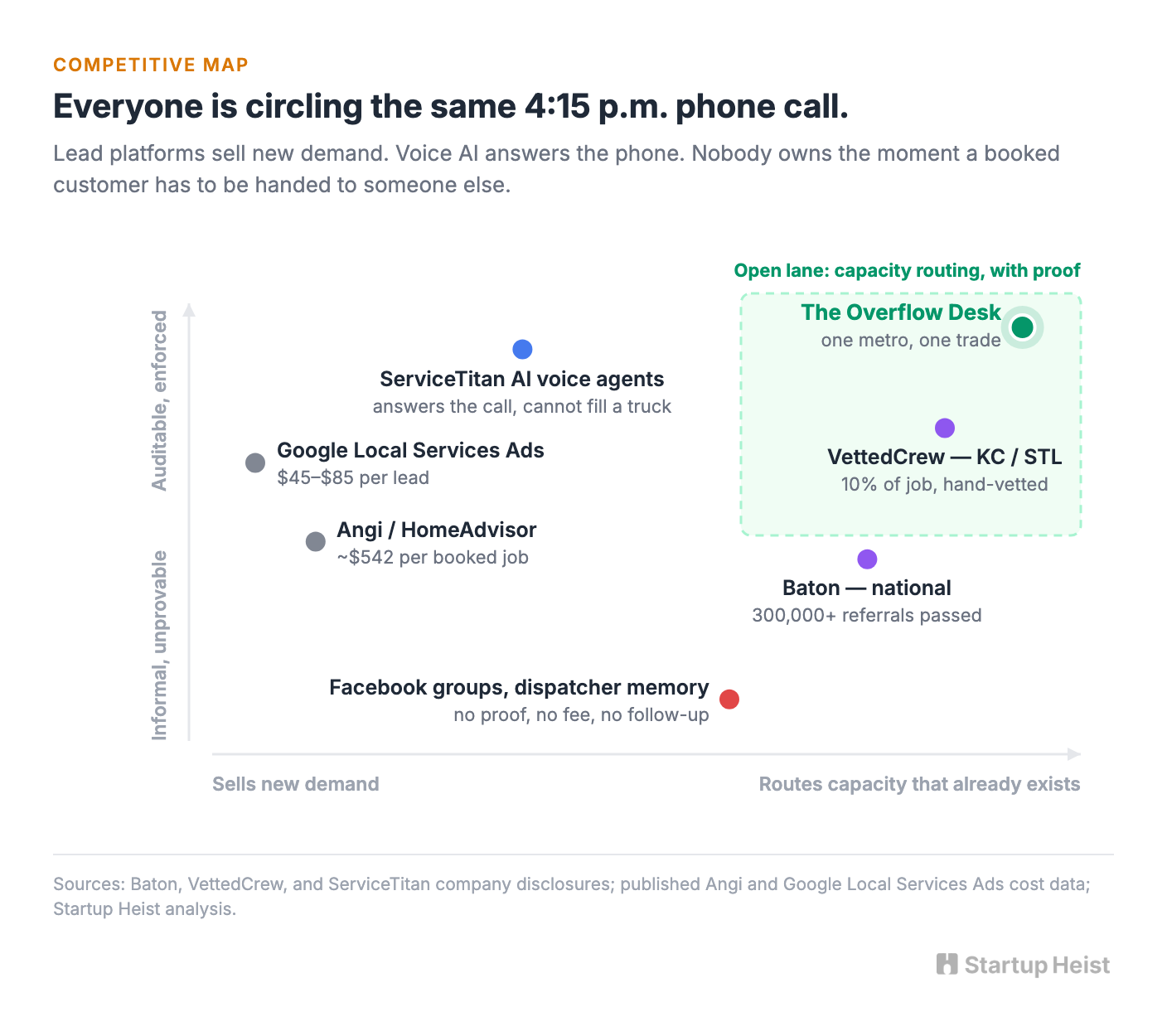
Meanwhile the field service software incumbents are closing in on the same moment from the other side. ServiceTitan sells AI voice agents that handle overflow and after-hours calls inside Contact Center Pro, and reports one customer cutting missed calls by 60 percent. Voice agents solve the answer the phone half of the problem and do nothing about the call that gets answered perfectly and still ends in "next Thursday."
So the play has to be narrower and more defensible than "contractor referrals": own the operating workflow for capacity-based referrals in one local HVAC market.
Your real competitor is the dispatcher's current behavior. She says no, or recommends a friend from memory, or posts in a Facebook group, or texts three owners and hands over whoever answers first. She never finds out what happened, never collects a dime, and quits referring after one bad experience. It costs nothing and works badly. Your job is to make the alternative dependable enough that she reaches for it at 5 p.m. on the worst day of the summer. Before any of that, you need to know which jobs you are legally allowed to move at all.
The legal perimeter is part of the product
Before you take a single dollar, work out what you are allowed to broker. Three constraints shape the entire design.
Unlock the Vault.
Join founders who spot opportunities ahead of the crowd. Actionable insights. Zero fluff.
“Intelligent, bold, minus the pretense.”
“Like discovering the cheat codes of the startup world.”
“SH is off-Broadway for founders — weird, sharp, and ahead of the curve.”


