


The Office Exit Heist
Every office move creates two problems within a few miles of each other.
One company has 80 chairs, 40 desks, three conference tables, two acoustic phone booths, and a lease that expires Friday. Another company just signed a lease down the road and is about to spend six figures furnishing a floor.
They should find each other, and they almost never do.
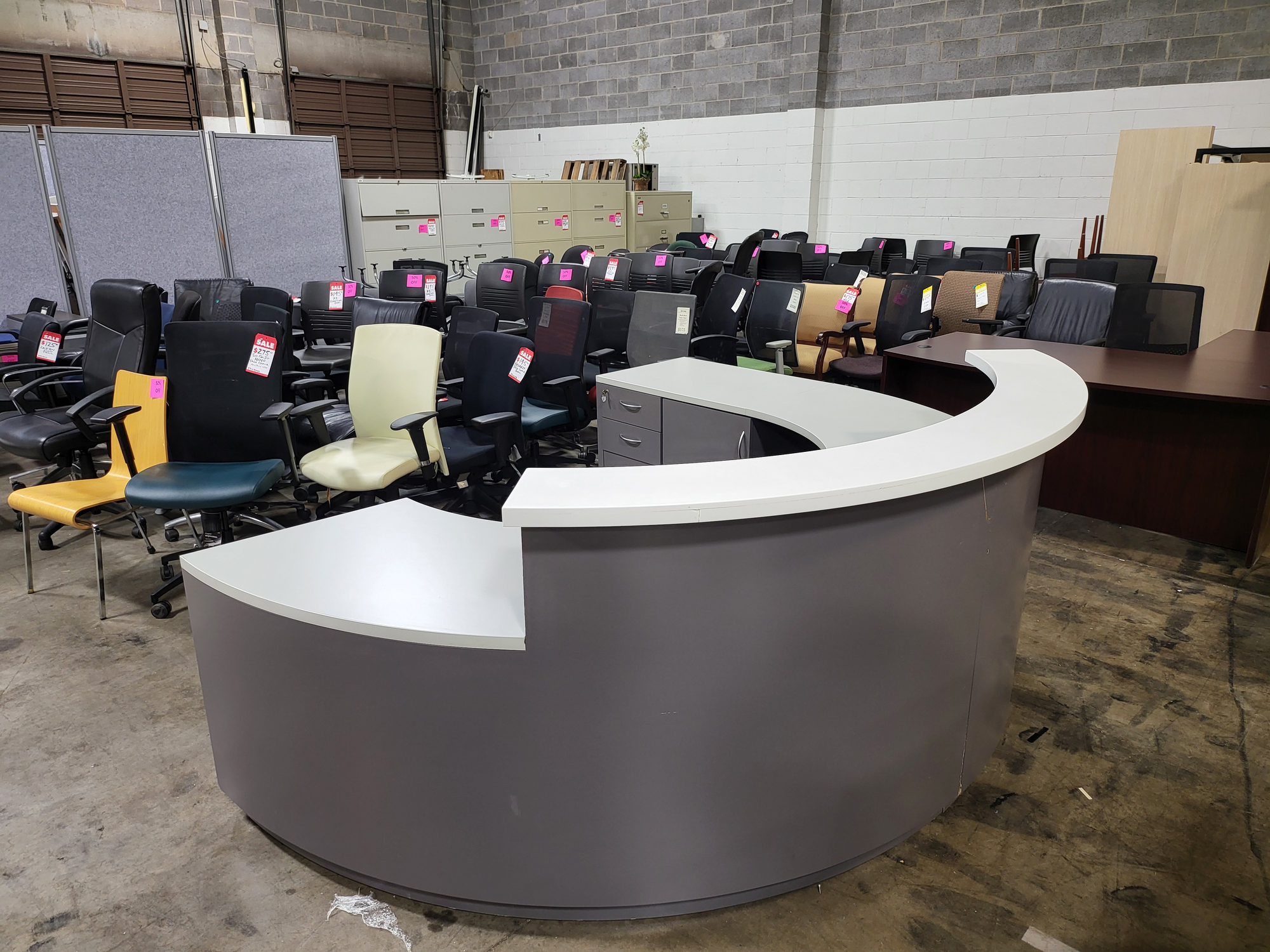
The company leaving calls an office furniture liquidation service, a mover, a junk hauler, or a decommissioning firm. The company arriving buys new from a dealer, or spends three weeks picking through fragmented used office furniture listings that may or may not still exist. Perfectly good commercial furniture gets sold at salvage prices, donated in a panic, warehoused at real cost, or thrown away.
The opportunity is to stand between those two transactions.
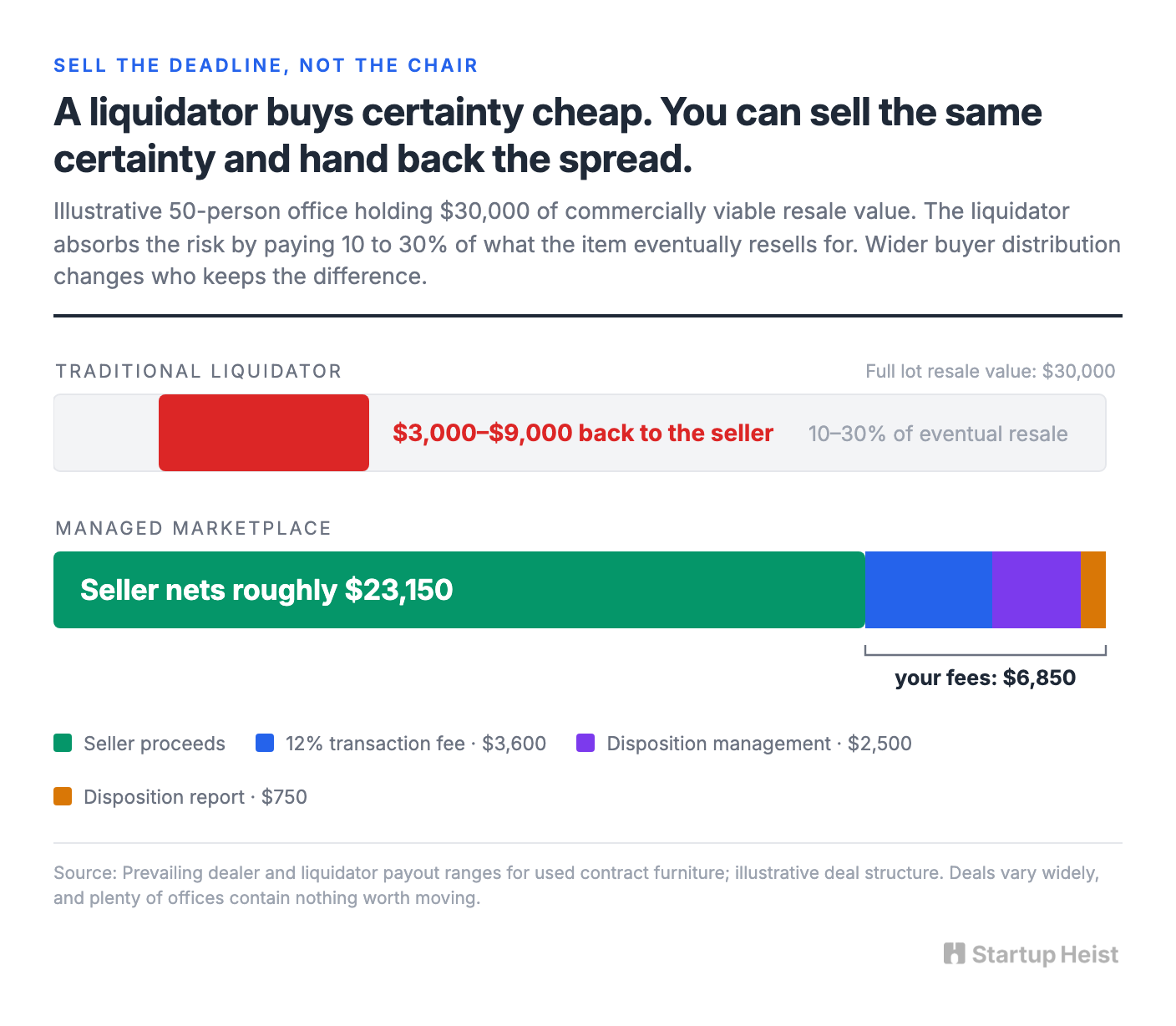
The money: One 50-person office exit clears about $6,850 in fees. Four a month puts you near $25,000 monthly. Eight makes it a real local business.
Inside:
• The 48-hour disposition plan that sells itself
• Ops console MVP scope before any marketplace
• Three-layer pricing past the 15% take rate
• The broker cold email that lands deal one
The shape is a managed marketplace for commercial office furniture, starting with premium standardized inventory. Give companies facing an office exit a 48-hour disposition plan, match the valuable inventory to nearby companies furnishing space, and coordinate the ugly operational details nobody else wants to touch. Then hand the client an auditable record of exactly what was resold, reused, donated, recycled, and discarded.
Auditable is the word doing the work there, though the record itself is easy enough to copy. What's hard is knowing what's leaving which building and when, what it's worth, who nearby wants it, and how to get it from Floor 17 to Floor 9 before somebody's lease clock runs out.
The Least Recycled Thing in America
The U.S. office furniture market runs around $16.5 billion a year. That number is a supply forecast. Every dollar of primary-market furniture eventually becomes secondary inventory, and the secondary side has almost no infrastructure.
The most recent EPA accounting put 12.1 million tons of furniture and furnishings into the municipal waste stream, roughly 4% of everything Americans throw out. More than 80% of it went straight to landfill. The recycling rate sits near 0.3%, which makes furniture one of the least-recovered product categories in the country.
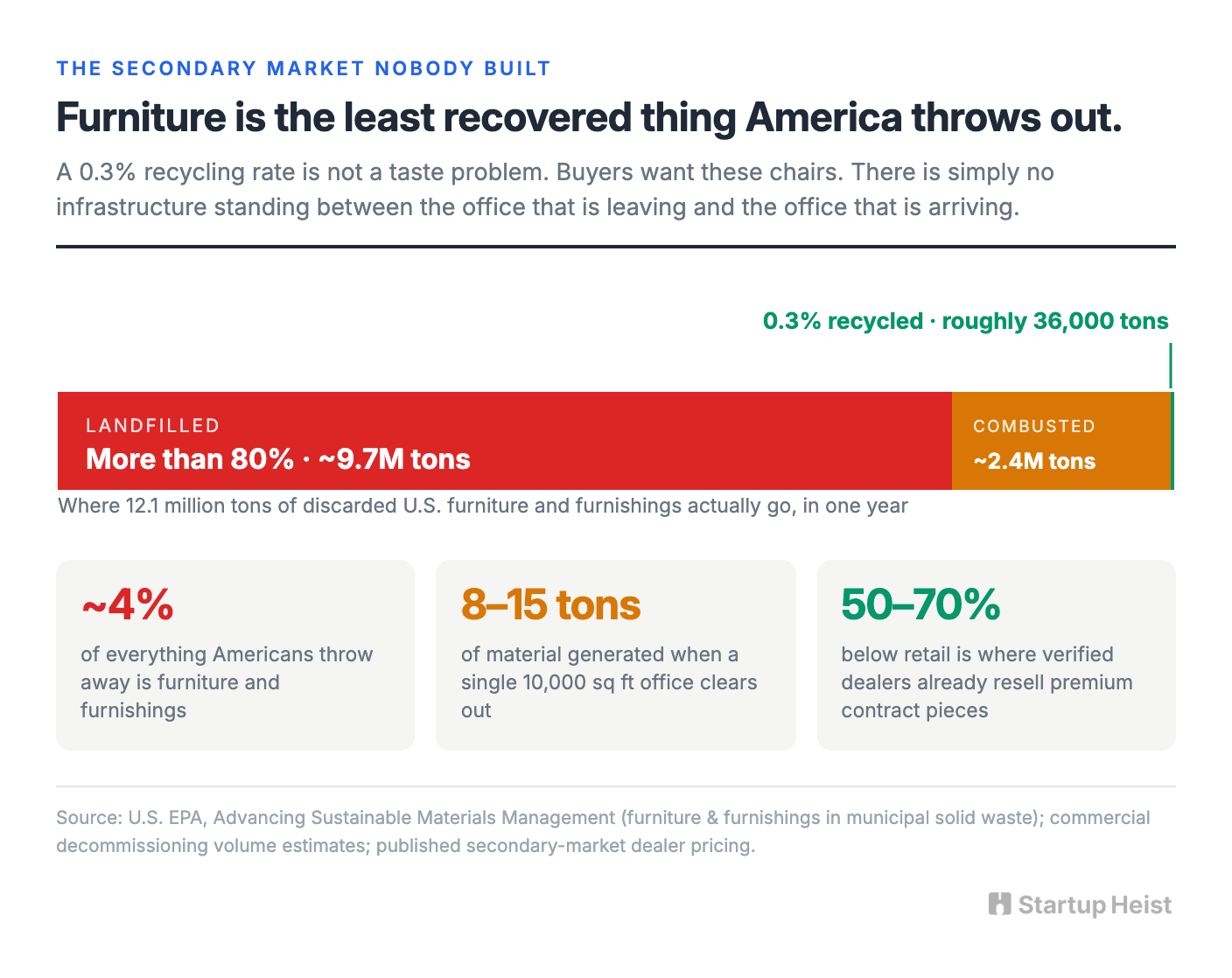
Office furniture is the fattest slice of that stream. A 10,000-square-foot office generates 8 to 15 tons of material when it clears out. Somebody pays to haul it, somebody pays the tipping fee, and the whole transaction generates zero recovered value for anyone.
This is a matching failure. Buyers want this furniture. Verified dealers move authenticated premium pieces at 50 to 70% below retail and clear inventory constantly. Somebody wants those chairs, and the chairs still end up in a dumpster.
Churn Is the Product
Office activity is accelerating, which sounds like bad news for a business built on companies clearing out. It's the reason the business works.
CBRE clocked 62.4 million square feet of U.S. office leasing in the second quarter of 2026, up 16% year over year, with net absorption of 12.6 million square feet and the ninth consecutive quarter of positive demand. National vacancy fell 30 basis points to 18.3%, the largest quarterly decline since 2015. JLL called the same quarter a post-pandemic leasing high and counted more than 30 million square feet of occupancy gains over the prior twelve months.
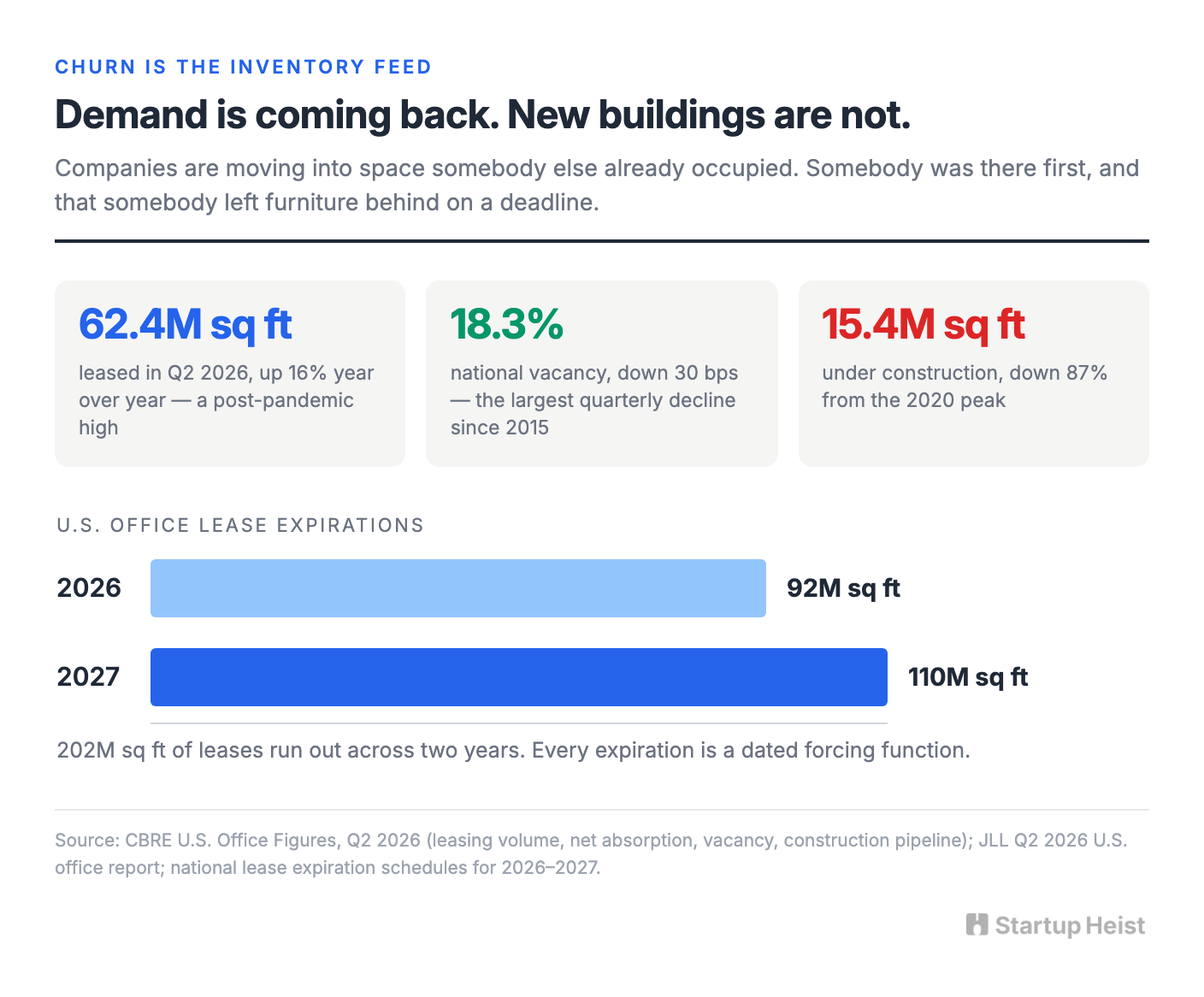
Meanwhile the office construction pipeline collapsed to 15.4 million square feet, down 87% from its 2020 peak, with the lowest first-half completions since CBRE started tracking in 1990. Demand is returning to a building stock that isn't growing. Companies are moving into existing space, which means somebody was there first, and that somebody left furniture behind.
You don't need permanent office decline for any of this to work. You need churn, and churn is everywhere. A tenant shrinking from 40,000 square feet to 20,000 creates surplus office furniture overnight. A startup graduating out of coworking needs 60 chairs by the end of the month. A law firm moving into renovated Class A space would rather buy new than pay to transport the old, and a company consolidating three offices into one becomes a seller and a buyer at the same time.
The calendar is already written. Roughly 92 million square feet of U.S. office leases expire in 2026 and another 110 million in 2027. Every one of those expirations carries a date, and every date is a forcing function. That's your inventory feed.
Why the Obvious Marketplace Dies
The instinct is Craigslist for offices. Build a site, let companies list desks, take 15%.
Kaiyo tried the consumer version of that. The New York company raised close to $50 million, grew triple digits during the pandemic, owned its own logistics stack, and wound down in August 2024 with sellers publicly complaining about withheld payments. People didn't reject used furniture. Moving heavy objects between strangers is a brutal business, and it eats margin at every step.
Commercial furniture is harder still. The seller and the buyer aren't matching on product and price alone. They're matching on six variables at once: product, quantity, condition, geography, building logistics, and time.
Say a seller has 63 Steelcase chairs and a buyer needs 50. Good match on paper. Now the seller must vacate on September 28, the buyer can't access its new space until October 7, neither side has storage, the buyer's building demands a certificate of insurance from the carrier, freight elevator reservations only exist Tuesday morning, and nobody is certain the chair in the seller's photo is the model the buyer thinks it is.
No website solves that, and a prettier website solves it less. Which is why every serious player in this category wraps services around the transaction. The coordination is the product.
What the Incumbents Already Prove
Look at who's making money here and the shape of the business gives itself away.
Green Standards runs enterprise office decommissioning for more than a quarter of the Fortune 100: asset assessment, donation matching, logistics, resale, recycling, and item-level sustainability reporting. It has diverted more than 125,000 tons from landfill at a cumulative 98.6% diversion rate. The Microsoft engagement alone covers 1.2 million square feet of the Redmond campus since 2018, with 1,000-plus tons kept out of the ground and nearly $500,000 in donations to 110 nonprofits. Across General Motors' three Michigan facilities, the same motion has moved 7,100 tons since 2016 and produced roughly $1.07 million in in-kind donations to 102 nonprofits.

RESEAT attacks it from the marketplace side, pairing pre-owned contract furniture with liquidation and installation services; one published ServiceNow project earned the client $40,000 in furniture credits while avoiding about $47,500 in removal fees. Rheaply raised $20 million to build reuse software for institutional customers. ANEW has routed surplus to more than 2,000 recipient organizations since 2005.
Every one of them sells operations. And all of them chase enterprise accounts with national footprints, which leaves the entire middle of the market — the 30 to 200-person office with $20,000 of good furniture and a hard move-out date — served by nobody in particular. That's the gap.
Sell the Deadline, Not the Chair
The seller almost never wants to maximize the resale price of every desk.
Unlock the Vault.
Join founders who spot opportunities ahead of the crowd. Actionable insights. Zero fluff.
“Intelligent, bold, minus the pretense.”
“Like discovering the cheat codes of the startup world.”
“SH is off-Broadway for founders — weird, sharp, and ahead of the curve.”


