


The $20 Hotel Rack: Sell Travelers the Clothes They Need at 11:30 P.M.
Retailers file socks under apparel. A traveler standing in a hotel lobby at 11:30 p.m., after an airline routed his suitcase to another city, files them under problems that have to disappear before breakfast. The opportunity lives in the distance between those two filing systems.
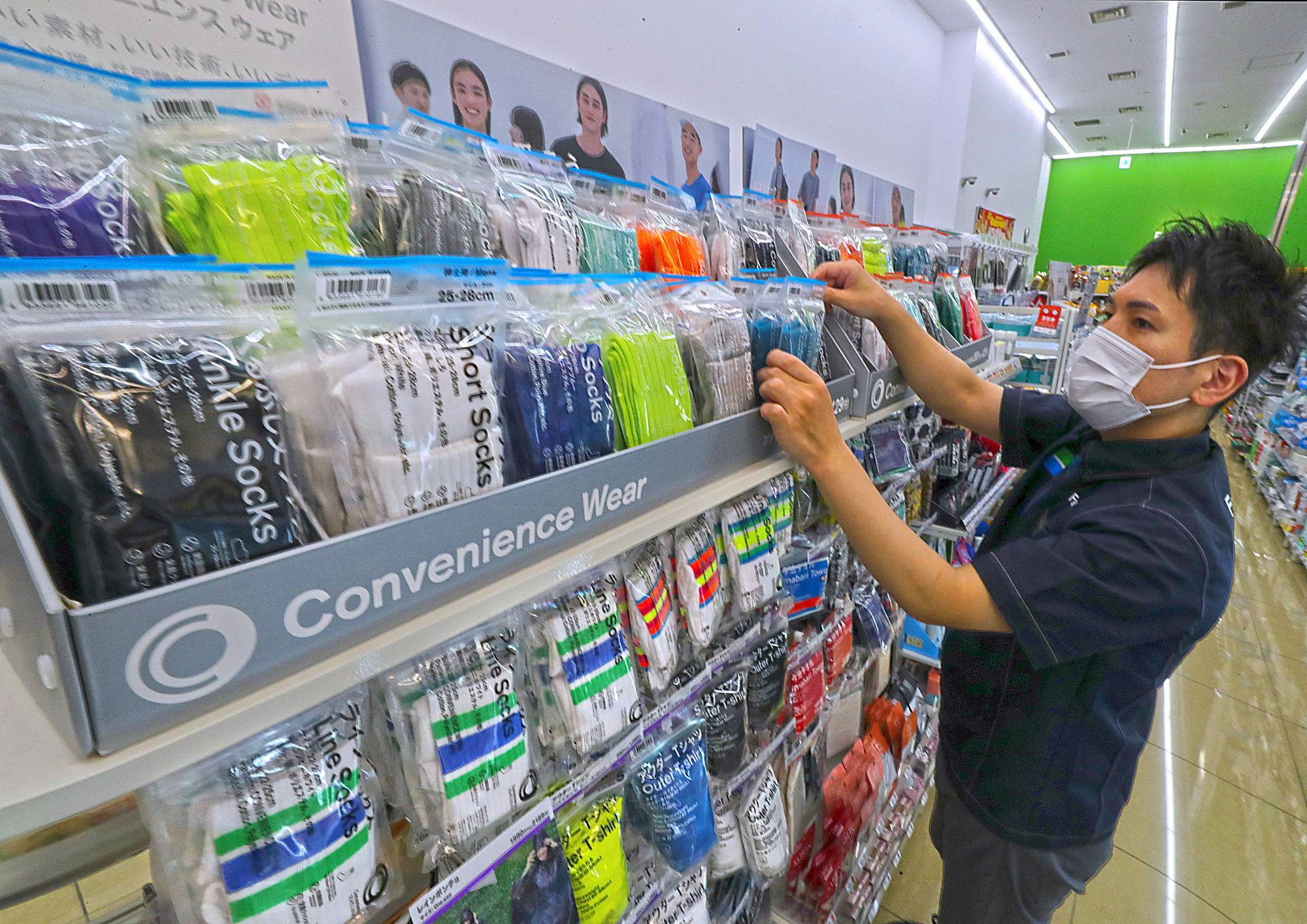
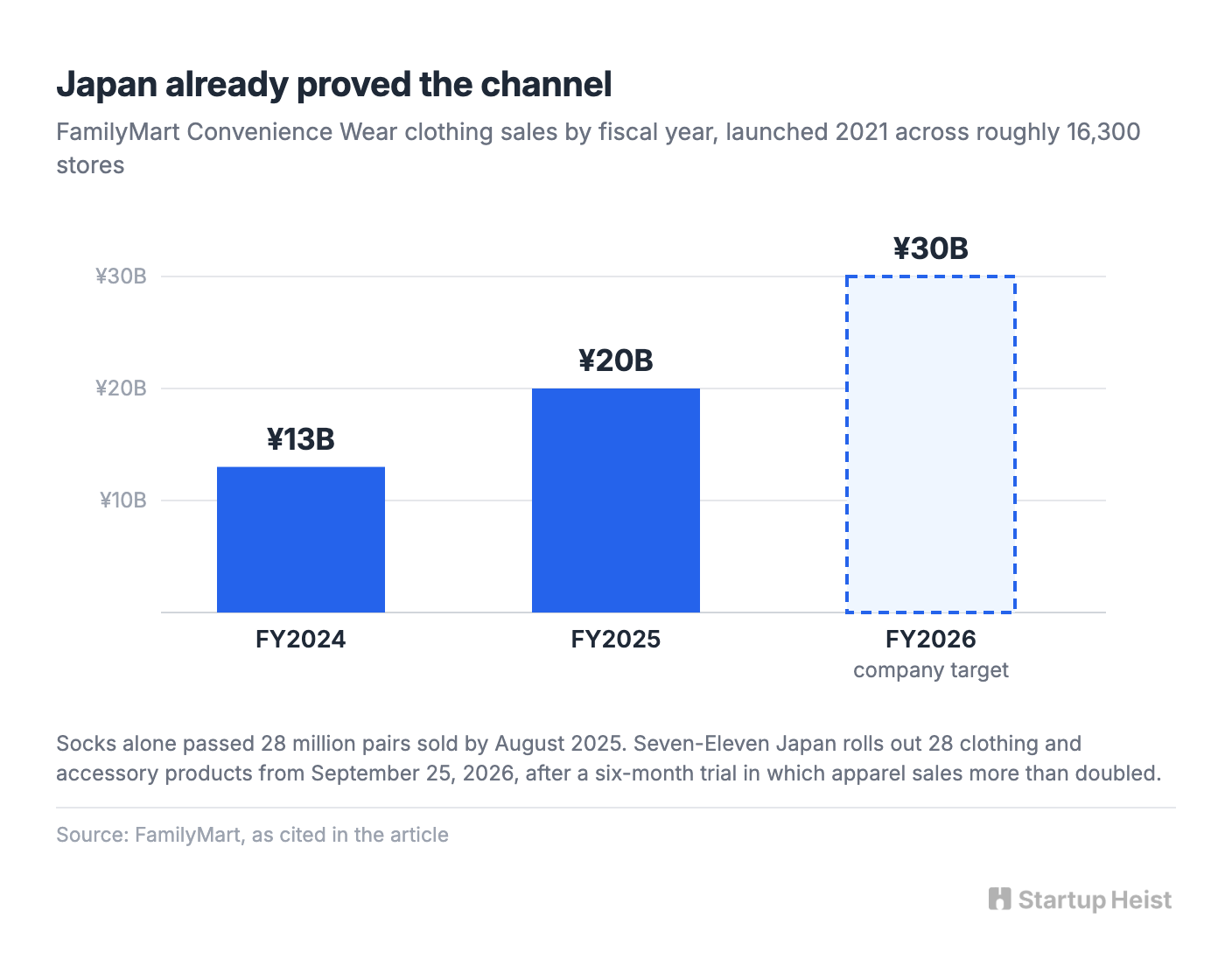
Japan has already shown how much money sits in that gap. FamilyMart launched its Convenience Wear line in 2021, selling well-made basics through roughly 16,300 convenience stores, and by August 2025 its socks alone had passed 28 million pairs sold. The clothing business did about ¥13 billion in fiscal 2024, crossed ¥20 billion in fiscal 2025, and is targeting ¥30 billion for fiscal 2026. Seven-Eleven Japan is chasing the same customer: 28 clothing and accessory products developed with And ST Holdings roll out from September 25, 2026, after a six-month trial in which apparel sales more than doubled, and the chain says it wants to double annual clothing sales.
The lesson for U.S. builders is narrower than "Americans will buy fashion from odd places." Need-state beats category. A black T-shirt sitting beside 300 other T-shirts is apparel. The same shirt sold downstairs from your hotel room after your suitcase fails to arrive is closer to infrastructure.
That distinction supports a small, unglamorous, surprisingly durable business.
The money: 50 hotels at 40 transactions a month: about $42K monthly retail, roughly $181K a year retained before route labor. Impulsify says lobby markets already average $4,800 a month.
Inside:
• Six-SKU MVP and the Tomorrow Kit bundle
• Price ladder and the 60/40 gross-profit split
• 90-day playbook with the pilot pitch email
• Kill criteria and the three-layer moat
No vending machine, no boutique, no SaaS dashboard. This is a hospitality-retail operation first, and the software can come later if it ever earns its place.
The Heist
It's 10:47 p.m. The checked bag never appeared on the carousel, and there's a client meeting at 8:30 tomorrow morning. The hotel gift shop, if there is one, has bottled water, Doritos, Advil, toothpaste, and a sweatshirt with the hotel's logo on it. Target is seven miles away. Walgreens closes in thirteen minutes. DoorDash might work, assuming the shopper finds the right size and the guest wants to spend the next hour in a shopping app.
What the guest actually wants is black socks, underwear, a clean T-shirt, maybe sleep shorts, and then bed.
The hotel already owns the hardest part of this transaction, because the customer is physically standing inside the building. You're building the missing planogram. Call it Arrival Recovery, Overnight Rescue, or something equally literal. The sign should never say APPAREL. It should say something closer to Bag delayed? Forgot something? Get through tomorrow. That framing is the whole positioning strategy, and it's the part every existing hotel lobby market gets wrong.
The Demand Is Smaller Than the Headline, and Better
Lost luggage makes a great pitch-deck slide and a bad business plan, because the numbers are large and moving the wrong way for a fear-based story. The U.S. Department of Transportation recorded 1,052,492 mishandled bags among roughly 213 million enplaned bags in the first six months of 2026. That's 0.49 per 100 bags, down from 0.52 in the same period of 2025. Globally, SITA's 2026 Baggage IT Insights report says mishandling fell 23% in 2025 to 4.9 bags per 1,000 passengers. That still left 24 million mishandled bags and an industry cost of $6.3 billion, and roughly three-quarters of those incidents were delays: the guest sleeps in a hotel tonight and gets the suitcase tomorrow.
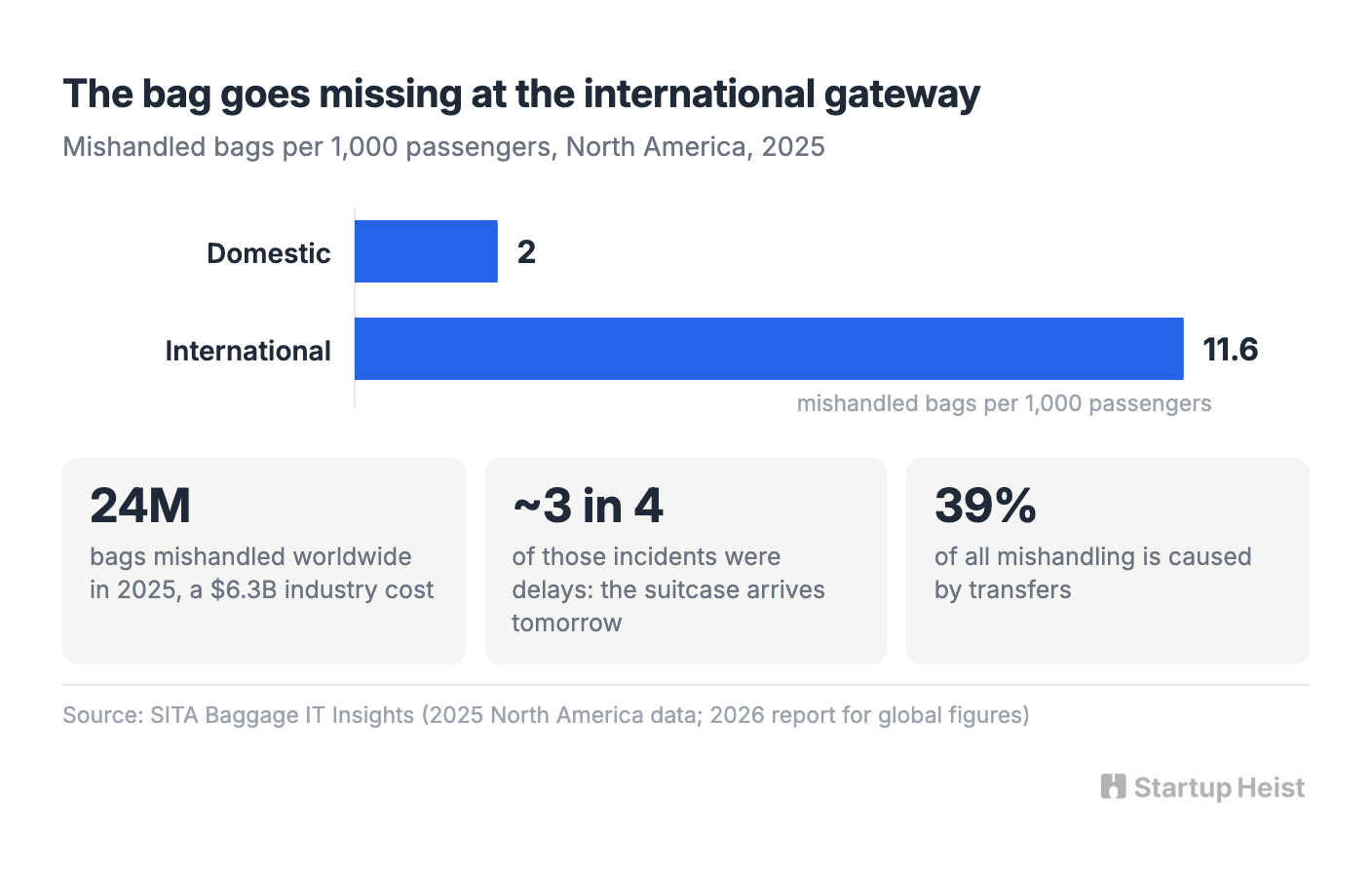
Where those bags go missing matters more than how many. SITA's 2025 data for North America shows about 2 mishandled bags per 1,000 domestic passengers against 11.6 per 1,000 international passengers, and transfers cause 39% of all mishandling. So the hunt starts around international gateways and connecting hubs: airport hotels taking late arrivals, business hotels where the guest has to look presentable at 8:30 a.m., convention hotels during major events, hospital-adjacent properties serving families who arrived without warning, and isolated interstate properties with no walkable retail. STR has counted roughly 2,300 U.S. hotels in or near airports, a segment its older data put at occupancy in the low-to-mid 70s, well above the national average.
Delayed baggage is the hook, though, and it should never be the whole demand model. The same rack solves forgotten underwear, a coffee spill on the only shirt someone packed, clothes soaked in a storm, an unexpected extra night, a missed connection, a guest who packed for 80°F and landed in 50°F, and a hospital visitor who expected to stay three hours and is now staying three days. Add those up and you have a much healthier business than lost-luggage socks.
One more wrinkle turns a $40 purchase from a grudge into a reimbursable expense. DOT requires airlines to compensate passengers for reasonable, verifiable, actual incidental expenses while a checked bag is delayed, up to a liability cap of $4,700 on domestic flights, and it specifically names toiletries and changes of clothing as examples. Not every hotel T-shirt gets reimbursed, so your merchandising should look like a reasonable emergency purchase: good $10 socks, a respectable $22 shirt, a UPC and clear price on every package, and a receipt at every checkout the guest can attach to a claim. Urgency creates margin without gouging, and the vendor who behaves fairly on a customer's bad night is the one the hotel keeps.
Why a Hotel Says Yes, and the Trap Behind the Yes
The pitch to a general manager is never "would you like to sell underwear." The pitch is: your front desk already fields guests asking where to buy clothes after a late arrival, and we turn those requests into a managed 24/7 amenity and a hotel ancillary-revenue line without you running another store.
Hotels have reasons to listen. AHLA projects U.S. hotel guest spending near $805 billion in 2026, up 1.7%, while gross operating profit per available room still sits at roughly 90% of its 2019 level because operating costs keep rising. Phocuswright puts 2025 U.S. room revenue at $207.9 billion, up just 1%, with occupancy slipping to 62.3%, the first decline since 2020. With room revenue flat, operators have started managing to TRevPAR, total revenue per available room, and one hotel group has reported that adding retail lifted total portfolio revenue by more than 1%. Incremental revenue that needs no real estate and almost no labor has obvious appeal. And lobby retail already works: Impulsify, which sells the point-of-sale and inventory software behind many hotel lobby markets, advertises average monthly lobby-market revenue of about $4,800 per property. It's a vendor-reported figure, and it still proves the behavior.
Hotels have circled the need itself without selling into it. Kimpton's "Forgot It? We've Got It" program lends forgotten items free at the front desk, and Uniqlo put clothing vending machines into Oakland and Houston airports in August 2017, selling $14.90 HEATTECH tops and $69.90 down jackets to travelers who packed for the wrong climate. Both prove the guest exists. Neither sells a stranded business traveler clean underwear at midnight, no U.S. operator has yet built a managed hotel-lobby program around stranded-traveler apparel, and the vending version carried machine capex a rack doesn't.
The trap is building the wrong layer. Impulsify already provides POS, self-checkout, room charging, inventory management, planograms, and automated replenishment. Vistar already delivers food and non-food products with planogram support to hospitality accounts nationally. Avendra runs hotel gift-shop procurement programs, and GPOs such as Entegra aggregate hotel purchasing at enormous scale. If your opening move is "we'll build AI inventory software for hotel emergency apparel," you're building the wrong company. The underserved layer is the merchandise program: what to stock, in what sizes and packaging, at what price, where it sits, which hotel archetypes produce demand, what the front desk says, and how much inventory a 130-room JFK property carries versus a 250-room convention hotel in Dallas. At first the algorithm is a spreadsheet and someone who knows how to count shirts.
The Unit Economics Are the Entire Story
Unlock the Vault.
Join founders who spot opportunities ahead of the crowd. Actionable insights. Zero fluff.
“Intelligent, bold, minus the pretense.”
“Like discovering the cheat codes of the startup world.”
“SH is off-Broadway for founders — weird, sharp, and ahead of the curve.”


