


The Anti-Storage Business: Get Paid to Empty the Unit Nobody Wants to Open
Self-storage runs one of the cleanest business models in America. A customer looks at a couch, six plastic tubs, an old bicycle, three lamps, a box of tax records and a dining table, and asks whether any of it should stay. Storage answers: you can decide next month for $120. Then it charges again. And again.
The postponement is now an industry. U.S. self-storage generates more than $40 billion a year across more than 50,000 facilities and 2.2 billion square feet, and the country holds roughly 90% of the world's storage inventory. StorageCafe's August 2026 data puts the average advertised 10x10 street rate at $120 per month. The New Yorker's September 21, 2026 print issue gave the sector a 4,800-word feature in which David Owen called church and self-storage "the two great pillars of American culture."
The tenants keep paying. Extra Space Storage, the largest operator by store count, told investors on its April 30, 2026 earnings call that about 64% of current tenants had been in place more than 12 months and about 46% more than 24 months, both up from a year earlier. StorageCafe's 2026 survey of 1,430 U.S. residents found one in four Americans currently renting storage and another 28% planning to, with storage searches across the 150 largest cities up 23% in 2025, nearly triple the prior year's growth.
So a very large industry rests, in part, on one human behavior: nobody wants to make a hundred small decisions today.
There's an anti-product hiding inside that behavior.
The money: 40 clear-outs a month at roughly $600 each is $24,000 a month from one metro. Extra Space says 46% of its tenants have paid for two years or more.
Inside:
• Three-tier pricing: $49 plan to 30-40% recovery
• Line-by-line economics of a 10x10 clear-out
• Partner outreach email plus facility QR pitch
• The 90-day plan to 25 paid clear-outs
Call it ExitMyUnit. The customer records a short walkthrough video, and ExitMyUnit tells them what's probably worth pulling for resale, what should be donated, what gets recycled, what will cost money to remove, and what it costs to make the whole problem disappear. Then it coordinates the clear-out. The customer approves one plan, someone empties the unit, and the recurring charge stops. The AI is the least important part of the offer. What the customer pays for is decision compression.
The Customer Isn't Buying Junk Removal
Take someone who has been paying $165 a month for three years. That's $5,940, and they know it. They've said "I really need to clean that thing out" 20 times. The trouble is that opening the door creates a different problem, because there's no single task called empty the storage unit. There are dozens: is the dresser worth anything, can Goodwill take the chairs, who takes a mattress, is the china collectible, what was in that box. Maybe next month. Storage wins again.
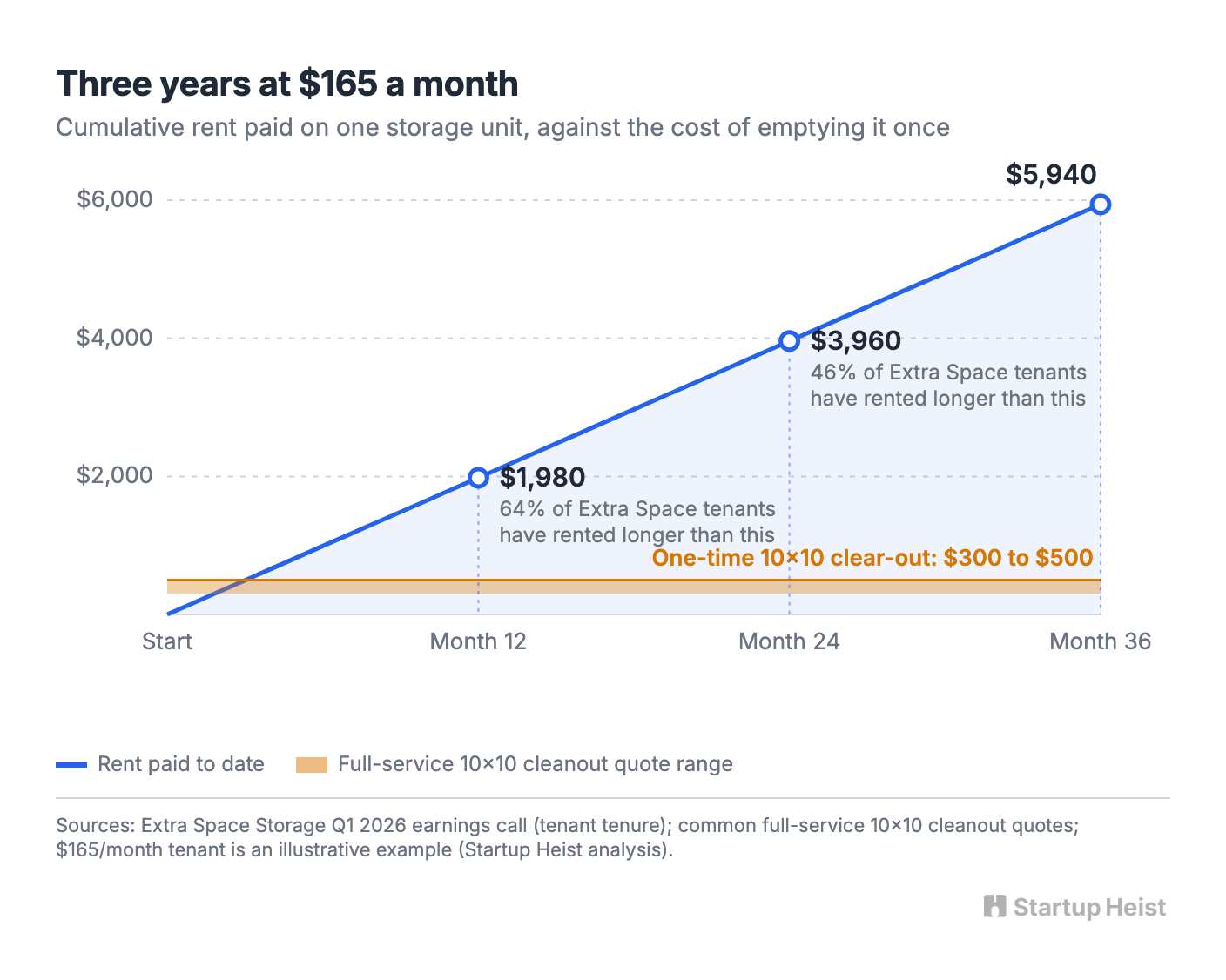
Traditional junk removal solves only the last physical step. A full-service 10x10 storage unit cleanout is commonly quoted at $300 to $500, and the big franchises still price in person: 1-800-GOT-JUNK offers no exact quote online, sends a crew to look, and averages about $240 a job with full truckloads running $700 to $1,000. The hard part, psychologically, happens before the truck arrives. The customer is afraid the hauler will throw away something valuable, so they do nothing.
ExitMyUnit sells a different promise: we'll tell you what deserves attention, clear everything else, document where it went, and get the unit closed. It's a stronger sentence than "we haul junk," and it's the one that gets the door opened.
The First Trap: Don't Build an AI Appraisal Company
The obvious version of this idea is seductive: upload a video, the model recognizes everything, pulls comparable sales, and announces a resale value of $2,410 against $480 in disposal, estimated profit $1,930. It makes a beautiful demo and a dangerous business.
Ordinary possessions carry an enormous gap between theoretical value and liquidation value. A table may have sold online for $450. That doesn't mean a reseller will drive across Philadelphia, carry it out of a unit, warehouse it, photograph it, answer messages and wait three weeks to collect $450. The relevant question is what someone will actually pay for this object, in this condition, in this ZIP code, fast enough that handling it makes economic sense. Professional liquidators price this honestly: MaxSold's managed auction service charges a 30% commission plus a $2,000 flat fee, and estate-sale companies typically take 30% to 50% of gross, with 35% to 40% the most common band. They charge that much because turning miscellaneous possessions into money is labor at every step: cataloging, photography, transport, buyer messages, no-shows, unsold leftovers.
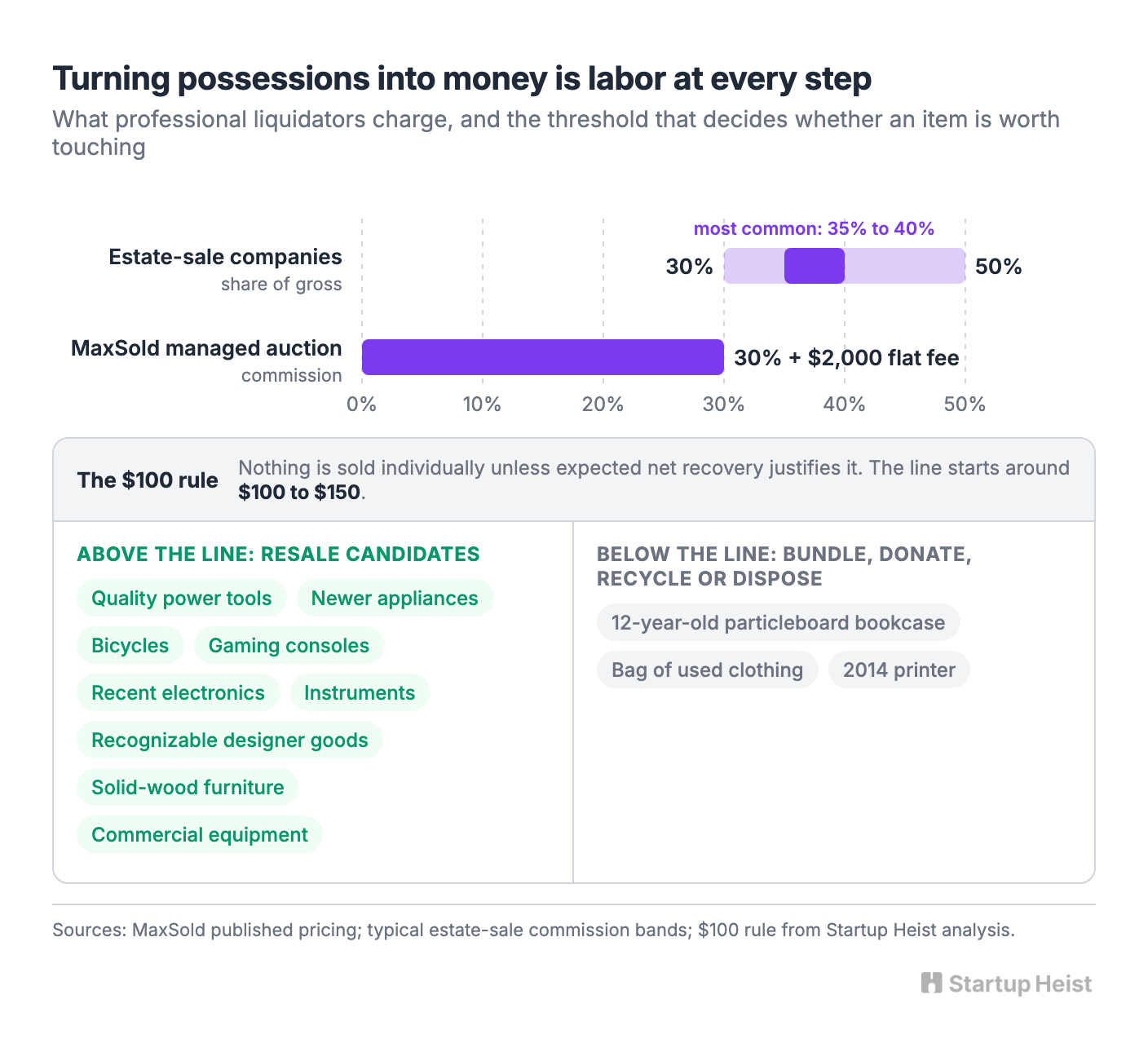
ExitMyUnit's job, then, is economic resolution rather than maximum resale, and in practice that means most items never become individual listings. The operating rule is a threshold, call it the $100 rule: nothing gets sold individually unless the expected net recovery justifies touching it, and the line starts somewhere around $100 to $150. Below it, bundle, donate, recycle or dispose. Above it, the candidates are predictable: quality power tools, newer appliances, bicycles, gaming consoles, recent electronics, instruments, recognizable designer goods, solid-wood furniture, commercial equipment. A 12-year-old particleboard bookcase, a bag of used clothing, a 2014 printer: no. The system has to be brutally good at saying "this has value, but not enough to justify a transaction," which is a more useful intelligence layer than another price estimator and the one nobody has built for storage.
The Adjacent Players Prove the Motion Without Owning the Wedge
The pieces already exist in other markets. Remoov, operating in the Bay Area, Los Angeles and Phoenix, quotes from uploaded photos, picks up household items, resells what it can, donates or recycles the rest, and pays the customer 50% of resale proceeds with a tax receipt for donations. LoadUp quotes nationwide from an online item list or a texted photo, guarantees the price with no in-person visit, and lists storage unit cleanouts as a named service, which is the clearest sign that no-visit junk quoting has gone mainstream. The Junkluggers franchise has grown to more than 150 locations on a donate-first, recycle-second process. MaxSold runs a partner program aimed squarely at senior move managers and organizers. Each of them treats the storage unit as one more pickup address. None triages a video for what's worth pulling, prices the exit against the rent, or owns the search phrase "how do I get rid of my storage unit."
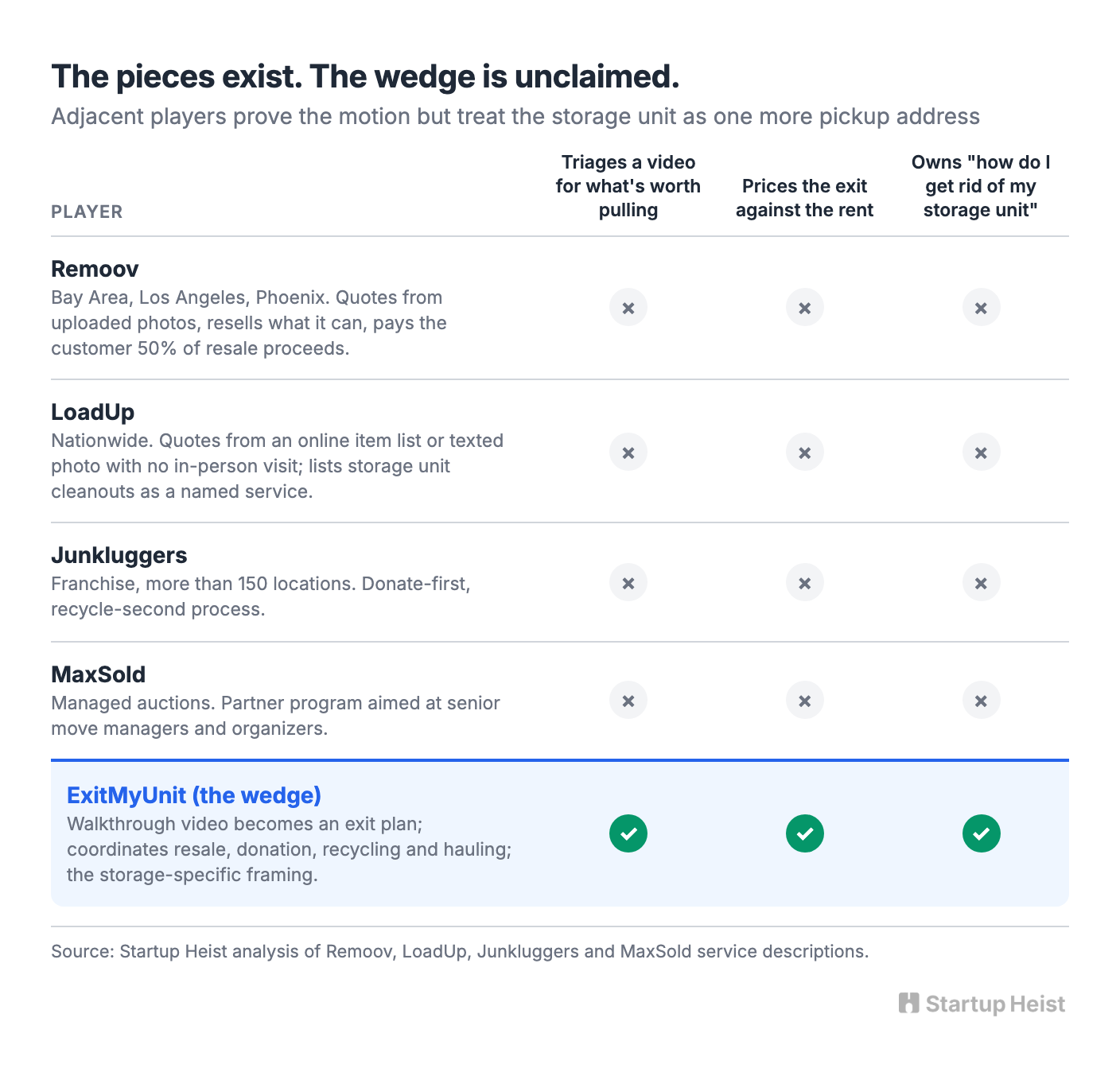
The behavior is validated, the supply side is fragmented and hungry, and the storage-specific framing, where the customer compares a one-time clear-out to another year of rent, is unclaimed in every metro in the country.
What the Product Actually Does
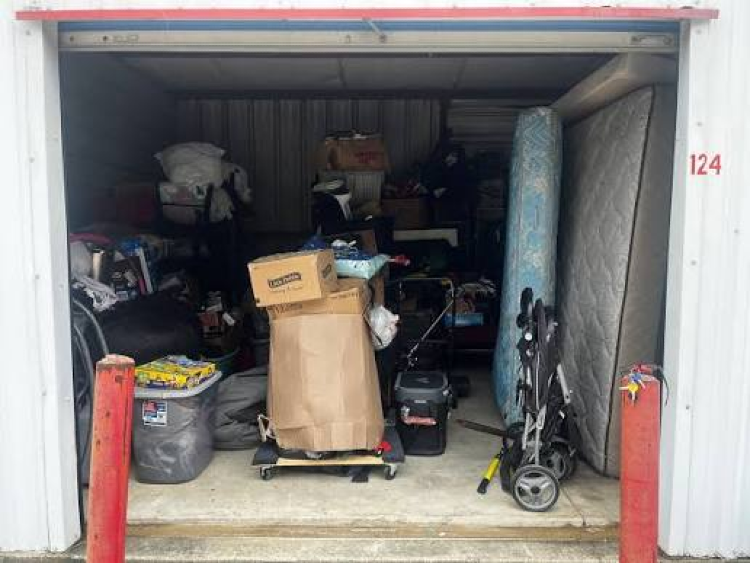
Step 1 is a guided film. The customer gets instructions for a two-to-five-minute walkthrough: start at the entrance, move slowly, show the floor, show large furniture, pause on electronics, tools, bikes, appliances, collectibles and anything they suspect is valuable. Then comes a short intake form.
Unlock the Vault.
Join founders who spot opportunities ahead of the crowd. Actionable insights. Zero fluff.
“Intelligent, bold, minus the pretense.”
“Like discovering the cheat codes of the startup world.”
“SH is off-Broadway for founders — weird, sharp, and ahead of the curve.”


