


The Night Shift: Sell Finished Work, Not Cheap Tokens
DeepSeek published a pricing page that reads like a footnote and works like a business plan.
Its V4-Pro model runs a 1-million-token context window and charges $0.66 per million uncached input tokens and $1.98 per million output tokens during off-peak hours. Run the same job during peak and it costs $1.32 and $3.96. Peak is a narrow window: 01:00–04:00 and 06:00–10:00 UTC. The other seventeen hours of every day are half price.
The obvious startup writes itself. Collect a company's AI work during business hours, sit on it until compute gets cheap, deliver the results before anyone wakes up, and keep the spread.

The trick is real. It just isn't a business, because the discount has already been commoditized. OpenAI's Batch API discounts requests 50% and completes them within 24 hours, using a separate rate-limit pool so batch work doesn't consume your synchronous capacity. Anthropic's Message Batches API cuts prices by the same 50%, with most batches finishing in under an hour. Cheap asynchronous inference is a standard feature at every major lab, available to anyone with an API key. There's no supply-side secret left to resell.
The opportunity sits one layer up, in owning the work that happens while the office is empty. What a company will actually pay for: go home with a backlog, come back to finished work.
Here's the version worth building.
The money: Fifteen agencies on the $2,000 tier is $30K MRR. Momentum charges $69 per seat and has no HubSpot path at all.
Inside:
• Six-screen MVP a solo founder can ship
• Four-tier routing policy that gates PII
• Pricing from $750 to $4,000 per month
• Shadow-mode proof that closes agencies
The arbitrage is urgency
Nearly every AI product assumes the same thing: faster is better. Ask a question, get an answer, keep the human in the loop and the latency near zero. That assumption is correct for chatbots, coding assistants, search, and any interface where a person is sitting there waiting.
It's wrong for most of the operational work inside a business. No marketing agency cares whether 4,800 CRM records get cleaned at 3:17 PM or 5:30 AM. A sales manager doesn't need a recorded call converted into structured CRM fields seven seconds after the Zoom ends. That work has a deadline measured in mornings, not milliseconds.
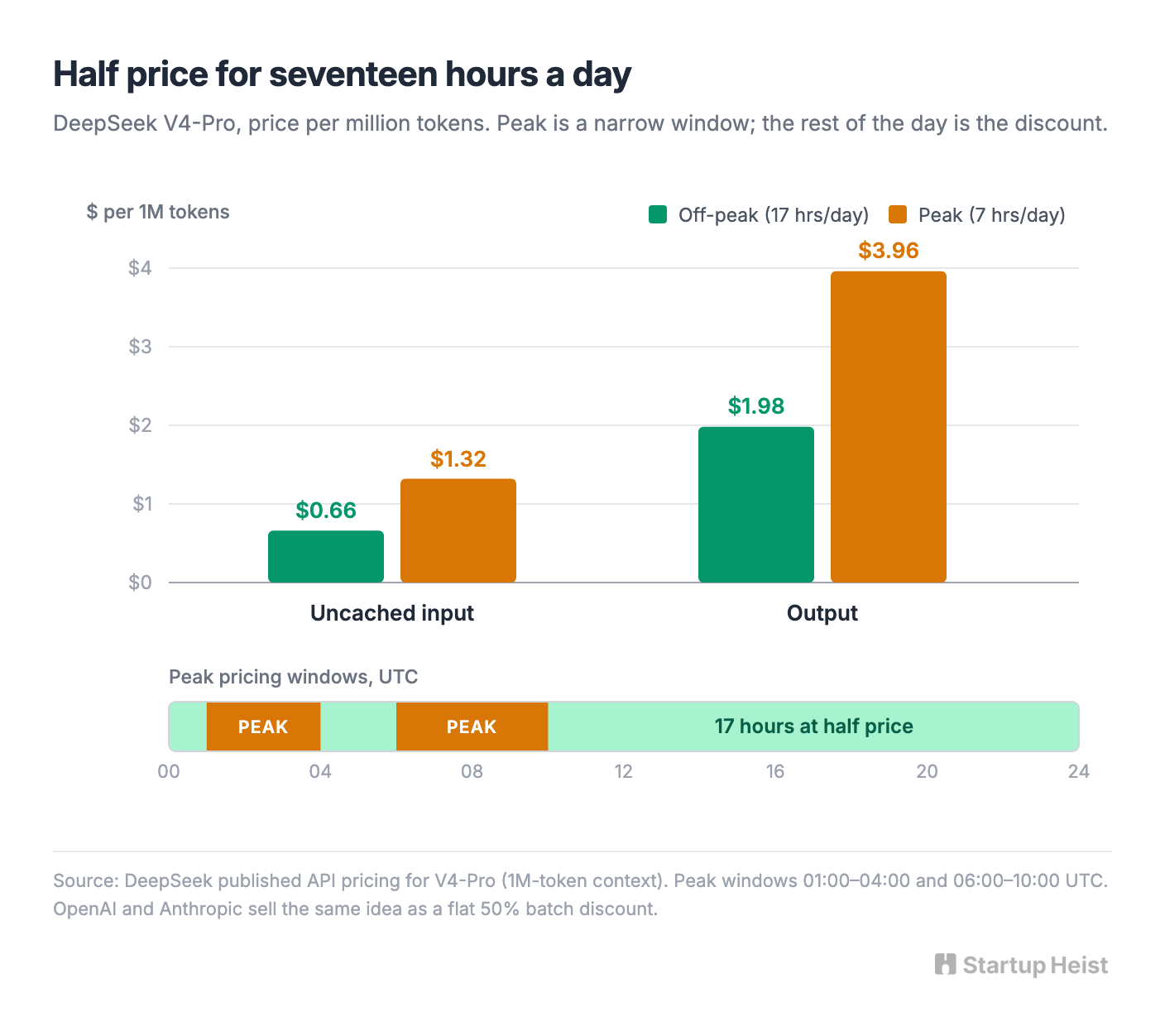
Remove the real-time constraint and the system gets to optimize for everything else: cost, retries, model choice, human review, data residency, validation. Simple jobs route to a cheap model and ambiguous ones to a stronger one. Anything bound for DeepSeek waits out its peak window. Failures retry silently because nobody's watching a spinner, and low-confidence records land in an exception queue before a customer ever sees them.
You're buying time from the customer, and the customer hands it over gladly, because nobody was going to touch that work at 2 AM anyway.
The gap this lives in
Every major lab now sells asynchronous inference as explicit infrastructure. OpenAI markets Batch for dataset classification, evaluations, and embedding entire content repositories. Anthropic caps a batch at 100,000 requests with a 24-hour expiry. DeepSeek added a time-of-use version of the idea. Founders can stop pretending every AI operation deserves premium real-time compute.
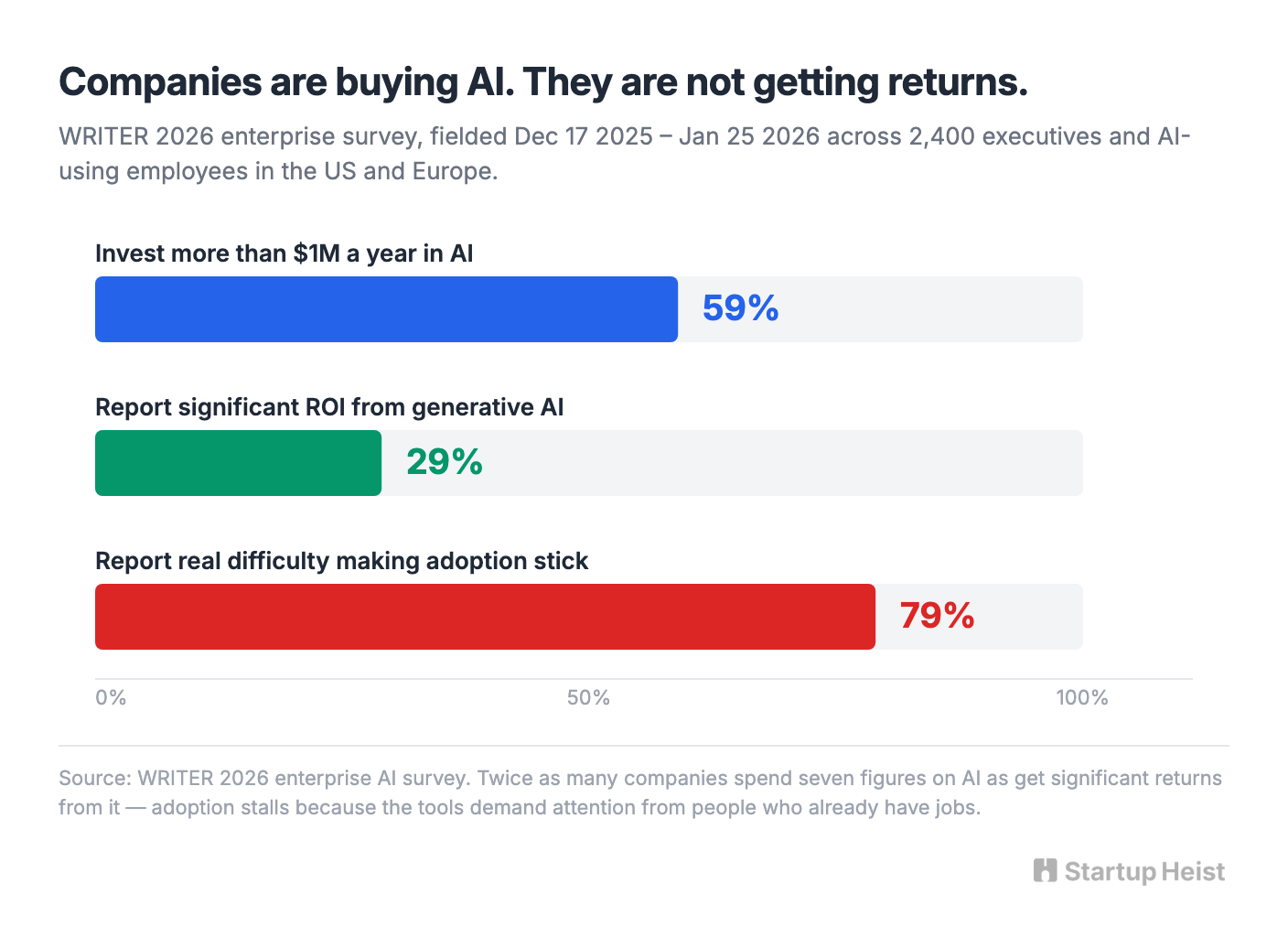
At the same time, companies have discovered that buying AI and getting returns from AI are different activities. WRITER's 2026 enterprise survey, fielded between December 17, 2025 and January 25, 2026 across 2,400 executives and AI-using employees in the US and Europe, found that 59% of companies invest more than $1 million a year in AI while only 29% report significant ROI from generative AI. Seventy-nine percent reported real difficulty getting adoption to stick.
The distance between those two numbers is where this business lives. Adoption stalls because tools demand attention from people who already have jobs. A business process that completes itself while the office is dark demands none.
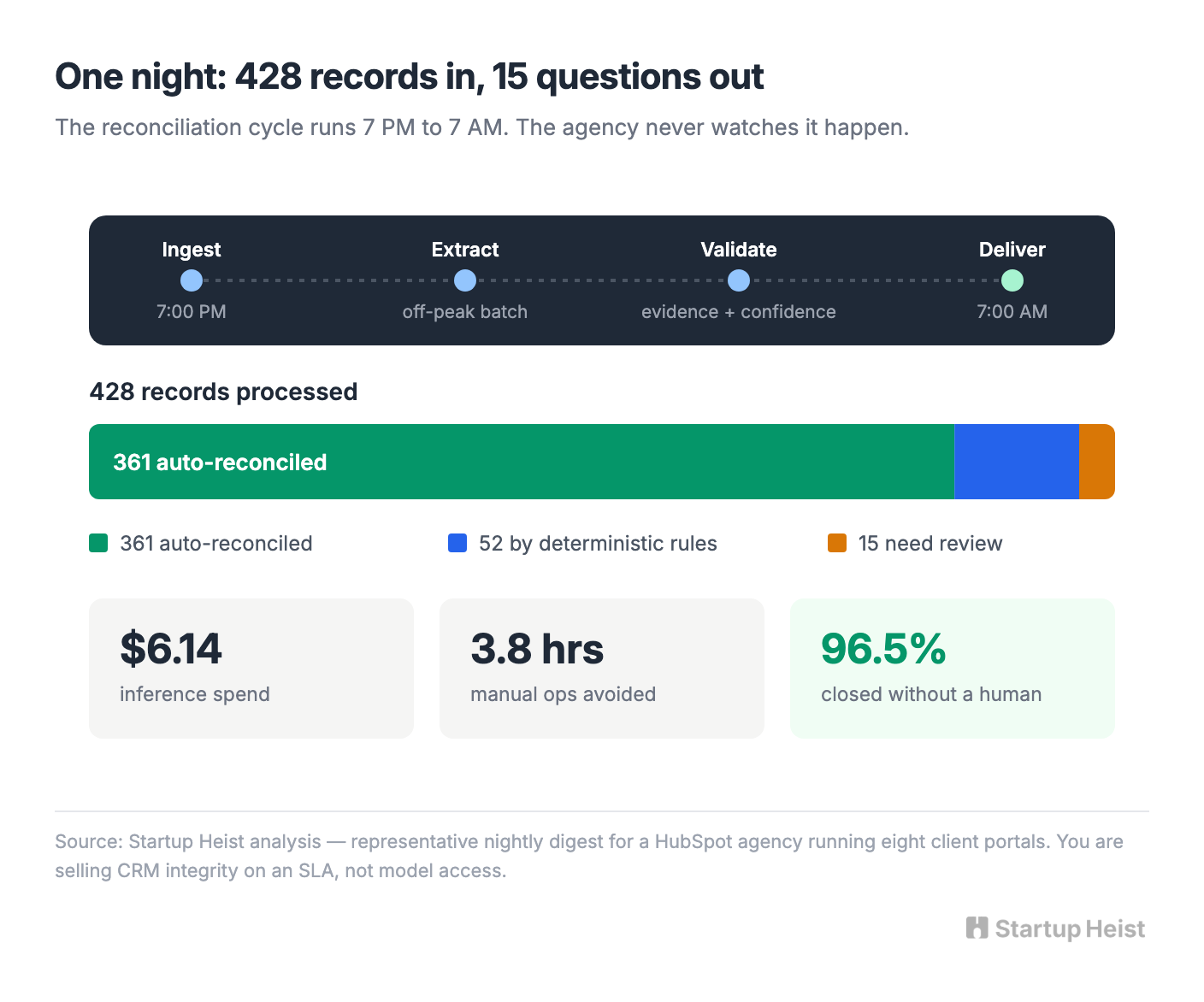
It also changes what a status report looks like. Yesterday there were 2,814 uncategorized records; this morning there are zero. Yesterday 174 sales calls hadn't been logged properly; this morning 163 are updated and 11 are waiting for a human. Nobody on the payroll had to learn prompt engineering.
The horizontal version gets crushed
The tempting product is NightShift.ai: upload anything, describe what you want, we process it with the cheapest model overnight. That company won't survive contact with its own customers.
Model routing is already commodity plumbing. LiteLLM handles routing, retries, fallbacks, and load balancing. Portkey does conditional routing and gateway controls. OpenRouter spans hundreds of models with provider failover built in. A competent engineer wires one of those to a queue, a cron job, and a batch endpoint in a weekend. You can't charge meaningfully for that.
The support problem is worse than the pricing problem. Customer A uploads support tickets, B uploads legal PDFs, C wants product descriptions, D wants Salesforce enrichment. Every one has a different input format, output schema, quality bar, and private definition of "correct." You've built a consulting agency with an upload button.
Go narrow enough that you can define what good output means, and defend that definition in writing.
The wedge: overnight CRM reconciliation for agencies
The best first customer runs the same workflow across many clients: a RevOps agency operating HubSpot for eight portals, a support firm triaging tickets for a dozen brands, an e-commerce operator managing catalogs for twenty Shopify stores. The work repeats, but each account has slightly different schemas and naming conventions, which is the combination software handles well and a per-seat tool handles badly.
Unlock the Vault.
Join founders who spot opportunities ahead of the crowd. Actionable insights. Zero fluff.
“Intelligent, bold, minus the pretense.”
“Like discovering the cheat codes of the startup world.”
“SH is off-Broadway for founders — weird, sharp, and ahead of the curve.”


