


Stop Renting AI for the Small Stuff: The Local-Model Switchboard Hiding Inside the New Laptop Cycle
The next wave of laptops arrives with a strange mismatch built in.
People are buying machines stuffed with neural processing units, Apple Neural Engines, fast GPUs, and increasingly capable on-device AI frameworks. Yet most everyday AI features still behave as if the laptop were a thin client from 2015. Send a paragraph to a remote server. Wait. Pay the cloud provider. Hope the document was handled responsibly.
That arrangement makes sense when the work is genuinely hard. Nobody should expect a small local model on a laptop to match a frontier cloud model on deep research, gnarly codebases, or multi-step reasoning. Send those jobs to the cloud. They earn it.
But a huge share of paid AI usage isn't hard at all. Rewrite this email. Summarize these notes. Pull out the action items. Clean up this paragraph. Classify these tickets. Turn this page into bullets. Suggest a sharper headline. These are lightweight jobs, and most of them can already run locally, privately, and for roughly nothing on hardware people already own.
The opportunity isn't another local chatbot. That shelf is full. The play is the missing switchboard: a polished Mac and Windows utility that quietly routes routine AI requests away from paid cloud models and onto smaller open-source models running on the user's own machine. A local AI proxy with a control panel a normal person can understand.
The promise fits on a bumper sticker.
Stop renting expensive cloud intelligence for jobs your laptop can already handle.
Here's the opportunity.
The money: A $49 to $99/year utility for developers and privacy-conscious knowledge workers. 20,000 paying users is a strong bootstrapped business, and the customer supplies the compute, so margins run unusually high.
Inside:
• Six-piece Mac-first MVP with routing engine
• Three-tier pricing plus a Teams plan
• Four compounding moats past the proxy
• Five-step launch with design-partner email
The New Laptop Is an Underused AI Server
The hardware shift is shipping, not forecast.
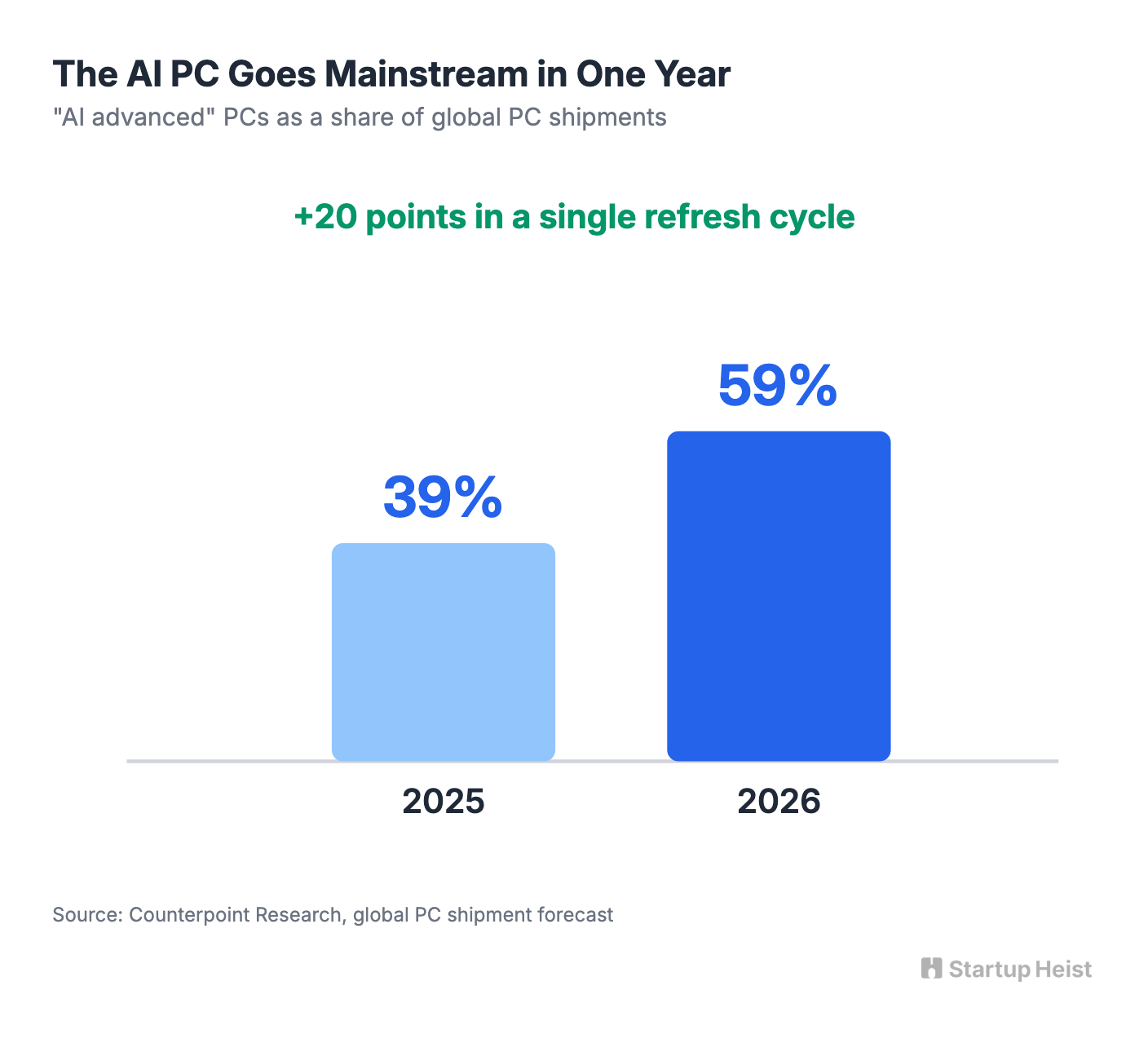
Counterpoint Research projects that "AI advanced" PCs will reach roughly 59% of global PC shipments in 2026, up from about 39% in 2025. The refresh has a forcing function behind it. Windows 10 support ended on October 14, 2025, pushing a wave of corporate upgrades into machines that clear Microsoft's Copilot+ PC bar of 40-plus TOPS of NPU performance. Apple has been shipping AI-capable silicon across its entire Mac line for years. The neural hardware is arriving by default, whether or not buyers asked for it.
The software stacks have caught up. Apple's Foundation Models framework now hands developers direct access to the same roughly 3-billion-parameter on-device model that powers Apple Intelligence, callable in a few lines of Swift. Apple is blunt about what it's good at: summarization, extraction, refinement, text understanding, classification. It's equally blunt about what it isn't for. The model is optimized for those focused tasks, not world knowledge or hard reasoning. Microsoft built the mirror image on Windows. Windows ML is a unified local inference runtime that spreads models across NPUs, GPUs, and CPUs. Its Phi Silica small model is tuned for Copilot+ NPUs, and Foundry Local runs open models on the machine while exposing an OpenAI-compatible endpoint at localhost.
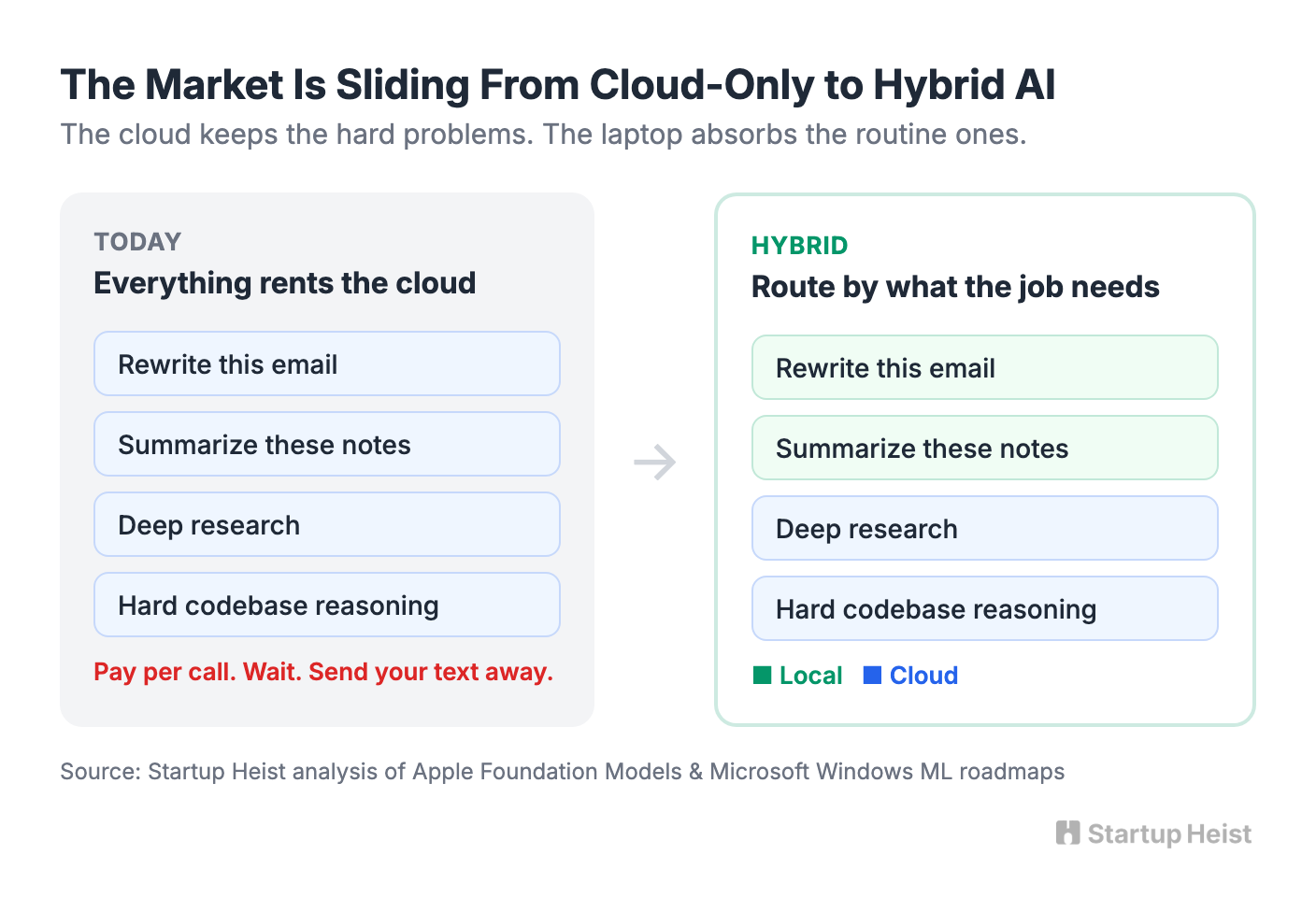
Read those two roadmaps side by side and the message is the same. Some AI is supposed to happen on the device now. The market is sliding from cloud-only AI toward hybrid AI, where the cloud keeps the hard problems and the laptop quietly absorbs the routine ones.
The Product Is Not a Chatbot
The obvious build is also the wrong one.
A founder watches local models get good and ships another desktop chat window. Users download an open model and ask it questions instead of opening ChatGPT. Useful, sure. Also a crowded street. LM Studio already runs local models offline and serves them through an OpenAI-compatible API on localhost. Ollama exposes the same compatible surface and has become the default for headless local inference. Jan ships a local server it openly calls a drop-in replacement for cloud APIs. And LiteLLM proves the routing layer at the infrastructure level, with a unified OpenAI-style interface, fallbacks, budget caps, and cost tracking across more than 100 providers.
The technical pattern is settled. Point an app at a local base URL instead of a remote one, let a small model handle the request, and escalate to the cloud only when the job demands it. The raw proxy is a solved problem, and a solved problem is not a business. The business is taking that fragmented developer plumbing and turning it into something a writer, a consultant, or a privacy-conscious manager can install and trust.
The Heist: Productize the Routing Layer
Most people will never choose a quantization format, inspect GPU layers, or debug why an app stopped talking to localhost. They want a switch.
They want to install one app and see plain-language toggles. Writing help runs locally. Document summaries run locally. Sensitive files never leave the machine. Heavy reasoning goes to a premium cloud model. Coding autocomplete uses the fastest backend available. On battery, prefer the smaller local model. On a plane, keep working. And a line that does the real selling: this month you avoided $18.42 in cloud charges.
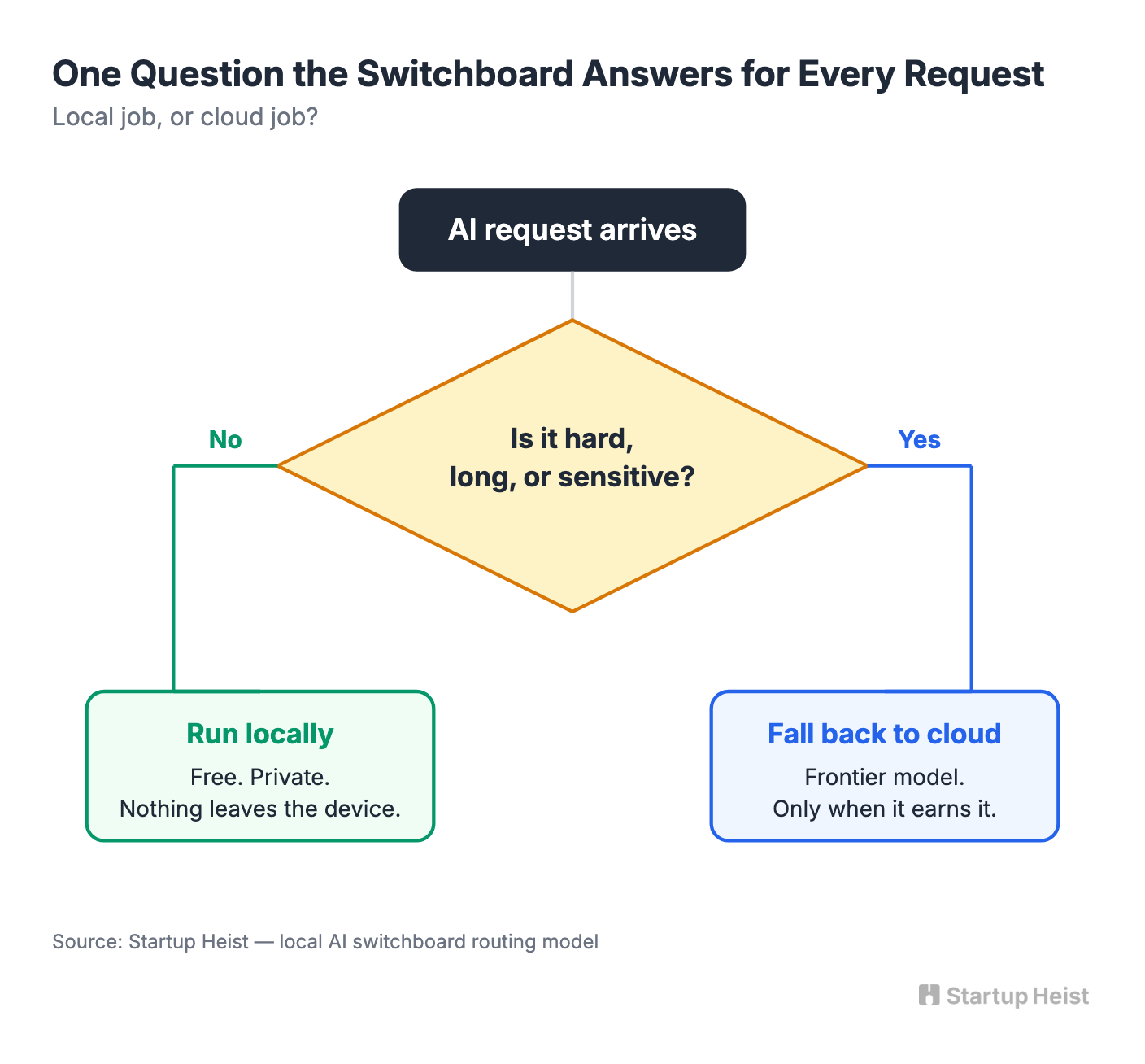
Call it a local AI switchboard. A menu-bar or system-tray utility that exposes one OpenAI-compatible endpoint, ships prebuilt integrations, picks the right local model for the machine, routes each request by the user's rules, and falls back to approved cloud models when the job exceeds what the laptop can do.
The pitch isn't that it replaces every AI service. The pitch is that it stops wasting cloud AI on jobs that never needed it. That single distinction is the whole company.
The MVP
A credible Mac-first build is far narrower than the long-term vision. Six pieces:
Unlock the Vault.
Join founders who spot opportunities ahead of the crowd. Actionable insights. Zero fluff.
“Intelligent, bold, minus the pretense.”
“Like discovering the cheat codes of the startup world.”
“SH is off-Broadway for founders — weird, sharp, and ahead of the curve.”


