


The Checkout Boss Battle
Turn discounting into a game customers feel they won — without giving away the store
A customer lands on a $1,800 dining table. They spend four minutes studying the dimensions, open the shipping policy, add it to the cart, hesitate, and leave.
Most stores answer that moment with one of three blunt instruments. A popup offering 10% off for an email address. An abandoned-cart email with a coupon code. A permanent sale banner that quietly trains every customer to ignore the list price. These tactics work, but they've become background noise. The shopper has seen the popup a thousand times and knows the banner will be back next week.
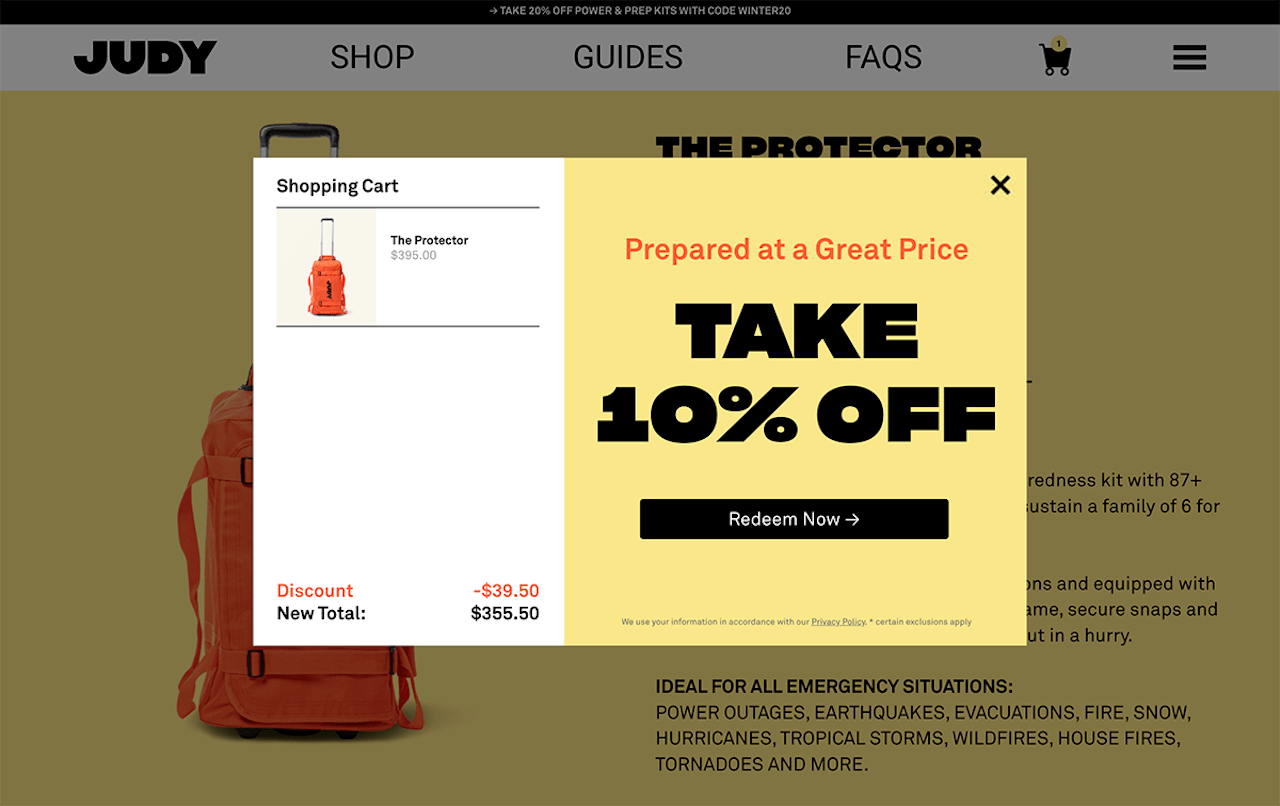
There's a more interesting play here: a Shopify app that lets selected shoppers negotiate with an AI sales manager. Not a generic chatbot, and not a sad little "make an offer" form. A tightly designed, on-brand mini-game. The shopper sees a prompt: Still deciding? You have three rounds to unlock a private deal. They make an offer. The store's AI counters. A deal meter moves. The AI might ask them to grow the cart, accept a shorter return window, buy today, or add a matching item. The merchant sets the floor price, eligible products, maximum discount, inventory rules, and brand voice. The shopper gets the emotional satisfaction of winning. The merchant gets a margin-controlled conversion tool.
Here's the opportunity:
The money: 100 merchants at an average of $150/month clears $15K MRR. A $1,500 launch package per store manufactures case studies and margin while you scale.
Inside:
• Full MVP scope with dialogue/economics split
• Deal Unlock: the one game mode to ship first
• Three-tier pricing plus a $1,500 launch package
• Willingness-to-pay data as the long-term moat
It starts as a micro-SaaS. If it works, it becomes something more valuable: a pricing-intelligence layer that learns how much each customer will actually pay, which concessions close sales, and when a discount was never needed at all.
This isn't a greenfield, which is the good news. A handful of Shopify apps already offer AI bargaining and rules-based offer flows. The basic mechanism has been validated by real merchants spending real money. The opening is to build the premium version: a conversion-safe negotiation engine for high-margin DTC brands, designed with the care of a game studio and measured like a CRO product.
The problem isn't cart abandonment. It's unresolved hesitation.
Roughly seven in ten online carts are abandoned. Baymard Institute's tracked 2026 average sits at 70.22%, a number that has barely moved in a decade despite enormous investment in checkout UX. The leading checkout-stage reason is unexpected costs (shipping, taxes, fees), cited by 48% of abandoners and ranked first for six straight years. A negotiation app fixes none of that. It can't make delivery faster, repair a clumsy checkout, or make an untrusted brand trustworthy.
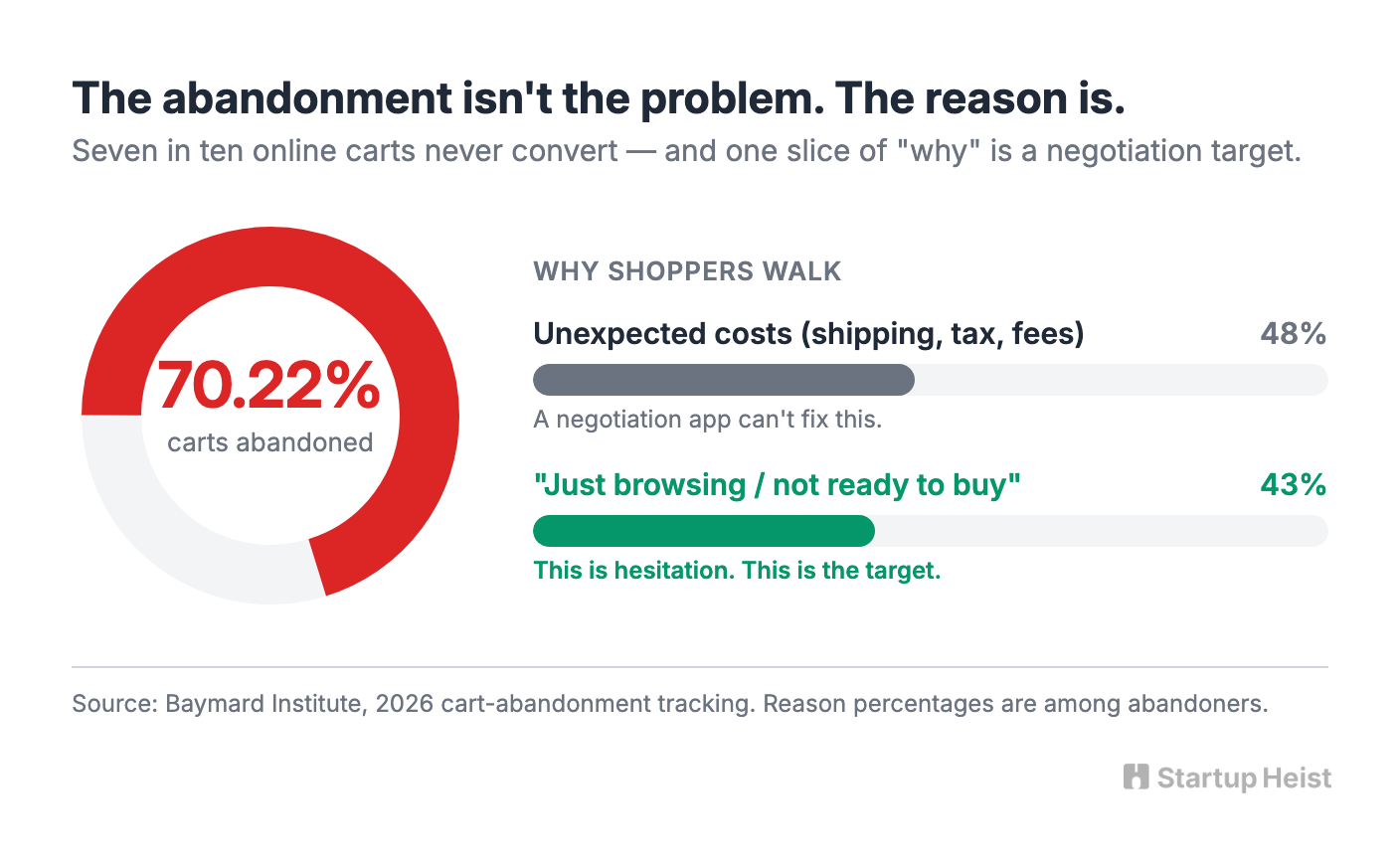
But buried in Baymard's data is the real target. Forty-three percent of shoppers abandon because they were "just browsing / not ready to buy." That isn't a checkout failure. It's hesitation. And a meaningful slice of those people are closer than they look. Their objection is narrow: I like it. I'm just not sure I want it badly enough at this price.
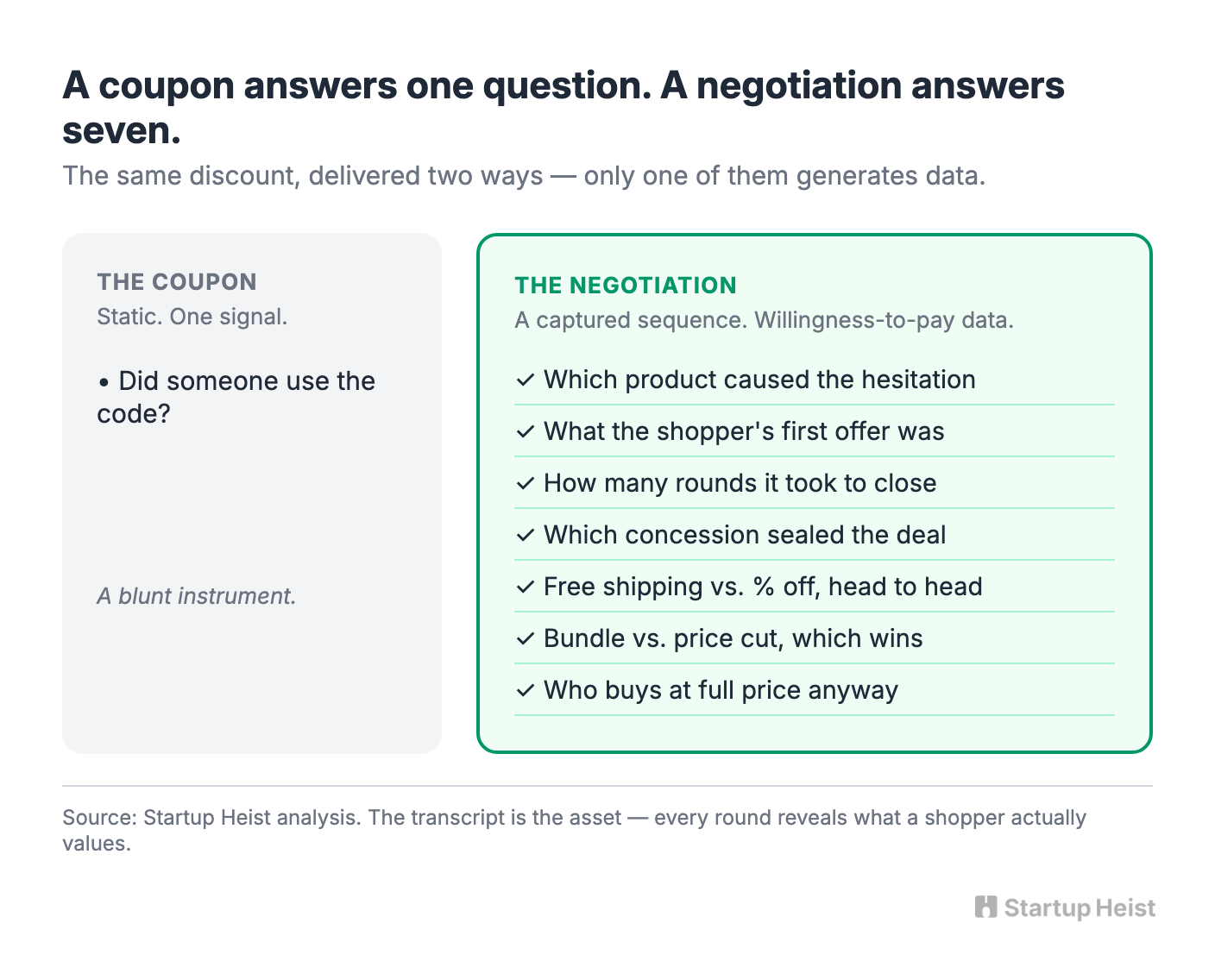
Merchants already spend heavily to win these customers back, and the usual move is to fire the same 10% coupon at everyone. A negotiation engine is selective. It can offer 4% to one shopper, free shipping to another, a bundle to a third, and nothing at all to someone who looks ready to buy anyway.
The interaction itself does useful work. The shopper invests time, reveals intent, and walks away with a deal that feels private rather than mass-distributed. A spin-to-win wheel hands out a coupon. A negotiation game hands the shopper a story: I talked them down from $1,400 to $1,310. That story is the product.
Why a game beats a chatbot
The obvious build is a chat window. Customer: can you do better? Bot: I can offer 5% off. Customer: how about 15%? Bot: I can do 7%. Functional, and forgettable.
The stronger product borrows from game design: a clear objective, visible progress, real constraints, and a satisfying end state. Three rounds. A visible deal meter. A countdown. A named AI character matched to the brand. Optional side quests: add a second item, clear a cart-value threshold, buy within twenty minutes, join the loyalty program. A final locked-deal screen with a code or an auto-applied discount.
The character flexes by vertical. For a premium furniture brand it reads like a calm showroom manager. For streetwear, a drop-day challenge. For a watch reseller, a private dealer. The interface should never become a five-minute improv session with a language model. Shoppers don't want to negotiate a hostage release. They want a quick hit of agency and a clean win. The ideal session runs 30 to 90 seconds.
The wedge: high-consideration DTC, starting with furniture
This isn't a universal app, and pretending otherwise is how it dies. The worst early customers are low-margin merchants selling commodities. A store moving $19 phone chargers can't negotiate every order. An everyday skincare brand may damage its positioning if customers learn to haggle. A luxury label may reject the premise outright because visible bargaining feels cheap.
The best first customers share four traits: a meaningful order value, enough gross margin to make selective concessions, customers who genuinely hesitate, and products where negotiation doesn't feel strange. Furniture and home décor sit at the center of that Venn diagram. A shopper weighing a $900 chair, an $1,800 table, or a $3,500 sectional already behaves differently from someone buying socks. They compare, revisit, ask about shipping, and will often buy today if the final price feels slightly better. The merchant also has room to structure the concession with intelligence: 5% off, free white-glove delivery, a chair-plus-table bundle, an open-box unit, a faster close on slow-moving stock, an offer that expires tonight.
Jewelry, watches, collectibles, resale fashion, specialty equipment, custom products, and higher-ticket gifts follow the same logic. Start narrow where the sales math is obvious, build case studies, then widen.
There's already a market. Don't build the generic version.
Shopify already has a visible negotiation category, and that works in your favor. Bargain Buddy lets customers haggle with an AI bot on the product page, with maximum-discount rules, custom tone, automatic deal discounts, and triggers based on dwell time, repeat visits, and other behavioral signals. Bargenix positions itself as an AI sales agent with product-level floor-price logic, negotiation logs, analytics, and human takeover. The older guard proves demand runs deep: Magical Make an Offer has operated since 2015 and carries more than 170 reviews at 4.6 stars, while the newer Offerly launched in 2024 and already holds a 4.9 rating. Merchants install flexible-pricing tools, and a real subset of shoppers enjoy using them.
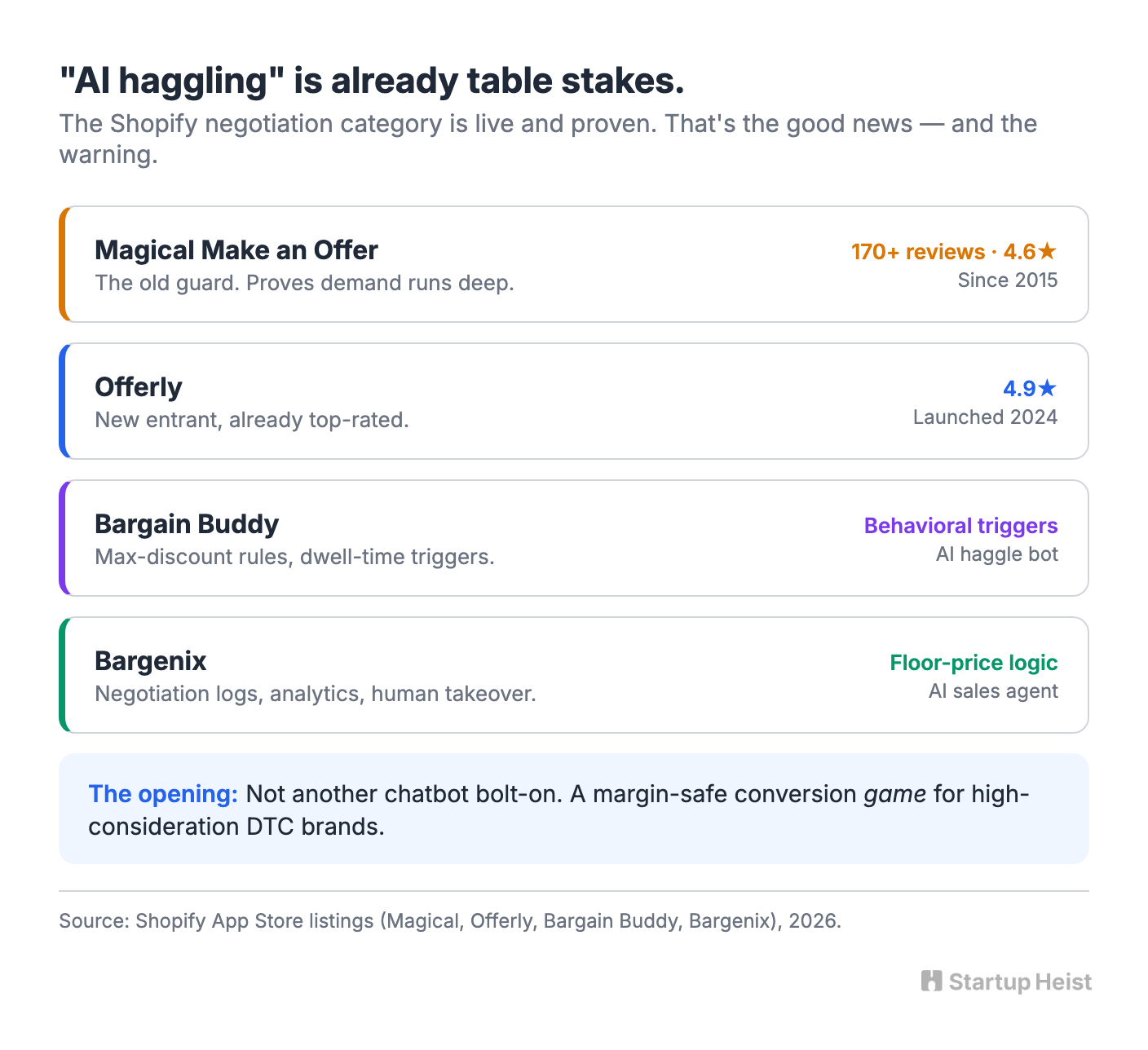
The lesson isn't that the opportunity is gone. It's that "AI haggling" is now table stakes. A new entrant needs a sharper promise: we don't bolt a chatbot onto your store. We turn price hesitation into a margin-safe conversion game. That demands a better interface, stronger merchant controls, credible experimentation, and vertical playbooks. The moat is not the system prompt.
The MVP: build the profit-controlled version first
A solo founder or two-person team can ship V1 without inventing infrastructure. The right MVP lives on product and cart pages. Shopify's theme app extensions let merchants drop app blocks into compatible storefront sections without touching theme code, and the discount APIs handle the actual price logic.
Don't make deep checkout integration the first dependency. Shopify allows checkout UI extensions at defined steps, but extensions on the information, shipping, and payment steps are restricted to Shopify Plus stores. That restriction is a gift. It becomes a premium tier later, and it should never block the broad-market launch.
Unlock the Vault.
Join founders who spot opportunities ahead of the crowd. Actionable insights. Zero fluff.
“Intelligent, bold, minus the pretense.”
“Like discovering the cheat codes of the startup world.”
“SH is off-Broadway for founders — weird, sharp, and ahead of the curve.”


