


The One-Star Review Wall: Turning a Business's Worst Review Into Its Best Ad
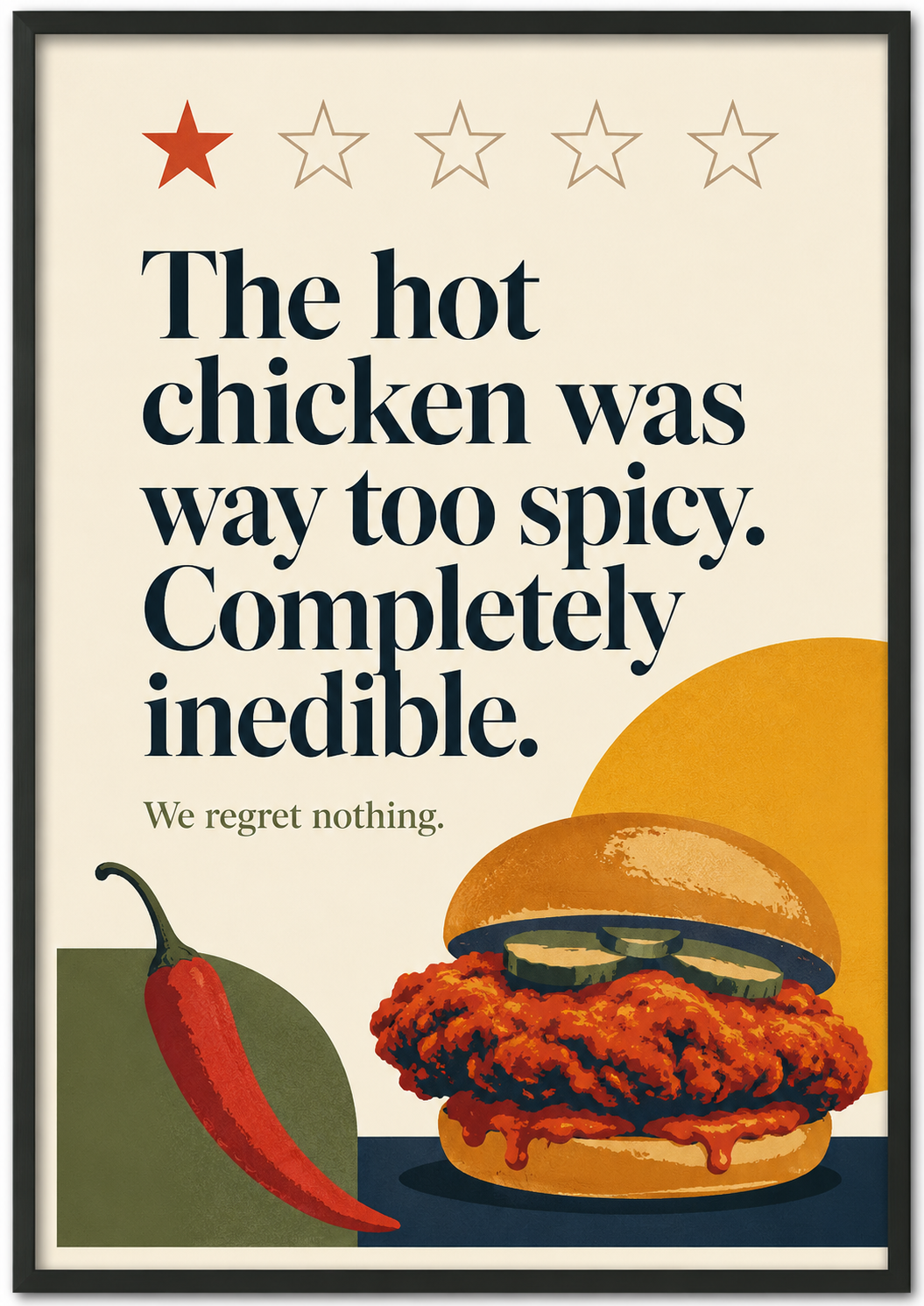
A customer walks into a Nashville hot chicken shop and spots a framed review hanging by the register:
★☆☆☆☆
"The hot chicken was way too spicy. Completely inedible."
Underneath, in small type:
We regret nothing.
That framed review isn't reputation management. It's positioning. Most local businesses treat a one-star review like a spill to be mopped up: respond politely, bury it under five-star requests, hope nobody scrolls far enough to find it. But the right negative review does the opposite of damage. It tells a customer exactly what the business stands for.
The barber who is "too old-school." The gym where the trainer "wouldn't let me take it easy." The dive bar that is "too loud." The restaurant whose curry is "aggressively spicy." For the wrong customer, these are complaints. For the right customer, they're advertisements.
Here's the opportunity: turn those reviews into physical products. Gallery-quality framed posters, bathroom prints, staff shirts, stickers, ready-to-post social graphics. The business is a small, high-margin micro-brand with a software-assisted backend. It reads a local business's reviews, finds the funniest badge-of-honor candidate, mocks up a polished poster, and sends the owner an email that's hard to ignore: "Someone left you a terrible review. You should frame it."
The money: A solo operator selling 100 orders a month at a $140 average order value clears $14K in monthly revenue, before campaign kits and merch lift it higher.
Inside:
• The embarrassingly manual MVP, step by step
• Four-tier offer ladder from $89 to $599
• The cold email that does all the selling
• The Spite Score that ranks reviews to print
This isn't a billion-dollar SaaS company, and it's probably not even venture-backed. It's a sharp little heist: prototyped by hand, sold with personalized outbound, fulfilled without inventory, and expanded into a broader review-merch studio only after customers prove they want it.
Some Complaints Are Free Positioning
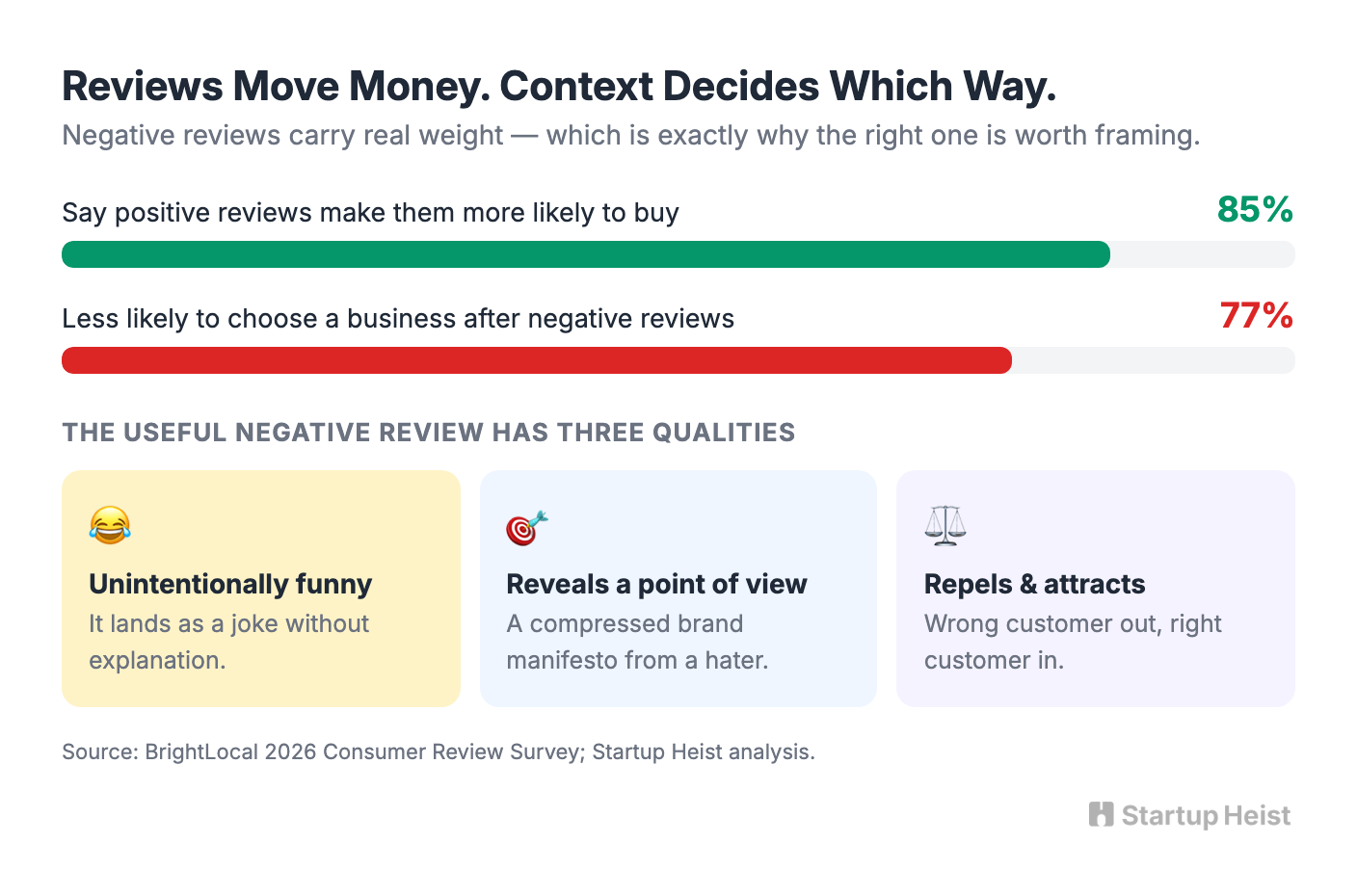
Reviews carry real economic weight. BrightLocal's 2026 consumer survey found that 77% of consumers are less likely to choose a business after reading negative reviews, while 85% say positive reviews make them more likely to buy.
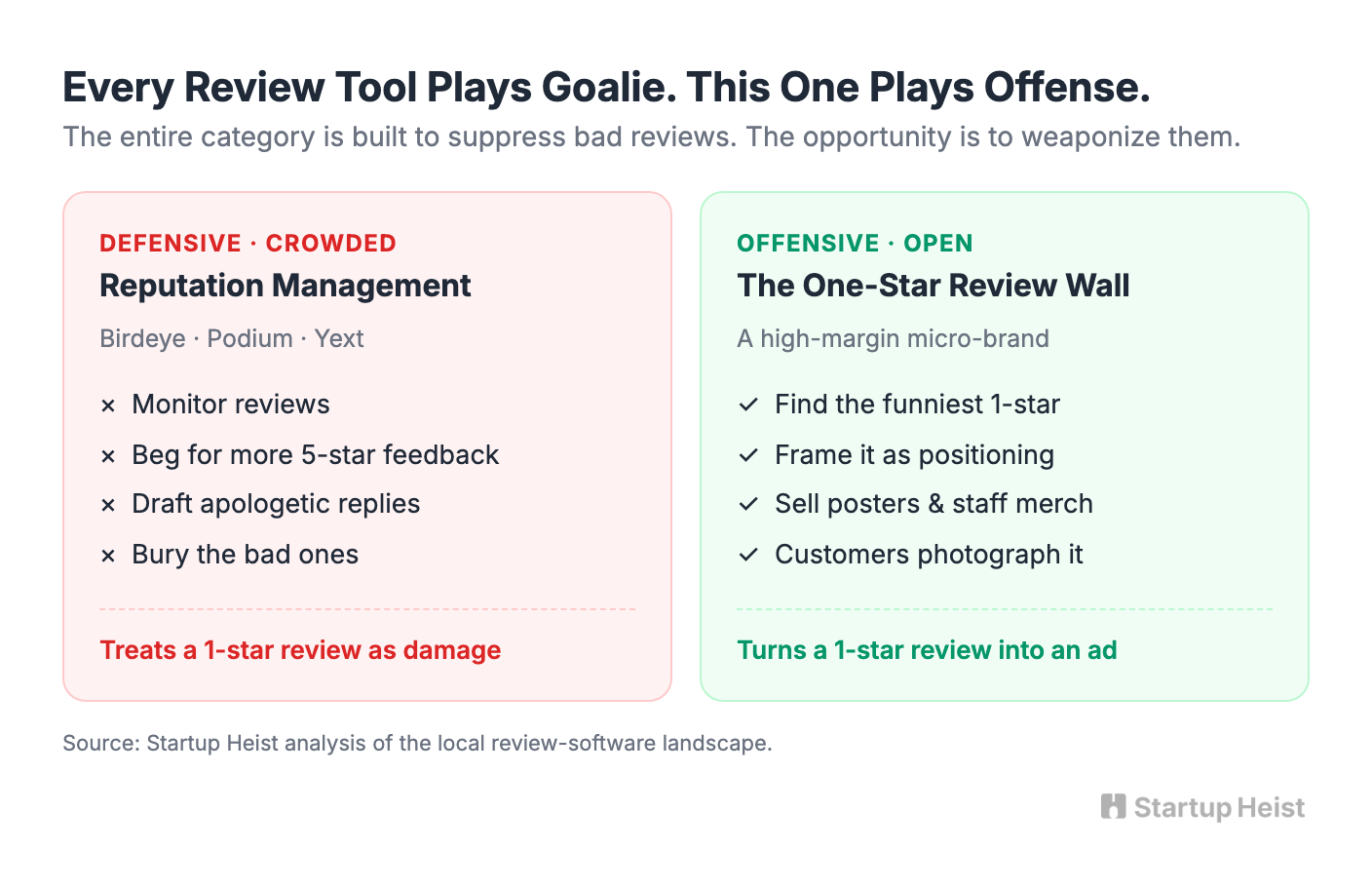
That weight is exactly why nearly every review product is defensive. The category is crowded with reputation management tools that monitor reviews, beg for more five-star feedback, draft apologetic responses, and suppress reputational damage. Incumbents like Birdeye, Podium, and Yext all play goalie.
But a one-star review isn't automatically damage. Context decides. "The food made me sick" is a crisis. "The salsa was so spicy I could barely finish it" is a sales asset for a place that wants to be known for heat. "This gym is full of intimidating people lifting heavy weights" is a recruiting poster for the exact members the gym wants.
The useful negative review has three qualities: it's unintentionally funny, it reveals a real point of view, and it repels the wrong customer while attracting the right one. The best ones are compressed brand manifestos, written by someone who hated the brand. Finding them is the whole business.
The Art Is the Product. The Software Is the Margin.
There is already a consumer market for review-themed decor. Etsy is full of funny restaurant-review prints, bathroom-rating posters, and framed-review jokes, priced from a few dollars for a digital download to roughly $15 to $30 for a physical print. The visual language is familiar to buyers.
Almost all of it is generic, though. "Chef was cute. Would eat here again." "Would poop here again." Wall filler with no owner.
The B2B version is personal. It uses the business's own review, its own name, its own story. The poster stops being decor and becomes a conversation piece customers photograph. That's why an owner will pay $89 for what looks like a piece of paper in a frame. They aren't buying paper. They're buying a tiny marketing campaign disguised as a joke, hanging right where every customer pays.
A dashboard that surfaces "your funniest negative review" is mildly interesting. A framed poster beside the register becomes part of the customer experience. The physicality is the point.
Productized Service First, Software Second
The tempting version is a polished self-serve platform: connect your Google Business Profile, import reviews, let an algorithm rank your funniest one-star comments, pick a template, order a frame, auto-generate shirts and stickers.
That product is buildable. Google's Business Profile API lists and retrieves reviews for verified locations. Printify and Printful both expose APIs that create products and submit orders programmatically. The plumbing exists.
Building the full platform first would still be a mistake, because the scarce resource isn't engineering. It's taste. An algorithm can spot a low rating and an odd phrase. It cannot reliably judge whether a review is funny, brand-enhancing, legally safe, and good enough to put on a shirt. The first hundred customers need a human editor with a good eye.
So start as a concierge micro-brand with a software-assisted backend. Find a business with a frame-worthy review. Mock it up. Email the owner. Fulfill through a print-on-demand provider. Learn which jokes people actually pay for. Automate only the work that repeats. You don't need a dashboard to sell the first fifty posters. You need a great mockup.
The First Wedge: Restaurants With a Point of View
Don't sell to every local business. Start with restaurants that already have a strong identity: hot chicken shops, barbecue joints, dive bars, breweries, taco shops, ramen counters, diners, food trucks, chef-driven neighborhood spots.
Restaurants are ideal because the complaints come out sensory, specific, and funny:
"The Nashville hot chicken was painfully hot."
"The portions were ridiculous. Nobody needs that much brisket."
"The bartender refused to make my frozen strawberry daiquiri."
That's built-in copywriting. Restaurants also come with the surfaces this business needs: walls, bathrooms, counters, staff uniforms, social feeds, regulars. One selected review can fan out into a whole product line.
The easiest buyer isn't a fine-dining group with six approval layers. It's an owner-operator with personality, a recognizable local following, and the confidence to laugh at themselves. Bars, gyms, tattoo shops, salons, barbershops, and independent retailers come later. The engine is reusable. The first outbound should be narrow enough that every email feels handmade.
The Offer Ladder
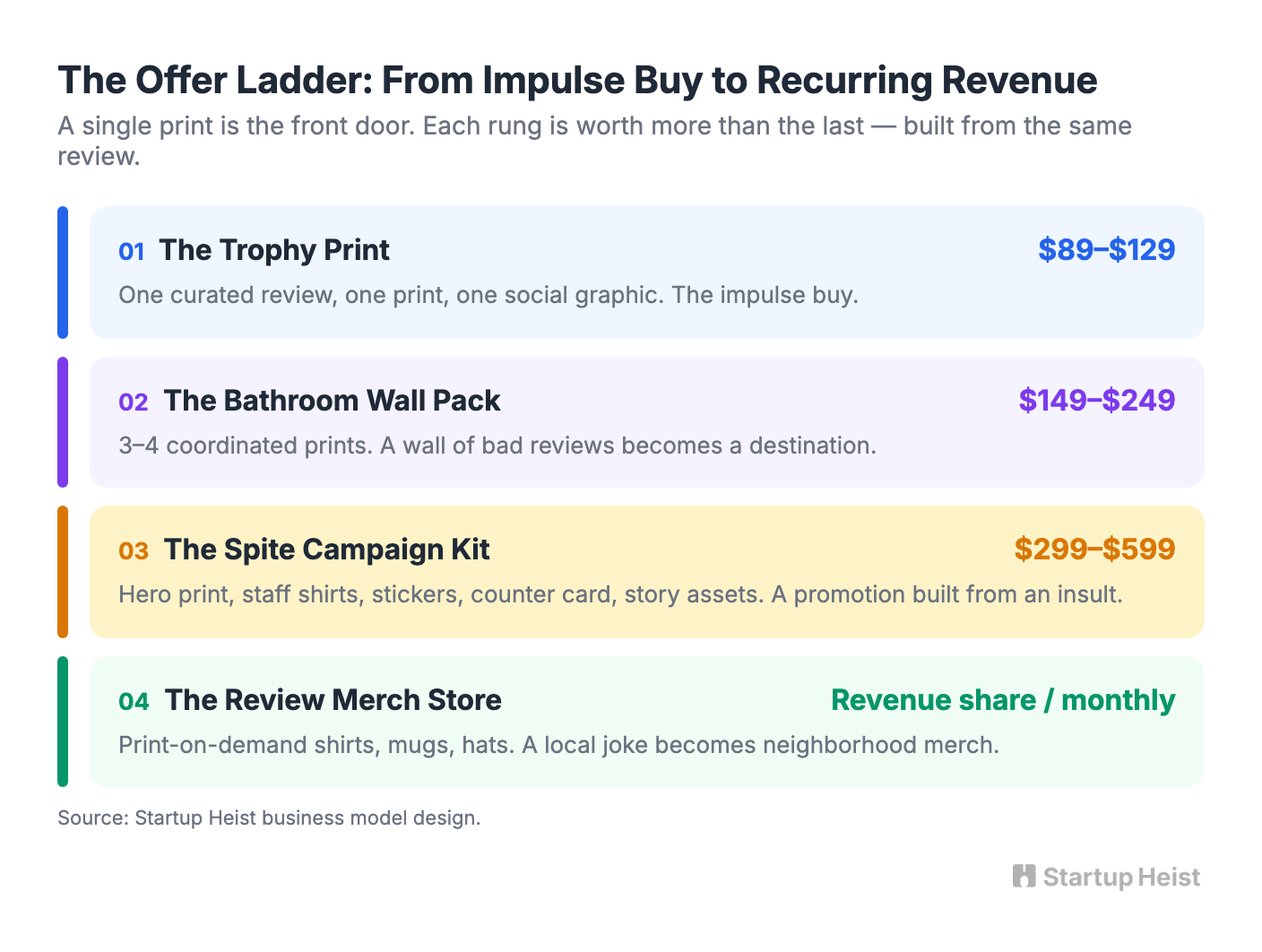
A single framed print is a fine front door. It shouldn't be the whole house. The model is a ladder of campaign kits, each worth more than the last.
The Trophy Print — $89 to $129. One curated review, one design style, business name or logo, anonymized attribution, one framed print, one social graphic. This is the impulse buy. The cold email already contains the mockup, so the owner isn't imagining a product. They're approving a finished one.
The Bathroom Wall Pack — $149 to $249. Three or four coordinated prints for a bathroom, hallway, or waiting area: one hero piece, two or three smaller prints, plus social-story templates. A single print is decor. A wall of bad reviews is a destination inside the business.
The Spite Campaign Kit — $299 to $599. A full mini-campaign around one or more reviews: framed hero print, secondary prints, a staff-shirt design, stickers, a counter card, a social graphic, a vertical story asset, caption suggestions, a reorder page for staff merch. The message writes itself: "Come try the sandwich one reviewer called 'an act of violence.'" The owner isn't hanging art. They're running a promotion built from an insult.
The Review Merch Store — revenue share or monthly fee. Once a review earns real love, spin up a small storefront for shirts, mugs, hats, totes, and stickers. No inventory: print-on-demand handles production and shipping. A good local joke becomes neighborhood merch, and the poster turns into customer acquisition for the merch.
Unit Economics: Small Orders, Healthy Spread
This isn't a software-margin business at the start. It's still attractive. A simple framed-poster offer:
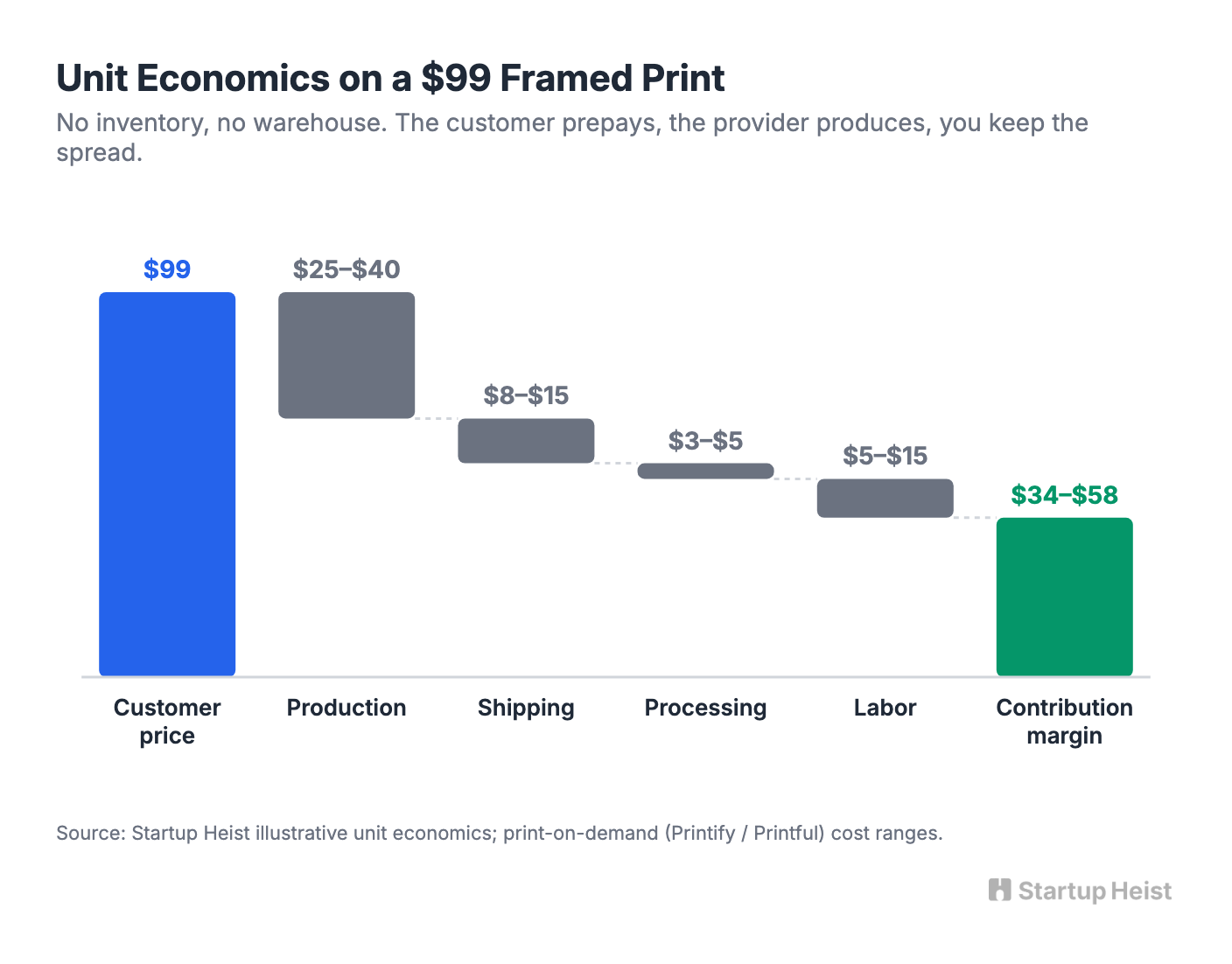
Costs move with print size, frame type, geography, and provider. The structure is what matters: no inventory risk, no warehouse, no batch manufacturing. The customer prepays, the provider produces, you keep the spread.
The real margin lives in the bundles. Once the design asset exists, spinning out a social graphic, a bathroom print, or a shirt variation is nearly free. The expensive part, the editorial work, already happened. A $99 poster is a respectable sale. A $349 bundle built from the same review is a far better business, which is why the product should never be sold as "custom wall art." It's a badge-of-honor marketing kit.
The Best MVP Is Embarrassingly Manual
The first version needs no API approval, no OAuth, no design editor, no merchant dashboard. It needs four things: a landing page, a repeatable review-discovery routine, three strong poster templates, and a Stripe payment link.
The workflow:
Unlock the Vault.
Join founders who spot opportunities ahead of the crowd. Actionable insights. Zero fluff.
“Intelligent, bold, minus the pretense.”
“Like discovering the cheat codes of the startup world.”
“SH is off-Broadway for founders — weird, sharp, and ahead of the curve.”


