


Get Found by the Robot
Ask an AI assistant to plan a long weekend in Asheville. You will get a competent itinerary: a morning hike, a brewery, a couple of restaurants, maybe a boutique hotel with exposed brick and a mountain view. Push for something specific, like a romantic inn near downtown, an unusual place with local character, or a hotel built for a food-focused trip, and the assistant narrows the field with confidence.
The traveler may never open a search-results page. That is the problem, and the opportunity.

Independent hotels have spent two decades learning to survive Google, TripAdvisor, Booking.com, Expedia, Instagram, and the travel-blog ecosystem. A new discovery layer is now forming above all of them. ChatGPT, Gemini, Perplexity, Google's AI surfaces, and a wave of travel-planning agents assemble recommendations before a traveler ever reaches an OTA or a hotel website. The machine does not hand back ten blue links and step aside. It composes an answer, names a few properties, and lets everyone else vanish.
Here is the opportunity: an AI-visibility agency and monitoring product for independent hospitality. It audits whether a hotel shows up in AI-generated itineraries, reveals which competitors get recommended instead, fixes the hotel's fragmented digital footprint, and tracks whether visibility climbs over time.
The money: 25 properties at $550/month is roughly $14K MRR for a solo founder; 50 is $27.5K. Setup fees fund the labor-heavy fixes.
Inside:
• Five-part audit MVP, no ML required
• Three-tier pricing plus DMO reports
• "Publish the index" go-to-market play
• 30-day plan and outreach template
The industry has ugly acronyms for the underlying craft: generative engine optimization, answer engine optimization, GEO, AEO. Hotel owners do not care. They want an answer to one question. When a traveler asks the robot where to stay, does it say our name?
The winning version is not another dashboard. It is a productized service with proprietary local data, sitting somewhere between monitoring software, hospitality marketing agency, and destination-intelligence engine. This is not a billion-dollar SaaS company out of the gate. It is a credible path to $10,000–$30,000 in monthly recurring revenue for a focused founder, with a longer road toward a defensible data product.
From search ranking to recommendation share
Travel is unusually exposed to AI discovery because trip planning is conversational by nature. A traveler does not want a list of hotel URLs. They want judgment: plan a three-day anniversary trip to Sedona, find a quiet boutique hotel near good restaurants in Charleston, lay out an Asheville weekend with local food, hiking, and a room under $350. Traditional search splits those into a dozen queries. AI answers them in one.
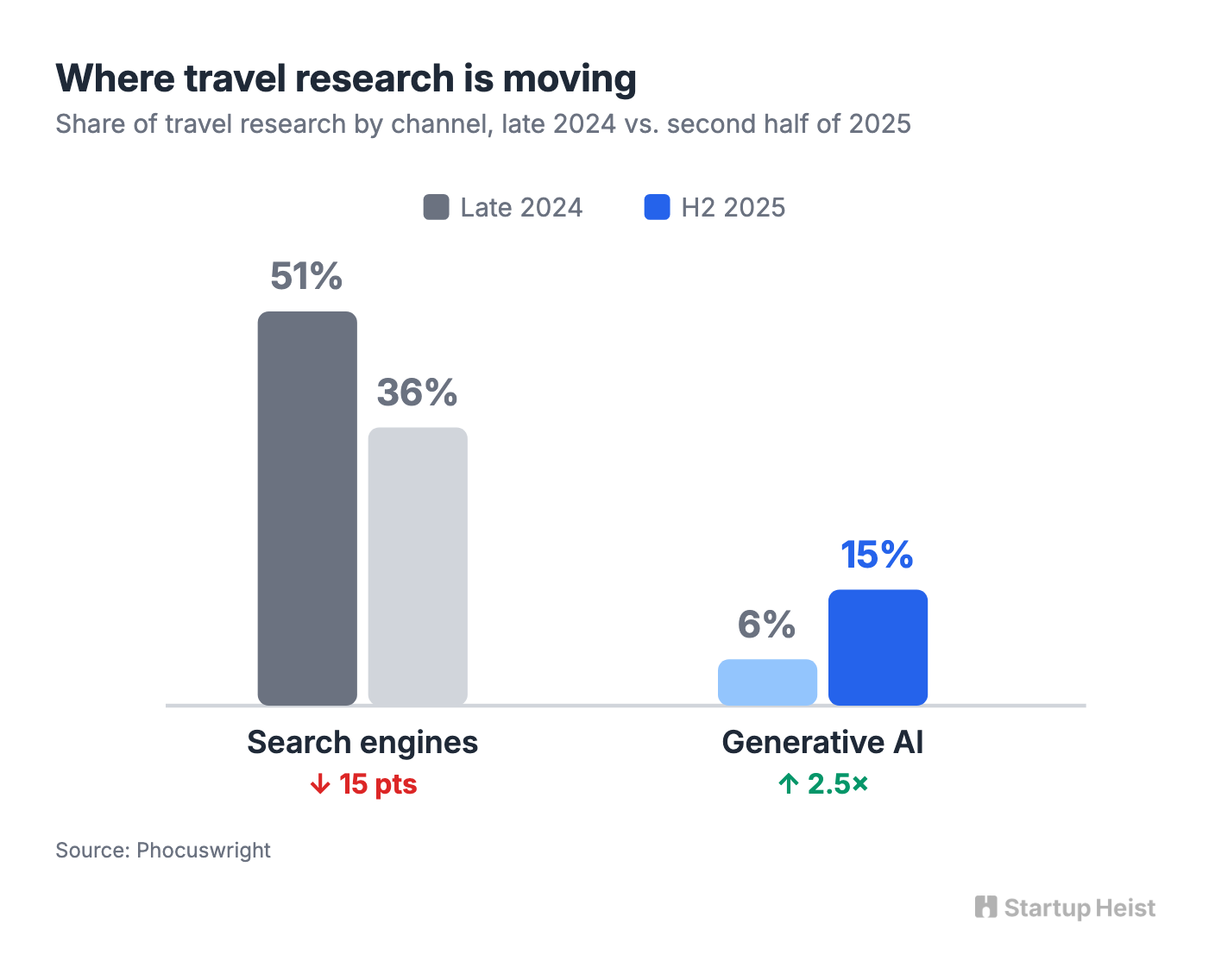
The behavior has already shifted. Phocuswright found that search engines fell from 51% of travel research in late 2024 to 36% by the second half of 2025, while generative AI platforms climbed from 6% to 15% over the same stretch. Adobe Analytics measured a roughly 1,700% surge in traffic to U.S. travel and hospitality sites from AI sources between July 2024 and February 2025. Nearly a third of travelers have now used generative AI to plan a trip, and 84% of them say it improved the experience. McKinsey reported in March 2026 that visitors arriving at travel sites from AI sources bounce 45% less often than other traffic.
None of this means Google disappears. It means a valuable slice of travel intent now runs through recommendation engines, and that slice is the high-value kind. A traveler who asks an AI to design an itinerary has handed over dates, budget, companions, location, and taste. The assistant qualifies the lead before any traffic moves downstream.
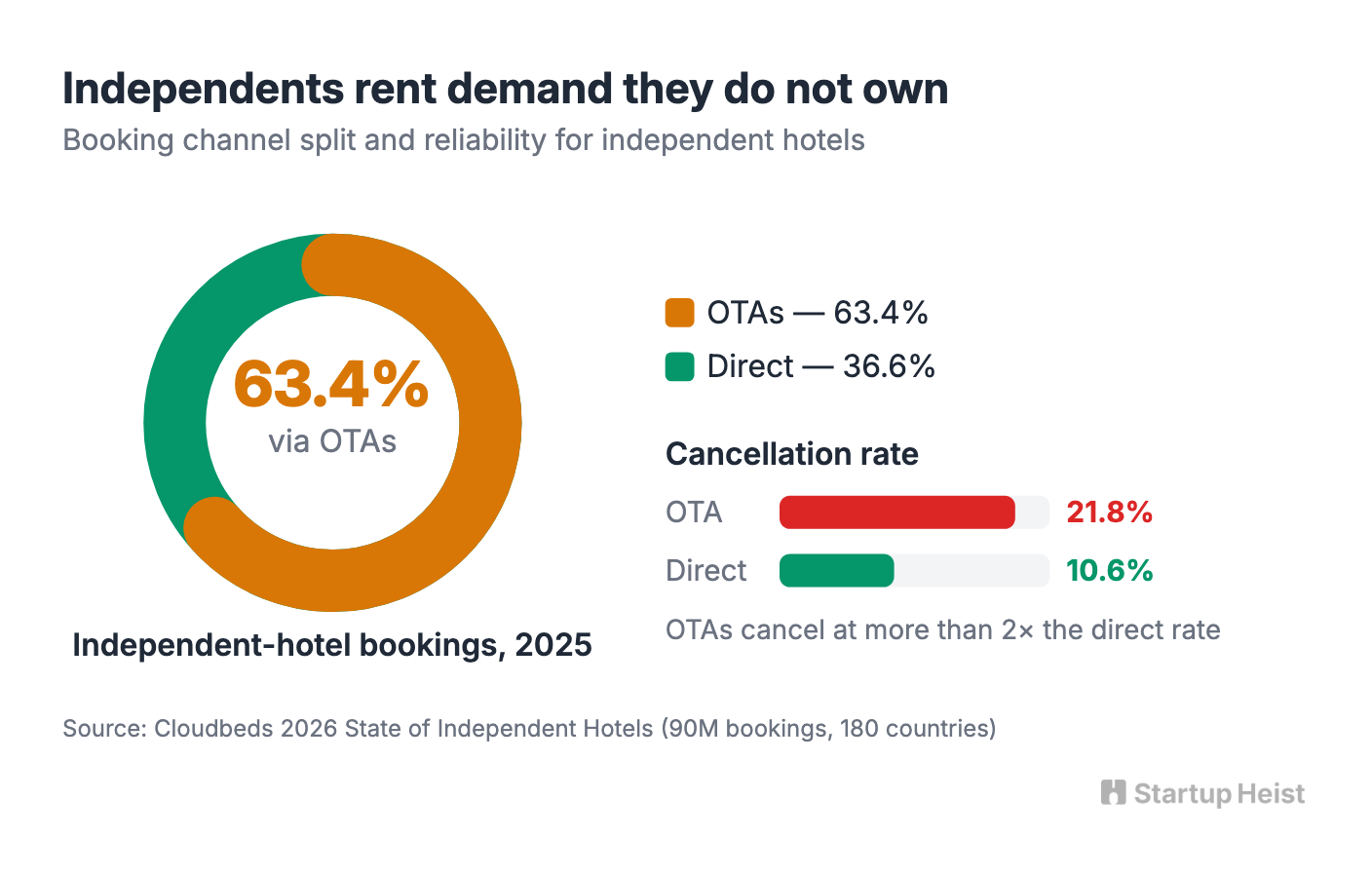
The timing is brutal for independents. Cloudbeds' 2026 State of Independent Hotels report, built on 90 million bookings across 180 countries, found OTAs took 63.4% of independent-hotel bookings in 2025 against just 36.6% direct, and OTA reservations cancel at 21.8%, more than double the 10.6% rate for direct bookings. The deeper cost is control. Book through an OTA and the hotel becomes a room supplier inside someone else's interface. AI discovery could harden that dependency. It could also open a fresh path back to direct demand, if the hotel earns a place inside the answer before the OTA closes the loop.
Why the robot ignores the charming inn
A small owner assumes recommendation quality comes down to a decent website, a Google Business Profile, and strong TripAdvisor reviews. Not anymore.
In 2025, Cloudbeds studied 145 properties that consistently ranked high in AI recommendations across six destinations. Every one had strong ratings and real review volume. The revealing part: 98% appeared on YouTube, 97% in travel blogs, and 95% on Reddit. The same study found that 72.4% of AI-recommended hotels were branded or large-group properties, which showed 4.43 percentage points more visibility than independents. The robot, left alone, flattens a destination into the same familiar chains.
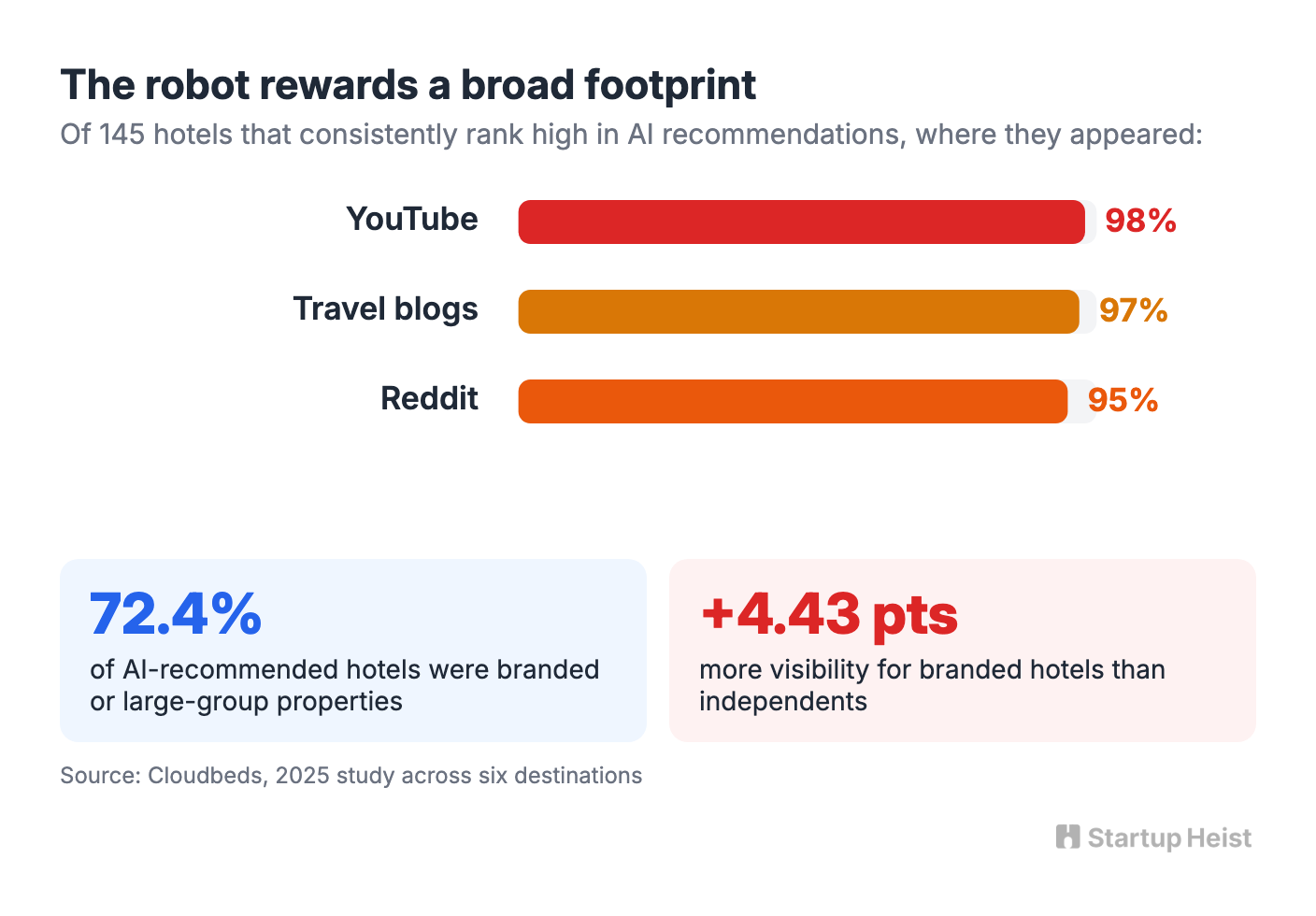
The lesson is not to spam Reddit. It is that AI systems reward a broad, credible, consistent footprint, where many independent signals agree with each other. The website states plainly what the property is, where it sits, and why it is distinctive. Amenities, room types, policies, and nearby attractions read the same everywhere. Structured data helps machines parse it. Google, OTA, and directory profiles do not contradict one another. Reviews back the positioning. Blogs, local guides, videos, and forum threads reinforce relevance. And the hotel has real content for specific intents: romantic weekends, pet-friendly stays, hiking trips, food tourism, family travel, seasonal events.
Classic SEO asks whether your page ranks for a keyword. AI visibility asks whether the wider internet offers enough corroborating evidence for an assistant to confidently recommend you for a particular kind of trip. That gap is where a vertical specialist lives.
Horizontal tools already exist, and they validate the category without closing it. Profound tracks brand mentions across the major answer engines, with entry pricing around $99 a month for a single platform and a few dozen prompts. But a boutique owner does not want to learn a marketing platform, build a prompt library, read citation graphs, rewrite twenty pages, add schema, reconcile listings, court local creators, and design a review workflow. The owner wants the problem handled. That is the whole business.
The wedge: experience-led independent hotels
Do not start with every hospitality business. Restaurants, wineries, tour operators, attractions, and vacation rentals are adjacent, but each has different data sources, economics, and buyers. The clean entry point is narrow:
Experience-led independent hotels, inns, and B&Bs in high-intent leisure destinations.
Think Asheville, Sedona, Napa, Charleston, Savannah, Santa Fe, Palm Springs, Cape Cod, Key West, the Hudson Valley. The ideal first customer runs roughly 10–100 rooms, charges a nightly rate high enough that one extra booking matters, has a genuine story or location edge, leans hard on OTAs, runs a functional website, and earns strong reviews while distributing almost no content. There is an owner or GM who can approve changes fast.
Skip the hardest cases. A roadside motel with weak reviews and a broken booking flow does not have an AI-visibility problem. It has a product problem, and you cannot optimize a property into a recommendation it does not deserve. The best first customer is already good and badly under-described online. That is where a small operator produces visible wins fast.
The offer: diagnose, fix, monitor
Sell one outcome, not a pile of marketing tasks: we help independent hotels show up more often when travelers ask AI assistants where to stay. Behind that line sit three layers.

Unlock the Vault.
Join founders who spot opportunities ahead of the crowd. Actionable insights. Zero fluff.
“Intelligent, bold, minus the pretense.”
“Like discovering the cheat codes of the startup world.”
“SH is off-Broadway for founders — weird, sharp, and ahead of the curve.”


