


The Experience Factory
Manufacture the first job AI deleted
For decades, the first white-collar job came with a hidden subsidy.
A junior hire was not expected to arrive finished. They spent a year preparing research, cleaning spreadsheets, drafting basic reports, updating websites, building slide decks, and learning how to email a client without starting a small diplomatic incident. The work was not glamorous, and that was the point. The bottom rung gave people a safe place to become useful.

AI is quietly removing part of that rung. This isn't the apocalypse story you've already heard. Entry-level jobs are not all vanishing. Something more specific is happening: the routine tasks get automated first, and the junior hire is now expected to show up with judgment, initiative, and AI fluency on day one. The first job is becoming a second job.
That gap is the opportunity. Call it an experience factory for college seniors and recent graduates: real-client, AI-supported portfolio projects packaged as a career-readiness outcome and sold to university career-services offices.
Here's the shape of it.
The money: 20 institutions at $60K a year is $1.2M revenue. A single pilot runs $15K to $25K, and consortium tools already clear $65K per school.
Inside:
• Three standardized project tracks to grade at scale
• Pilot-to-annual pricing from $15K to $100K
• Career-center outbound email and pitch deck
• Four-layer evidence-network moat
It isn't a job board, another stack of courses, or a simulation where a student pretends to advise a fictional client. It's a cohort program. Students complete real, tightly scoped projects for nonprofits and small businesses, supported by structured AI workflows and human review. Each one walks away with proof: a finished portfolio artifact, client feedback, and a verifiable credential describing what they actually shipped.
Everyone in the triangle gets paid in the currency they care about. The university buys a measurable career-readiness outcome. The client gets useful work at a manageable cost. The graduate gets the one thing that's suddenly scarce: evidence they can operate beyond the classroom.
It's a big problem with a deliberately narrow first move. Don't launch a three-sided marketplace and pray for liquidity. Run the factory yourself.
The new experience gap
The hard market for new grads is not a vibe. The Federal Reserve Bank of New York reported that unemployment among recent college graduates held near 5.7% in the first quarter of 2026, with underemployment at 41.5%. For context, unemployment for degree-holders aged 22 to 27 sat at 3.6% in March 2019. It has since climbed past 5.6%, and Fed economists tie much of the jump to remote work — employers find it harder to train juniors they never see.
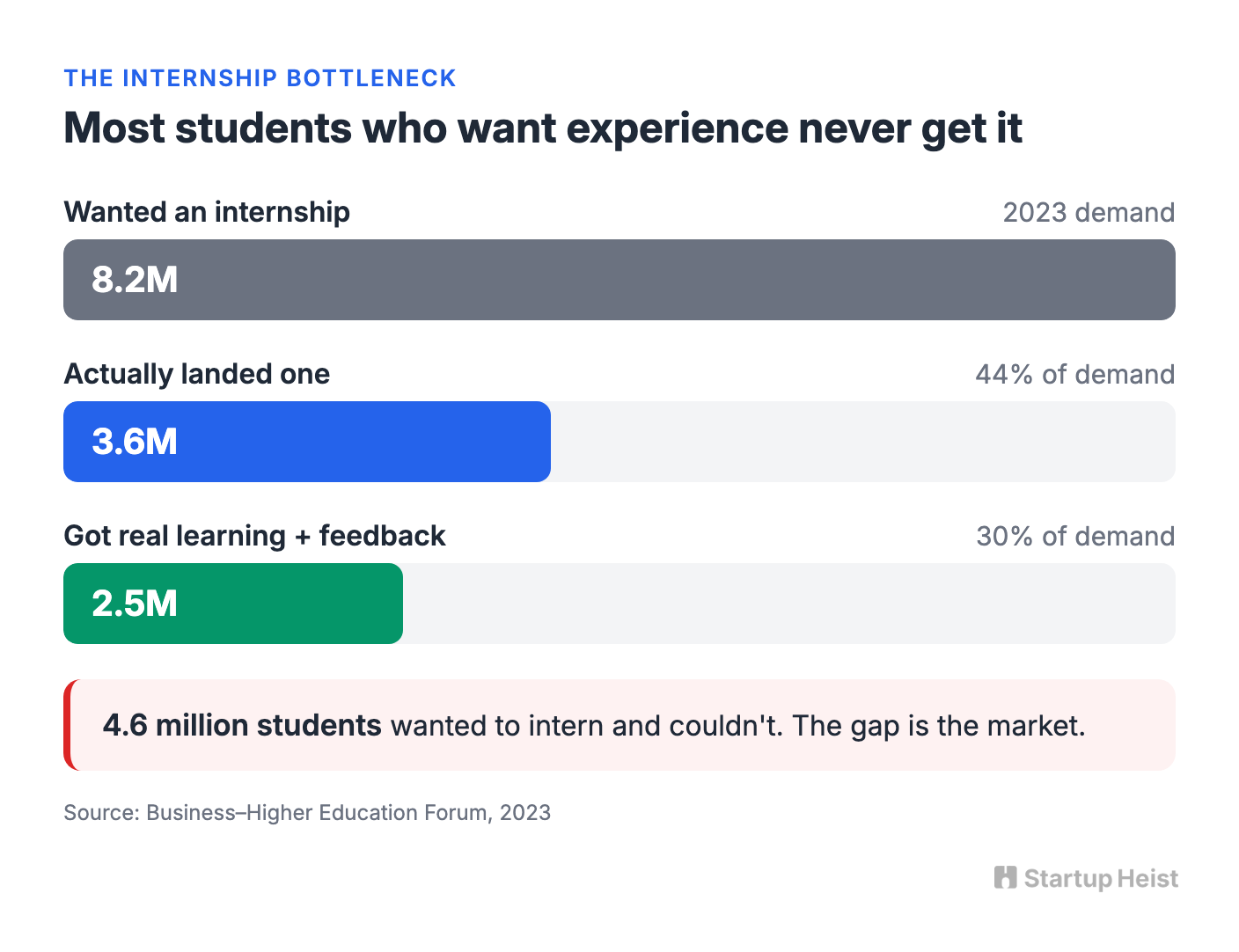
The deeper problem is that experience is now both more important and harder to get. The Business–Higher Education Forum estimated that 8.2 million learners wanted an internship in 2023, but only 3.6 million landed one. That stranded 4.6 million students who wanted to intern and could not. Quality split the survivors further: only 2.5 million completed an experience with real learning outcomes and feedback. And the payoff is measurable. NACE found that students who completed a paid internship received an average of 1.61 job offers, versus 0.77 for students with no internship at all.
The obvious read is that universities need more internships. The sharper read is that they should stop treating the internship as the only valid unit of experience.
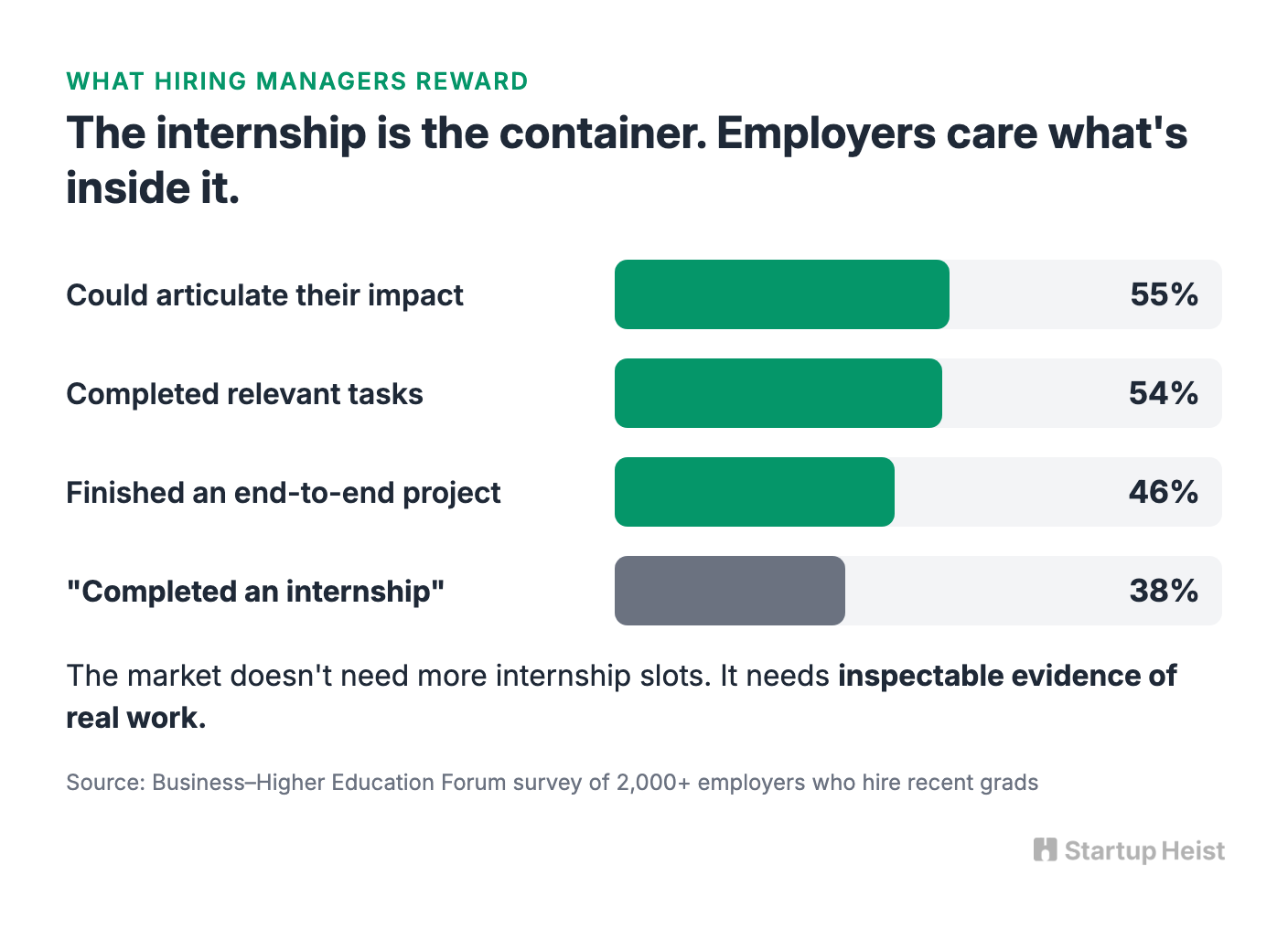
An internship is a container. Employers care about what happened inside it. In a survey of more than 2,000 employers who hire recent graduates, the same forum found only 38% considered "completed an internship" important to a hiring decision. They cared far more about specifics: 55% wanted candidates who could articulate their impact, 54% valued completion of relevant tasks, 46% valued a finished end-to-end project. The market doesn't need more internship slots. It needs a scalable way to manufacture credible, inspectable evidence of work.
AI did not erase the junior job. It raised the cover charge.
The loud version of this story is the bloodbath. In 2025, Anthropic CEO Dario Amodei warned AI could wipe out roughly half of entry-level white-collar jobs within five years. A global BSI study found 39% of business leaders had already cut entry-level roles because AI now handles research, admin, and briefing work, with 43% expecting more cuts within a year.
Don't build around the loudest prediction. Build around the more useful one: AI is unbundling entry-level work, not deleting it.
A Strada Institute for the Future of Work study of nearly 1,500 executives and senior talent leaders found that among employers exploring AI, 42% said it increased the analytical, judgment-based responsibilities handed to entry-level workers, while 41% said it reduced their routine and administrative tasks. In the same study, 46% of those employers reported an increase in entry-level hiring during 2025, against 13% reporting a decrease. Some firms cut juniors. Others hire more, because each one is now more productive. Either way, the profile of the employable graduate changes.
The candidate who once needed an employer to teach them how to produce basic work now needs to arrive already able to use AI responsibly, judge its output, finish a real deliverable, and explain the tradeoffs they made. So the experience factory isn't a consolation prize for kids who missed the internship lottery. It's an adaptation layer for a labor market that changed the entrance requirements overnight.
The market is real, and already half-occupied
This is not greenfield. Three companies have already proven that students, employers, and universities will adopt shorter, more flexible work experience, and the shape of their success maps the gap you can walk into.
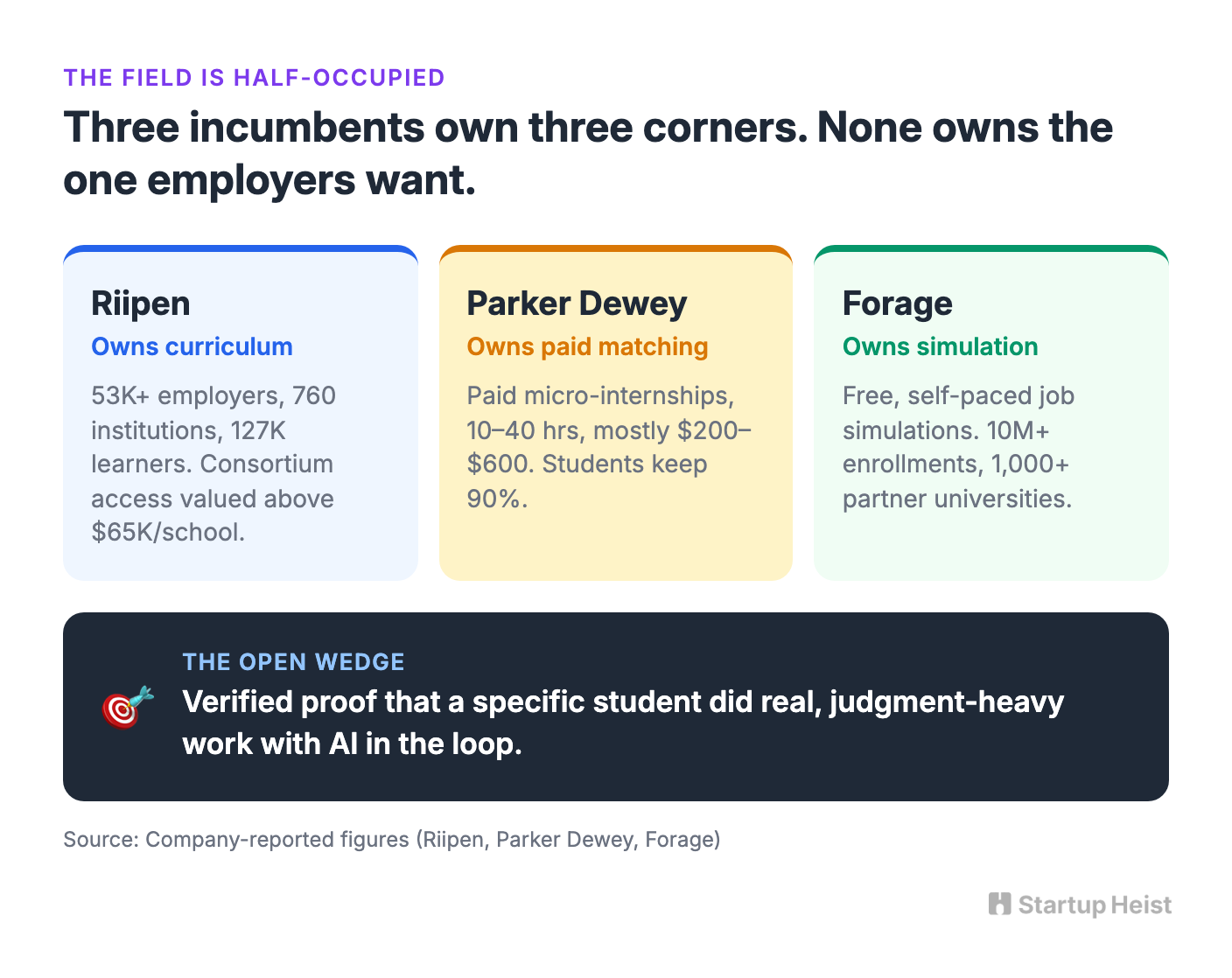
Riipen embeds employer-designed projects directly into coursework and reports a network north of 53,000 employers, 760 institutions, and 127,000 learners; the Council of Independent Colleges built a multi-year consortium on top of it, with institutional access valued above $65,000 per school. Parker Dewey pioneered the paid micro-internship — fixed-fee assignments of 10 to 40 hours, most priced between $200 and $600, with students keeping 90%. Forage went the other direction with free, self-paced job simulations and reports more than 10 million enrollments across 1,000-plus partner universities. Riipen owns curriculum. Parker Dewey owns paid matching. Forage owns scalable simulation. None of them owns the thing employers now say they want most: verified proof that a specific student did real, judgment-heavy work with AI in the loop.
That's your wedge, and it's narrow on purpose:
Real-client, AI-supported portfolio projects for seniors and recent graduates, packaged as a measurable outcomes program for career centers.
The project is not a listing. The credential is not a completion badge. The AI is not an open chatbot. The product is a structured path from zero experience to defensible evidence, and that path is where the rest of this playbook lives.
The heist: sell outcomes, not access
The weak version of this business is a marketplace. Students make profiles, nonprofits post projects, everyone waits, and the founder learns that marketplaces are elegant spreadsheets with no transactions.
The strong version sells an outcome to a career-services office. The university doesn't buy access to a platform. It buys a guarantee:
By the end of the semester, 100 seniors and recent graduates each complete one or two real-client projects, produce portfolio-ready work samples, receive structured feedback, and earn verified credentials tied to demonstrated skills.

That framing matters. Universities already own career portals, résumé workshops, alumni databases, and job boards. You won't win by adding another place to browse. You win by selling something closer to Outcomes-as-a-Service: you recruit the project supply, scope the work into repeatable formats, match students into cohorts, run AI-supported delivery, review the outputs, issue portable credentials, and report the results.
This isn't pure SaaS. It's a managed program with software leverage. In the early years, that's the advantage, not the embarrassment.
What the factory actually produces
The fastest way to lose is to accept random requests. A nonprofit wants a website. A shop wants "help with social media." A student wants to build an app. Take all three and you're running a chaotic junior consulting agency with no repeatability.
The fix is to standardize the unit of production. Start with three tracks.

Unlock the Vault.
Join founders who spot opportunities ahead of the crowd. Actionable insights. Zero fluff.
“Intelligent, bold, minus the pretense.”
“Like discovering the cheat codes of the startup world.”
“SH is off-Broadway for founders — weird, sharp, and ahead of the curve.”


