


The Overnight AI Job Shop
Sell boring, fixed-price AI work to the businesses that never want to touch a GPU
On June 5, 2026, Google shipped a small tool that looks like plumbing and reads like an opportunity: the Google Colab command-line interface.

Colab was always the scrappy builder's way to borrow a cloud GPU without opening a serious cloud account. The CLI turns those borrowed runtimes into programmable workers. From a local terminal you can request a specific accelerator (`colab new --gpu A100`), run a Python script on the remote machine (`colab exec`), pull the outputs back down, save a replayable notebook log, and tear the session down again. Google even ships a skill file so coding agents like Claude Code and Codex can drive the whole loop themselves. The tool is built for developers and the agents working alongside them.
That reads like infrastructure news. The more interesting story is the service business hiding underneath it.
Here's the opportunity:
The money: A solo operator running five repeatable recipes can reach $5,000 to $15,000 a month. A plausible early month: $11,241 across audits, batches, and two agency retainers.
Inside:
• Five productized catalog-cleanup recipes
• Deliverable-based pricing menu and retainers
• MVP: checkout, queue, hardened GPU layer
• The exception library that becomes the moat
Picture three desks. A small ecommerce agency has 12,000 product photos that need backgrounds removed, dimensions normalized, duplicates flagged, and alt text written before a storefront migration goes live. A podcast network has 300 old episodes to transcribe, chapter, summarize, and turn into a searchable archive. A boutique consultancy has 40,000 customer comments to sort into a usable taxonomy before Monday's client meeting.
None of these people want a notebook. They don't want a GPU dashboard, a model comparison, or a lecture on what an A100 is. They want to upload a folder on Tuesday and get a clean deliverable back on Thursday.
That demand is the opening for a small AI job shop that sells fixed-price, outcome-based batch work. Colab CLI runs as one internal execution lane in the early days. You wrap it with a lightweight queue, hardened scripts, simple quality controls, and human review where it matters. You don't sell compute. You sell the finished chore.
This isn't a venture-scale infrastructure bet. It's a realistic solo-founder business with a credible path to $5,000–$15,000 a month, and room to grow if the recipes get repeatable enough to support recurring agency accounts and an API. But the first version stays narrow on purpose: a productized AI-ops desk for businesses sitting on expensive backlogs.
The gap isn't GPU access. It's operational patience.
Compute keeps getting cheaper. Colab sells pay-as-you-go units without a subscription, and the broader market has matured underneath it. Serverless platforms like Modal and Runpod rent accelerators by the second and scale to zero when the work stops, so a builder pays for active compute and nothing else. Modal's H100 time runs under $4 an hour with no reserved capacity.
So the raw economics now look strange. A competent developer can process a large batch of content for a surprisingly small bill. But a normal business still experiences the project as expensive, because the real cost was never the silicon. The real cost is everything around it: choosing the right workflow, cleaning messy inputs, defining what "good output" means, handling exceptions, retrying failed jobs, checking quality, and packaging the result into something a client can actually use.
That's why this opportunity is easy to underestimate. Customers pay you to remove the uncertainty, and the scripts are just how you do it.
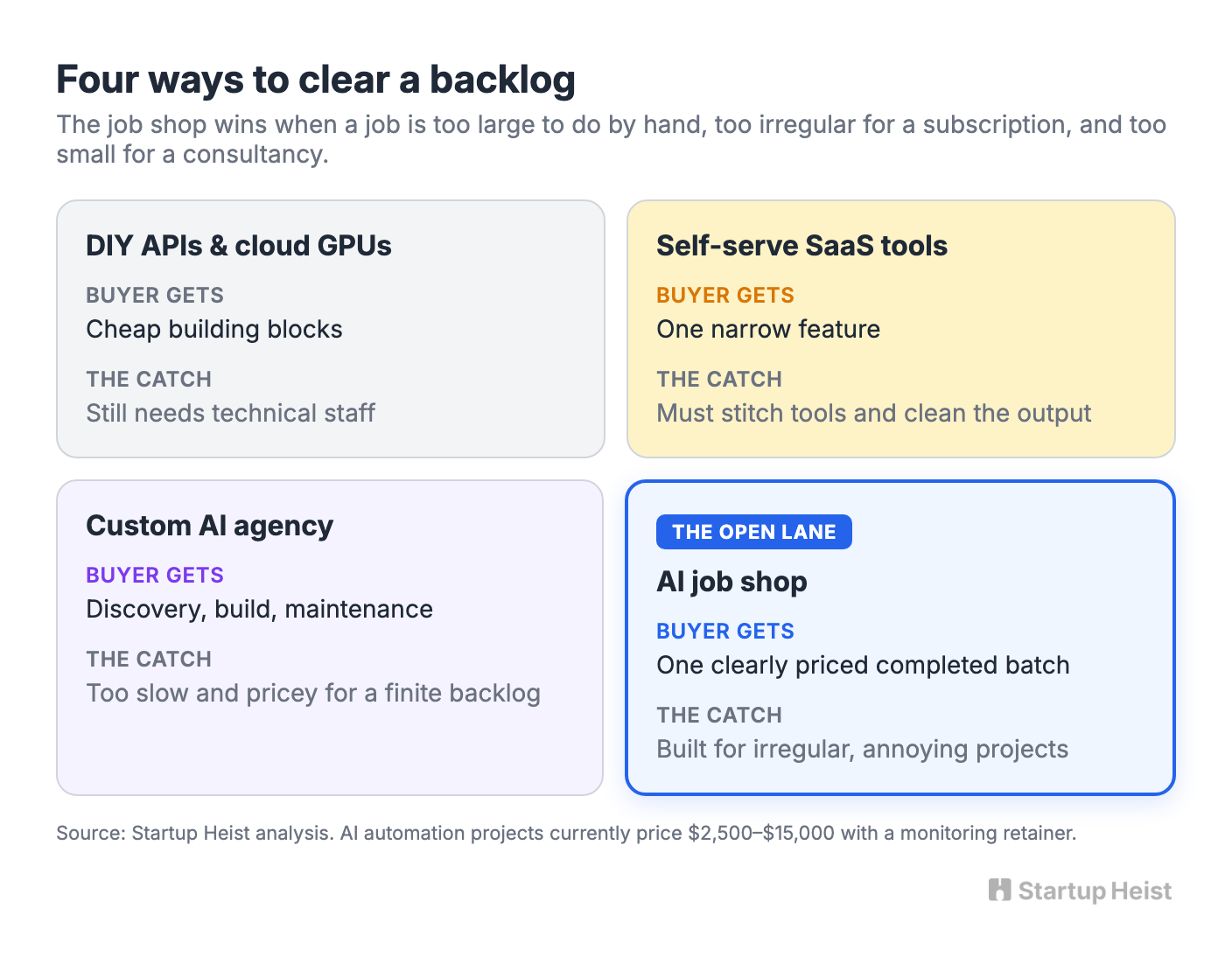
And the buyer pool is enormous. The U.S. Census Bureau counted 30.4 million nonemployer businesses in 2023, up from 29.8 million the year before, generating close to $1.8 trillion in revenue. Most will never commission a custom AI build. But plenty already pay contractors and agencies to clear repetitive operational bottlenecks, and AI automation shops currently price even a focused workflow project in the low thousands, often $2,500 to $15,000 with a monitoring retainer behind it. That leaves a useful middle lane wide open:
| Option | What the buyer gets | The catch |
|---|---|---|
| DIY APIs and cloud GPUs | Cheap building blocks | Still needs technical staff |
| Self-serve SaaS tools | One narrow feature | Must stitch tools together and clean up the output |
| Custom AI agency | Discovery, build, maintenance | Too slow and expensive for a finite backlog |
| AI job shop | One clearly priced completed batch | Built for irregular, annoying projects |
The job shop wins exactly when a job is too large to do by hand, too irregular to justify a new software subscription, and too small to justify a consulting engagement. That gap is where the money is.
Start with ecommerce catalog operations
The temptation is to launch with a buffet: transcription, ticket sorting, fine-tuning, video processing, document extraction, product imagery. Resist it.

The strongest opening wedge is ecommerce catalog cleanup for small agencies, migration specialists, and multi-channel sellers. Catalog work has rare properties for a young service. The inputs are concrete (a folder, an export, a cloud link). The output is inspectable, since anyone can see whether a background, a dimension, or an alt-text field is right. The jobs run fine overnight. And the value is obvious, because manual cleanup across thousands of SKUs is miserable and expensive. The privacy risk is low compared with health or financial records, and the underlying plumbing of ingestion, queue, exception handling, and QA gets reused by every recipe that follows.
One nuance separates a real operator from a hobbyist: don't insist that every task run on your own GPU scripts. Photoroom will remove a background through its API for as little as $0.02 an image. Replicate offers a menu of background-removal models, some lightweight ones costing fractions of a cent per run. Sometimes a mature API is cheaper and more reliable than anything you'd build in Colab. So route each recipe to the best lane — a polished API when it's good enough, Colab CLI for custom batch logic and open-source models, serverless GPU when reliability starts to matter more than prototype speed, and a human only where it protects the outcome. The customer never needs to know which lane you used. They just get the finished folder.
The first five recipes. Keep the storefront almost insultingly simple:

Unlock the Vault.
Join founders who spot opportunities ahead of the crowd. Actionable insights. Zero fluff.
“Intelligent, bold, minus the pretense.”
“Like discovering the cheat codes of the startup world.”
“SH is off-Broadway for founders — weird, sharp, and ahead of the curve.”


