


The Connecticut Paperwork Heist
Connecticut is about to manufacture a small, unusually clean software business. Almost nobody is going to build it.
The buyer here isn't a venture-backed startup. It's a general contractor, a construction manager, or a public-works subcontractor trying to get through a state-funded project without losing a week to administrative work. These people can pour concrete, repair a municipal building, or run a road job. What slows them down is the stack of forms, outreach logs, bid comparisons, follow-up notes, payment-status reports, change-order attachments, and submission deadlines they have to assemble before and after the contract is awarded. Someone has to prove the company followed Connecticut's contract-compliance rules correctly. That someone is usually the owner, at 9 p.m., reconstructing emails from three weeks ago.

The pressure is rising on a schedule. Connecticut's Commission on Human Rights and Opportunities, the CHRO, already enacted statutory changes on October 1, 2025, when Good Faith Efforts Plans replaced the old Set-Aside and Affirmative Action Plans. A second wave lands July 1, 2026, when project-specific participation goals take effect. The agency is running in-person information sessions across the state to explain the new rules and walk businesses through the new forms.
So here's the opening. Build a Connecticut-first public-works compliance cockpit: a guided workflow that helps a contractor pick the right packet, document good-faith efforts as they happen, compare subcontractor bids, preserve an audit trail, generate submission-ready documents, and remember the recurring reports that come after the award. Call it BidPacket CT.
The money: 100 contractors at $179/month plus advisor seats and packet fees puts a solo founder near $25K MRR, in a niche no competitor occupies.
Inside:
• 8-part MVP scope with CT threshold logic
• Three-tier pricing built around avoided pain
• Advisor-led GTM with a working cold email
• Three compounding moats, none of them code
This won't be a billion-dollar company, and it may never be one. Connecticut is a narrow geography, contractors are difficult software buyers, and regulatory software carries permanent maintenance overhead. But it has every ingredient of an excellent bootstrap business: a hard deadline, mandatory paperwork, clear rules, repeat usage, modest technical complexity, and buyers who lose real money when the administrative work goes wrong. The best ugly-software businesses don't invent demand. They stand between a customer and a costly mistake.
Why the paperwork actually matters
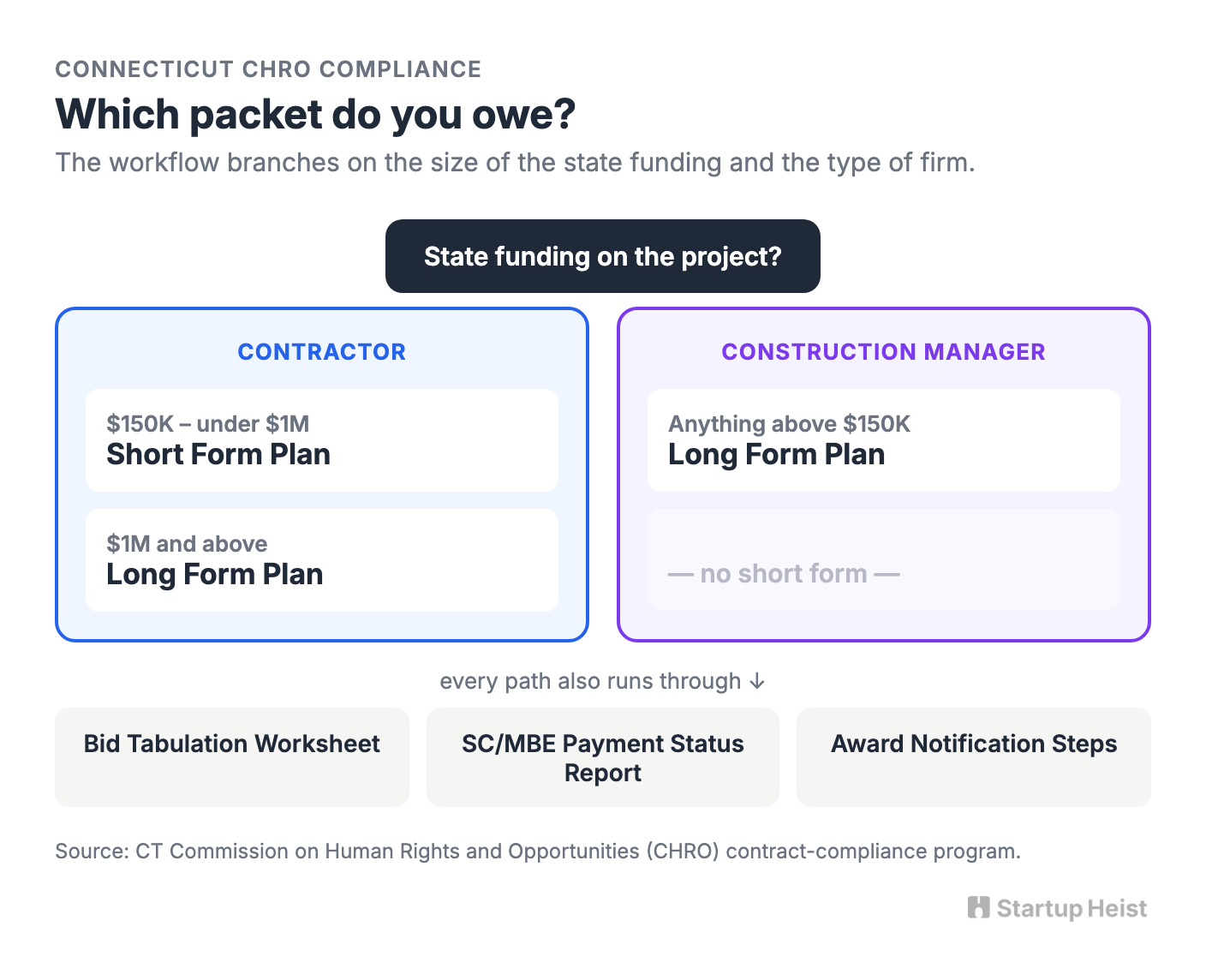
This isn't a "fill out the PDF" problem. Connecticut's workflow branches on the size of the state funding. A contractor on a public-works project receiving between $150,000 and under $1 million uses a Good Faith Efforts Short Form Plan. At $1 million or more, it's the Long Form. Construction managers use the Long Form on anything above $150,000. Both run through a Bid Tabulation Worksheet, and the CHRO portal layers on a Small Contractor and Minority Business Enterprise Payment Status Report plus separate award-notification steps for the awarding authority.
The policy underneath is durable. Connecticut agencies are expected to direct at least 25% of projected annual contracting dollars to certified small contractors, and a quarter of that, 6.25% of the total, to certified minority businesses. The contractor's job isn't simply to hit the number. The contractor has to show its work. The CHRO expects firms to solicit qualified small, minority-owned, women-owned, and disability-owned businesses from at least three sources, one of them the state's DAS Supplier Diversity database. It looks for real bid outcomes, genuine follow-up instead of a one-word "no response," and evidence the contractor considered breaking big packages into smaller jobs.
Then it hunts for failure. The state publishes its red flags: incomplete or inaccurate submissions, solicitations sent to companies that don't perform the trade, outreach to geographically implausible bidders, awards to firms never solicited in the first place, unexplained contract dollars, and false filings. Miss the plan, miss the deadline, or fail the good-faith test, and the penalties aren't cosmetic: withheld contract payments, disqualification from future bidding, and civil action by the CHRO. A cheap PDF editor can drop text into a field. It can't tell a contractor the evidence trail looks weak, or that the firm just awarded a package to a sub it never invited.
The real product is the audit trail
The most valuable thing BidPacket CT sells isn't the finished packet. It's the permanent record sitting behind it.
The CHRO can audit a contractor's records during or after a project. Firms must keep detailed logs of every solicitation and response. Written outreach gets preserved. Phone outreach requires written notes. Everything is held for at least two years after the project file is formally closed. That single requirement should reshape the entire build. Don't organize the app around forms. Organize it around evidence.
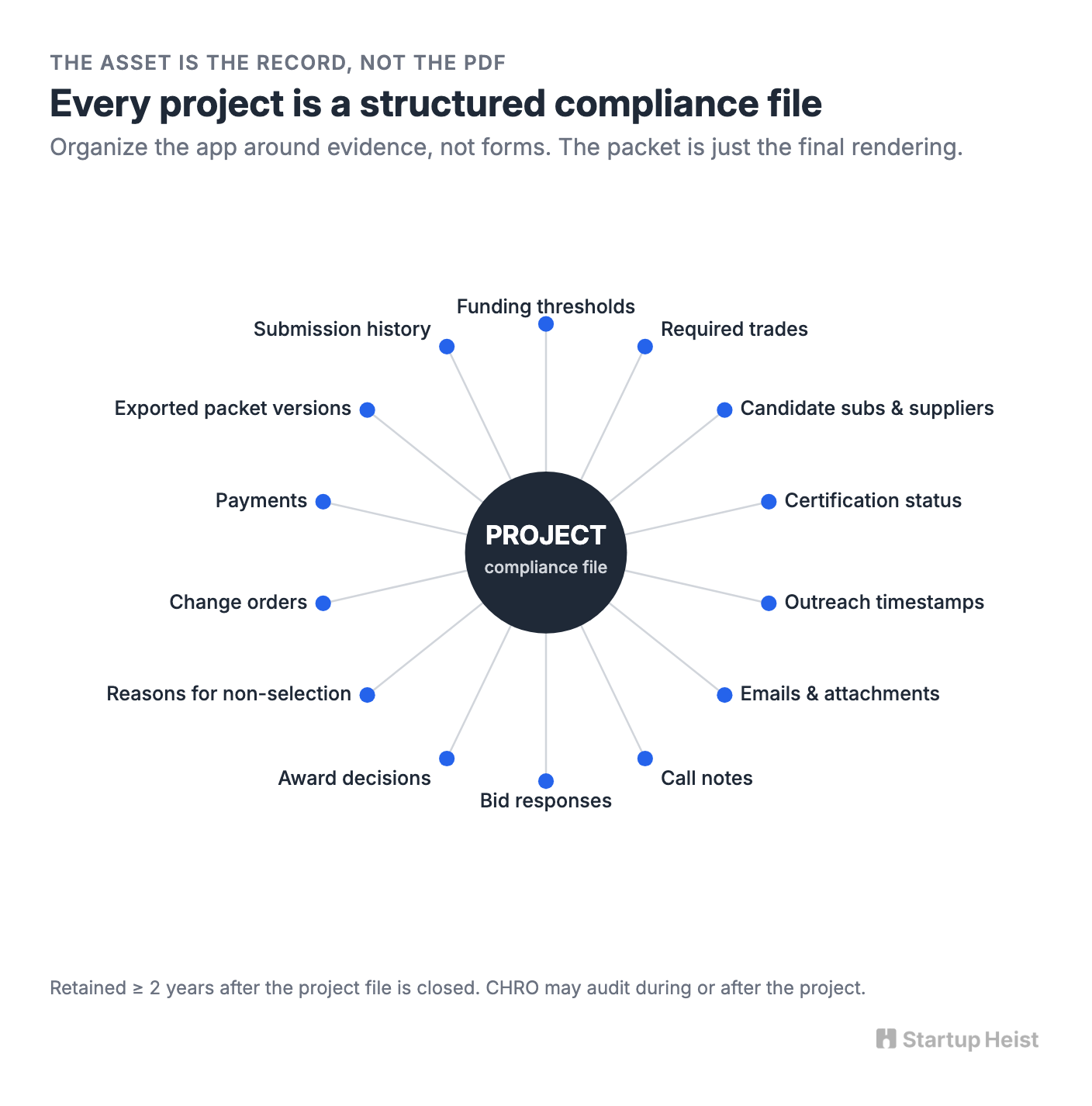
Each project becomes a structured compliance file: funding thresholds, required trades, candidate subs and suppliers, certification status, outreach timestamps, emails and attachments, call notes, bid responses, follow-up activity, award decisions, reasons for non-selection, change orders, payments, exported packet versions, and submission history. The PDF is just the final rendering. The asset is the contractor's growing document graph, a reusable map of who covers which trades, who holds which certifications, who responds, who declines, what each firm's realistic service area is, and which evidence patterns draw questions. That map makes the second bid easier than the first, and the tenth dramatically easier than the second.
Why now, and not a year ago
Most regulatory-software ideas die because the rule is old, buyers already adapted, and nobody feels enough pain to switch tools. Connecticut is the opposite case, because the transition is live right now. The CHRO's own forms page tells contractors to check back as the program migrates to the new statutory requirements. The agency is holding sessions in cities including Hartford, New Britain, and Waterbury, with an agenda that reads like a product spec: what changes on July 1, how to navigate the new forms, and direct Q&A with CHRO staff. It also runs recurring technical-assistance sessions on completing the Short and Long Form plans, scheduled monthly through the end of 2026.
There's a second twist that makes the timing even better. After July 1, the flat 25%/6.25% targets give way to project-specific goals that vary with the work and the available businesses in the area. Fixed percentages become a moving target. Moving targets are exactly what software is good at, and exactly what a spreadsheet is bad at.
When a state agency holds repeated classes just to explain its paperwork, the market is telling you exactly where the onboarding screens belong. That window won't stay open. Build before July 1.
The market is huge. Your wedge is tiny. That's fine.
In April 2026, U.S. public construction was running at a seasonally adjusted annual rate of $532.7 billion, with highway work alone at $149.6 billion. That number matters only as proof the category isn't a curiosity: public-works contractors everywhere wrestle with participation goals, certified-vendor rules, outreach records, prevailing-wage paperwork, and agency-specific forms.
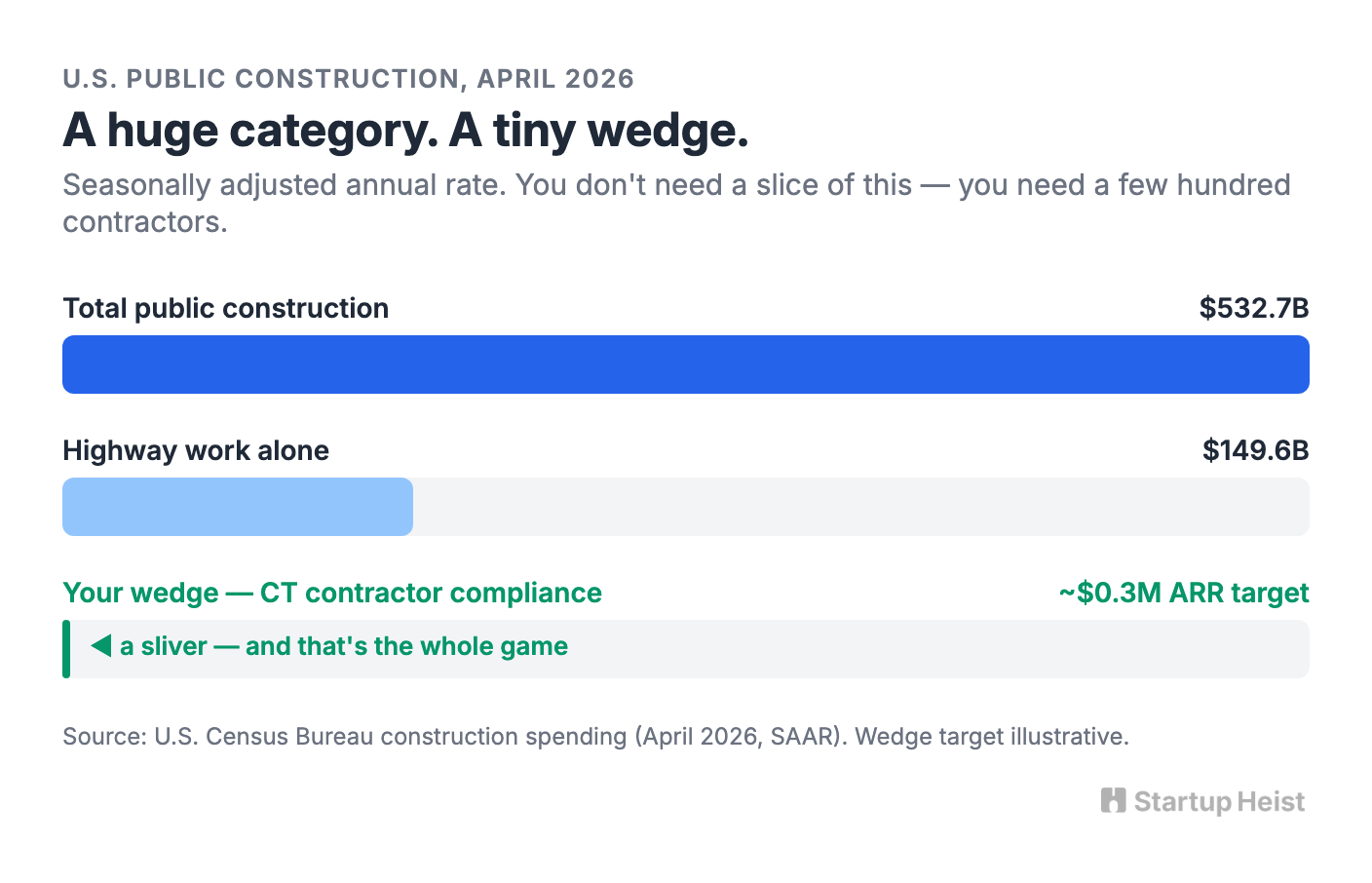
The size of the category isn't the size of your first business. BidPacket CT starts as a Connecticut micro-SaaS with a service layer, sold to a concentrated set of contractors and advisors who repeatedly touch state-funded work. The realistic outcome is a durable niche business that can reach low-to-mid five-figure monthly recurring revenue if it becomes the trusted local workflow. You don't need a slice of $532.7 billion. You need a few hundred contractors and a handful of channel partners who decide the product is cheaper than a compliance coordinator and less painful than another rejected packet. That's the whole game.
The product: from packet builder to compliance cockpit
Resist the urge to build "construction software." No estimating, no CAD, no project management, no subcontractor marketplace, no accounting. Own the thin paperwork layer between a contractor and a Connecticut public-works contract. Five pieces do the work.

Unlock the Vault.
Join founders who spot opportunities ahead of the crowd. Actionable insights. Zero fluff.
“Intelligent, bold, minus the pretense.”
“Like discovering the cheat codes of the startup world.”
“SH is off-Broadway for founders — weird, sharp, and ahead of the curve.”


