


The Last Thirty Feet: The Filter Route Hiding Behind a $250 Million Company
David Heacock sells air filters out of Talladega, Alabama. Filterbuy, the business he rebuilt from his family's old supply company in 2012, now runs roughly $250 million in annual revenue, employs more than a thousand people, and pushes about 100,000 filters a day out of its own U.S. plants. Its commercial arm will custom-build any dimension at any MERV rating with no surcharge, coordinate a rollout across five locations or five hundred, and handle the centralized billing and unified freight behind it.
So if your startup idea is "sell HVAC filters," skip it. Filterbuy and a handful of companies like it settled that war years ago, and you weren't in the fight.
The business worth looking at sits in the last thirty feet, between the loading dock and the filter rack.
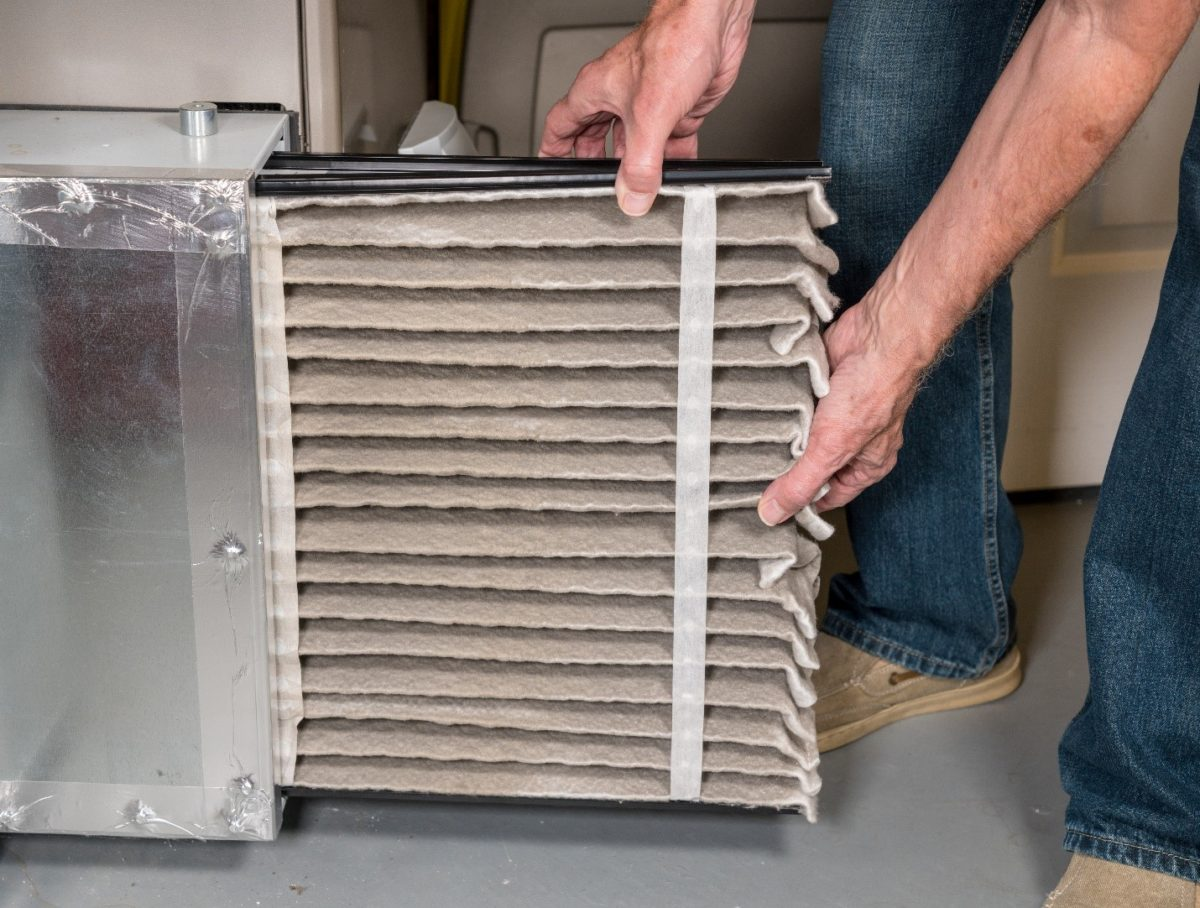
Somebody has to know which filter goes in which machine and remember when it's due. Somebody has to get into the mechanical room, pull the old one, seat the new one facing the right direction, log what happened, and make sure the next change actually occurs sixty days later. For a homeowner that's a chore. For an operator running twelve restaurants, six dental offices, or a strip-center portfolio, it's an unowned process. Unowned processes can be sold back to the people stuck with them.
The opportunity is a route-dense commercial filter service. You inventory every filter across a small portfolio, supply the correct replacements, install them on a fixed schedule, photograph and timestamp the work, and hand the customer one maintenance record covering every location. It's a deliberately narrow field-service subscription, wedged between the commodity suppliers underneath it and the licensed HVAC contractors above it.
The customer who makes it work is one operator who controls five, ten, or thirty locations inside a small geographic box. Fifty independent cafés scattered across the same metro will bankrupt you. That distinction is the entire business.
Here's what it looks like on paper:
The money: 200 clustered sites at $30 to $80 in monthly-equivalent value is $6,000 to $16,000 a month, solo, one vehicle, no outside capital.
Inside:
• Per-visit pricing that beats flat monthly plans
• Route density math: 35% vs 60% margins
• Clipboard MVP and the asset register spec
• Outreach email and qualification script
The awkward middle
The United States had about 5.9 million commercial buildings in the last comprehensive EIA survey, covering 96.4 billion square feet and $141 billion in annual energy spend. Ignore most of it. Hospitals have facilities departments. Office towers have building engineers. National chains sign facilities-management contracts with companies that have national coverage maps. Many tenants have HVAC folded into their lease and don't touch it at all.
What's left is the awkward middle: operators with too many locations to personally remember every filter, too few to justify a facilities hire, running work too simple to warrant dispatching a licensed technician, and clustered tightly enough that one person can hit several stops in a morning. Small property managers, restaurant groups, dental and medical groups, childcare operators, boutique gyms, franchisees, churches.
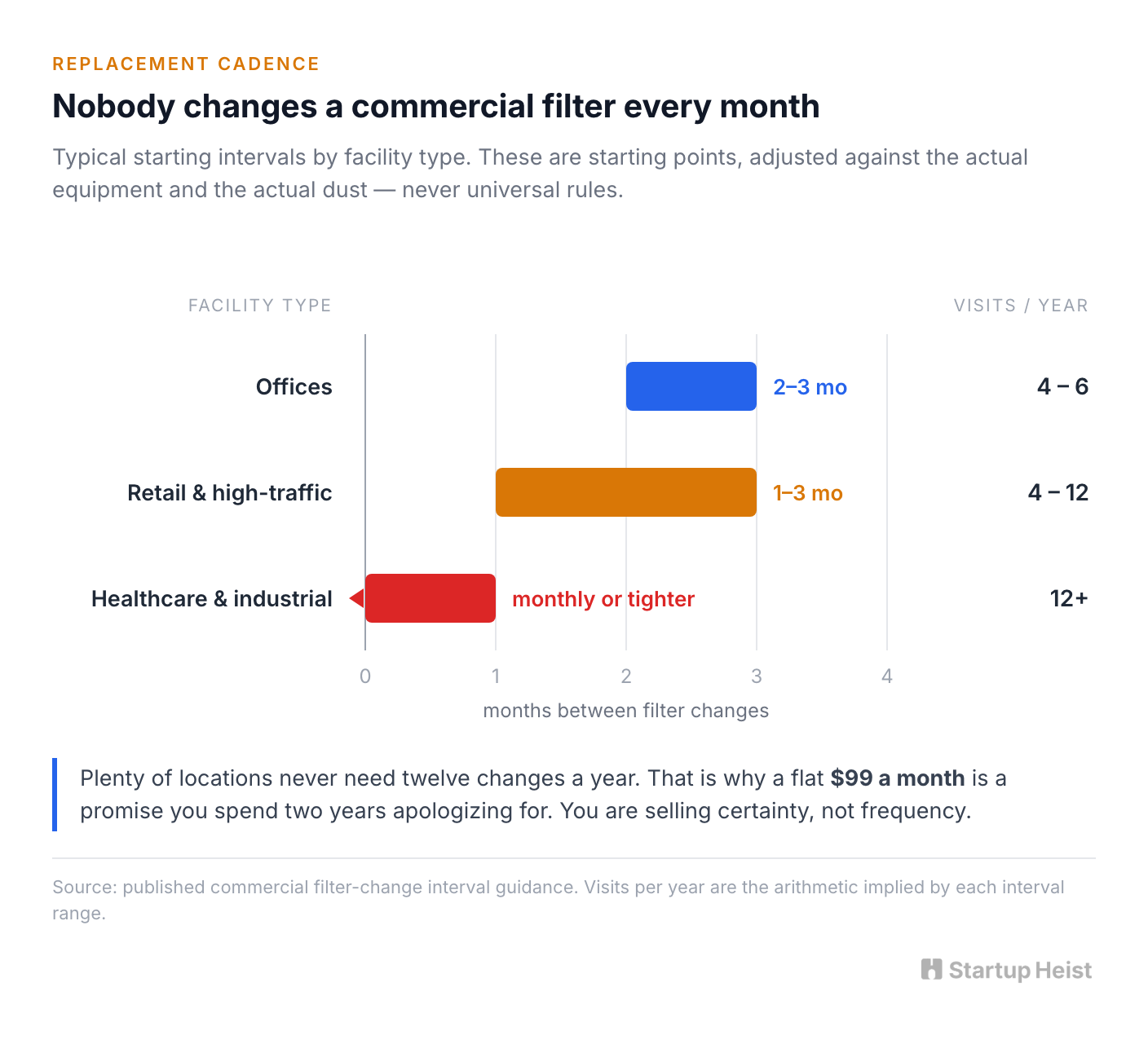
The work is genuinely recurring. Commercial filter guidance puts typical starting intervals at every two to three months for offices and every one to three months for retail and other high-traffic spaces, with healthcare and industrial facilities running monthly or tighter. Those are starting points to be adjusted against actual equipment and actual dust, never universal rules.
Which kills the most tempting version of this idea before you build it. Plenty of locations don't need twelve filter changes a year, and charging every café $99 a month is a promise you'll spend two years apologizing for. You're selling certainty, not frequency.
What the customer is actually buying
Pitch this as "we change your $15 air filters" and you lose. Your prospect can buy filters online tonight, in any size, at manufacturer-direct pricing, delivered next day. Procurement is a solved problem operating at industrial scale.
What isn't solved is accountability. The product you're selling is a register and a record.
The register is one row per filter, built once during an onsite survey: location, equipment ID, dimensions, depth, approved MERV rating, quantity, a photo of the slot, access instructions, cadence, responsible party, last service date, next scheduled date. The record is what you produce every time you show up — correct SKU delivered, filter replaced, orientation confirmed, old filter removed, installation photographed, visit timestamped, anything abnormal flagged and referred out.
The referral clause matters more than it looks. Damaged rack, standing condensate, strange noise, inaccessible equipment, a unit that's been swapped since your last visit: you document it and hand it to a licensed HVAC contractor. You don't diagnose it. Every service you refuse is one less category of training, licensing exposure, callback risk, and insurance argument.
What the customer actually pays for is one sentence a property manager can say out loud: every filter in the portfolio was changed when it was supposed to be, and here's the record.
Somebody is already running this route
The category already exists, which is good news. At the industrial end, Camfil sends technicians to remove used filters, clean the plenum and frames, install replacements, record installation dates on the client log book or a supplied label, and box the old media for disposal. At the residential end, Second Nature has built filter delivery into property-management software, pulling sizes from the accounting system and mailing date-stamped filters straight to residents. In the middle sit unbranded regional operators like Commercial Filter Service in Fort Wayne, Indiana, which runs an initial filtration survey, assigns each account a change-out frequency, and tracks more than 3,500 service customers on proprietary software.
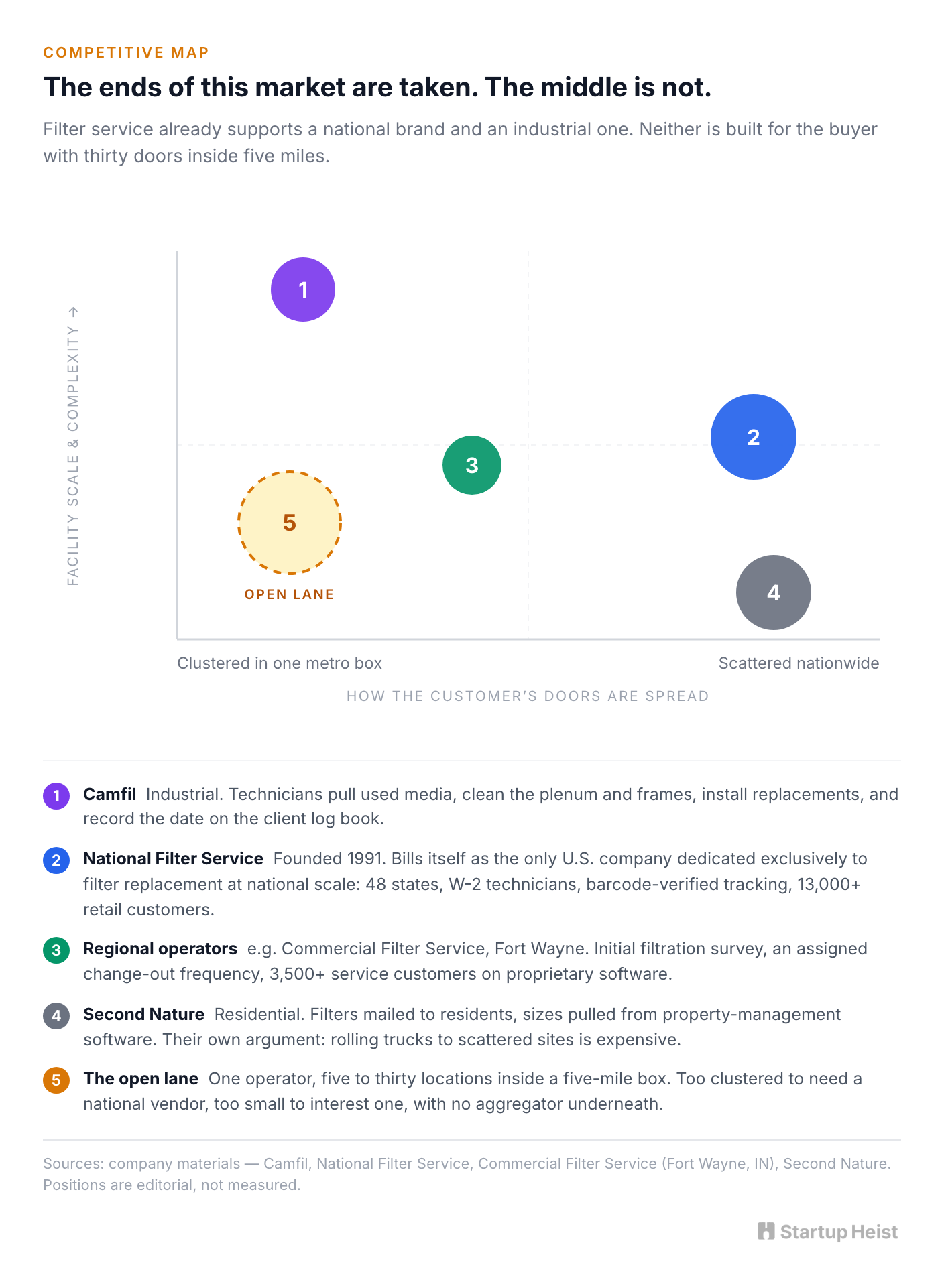
One company has already carried that middle tier to a national footprint, and you should know its name before you write a business plan. National Filter Service, founded in 1991, describes itself as the only company in America dedicated exclusively to HVAC filter replacement on a national scale: all 48 contiguous states, W-2 technicians instead of subcontractors, barcode-verified service tracking, more than 13,000 retail customers, and a pitch built for chains running five locations or five hundred. Filter service alone can support a national brand. It can also tell you where not to compete. NFS is engineered for geographically dispersed retail, restaurant, grocery, and convenience chains with centralized procurement and brand-standard specs, the buyer who wants one nationwide vendor and one invoice.
Which leaves the segment nobody has consolidated: the single operator with five to thirty locations packed inside a five-mile box. Dental groups, gyms, churches, boutique property portfolios. Too clustered to need a national vendor, too small to interest one, and served today by regional operators with no aggregation beneath them and no obvious successor when the founder retires.
Second Nature also hands you your own spec. Their argument for mail is that "rolling trucks and personnel to perform installation service 4-6 times per year to scattered-site properties is expensive." They're right, and that sentence is the exact boundary of your business. Mail is the correct answer for scattered doors. Your version only works where the doors stack up close together, in dense commercial corridors where one operator completes ten stops without spending the day crossing town.
The contractor is a partner, not a competitor
Commercial HVAC contractors can already change filters. They can also diagnose refrigeration, balance airflow, test controls, and rebuild a compressor, and their pricing reflects that. Certified technician labor typically runs $75 to $150 an hour. Nobody publishes a clean rate card for filter-only visits, but the ballpark on a rooftop unit is $50 to $100 per unit under a service contract and $75 to $150 per unit on a one-time call.
Undercutting them on price is a losing game. The opening is the work that never required a contractor in the first place. The positioning line is short: keep your HVAC company, we handle the repetitive consumable changes between their visits.
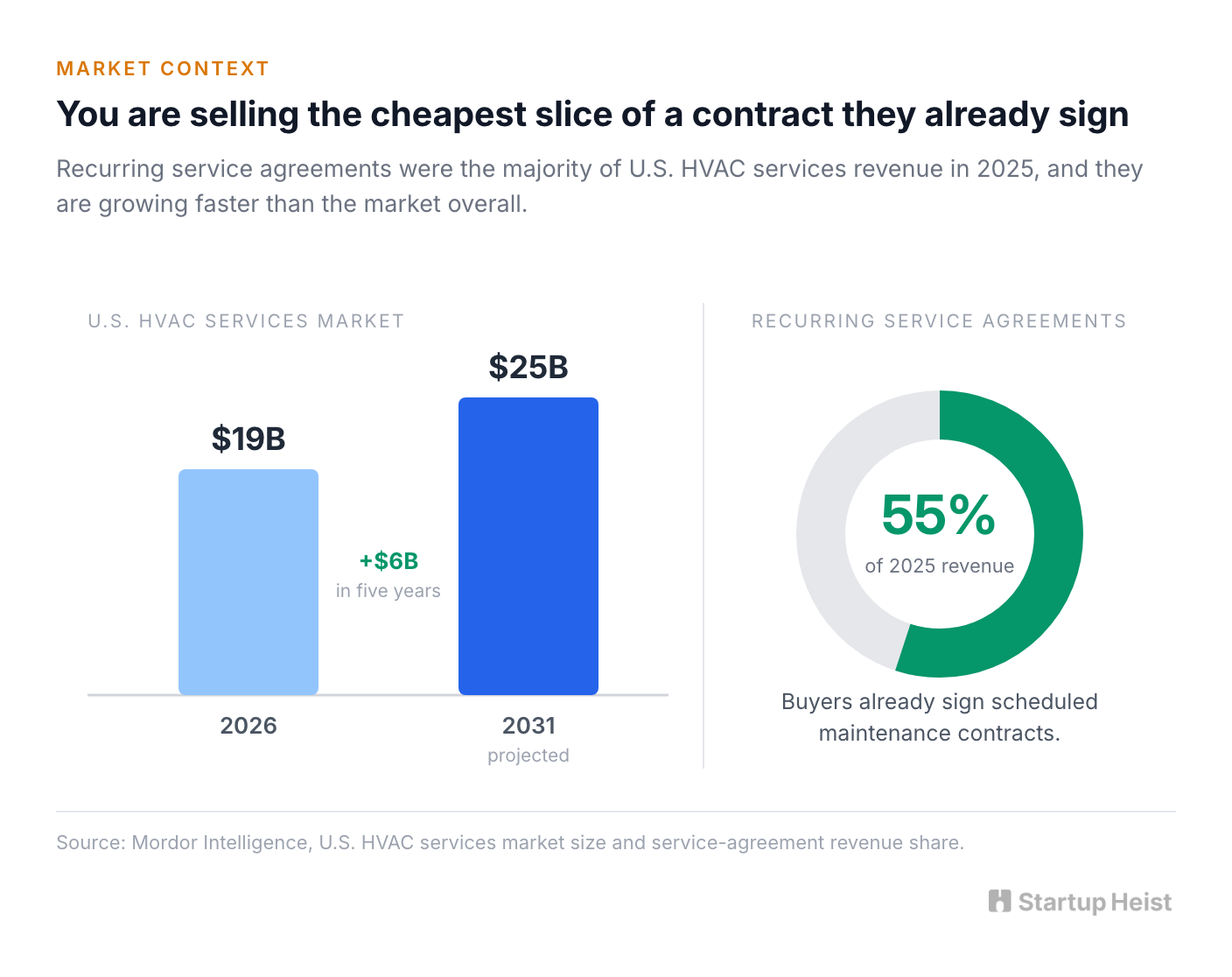
Contractors become a referral channel in both directions. They don't want to send a skilled technician across town because a boutique retailer needs two panel filters swapped. You do, because your labor model was designed around exactly that stop. The market is moving your way, too. Mordor Intelligence sizes U.S. HVAC services at roughly $19 billion in 2026, growing toward $25 billion by 2031, with recurring service agreements accounting for 55% of 2025 revenue and growing faster than the market overall. Buyers are already conditioned to sign scheduled maintenance contracts. You're just selling the cheapest, most repeatable slice of one.
Whether that slice makes money has almost nothing to do with your pricing. It depends on a variable most founders never model.
Route density is the whole business
Unlock the Vault.
Join founders who spot opportunities ahead of the crowd. Actionable insights. Zero fluff.
“Intelligent, bold, minus the pretense.”
“Like discovering the cheat codes of the startup world.”
“SH is off-Broadway for founders — weird, sharp, and ahead of the curve.”


