


The Bambu Escape Box
A small hardware wedge for owners who don't want their $700 printer chained to someone else's cloud
Bambu Lab did something rare in consumer hardware. It made 3D printing feel almost normal.
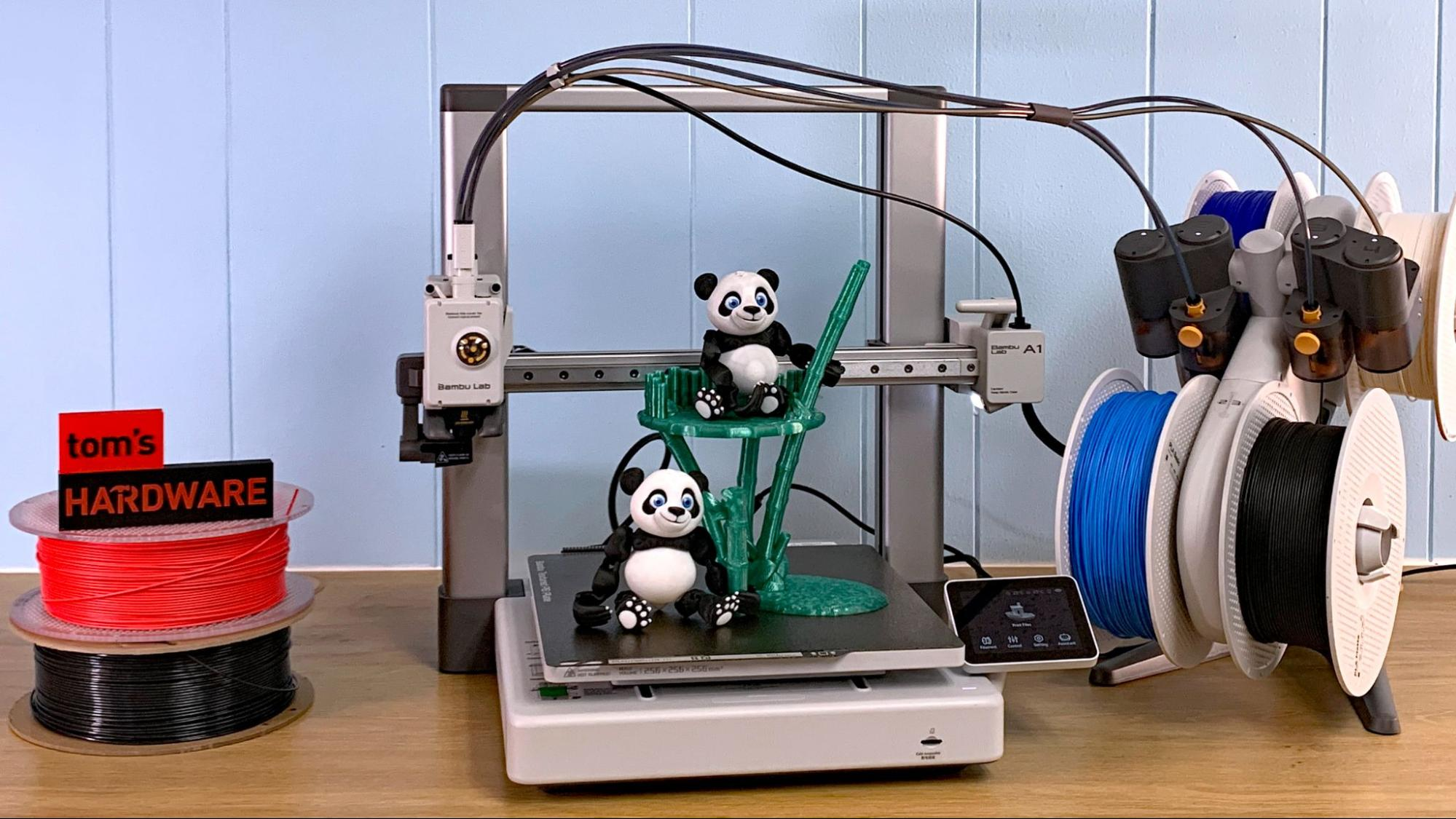
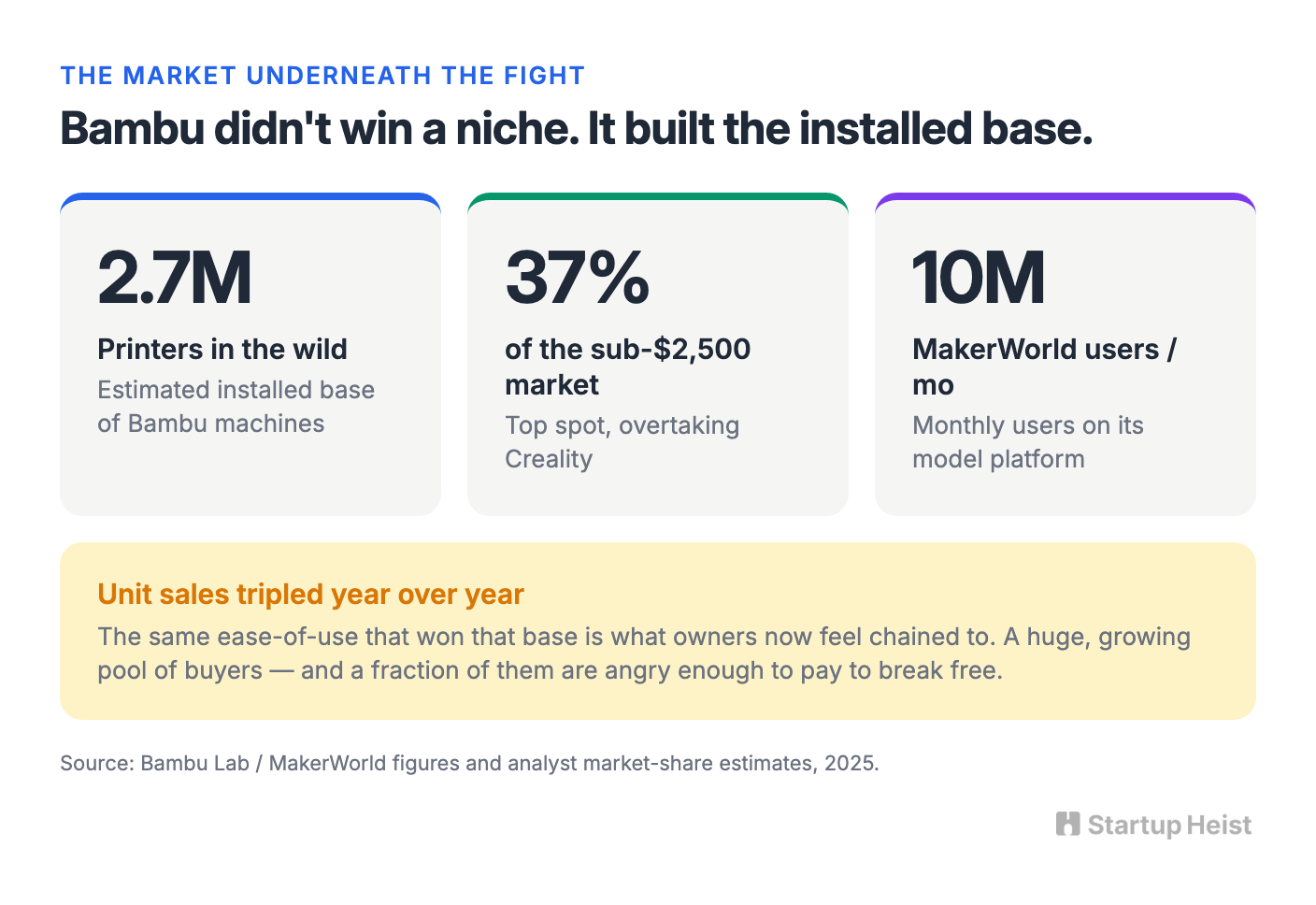
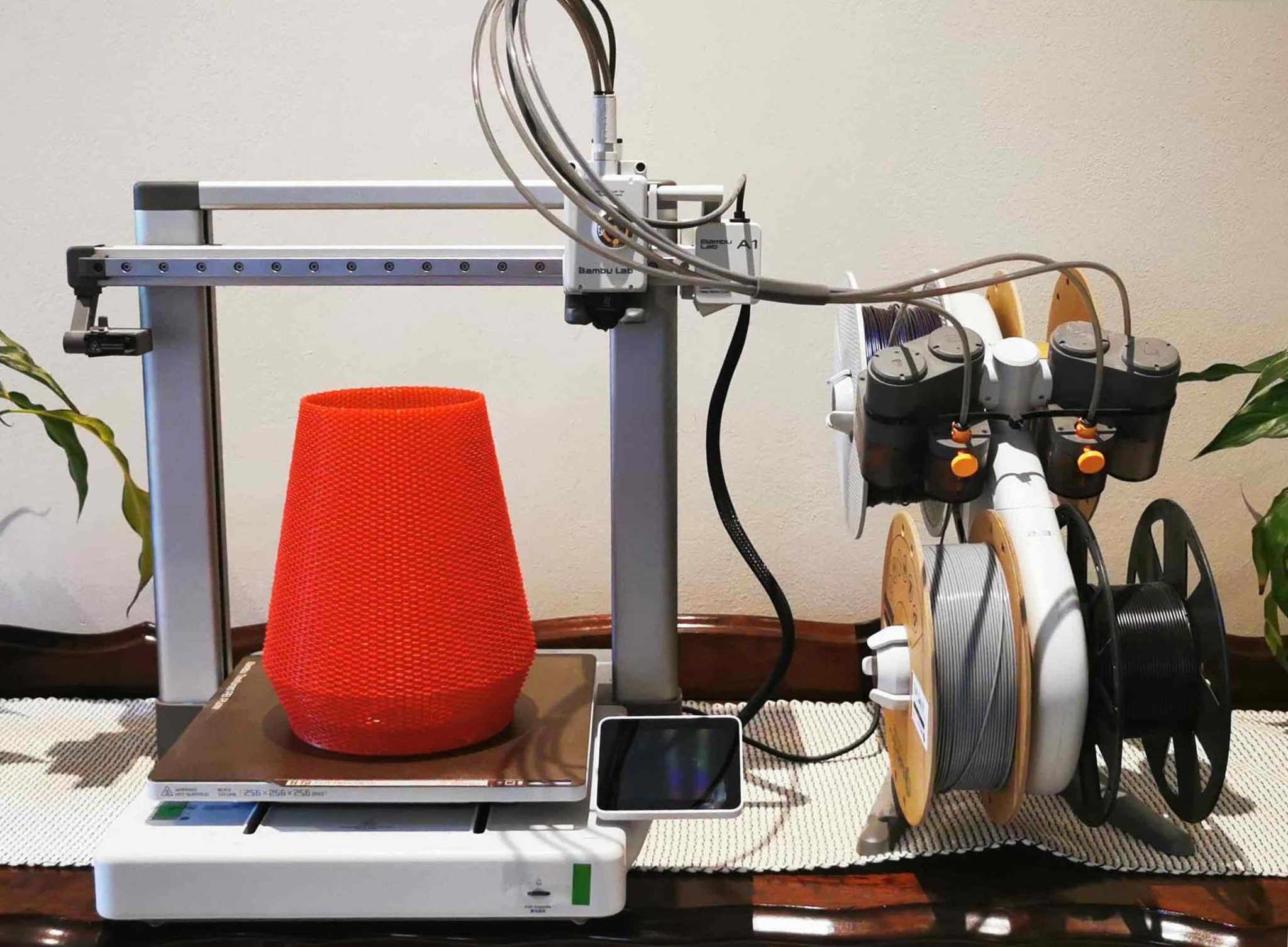
Before Bambu, desktop printing was a tinkerer's sport. Bed leveling, calibration, slicer settings, clogs, failed first layers, firmware quirks. You bought the printer, then you earned the right to use it. Bambu changed the deal. Its machines were fast, polished, and close enough to "it just works" that a new class of buyers walked in: Etsy sellers, school labs, product prototypers, and casual makers who had no interest in becoming firmware people. By the end of 2025 the company had ridden that ease to 10 million monthly users on its MakerWorld model platform and 37% of the entire sub-$2,500 printer market, with unit sales tripling year over year and overtaking Creality for the top spot. By analyst estimates, that puts the installed base somewhere around 2.7 million printers.
That convenience came with a trade. Bambu's cloud made remote printing, monitoring, and app control feel effortless. It also made the printer feel less like a tool you owned and more like a terminal wired into a vendor's system. Owners are now starting to push back, and the pushback is the opening.
Here's the opportunity.
The money: 500 boxes at ~$60 margin plus 200 owners on a $9 plan and 50 mini-farms at $29 lands roughly $3-8K MRR alongside hardware profit, before fleet upsells.
Inside:
• Six-piece MVP for a no-CLI relay appliance
• Four-tier pricing across hardware and SaaS
• Four compounding moats in a hostile market
• Community-first GTM with outreach templates
The fight that proved the demand
In January 2025, Bambu rolled out an authorization control system that routed print commands, motion control, camera feeds, and firmware updates through a Bambu-issued authentication layer. The company framed it as security and offered Bambu Connect as the sanctioned bridge for third-party tools. The community read it differently. OrcaSlicer, the most popular third-party slicer, publicly refused to adopt Connect at all. The worry was simple: if a printer's best workflows depend on Bambu's software, Bambu's authentication, and Bambu's cloud decisions, then ownership becomes conditional.
The fight escalated in May 2026. Polish developer Paweł Jarczak shipped an OrcaSlicer fork that restored cloud-style printing without routing through Bambu Connect. Bambu sent a cease-and-desist and demanded he pull it from GitHub. Instead of going quiet, the issue went nuclear. The Software Freedom Conservancy opened a formal enforcement effort, confirmed two AGPL violations — one in Bambu's networking library, one in the legal threat itself — made Jarczak its first volunteer, and launched a $250,007 fundraiser to pursue the case. YouTuber Louis Rossmann pledged $10,000 toward the legal defense and rehosted the disputed code himself, which is when the story stopped being a niche forum dispute. The Verge ran it under a headline you could not print on a billboard.
All of that is the visible drama. The startup opportunity is sitting one layer underneath it.
The opportunity is the painful setup
A self-hosted project called Bambuddy now lets Bambu owners run their printers locally and remotely without touching Bambu's cloud. It went live in late 2025 and has grown fast. Its Proxy Mode acts as an encrypted relay between slicer and printer, passing files, FTP, and camera through with the printer's real TLS certificate. Its Virtual Printer feature emulates a Bambu machine on your network so OrcaSlicer or Bambu Studio discovers it like any local printer, then queues and archives the jobs you send. The project's own tagline covers everyone from a single A1 to a 40-printer farm.
It works. It is also not a product. Bambuddy is open-source software you install in Docker, wire to your printer in LAN mode, and expose remotely through Tailscale. Its Docker image now bundles the Tailscale CLI, but you still install and configure Tailscale yourself, then paste the resulting address into your slicer. None of that is hard for a self-hosting hobbyist. All of it is a wall for the Etsy seller with five printers and a Saturday she would rather not spend in a terminal.
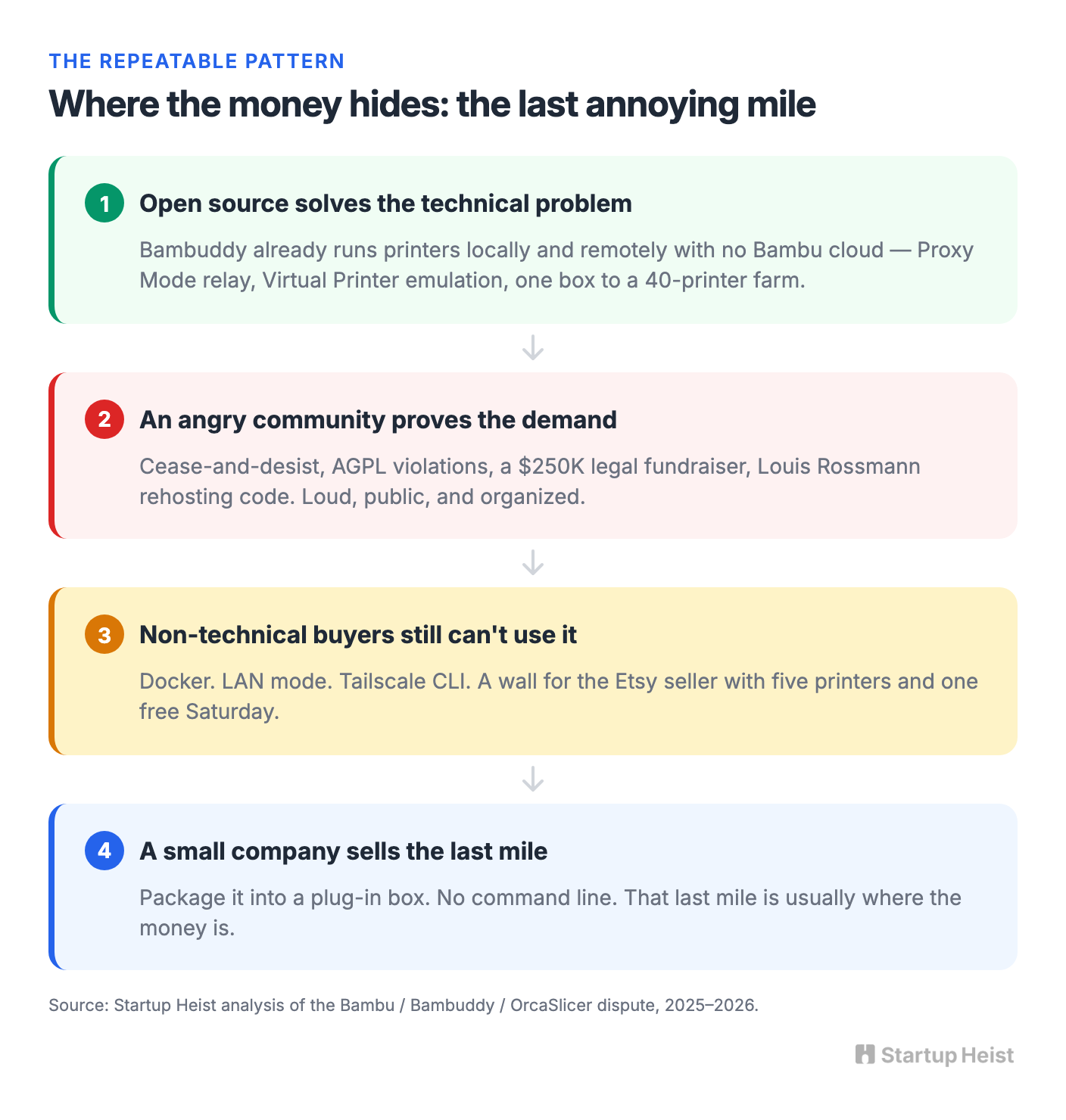
The pattern is a familiar one. Open source solves the technical problem. An angry community proves the demand. Non-technical buyers still can't use the thing, so a small company sells the last mile, which is usually where the money is.
The heist is to turn Bambuddy plus secure networking into a managed appliance. A small, preconfigured, no-command-line box for Bambu printers. Plug it into your network. Pair your printer. Scan a QR code. Print remotely without Bambu's cloud. Call it PrinterRelay.
The wedge
The buyer is not every Bambu owner, and that distinction is the whole game.
The lazy version of this idea says Bambu sold millions of printers, Reddit is angry, charge everyone $7 a month. Too broad, too cheap, too naive about what hardware support actually costs. The real wedge is narrower and better: prosumer Bambu owners and small print operators who want cloud independence without becoming self-hosting hobbyists. Etsy sellers running one to five printers. Product designers using Bambu for client work. School labs and makerspaces that need local, predictable access. Small shops that bought Bambu because it was easy, then realized "easy" can quietly mean "dependent."
These buyers feel three different pains. The emotional pain is lock-in. The practical pain is setup. The business pain is downtime. For the angry Redditor, the pitch is own your printer again. For the Etsy seller, it's don't let a cloud policy change freeze your order queue. For the school, it's keep printer access local, auditable, and maintainable. That last group may be the best customer of all. They care less about ideology and more about reliability and not having one staffer become the only human who understands the printer network.
The product
PrinterRelay should not launch as a SaaS dashboard. It should launch as an appliance.
The user buys a small box. It arrives pre-flashed. It sits on the same network as the printer, runs Bambuddy or a compatible self-hosted stack, handles secure remote access, updates itself, and shows a plain status page with recovery instructions. The promise fits on a card: remote access for your Bambu printer, without Bambu's cloud, without the command line.
The MVP is six things, no more.
Unlock the Vault.
Join founders who spot opportunities ahead of the crowd. Actionable insights. Zero fluff.
“Intelligent, bold, minus the pretense.”
“Like discovering the cheat codes of the startup world.”
“SH is off-Broadway for founders — weird, sharp, and ahead of the curve.”


