


The AI Readiness Janitor
Every mid-market company has an AI plan. Most of them don't have AI-ready data. That gap is now a business model.
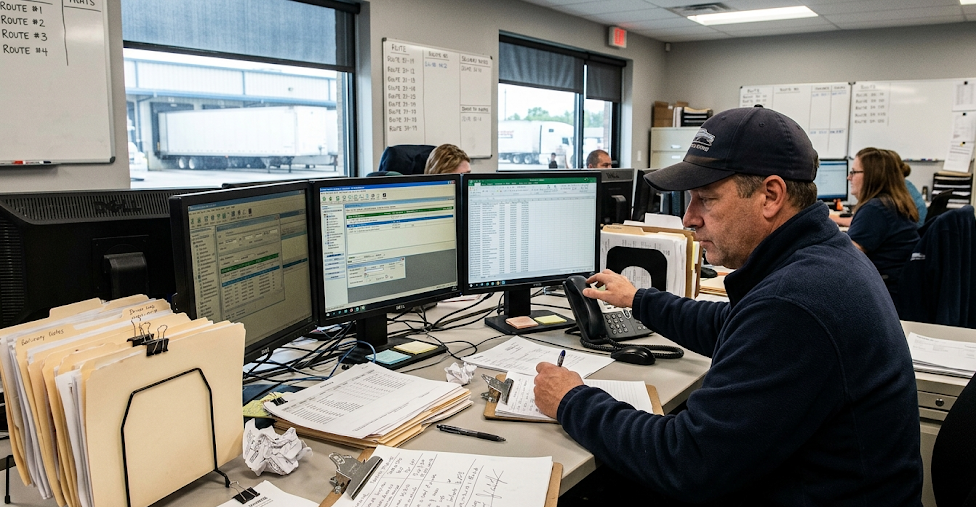
A regional logistics firm wants an AI assistant that can answer questions about delivery exceptions. Its records live across PDFs, dispatch notes, spreadsheets, emails, and half-maintained software exports. A plumbing supply distributor wants AI to help sales reps quote faster. Its product data has duplicate SKUs, inconsistent units of measure, outdated vendor names, and five different formats for the same item. A mid-sized law firm wants a document chatbot. Its files are scanned, inconsistently named, and full of folder logic that only one retiring paralegal understands.
When the answers come back wrong, the AI vendor gets blamed. The model is usually fine. The input is poison.

That gap is the heist: an AI readiness consulting service that cleans, structures, labels, and governs messy mid-market business data before the company spends real money on AI implementation. The pitch isn't "we clean spreadsheets." It's "before you buy the AI tool, make sure your data won't kill it."
This is a productized consulting wedge with automation behind it. SaaS comes later, if at all. The buyer doesn't wake up wanting data cleaning software. The buyer wakes up afraid that their CEO is asking for AI, their vendor is quoting six figures, and their internal data is a junk drawer.
Here's the shape of the play:
The money: $41K average first-year client. Ten retainers at $3K/month is $30K MRR before any project work. Cash-flow studio at $500K–$1.5M in 18–24 months.
Inside:
• One-vertical wedge: logistics or distribution
• Three-tier offer ladder with real pricing
• MVP service workflow and landing page
• Outbound script and 90-day go-to-market
Why the gap exists now
The AI market trained business owners to believe AI is a software purchase. Buy Copilot. Buy an agent platform. Buy an enterprise chatbot. Then reality arrives. AI needs context, and context lives in data: tribal knowledge, PDFs, CSV exports, customer notes, email attachments, billing records, scanned contracts, product catalogs, Slack threads, old ERP fields, and spreadsheet tabs named "FINAL_v3_real_final."
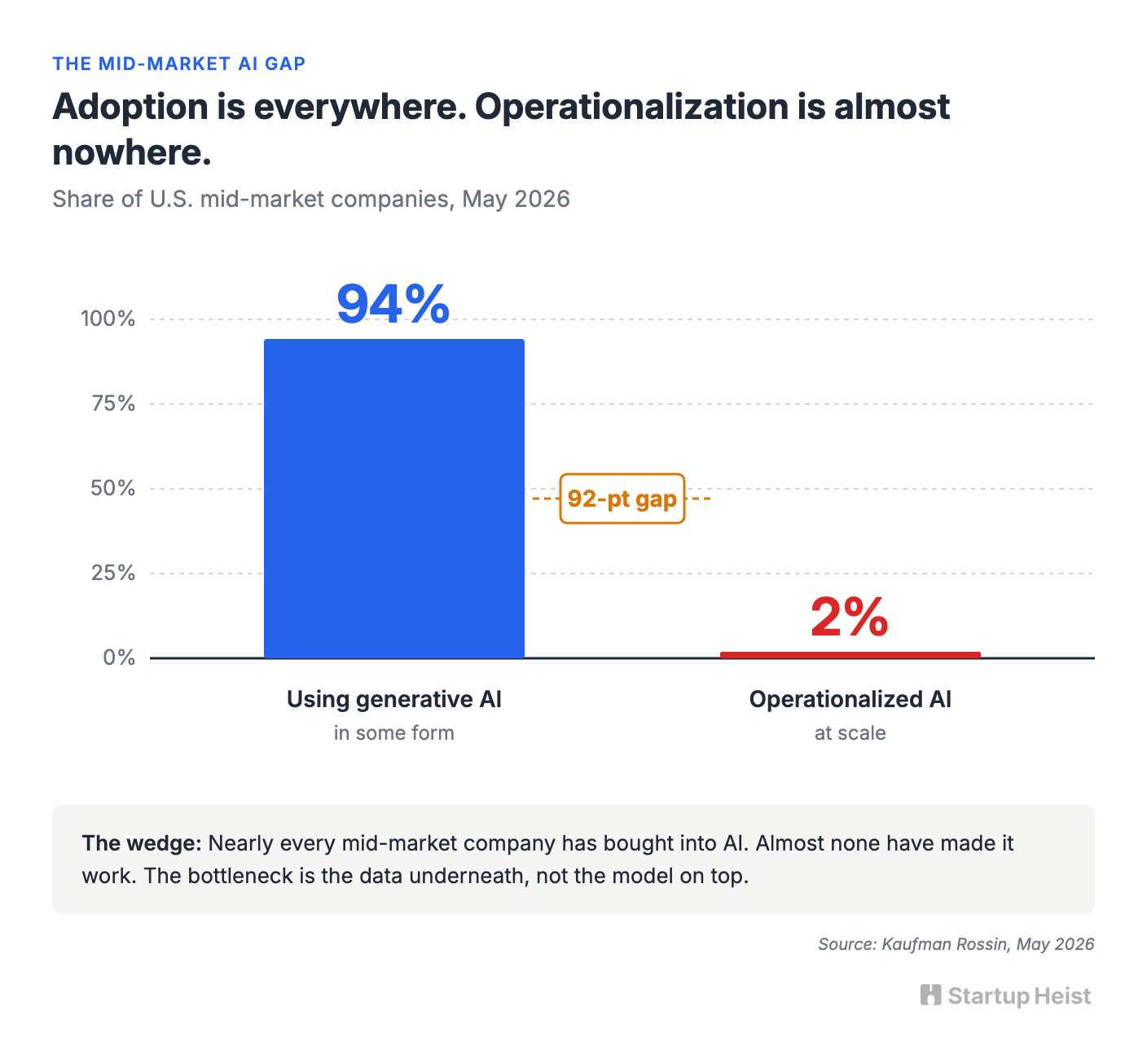
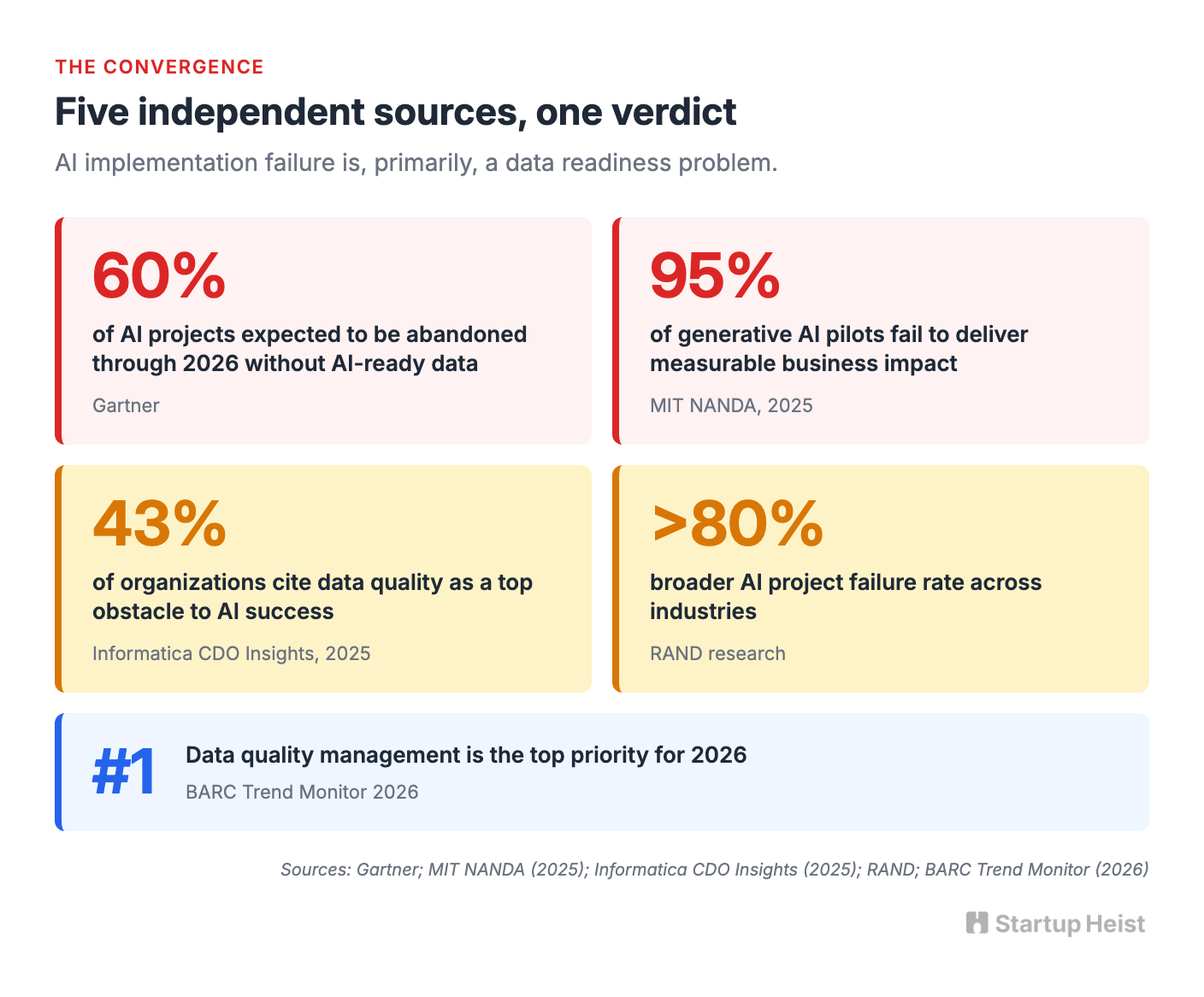
The signal is no longer hypothetical. As of May 2026, 94% of mid-market companies report using generative AI in some form, but only 2% have operationalized AI at scale (Kaufman Rossin, May 2026). MIT's NANDA report from 2025 found that 95% of generative AI pilots fail to deliver measurable business impact. Gartner has predicted that through 2026, organizations will abandon 60% of AI projects unsupported by AI-ready data. RAND research puts the broader AI project failure rate above 80%. Across companies of all sizes, 43% of organizations cite data quality and readiness as a top obstacle to AI success (Informatica CDO Insights 2025), and BARC's 2026 Trend Monitor names data quality management the #1 priority for the year. The consensus has converged: most AI implementation failure is a data problem dressed up as a model problem.
Then the timing tightens. The EU AI Act's Article 10 starts enforcement on August 2, 2026. It requires training, validation, and testing datasets for high-risk AI systems to be relevant, representative, free of errors to the best extent possible, and subject to documented governance practices. Non-compliance penalties for Article 10 obligations run up to €15 million or 3% of global annual turnover, whichever is higher. U.S. companies get pulled in once they sell into Europe, license to European vendors, or sit under acquirers that do. Data quality just became an accountability issue.
This is the boring infrastructure layer under the AI boom. The money is in standing in front of the AI budget.
Pick one ugly vertical
The horizontal play is a graveyard. "AI data readiness for every business" dies on a sales call. Pick one messy industry where data quality directly blocks AI adoption and the buyer has money.
Four candidates are worth considering. Regional logistics and freight operators sit on operationally messy data: shipment exceptions, delivery windows, driver notes, dispatch records, customer service logs, invoices, bills of lading, fragmented across four or five systems plus loose documents. HVAC, plumbing, and industrial supply distributors run ugly product catalogs with duplicate SKUs, vendor naming inconsistencies, replacement parts confusion, and quote histories trapped in operator memory. Mid-sized law firms have documents, matter histories, templates, clause libraries, intake forms, and scanned exhibits, all high-value but anxious about confidentiality and hallucination. Specialty healthcare admin firms have budget, but compliance overhead makes them a poor first wedge.
The sharpest opening is regional logistics or industrial distribution AI work. Operational pain is concrete, budgets are real, and regulatory exposure is mild compared to law or healthcare. Frame the offer around a specific outcome. "Get your dispatch, customer service, and invoice records AI-ready in 30 days" sells. "Data cleaning" doesn't.
What you sell, in three layers
The offer is a ladder. The audit gets people in the door. The sprint earns trust. The retainer pays the bills.
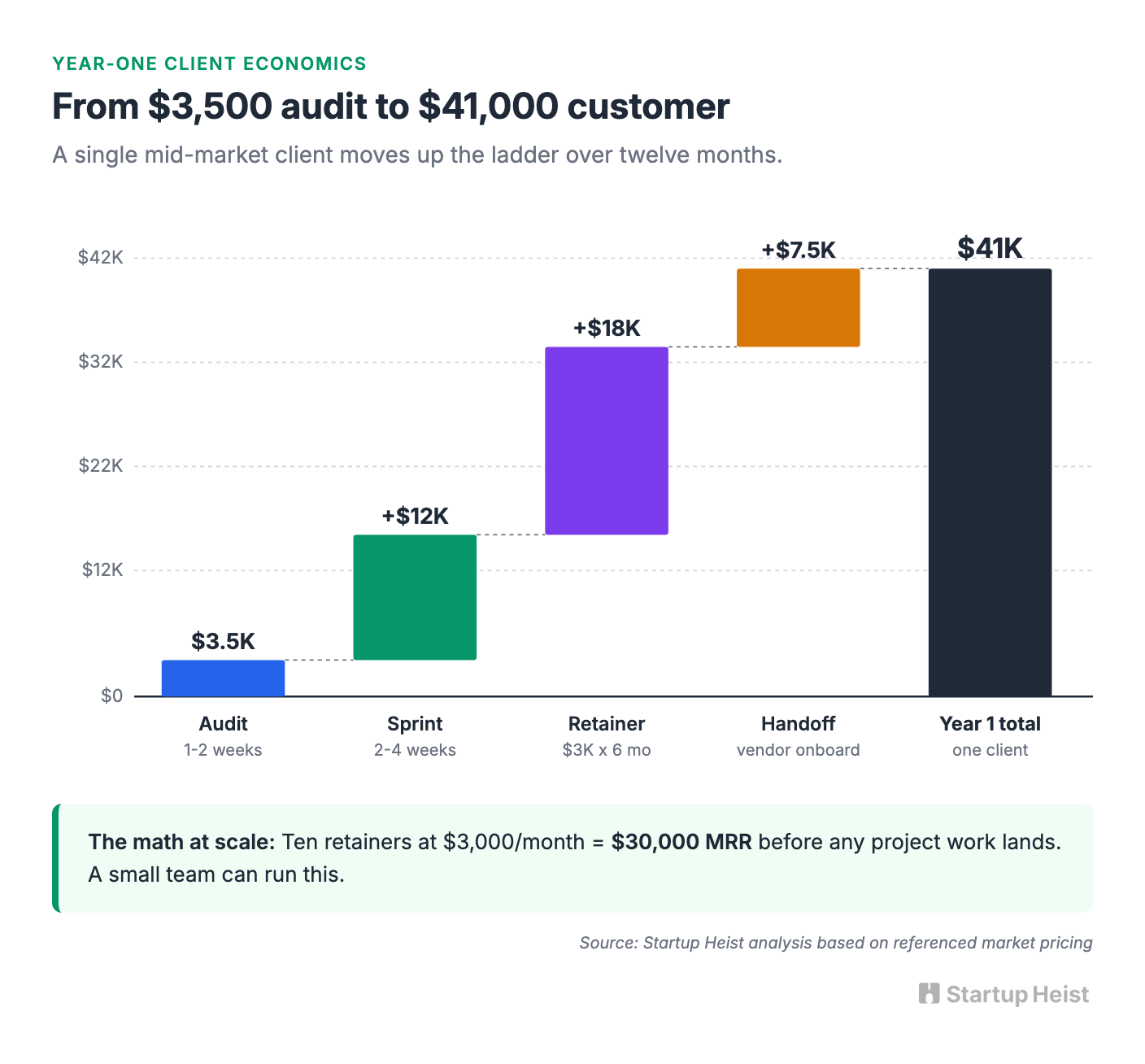
AI Readiness Audit — $2,500 to $5,000. One to two weeks. The deliverable is a scored report, not a strategy deck. It maps where the operational data lives, ranks which AI use cases the business should attempt first, scores data readiness by source, flags duplicate, missing, and unstructured-data problems, reviews security and access risk, and produces a cleanup roadmap with implementation estimates. Critically, it includes "do not buy AI yet" warnings where appropriate. The audit reframes the conversation. Many buyers don't know they have a data problem, only that they want AI. A $3,500 diagnostic is also easier to approve than a $25,000 cleanup project from a vendor they just met.
Data Foundation Sprint — $8,000 to $15,000. Two to four weeks. One high-value data domain gets cleaned, structured, documented, and made ready to feed an AI workflow. For a logistics client, that might mean normalizing shipment records, cleaning customer names, standardizing exception codes, extracting text from PDF delivery notes, tagging common delay reasons, and producing a searchable knowledge base plus a data dictionary. For an industrial distributor, it might mean normalizing SKU fields, standardizing vendor names, matching duplicate products, extracting product attributes from PDF catalogs, and building an AI-ready product-and-customer context layer. This is where trust gets earned. Show before-and-after: here is the messy source data, here is the cleaned version, here is what an AI tool can now answer that it couldn't answer last week.
AI Data Hygiene Retainer — $2,000 to $5,000 per month. This is where the business becomes durable. The retainer isn't "we clean data forever." It is tied to recurring deliverables: monthly data quality report, new file ingestion and cleanup, duplicate detection, data drift alerts, vendor and customer naming reconciliation, new document parsing, AI answer-quality testing, human review queue, quarterly readiness roadmap, and vendor handoff support. The retention hook is preventing AI decay. Every AI implementation creates a new maintenance problem. New invoices, support tickets, product sheets, customer records, employees, and naming conventions all leak fresh bad data into the system. Data quality is hygiene, not a one-time shower.
A fourth optional layer, the AI Vendor Handoff Package at $5,000 to $15,000, helps clients select and onboard an AI vendor using the cleaned foundation. It also positions the firm as a kingmaker for vendors, which is the second-order monetization angle.
A realistic first-year client looks like this: $3,500 audit, $12,000 cleanup sprint, $3,000 per month for six months, and a $7,500 vendor handoff. Total: $41,000. Ten retainers at $3,000 per month is $30,000 in monthly recurring revenue before any project work. That's a real business with a small team.
The MVP
The MVP doesn't need an app. It needs a repeatable service workflow, a credible vertical sales page, and a small library of internal automation templates.
The client-facing side is one vertical landing page. For a logistics-first launch:
Unlock the Vault.
Join founders who spot opportunities ahead of the crowd. Actionable insights. Zero fluff.
“Intelligent, bold, minus the pretense.”
“Like discovering the cheat codes of the startup world.”
“SH is off-Broadway for founders — weird, sharp, and ahead of the curve.”


