


The Phone Ban Is Not the Product. The Enforcement System Is.
A strange thing happens after a state bans student phones.
The political fight gets the headlines. Parents argue, teachers cheer, students complain, commentators debate whether phones are destroying childhood or whether schools are overreaching. Then the law passes, the press moves on, and a principal still has to answer the actual question: what happens at 8:07 a.m. when a student walks into second period with an Apple Watch, a parent says the phone is needed for anxiety, a teacher confiscates the device without logging it, and the student's mother shows up angry at the front office?
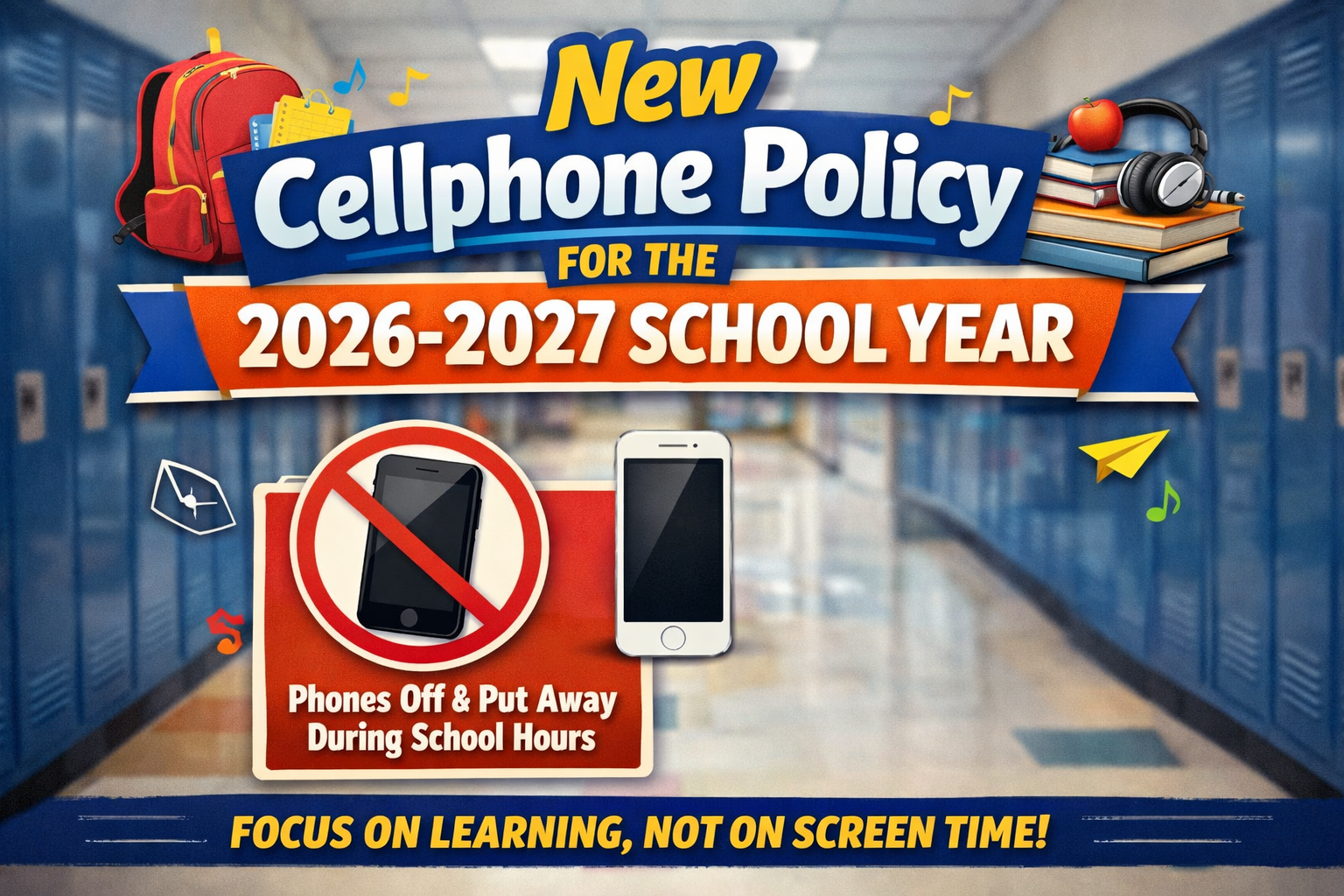
A school cellphone policy is easy to announce. It's hard to operate.
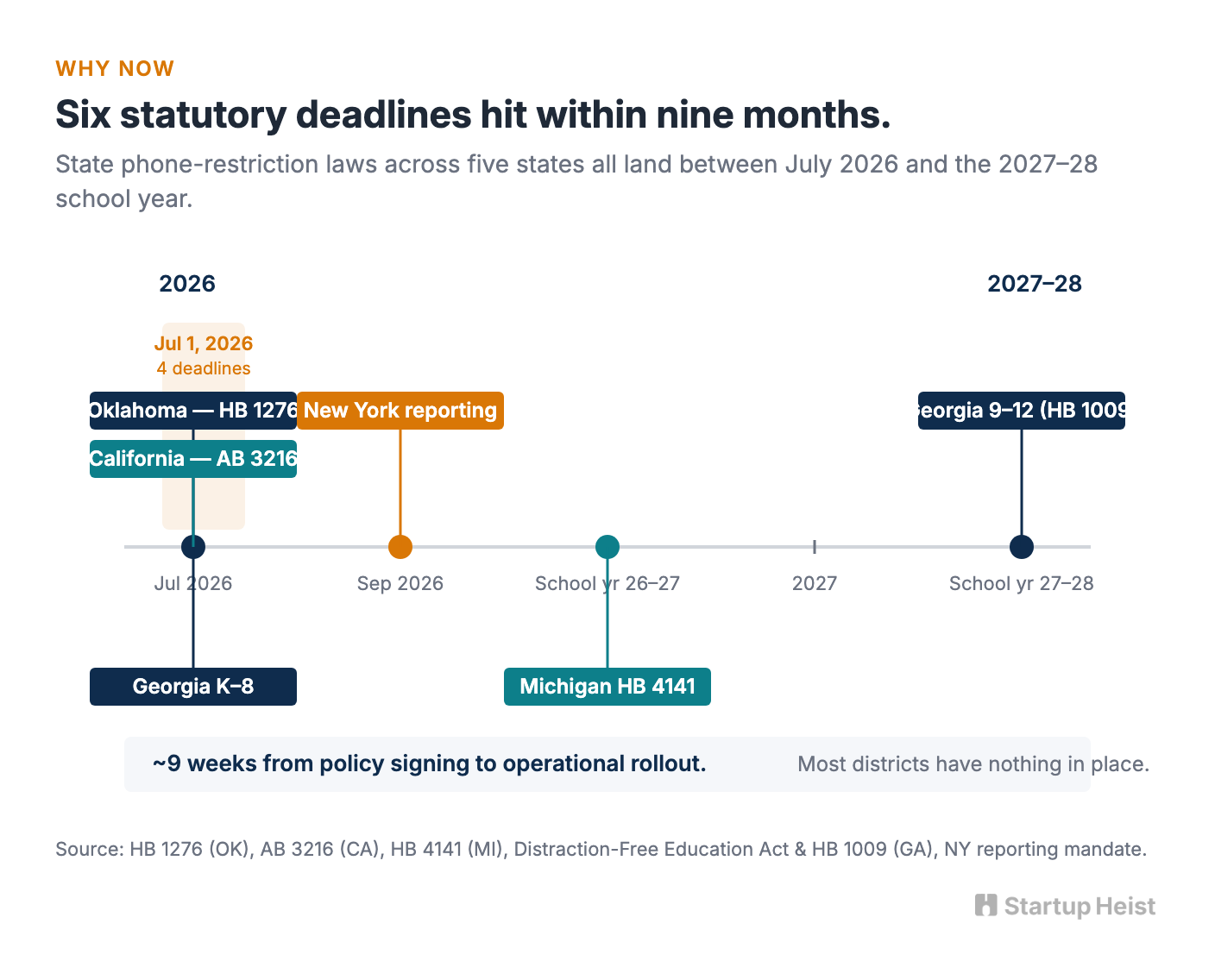
On May 5, 2026, Oklahoma Governor Kevin Stitt signed House Bill 1276, making "Bell to Bell, No Cell" permanent and covering cellphones plus non-school-issued electronic devices like smartwatches and tablets. On February 10, 2026, Michigan Governor Gretchen Whitmer signed HB 4141, requiring every K-12 public school in the state to restrict smartphone use during instructional time starting with the 2026-27 school year. California's Phone-Free School Act (AB 3216) gave every district until July 1, 2026 to adopt its own policy. Georgia's Distraction-Free Education Act lands on the same date for K-8, and on May 6, 2026 Governor Kemp signed HB 1009 extending the ban to grades 9-12 for the 2027-28 school year. Hundreds of districts across multiple states need a working enforcement playbook in roughly nine weeks, and most don't have one.
Michigan's law is the most revealing. It mandates that districts establish wireless device policies, but how those policies are enforced is left almost entirely to local boards. That's the operating condition baked into most of these statutes. When states mandate an outcome and leave implementation to districts, someone has to translate legal language into operational workflow. A law firm, an overworked assistant superintendent, a Google Doc copied from a neighboring district, or a purpose-built product.
The heist is a lightweight Phone Policy Enforcement Console for K-12 principals and district operations teams. Not a grand education platform. Not another debate about whether bans work. A state-aware operating system for the boring, expensive work that begins the moment the law passes.
Here's the opportunity:
The money: 500 schools at $99/month plus a $499 launch kit sold to 1,000 schools is roughly $1.1M ARR. District plans push it toward $2-5M ARR.
Inside:
• State-aligned policy templates for 4 launch states
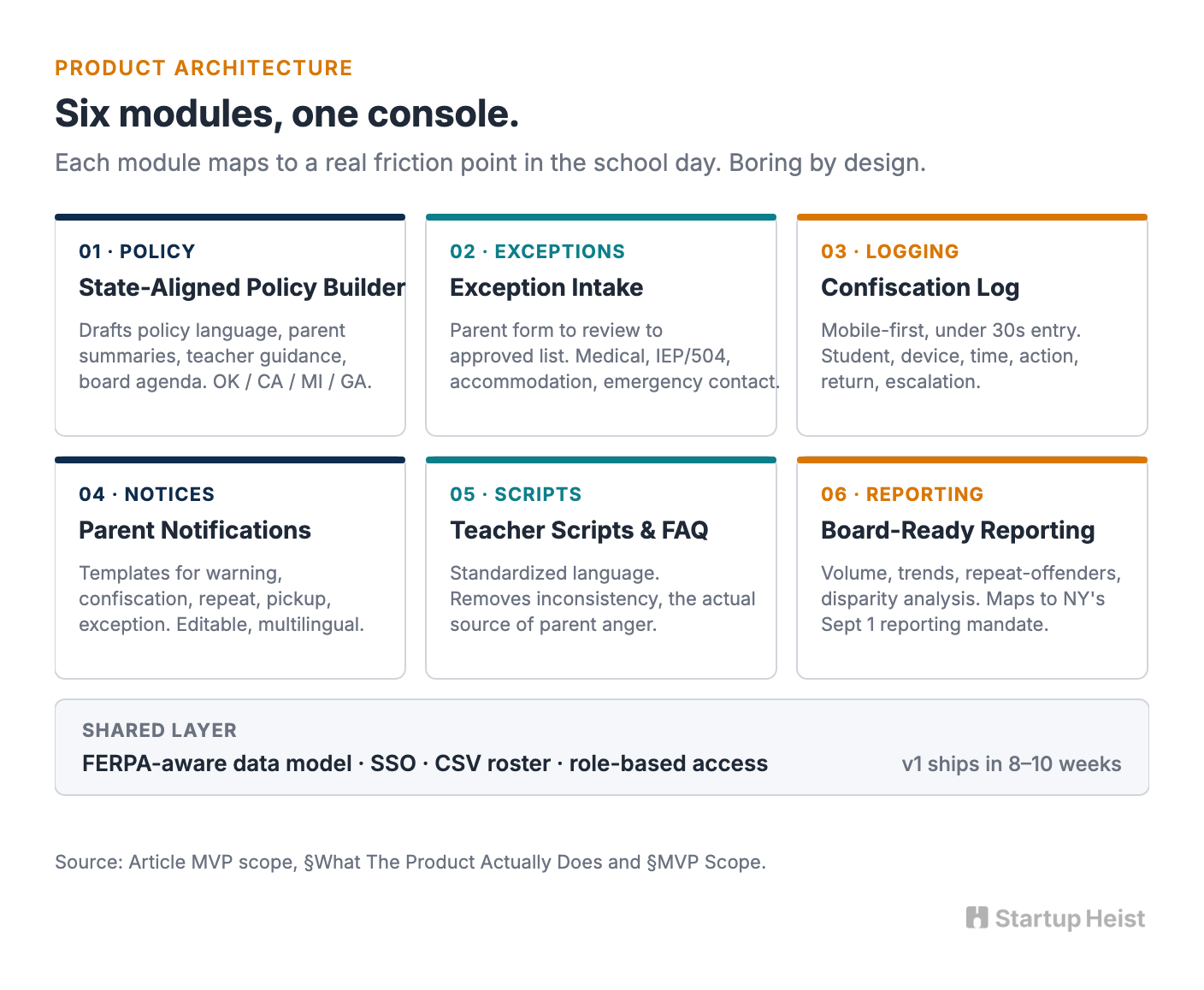
• Exception, confiscation, and parent notice workflow
• Board-ready reporting for NY's Sept 1 mandate
• Four moats and a 30-day Phase 1 kit
Why The Window Is Open Right Now
Education Week's tracker counts at least 37 states plus Washington, D.C. that ban or restrict student cellphones. The Center for American Progress recorded 17 states plus D.C. with all-grade bans in the past two years and 44 states plus D.C. that have taken some legislative action. The exact figure depends on how you count. The direction is identical.
In May 2026, the largest national study on school phone bans landed and rewrote the conversation. Researchers from Stanford, Duke, Michigan, and Penn, using actual locked-pouch deployment data from roughly 4,600 schools, published a working paper finding that bell-to-bell enforcement reduces phone use but doesn't move math or reading scores at the aggregate level. The clearest academic signal sits in high school math, where the study found modest positive effects. What the bans clearly move, at least in year one, is suspensions. Both in-school and out-of-school suspensions rose about 16 percent. Student well-being measures got worse in year one before turning positive by year two. Suspension rates normalize by year three.
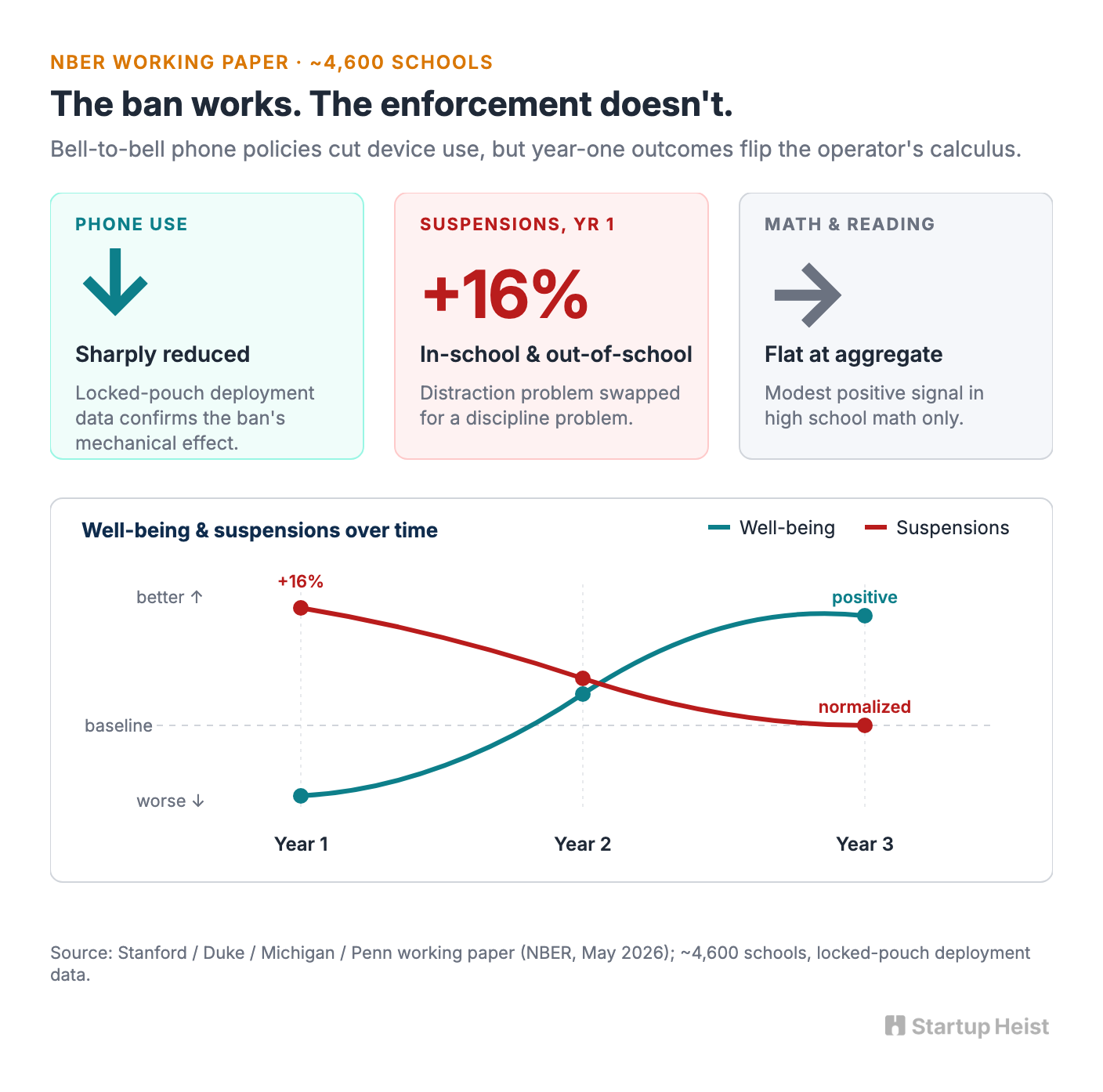
That finding flips the operator's calculus. The ban itself isn't the lever. The quality of enforcement is. A school that bans phones badly trades a distraction problem for a discipline problem. A school that bans phones well has to demonstrate, with documentation, that it did so consistently. That is the documentation.
A Real Market, Not A Fantasy
The U.S. operates 99,073 public elementary and secondary schools serving 49.3 million students as of the 2024-25 school year. That's not the addressable market. The realistic buyer is middle schools, high schools, and charter networks in states where phone restrictions are mandated, freshly changed, or politically salient. Still tens of thousands of campuses, each one wrestling with the same problem on the same deadline.
| Segment | Why It Matters | Sales Motion |
|---|---|---|
| Oklahoma public districts | Permanent bell-to-bell mandate effective July 1, 2026 | Urgency-driven launch kit |
| California LEAs and charters | AB 3216 implementation deadline July 1, 2026 | Implementation readiness campaign |
| Michigan public and charter districts | Smartphone policy required for 2026-27 school year | District operations sale |
| Georgia districts | Distraction-Free Education Act July 1, 2026 (K-8), HB 1009 expansion 2027-28 (9-12) | Regional rollout package |
| Middle and high schools in restriction states | Highest daily enforcement friction | Principal and AP sale |
| Charter networks | Faster procurement, centralized rollout | Network-level pilot |
This isn't a venture-scale unicorn category. It's a sharp niche-SaaS opportunity. Five hundred schools paying $99 per month is roughly $594,000 in annual recurring revenue. Add a $499 launch kit sold to 1,000 schools and you have another $499,000 in one-time revenue. A district-tier version selling annual contracts of $5,000 to $25,000 can scale into a $2-5 million ARR business if it owns the implementation category across the mandate-heavy states. Phones are the wedge. Smartwatches, earbuds, AI tools in classrooms, recording devices, and vaping-related incidents all sit on top of the same operational layer.
The Existing Players Solve Hardware. The Pain Is Software.
The category has visible incumbents that all solve the same half of the problem. Yondr's locking magnetic pouches run about $25 to $30 per student in the first year, and real district contracts in 2025-26 include LAUSD at $5.2 million and $29 million earmarked for New York City's rollout (city and state funds combined). A Van Nuys High School student newspaper has reported students bypassing Yondr pouches with magnets within days of the LAUSD deployment, which is the cleanest possible signal that hardware alone doesn't solve enforcement. NuKase ships a polycarbonate hard case with a pick-proof lock bar at $15-$20 per student, claiming 145,000 units across 40+ districts. LockedIn, founded by two Los Angeles high schoolers and now a team of 11-plus deployed across dozens of states, is a software-only product that locks the phone's operating system inside school geofences for $5-$25 per student per year. All of these control whether a student can use the phone. None of them control whether the school can prove what happened, which is the part that drives parent emails, board complaints, and the 16 percent suspension spike in the NBER data.
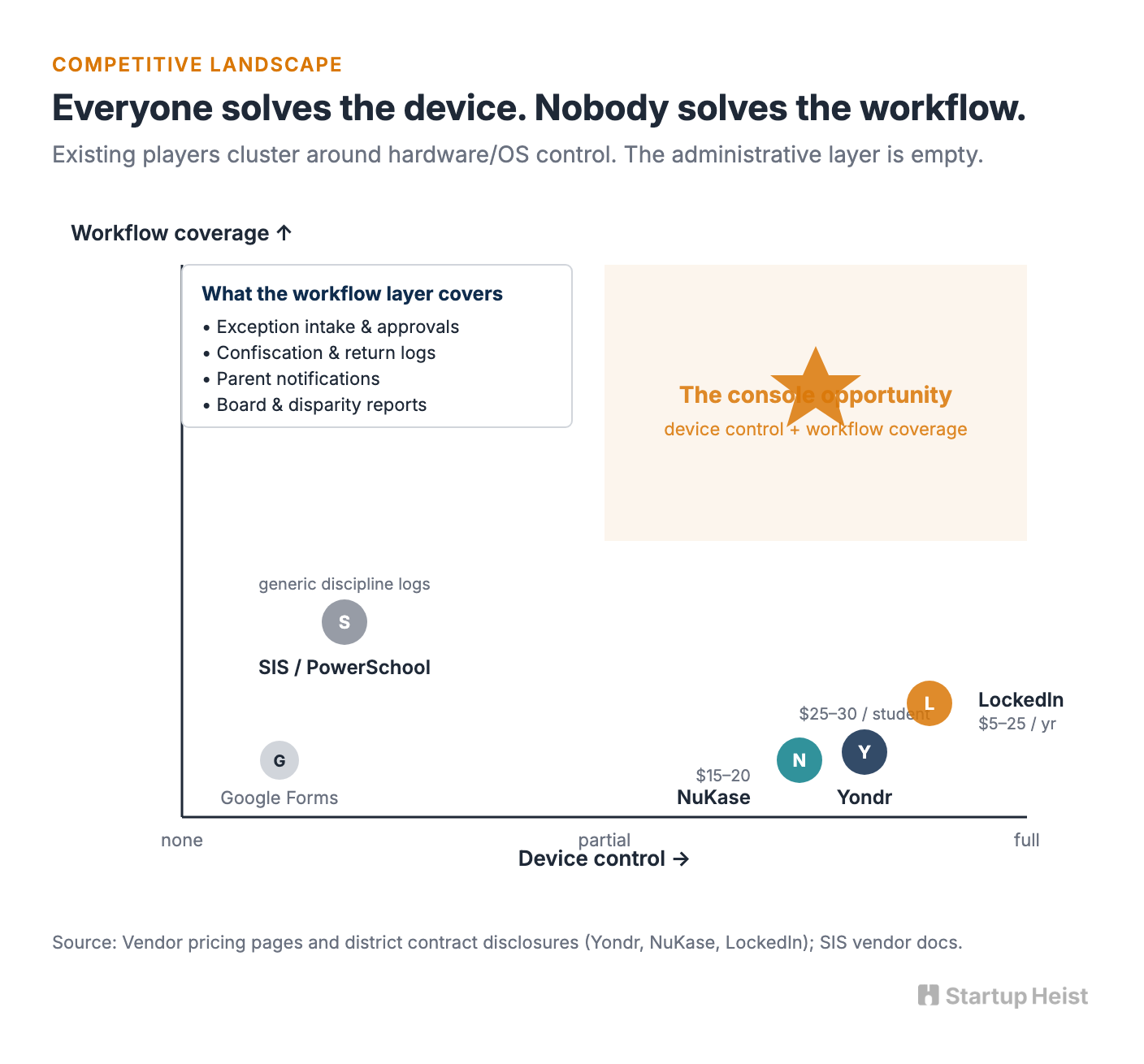
The administrative layer is empty. Student information systems can log a discipline incident, but they aren't designed around state-specific phone-policy rollouts. An assistant principal can create an SIS category called "phone violation," but that doesn't produce a parent exception form, a board report, a teacher script, or a clean repeat-offense workflow. A PDF policy doesn't tell the front office whether the phone was returned to a parent, whether the student has an approved medical exception, whether this is the third violation, or whether one teacher is generating 40 percent of all phone incidents. That gap is the console.
What The Product Actually Does
Unlock the Vault.
Join founders who spot opportunities ahead of the crowd. Actionable insights. Zero fluff.
“Intelligent, bold, minus the pretense.”
“Like discovering the cheat codes of the startup world.”
“SH is off-Broadway for founders — weird, sharp, and ahead of the curve.”


