


Grandma Doesn't Want a Camera. She'll Take the Radar.
The elder-care technology market has spent forty years trying to solve one brutally simple problem: how do you know your parent is okay when you're not in the room?
The default answers have aged badly. A pendant they forget to wear. A button they're too embarrassed to press. A camera they refuse to allow in the house. A smart speaker that only helps if they're conscious and willing to call out. A home security system that pings you when a door opens, but stays silent while Dad lies on the bathroom floor.

The clean opportunity sits in that gap, and it's narrower and more buildable than "AI elder care" or a full hospital-at-home platform: a privacy-first, camera-free elder-monitoring subscription that uses off-the-shelf mmWave radar sensors to baseline a parent's daily routine and alert family members when something is wrong. No cameras. No wearables. Nothing to charge. Nothing for the parent to remember.
The product isn't trying to watch Grandma. It's trying to notice when the rhythm of her home breaks. A camera says, "I need to see you." Radar says, "I only need to know that life is still moving normally in this house." That single distinction is the whole business.
Here's the opportunity:
The money: 1,000 paying homes at $29/month is $29K MRR. Path to $300K-$1M ARR bootstrapped, with care-manager and installer channels driving repeat customers.
Inside:
• Full v1 product scope and 5 alert types
• Pricing tiers: $24-$79/month with hardware bundles
• GTM playbook: 4 outreach channels with scripts
• Five-layer moat strategy for solo founders
The pain is already paid for
This market doesn't need education. Families already pay enormous amounts for peace of mind around aging parents.
In March 2026, AARP published its updated Valuing the Invaluable report. It estimated 59 million Americans now serve as unpaid family caregivers for adults, delivering 49.5 billion hours of care valued at $1.01 trillion — more than U.S. private business spent on health care that year. The average hour of family caregiving is now worth $20.41. These caregivers aren't nurses. They're adult children, working full-time jobs, often living in another state, fielding calls at 2:14 a.m. and refreshing weather apps to see whether Mom's town just lost power.
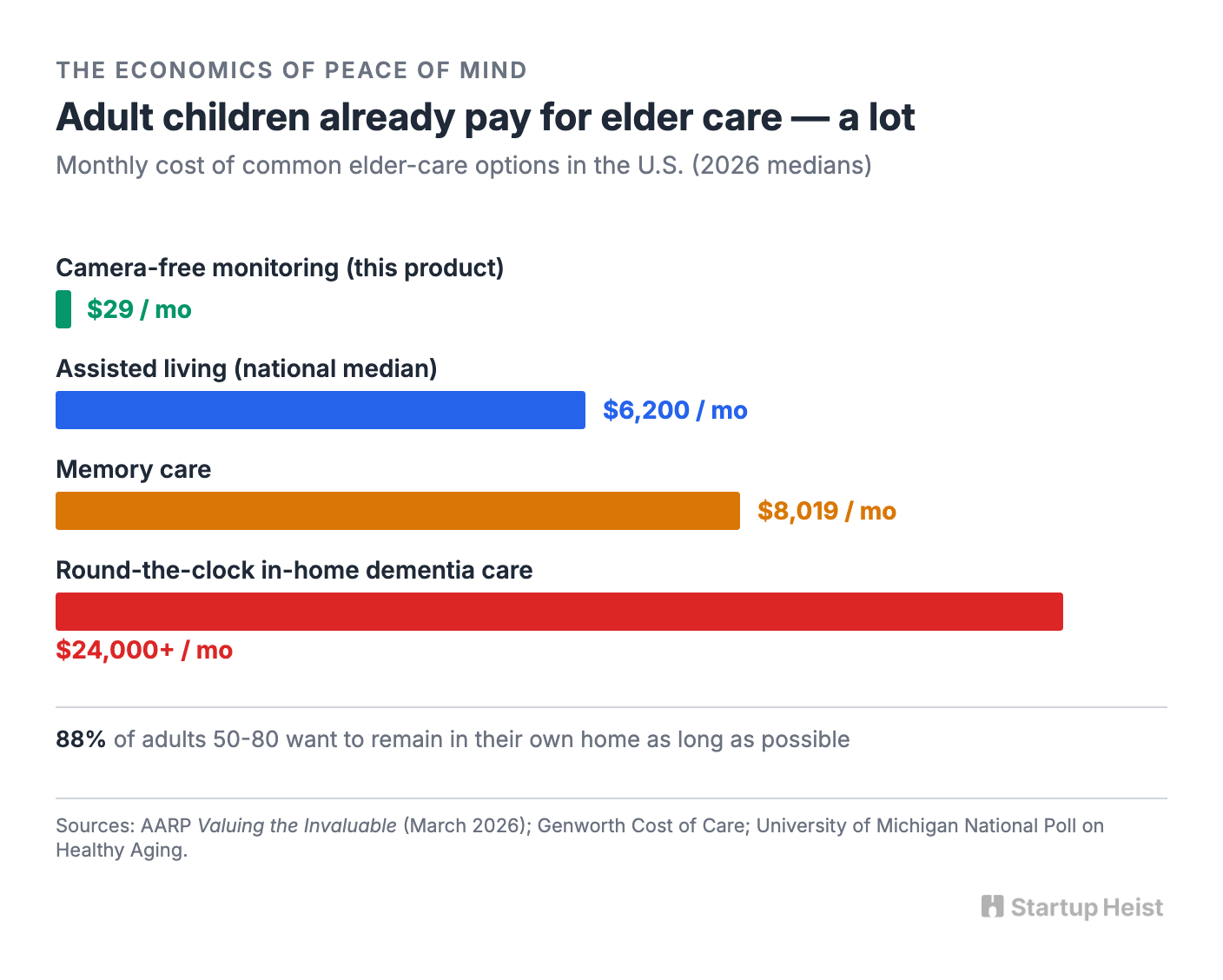
Paid care is no easier. Assisted living runs a national median of about $6,200 per month. Memory care runs roughly $8,019. Round-the-clock in-home dementia care exceeds $24,000 in many states. Meanwhile, 88% of adults aged 50 to 80 told the University of Michigan they want to remain in their own homes as long as possible. The adult child isn't buying a gadget. She's buying the ability to sleep without wondering whether the call she missed at dinner was the call. The parent isn't buying technology. He's defending his dignity.

That's why "no cameras, no wearables" is more than a marketing line. Pendants stigmatize. Wearables need to be worn, charged, and tolerated. Cameras feel invasive. Even when fall-alert devices exist, older adults often refuse them at exactly the moment they're needed. Peer-reviewed research identifies perceived stigma, comfort, and willingness as core adoption barriers, not edge-case UX. This product wins by removing the negotiation. The parent doesn't push a button. The child doesn't install a camera. The system learns the household's normal pattern and raises a hand when something looks off.
Why now: cheap radar, remote caregiving, privacy as a wedge
Three things changed at once, and together they create the opening.
The hardware got cheap enough. mmWave presence sensors that once required custom RF engineering now cost roughly the price of dinner for two. Aqara's wired FP2 already does radar-based presence sensing across zones up to 40 square meters, detects multiple people, and supports fall detection with real-time heart and respiratory rate tracking in sleep mode. In November 2025, Aqara launched the FP300, its first fully battery-powered presence sensor, combining 60 GHz mmWave with PIR, light, temperature, and humidity in one device. Two coin cell batteries run it for up to three years. Retail price: $49.99. It supports Thread and Matter. The FP2 ($60, wired, ceiling-mountable) handles the fall-detect node; the FP300 ($49.99, battery, flexible placement) handles the routine-presence nodes. On the commercial side, Milesight ships the VS373, a 4D 60 GHz mmWave fall detection sensor marketed at 99% accuracy for elderly care environments. What used to be a hardware bet is now a packaging, UX, software, and distribution bet — the kind of business a small team can win.
Adult children are already managing care remotely. Long-distance caregiving is no longer an edge case. The Administration for Community Living's Eldercare Locator exists because finding local support for older adults and families is mainstream behavior, not a niche concern.
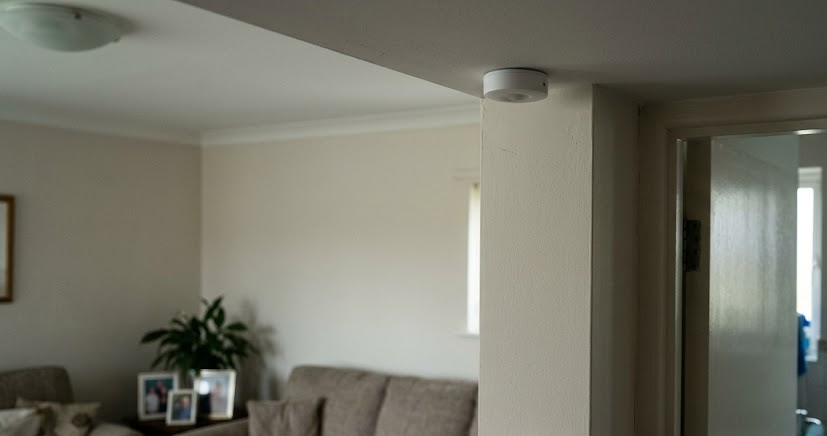
And privacy became the wedge. The home isn't a warehouse. The bathroom hallway isn't a Ring doorbell. A parent will accept a small white sensor on a wall long before they accept a lens in the living room. In this market, inferior information is the superior product. A camera gives more data than you need. Radar gives just enough.
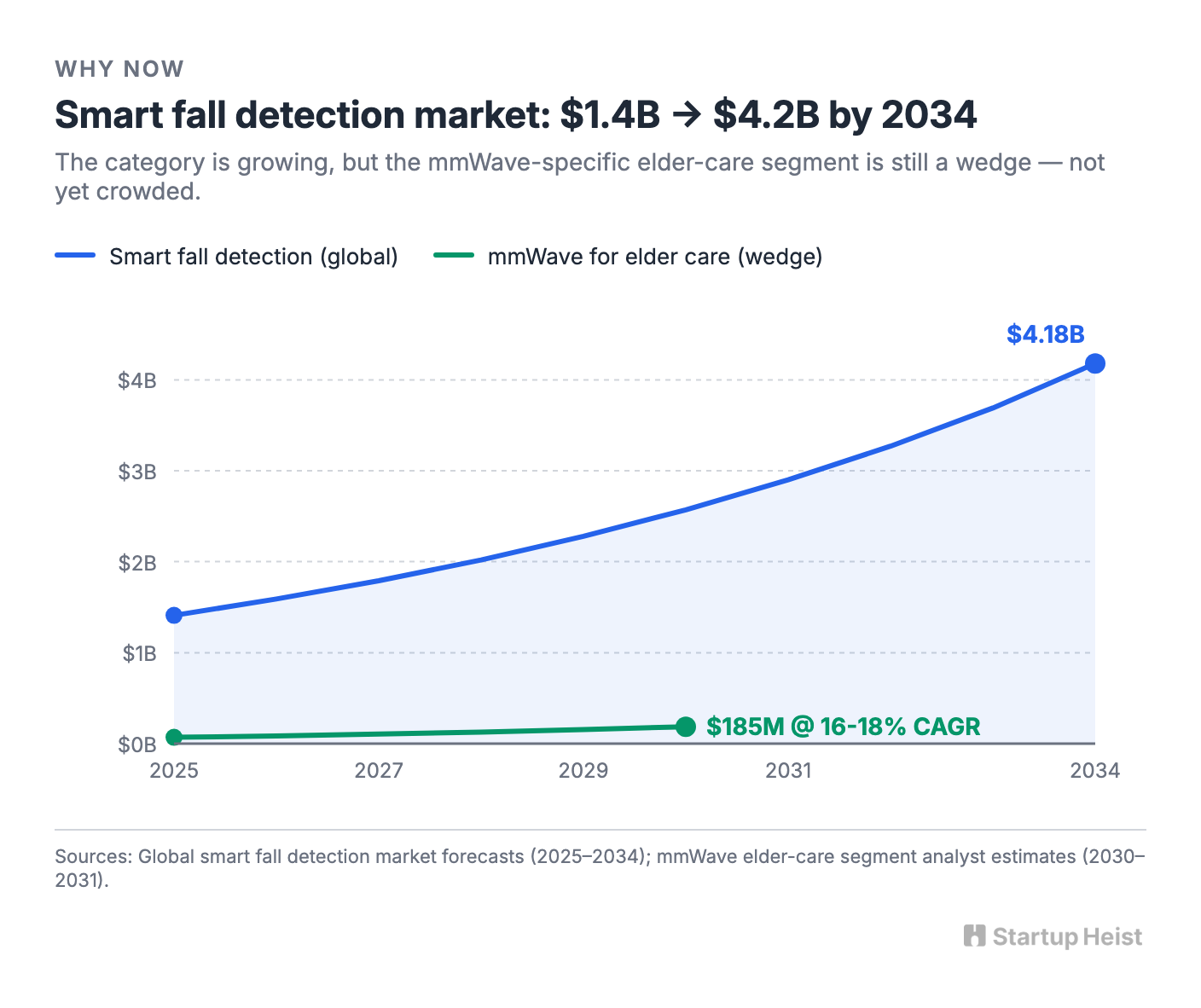
The forecasts confirm the trajectory. The global smart fall detection device market is projected to grow from $1.41 billion in 2025 to roughly $4.18 billion by 2034. Elderly safety monitoring equipment is on track for $4.7 billion by 2033. The mmWave-specific elderly-care segment is forecast to reach roughly $170-200 million by 2030-2031 at a 16-18% CAGR across analyst estimates. That last range is the most important. mmWave for elder care isn't yet a category. It's a wedge.
The hardware is no longer the company
The wrong version of this startup is a hardware company. That path leads into RF engineering, FCC certification, supply chains, firmware bugs, returns, and a decade of margin compression, all while competing with manufacturers who already make these sensors at scale.
The better play treats mmWave hardware as commodity infrastructure. Aqara, Milesight, Home Assistant, and the rest will produce raw signal: occupied, vacant, zone activity, fall event, motion pattern, room presence, time of activity. Raw signal isn't a caregiver product. A caregiver product answers five questions: What is normal for Mom? What changed? Who should be notified? How serious is this? What do I do next? The software layer answers those questions. The heist isn't inventing radar. It's turning cheap radar into a family trust product before the hardware companies figure out they're sitting on one.
Who's already proving it — and the gap they leave
Traditional PERS systems like Life Alert have brand awareness but depend on the user wearing or activating something. They solve the emergency-button problem, not the passive routine-awareness problem, and a landmark BMJ study found that when seniors who fell remained on the floor for over an hour, their call alarms went unused in 97% of cases. Wearables like Apple Watch and CarePredict's Tempo wristband (CarePredict has raised over $46M to date) can detect falls and track signals, but compliance is the Achilles' heel. Cameras provide rich information but trigger the same privacy resistance they've had for two decades. Smart-home sensors detect motion, doors, and occupancy, but most are sold as automation components rather than packaged elder-care products. Commercial radar systems like Milesight's VS373 prove the technical case for mmWave fall detection, but they're designed for facility deployment with LoRaWAN gateways, not a simple direct-to-family subscription with baselining and caregiver UX. DIY Home Assistant setups demonstrate real demand from technical caregivers but remain too complex for mainstream families.
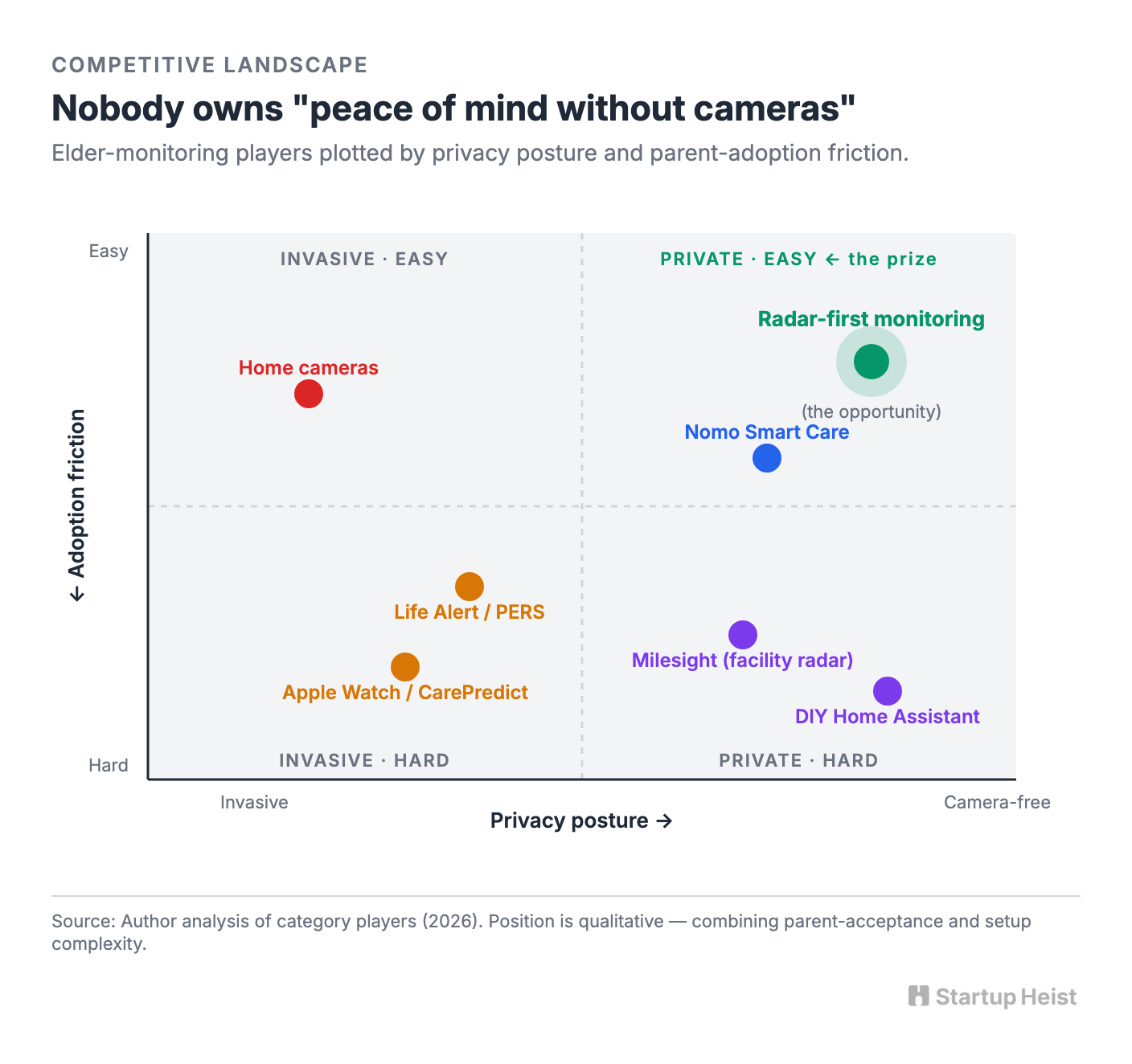
The closest direct competitor today is Nomo Smart Care, which already ships a camera-free routine-monitoring product with a care-circle app, motion-sensor hardware, and 911 integration at $199 plus $19.99/month. Nomo proves the demand. The opening it leaves is the radar layer: deeper presence detection across zones, richer routine baselining, the FP2/FP300 hardware tier, and an installer/care-manager channel Nomo hasn't built. A handful of others — envoyatHome, Veron Care, Nobi — are circling the same insight from different angles, but the category is still wide open. None has yet built the brand families instinctively name when their friend says, "Mom won't accept a camera." That naming gap is the opportunity. The product isn't better hardware. It's consumerized elder-care monitoring built on commodity radar, and the company that owns the phrase "peace of mind without cameras" will own the category.
What the product actually does
The first version is boring, focused, and extremely legible. Call it QuietCheck, NoCam Care, or StillHome — a name a 67-year-old will repeat to her sister without rolling her eyes.
The core promise: "Know your parent is okay without putting a camera in their home."
The v1 bundle is two supported mmWave presence sensors — an FP2 ceiling-mounted in the bathroom or hallway for fall-like event detection, plus an FP300 for routine presence in the bedroom or kitchen — a guided setup flow, and a caregiver dashboard. The system watches for routine breaks, not video events. Cover four high-signal areas:
- Bedroom
- Bathroom hallway or bathroom entrance
- Kitchen or living room
- Optional front door / entry area
Start with five alert types:
This one's free.
This playbook is unlocked for members. Grab a free account — no card, ten seconds — and keep reading. You'll also get one free briefing every weekday morning.


